GeMarkt Blog · Practical guide
Japanese Woodblock Prints: A Buyer’s Guide
Choose Japanese print reproductions with confidence: understand the object, compare three real designs, and check proportions, margins, paper and fine detail.

Choose the picture first, but establish what the seller means by “print” before paying. A nineteenth-century woodblock impression, a newly hand-printed interpretation and a modern reproduction of a museum image are different objects. All can be interesting; they should not be described as though they were interchangeable.
For a wall at home, the useful questions are often simpler than a collector’s questions. Will the complete design fit the space? Can you still see the rain, lettering or small figures that attracted you? Does the listing explain the paper and the actual printed area? These three examples show what to look for when choosing a reproduction, without pretending that a photograph can authenticate an antique.
First decide what you are buying
In traditional woodblock printing, ink transfers from the raised parts of a carved block to the sheet. The process can produce multiple impressions; an original print need not be a unique image. The V&A’s introduction to printmaking explains that distinction and the use of multiple blocks for colour.
An online listing may instead offer a contemporary print made from a scan. In that case, “woodblock” describes the historical source, not necessarily the process used for the item arriving at your door. A digital download is another step removed: you receive a file and arrange the printing yourself.
Look for a plain sentence identifying the actual product. If you are buying a historical impression, ask about its date, publisher, condition and provenance, and consider independent specialist advice. A reproduced signature or seal does not establish authenticity: a scan can reproduce those marks too. Our original, reproduction and print guide explains the vocabulary in more detail.
The Great Wave needs its small details
Hokusai’s Under the Wave off Kanagawa is an obvious starting point, but the curling wave is only part of the picture. The Met’s impression, JP1847, dates to about 1830–32. Look below the crest: long boats and small people give the scene its scale, while Fuji appears far away.
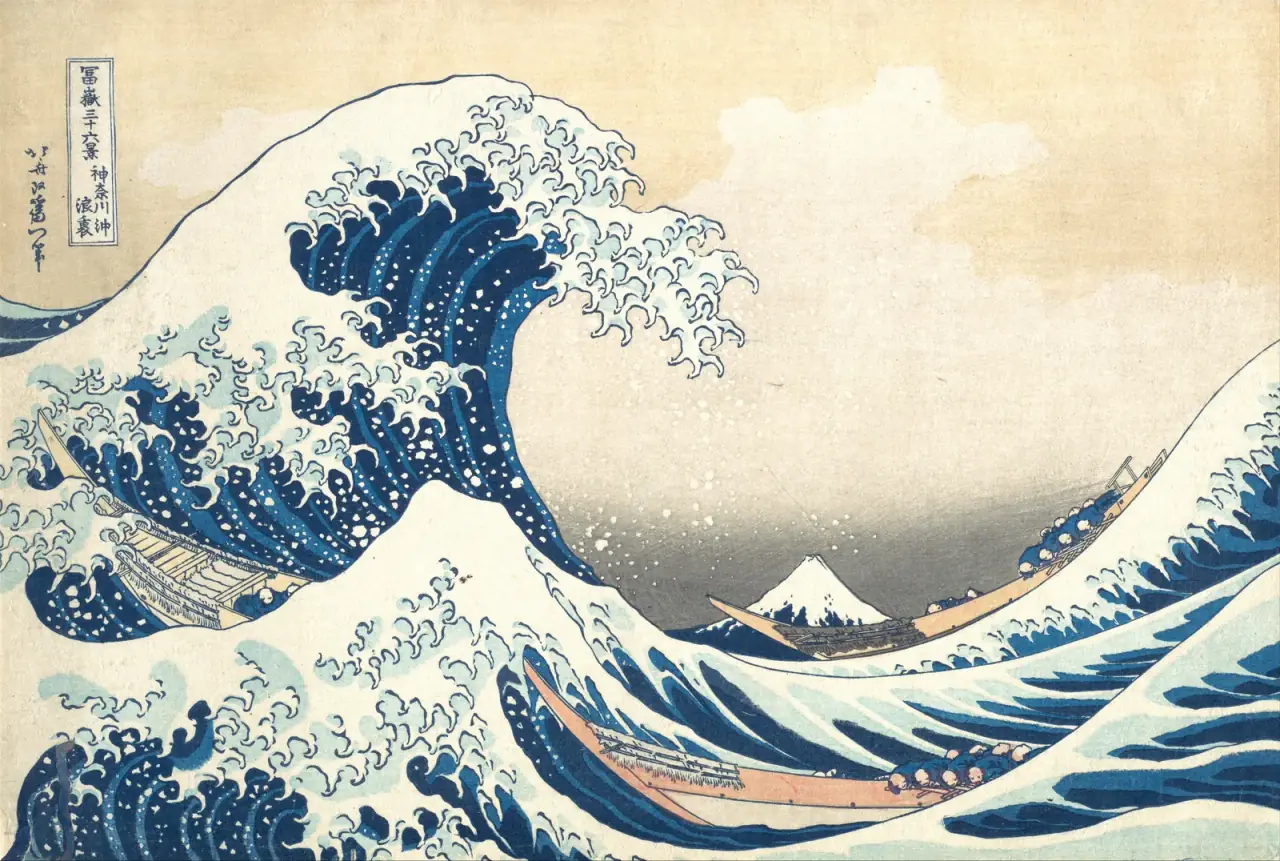
When comparing reproductions, inspect the boats and the foam rather than judging only the blueness. Do their outlines remain distinct in a close-up of the final print? An attractive room mockup cannot answer that on its own. Ask for a detail photographed on the offered paper if the listing does not show one.
Keep the lower boats and the left-hand writing in your size preview. A square crop may retain a recognisable wave while losing much of the scene you wanted. If the available frame is square, a smaller complete image with surrounding space may suit you better than enlarging until the paper is filled.
A vertical landscape is not a cropped horizontal one
Hiroshige’s Sudden Shower over Shin-Ōhashi Bridge and Atake offers a different shape from the outset. This is the Met’s 1857 impression JP644, not another museum’s copy of the same design. Its tall composition puts a bridge, river and dark sky above one another. The museum record identifies the medium as woodblock printing in ink and colour.
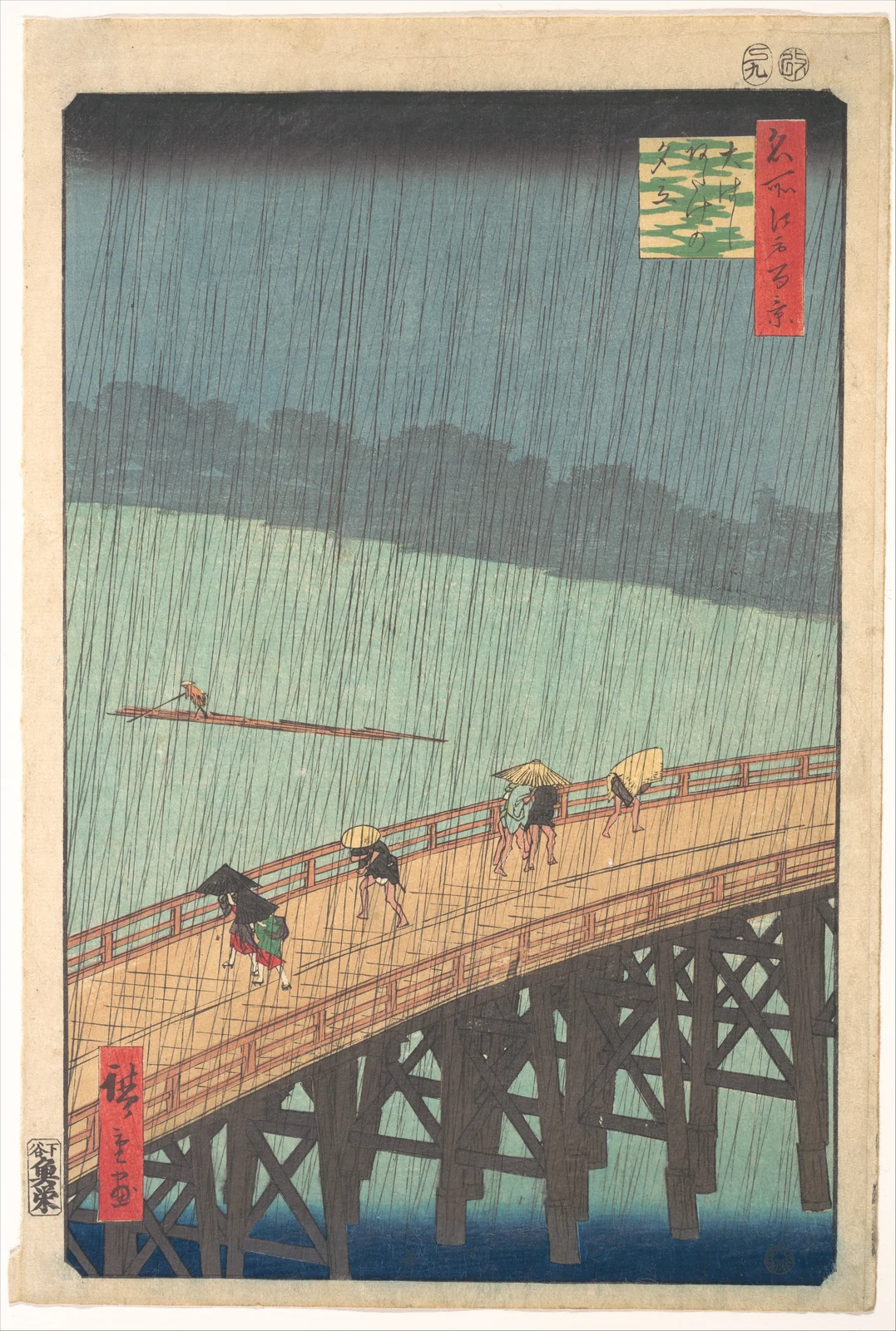
For a narrow wall, that built-in vertical arrangement can be more satisfying than forcing a broad landscape into a portrait frame. Check that the dark sky has not become an undifferentiated black band and that the fine rain lines remain visible. The people crossing the bridge should still be people, not just patches of colour.
The rectangular inscriptions also belong to the composition. If you want a clean-edged presentation, decide whether you mean hiding the sheet’s outer margin or removing those printed panels. They are different alterations. To compare the artists rather than the products, see Hokusai vs Hiroshige.
Flowers can offer a quieter picture
Not every Japanese print needs a mountain or a dramatic wave. In Hokusai’s Poppies in the Wind, bending stems carry flowers across a comparatively open background. The Met dates this sheet to 1820–34; it is JP1860.
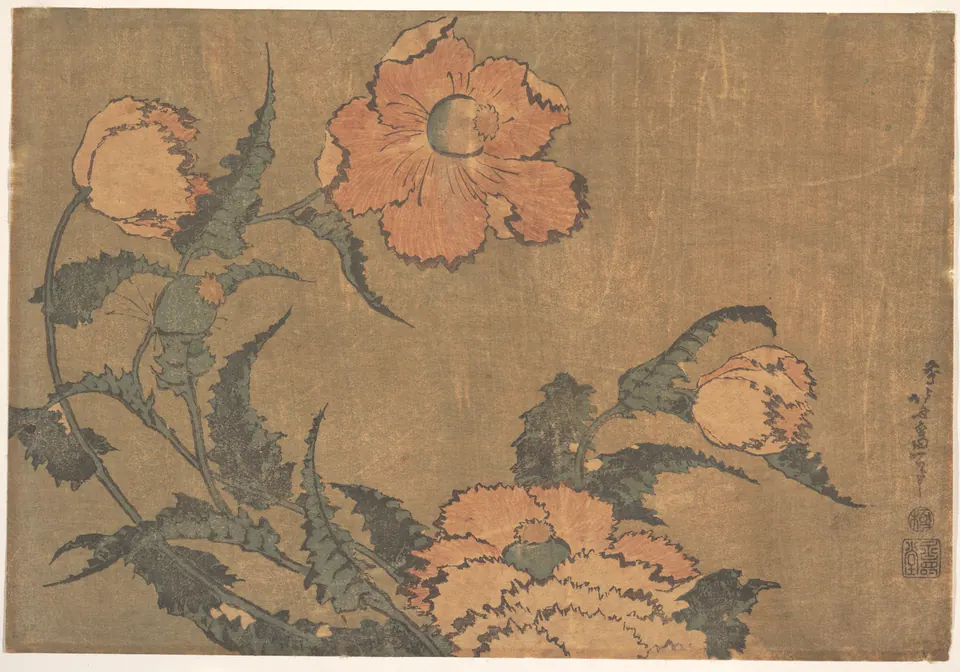
The empty-looking areas let the stems lean and separate the flower heads. Filling every edge with a crop would change that effect. This particular digital image also has a strongly warm background. If you like its muted character, check that the product preview actually uses this version rather than a brighter scan or a digitally whitened adaptation.
Consider where you will approach it. Beside a chair, the jagged petal edges can reward close viewing. Across a large room, the wider pattern of stems will matter more. That is a useful reason to choose a size, rather than simply selecting the largest option.
Choose the whole image before the frame
Treat image size, sheet size and frame size as separate measurements. As a hypothetical example, a 30 × 45 cm image on a 40 × 50 cm sheet, centred without cropping, leaves 5 cm of paper on each side and 2.5 cm above and below. That is a calculation, not a standard Japanese print format or an available product specification.
A mat opening may hide a little of the sheet, so ask which dimension the seller is quoting. If preserving every printed mark matters, check the complete framed preview as well as the unframed image. Our print-size guide separates the common measurements.
For a pair, compare the visible images rather than only matching the outer frames. Two equal frames can contain very different amounts of picture. An intentional shared mat colour often looks more coherent than stretching both images into the same proportions.
Ask about the file and the finished surface
A museum name is useful only if the seller can identify the particular source. Ask which impression was digitised and whether the reproduction retains its margins, marks and colours. “Hokusai” alone cannot tell you which file was used or how it was prepared.
Then ask about the current product: paper name and finish, printing process, borders and whether a frame is included. For these line-rich examples, comparing a smooth matte paper sample with a textured option can help you judge how much surface character you want. Canvas is a different presentation, not a more authentic woodblock simply because it costs more.
Do not treat “Japanese”, “vintage” or an old artist’s name as a complete file-rights check. The artwork, the particular image and any adaptation need their own identification. If buying a download, read its stated terms rather than assuming it includes permission to sell your own reproductions.
Make the last check at home
Mark the proposed outer frame size on paper and look from your usual seat. Then check one close detail in the product photograph and one full composition preview. Those two views answer different questions: whether the size belongs on the wall, and whether the image is worth approaching.
Keep paper prints away from direct intense light, leaks and heating vents; the Library of Congress’s paper-care guidance explains the basic risks. For an old or damaged impression, seek a paper conservator rather than trying a household cleaning method.
Choose the design whose details you want to keep noticing. A clearly described modern reproduction of the right image is a better everyday purchase than an ambiguously labelled “original” that leaves you guessing what you will receive.
Editorial record
About this article
- Author
- Publisher
- GeMarkt
- Published
- Reviewed
- Internal source & rights check. Conducted by GeMarkt Research Review. This is an internal editorial check—not independent peer review.
- Source standard
- Buying guide source standardSeparates measured or first-hand evidence from general guidance and keeps practical limits visible.
Found a claim that needs checking? Report a factual error.