GeMarkt Blog · Essay
The Pre-Raphaelites: Millais, Waterhouse and Their Wider World
Look closely at eight Victorian paintings, from Millais's Ophelia to Waterhouse and Leighton, while separating the founding Brotherhood from its wider legacy.

A woman floats among flowers. Another releases a boat’s chain. A knight sits beside an organ, apparently listening to music we cannot hear. These pictures share an intensity that can make the label Pre-Raphaelite feel obvious—until a busy Victorian street or a classically dressed mourner enters the room.
The useful question is not whether every painting passes the same stylistic test. It is how a small artistic rebellion opened into different ways of painting nature, stories and feeling. These eight works trace that widening circle. They include original members, later followers and a deliberately marked comparison with Leighton, whose art belongs beside this discussion without making him a member of the Brotherhood.
Beyond the long hair and flowers
The Pre-Raphaelite Brotherhood began in London in 1848, with seven young artists and writers. Millais, Dante Gabriel Rossetti and William Holman Hunt were central founders. The name looked back towards art before Raphael, challenging habits the group associated with contemporary academic painting. The Brotherhood itself was short-lived; its influence was not. The Met’s account distinguishes it from the later circle around Rossetti, Edward Burne-Jones and William Morris.
That distinction matters here. Waterhouse was a later painter, not a founder. Ford Madox Brown was an associate, not a signatory to the original group. Leighton offers an adjacent classical tradition. Even Millais did not keep painting exactly as he had in his early twenties.
Use the label as a starting point. Ask whether a picture makes us inspect natural detail, follow a literary incident, or linger in an imagined mood. Often it does more than one.
Two heroines, two moments on the water
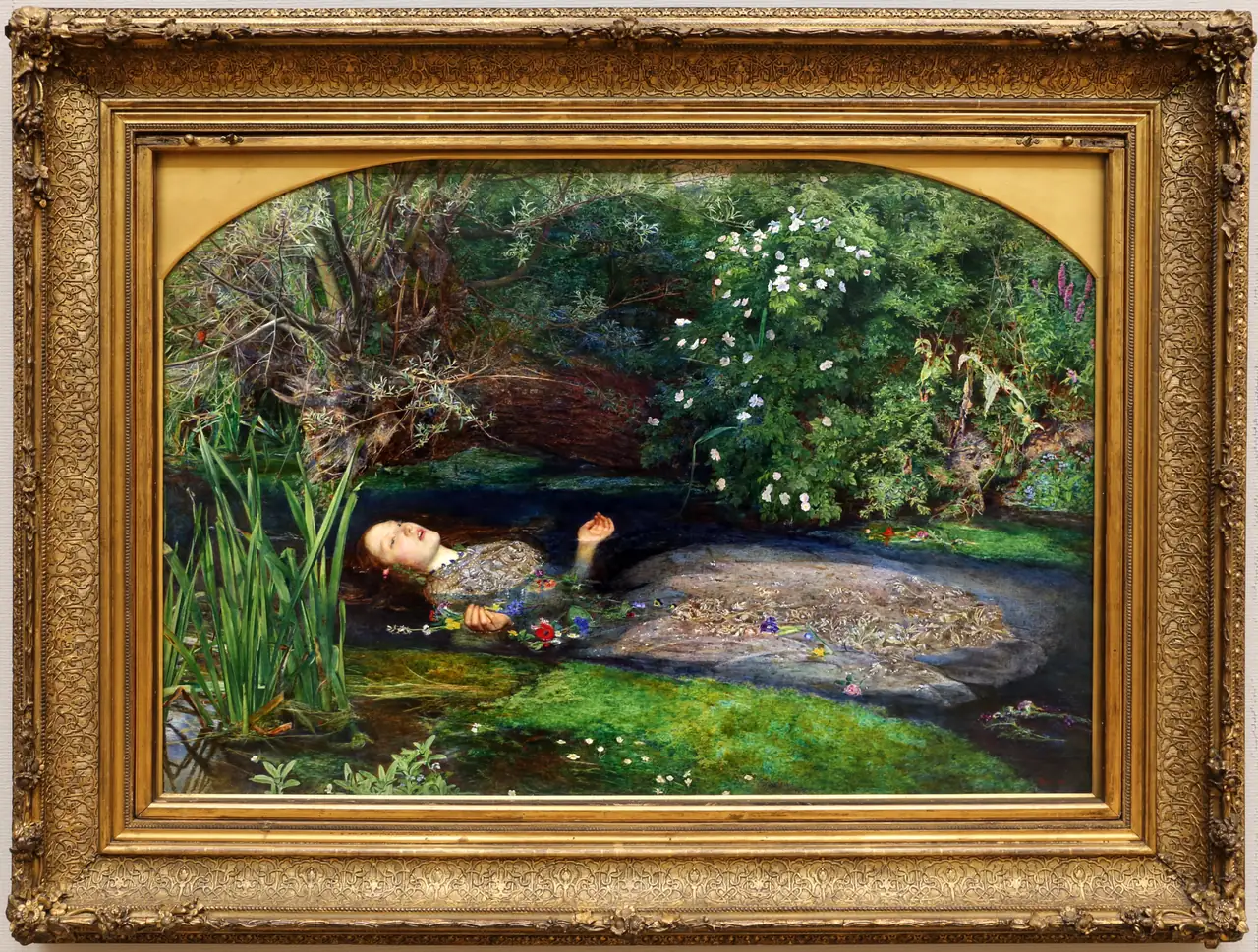


In Millais’s Ophelia, the figure lies almost horizontally inside an unusually busy natural setting. Reeds, small blossoms and reflective water demand attention alongside her face. Shakespeare supplies the tragedy, but the painting does not dissolve the world into a vague backdrop for it. The surrounding growth remains insistently present.
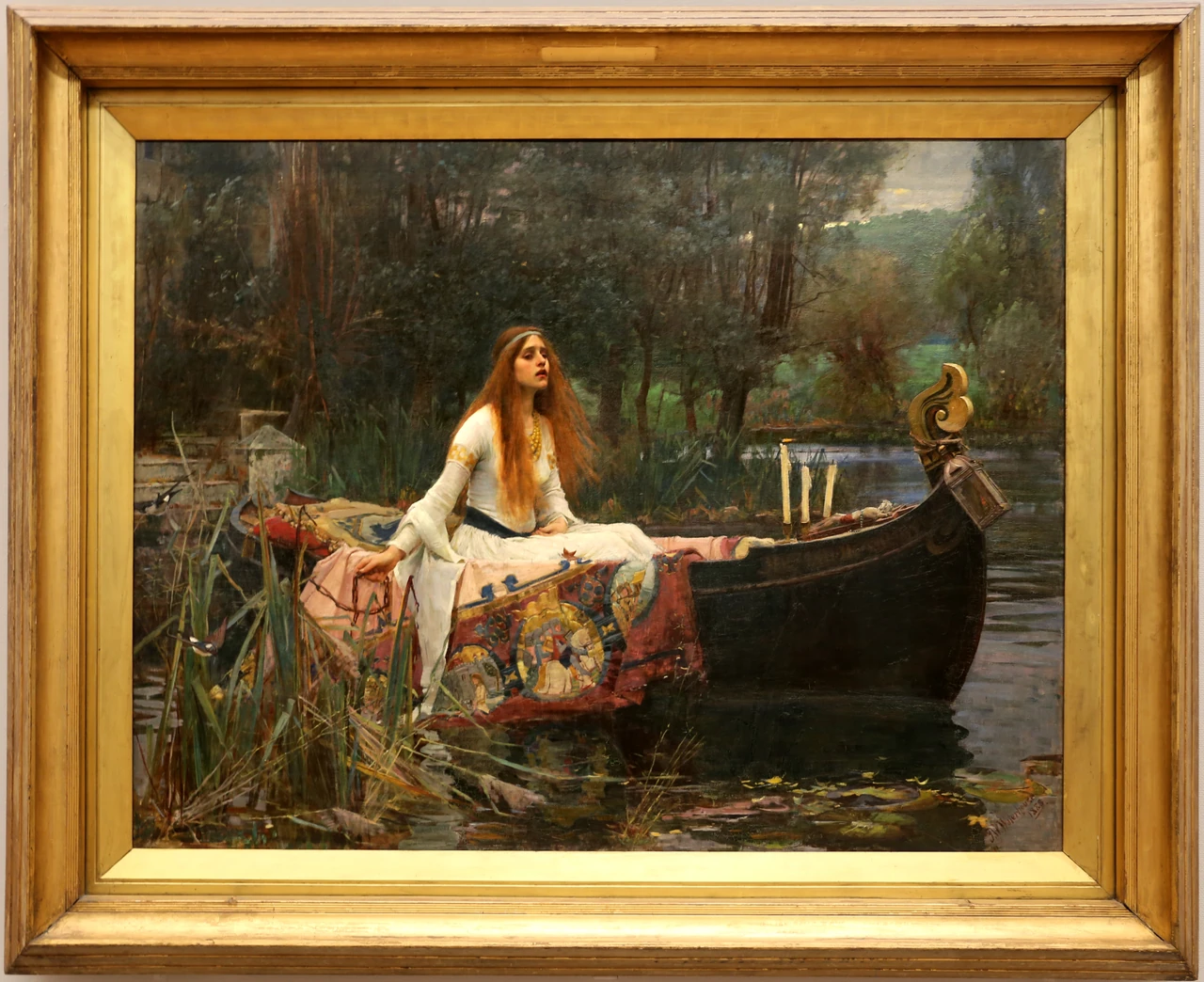
Waterhouse’s The Lady of Shalott, painted more than three decades later, gives its Tennysonian heroine a seated, upright body. The chain still connects her boat to the bank. The woven cloth spills over its side: an interior activity has travelled outdoors with her.
Compare the different kinds of suspense. Millais spreads our attention across a surface; Waterhouse directs it along a departure. The women’s literary identities are not interchangeable, and neither picture tells us what all Victorian women felt. Their costumes, gestures and settings are artistic decisions about particular stories. Our Millais and Waterhouse guides introduce more of each painter’s work.
Millais: a later Shakespearean presence
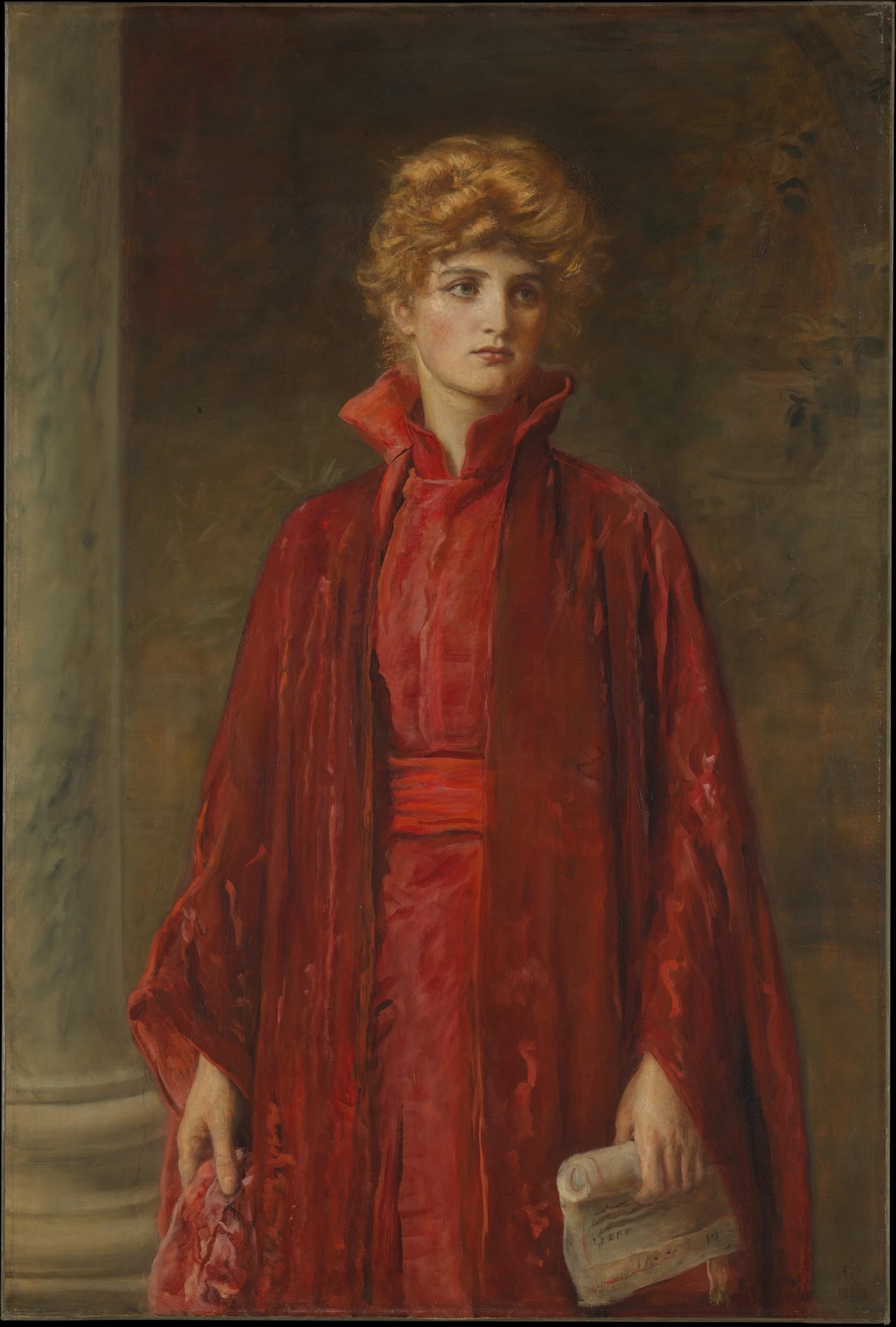
Portia makes a useful correction to the idea of one permanent Pre-Raphaelite look. Here the background recedes into brown and green shadows. A broad red robe, a face and a rolled document carry the picture; there is no equivalent to the crowded riverbank of Ophelia.
The Met identifies the model as Kate Dolan, wearing a costume associated with Ellen Terry’s stage performance. It is not simply a portrait of Terry. Portia’s lawyer disguise in The Merchant of Venice connects dress with public authority and dramatic deception. Looking from the document to the lifted chin gives us a compact introduction to the role, without reconstructing an entire courtroom. One founder’s later career already breaks the stereotype.
Rossetti and Dunn: a legend in a dressing room
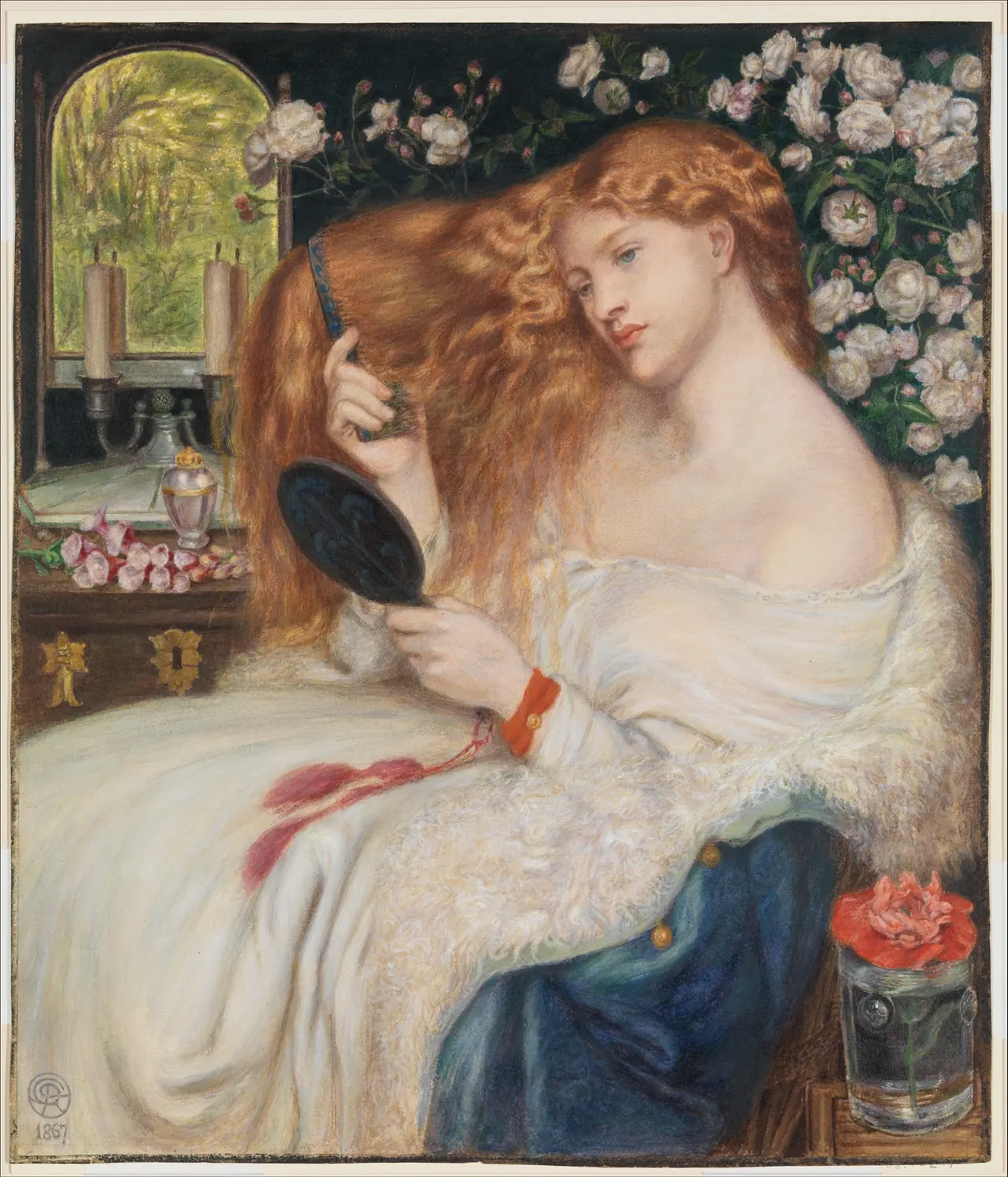
This is the Met’s 1867 watercolour, made by Rossetti with his assistant Henry Treffry Dunn, rather than the related oil painting now in Delaware. The distinction preserves both a collaborator’s contribution and the identity of the object we are seeing.
Lilith’s comb pulls one long band of hair across the picture. The mirror she holds turns her attention inward, while the reflective surface behind her opens an unexpected patch of green. Pale fabric and flowers crowd close to exposed skin. The museum identifies Fanny Cornforth as the sitter and explains the legendary Lilith association. That legend is the painter’s framing of a figure—not a factual judgement about the model. Notice how little external action is needed to make the surface feel charged.
Burne-Jones: a picture that asks you to listen
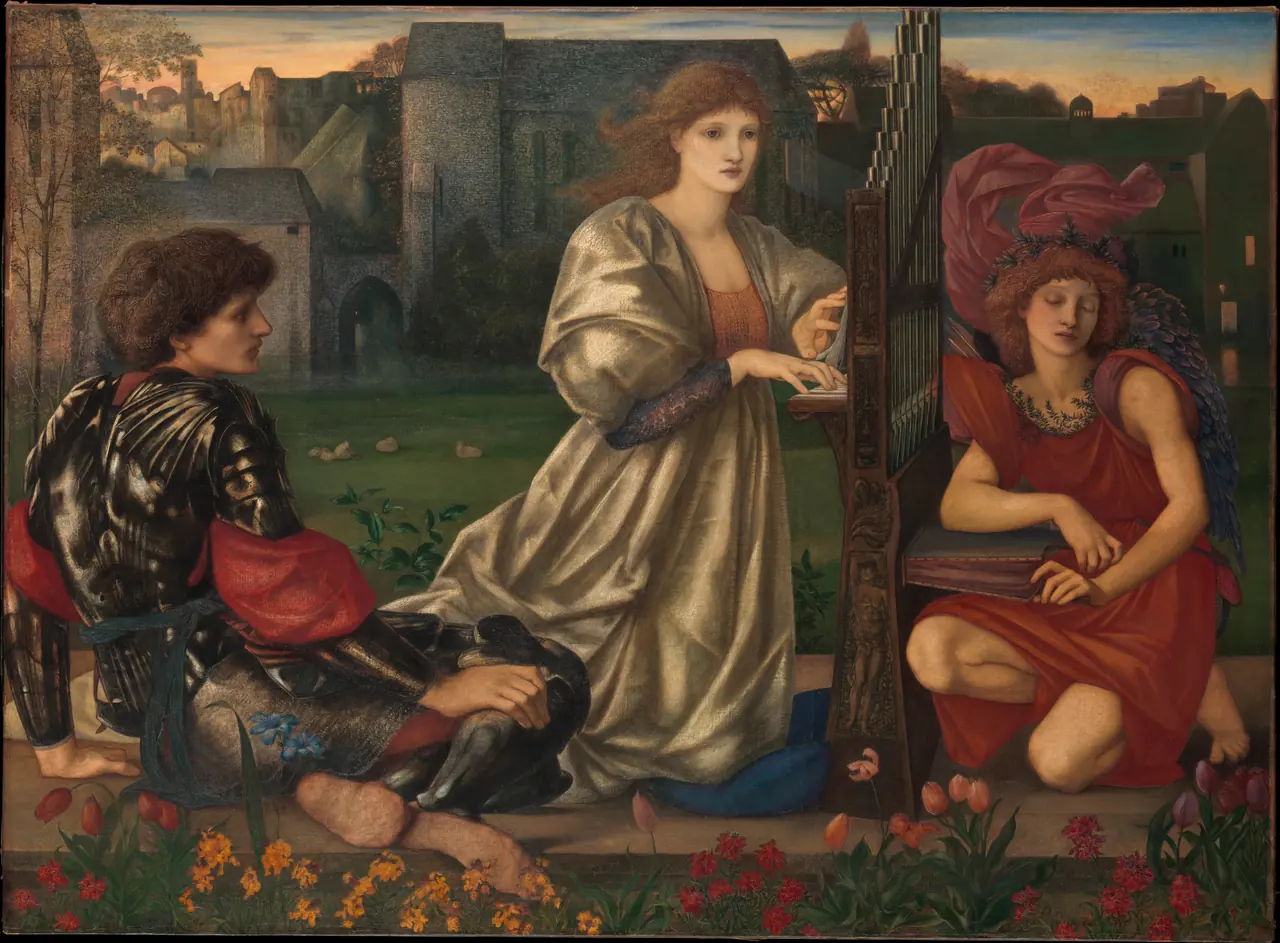
The figures in The Love Song seem to inhabit different kinds of stillness. The knight turns towards the musician; she faces outward while touching the keys; Cupid works beside the instrument. Armour, organ pipes and heavy folds establish slow visual rhythms.
The Met connects the painting with music and emotion, rather than a single incident we must identify to understand it. That is a useful way to approach its imaginary past. You can follow the curve of the player’s sleeve into the instrument and down towards the flowers before asking which architectural period surrounds her. This particular object is the 1868–77 oil painting, not an earlier watercolour. Its extended, suspended encounter is a different proposition from the urgent river scenes.
Brown: the modern street enters the picture
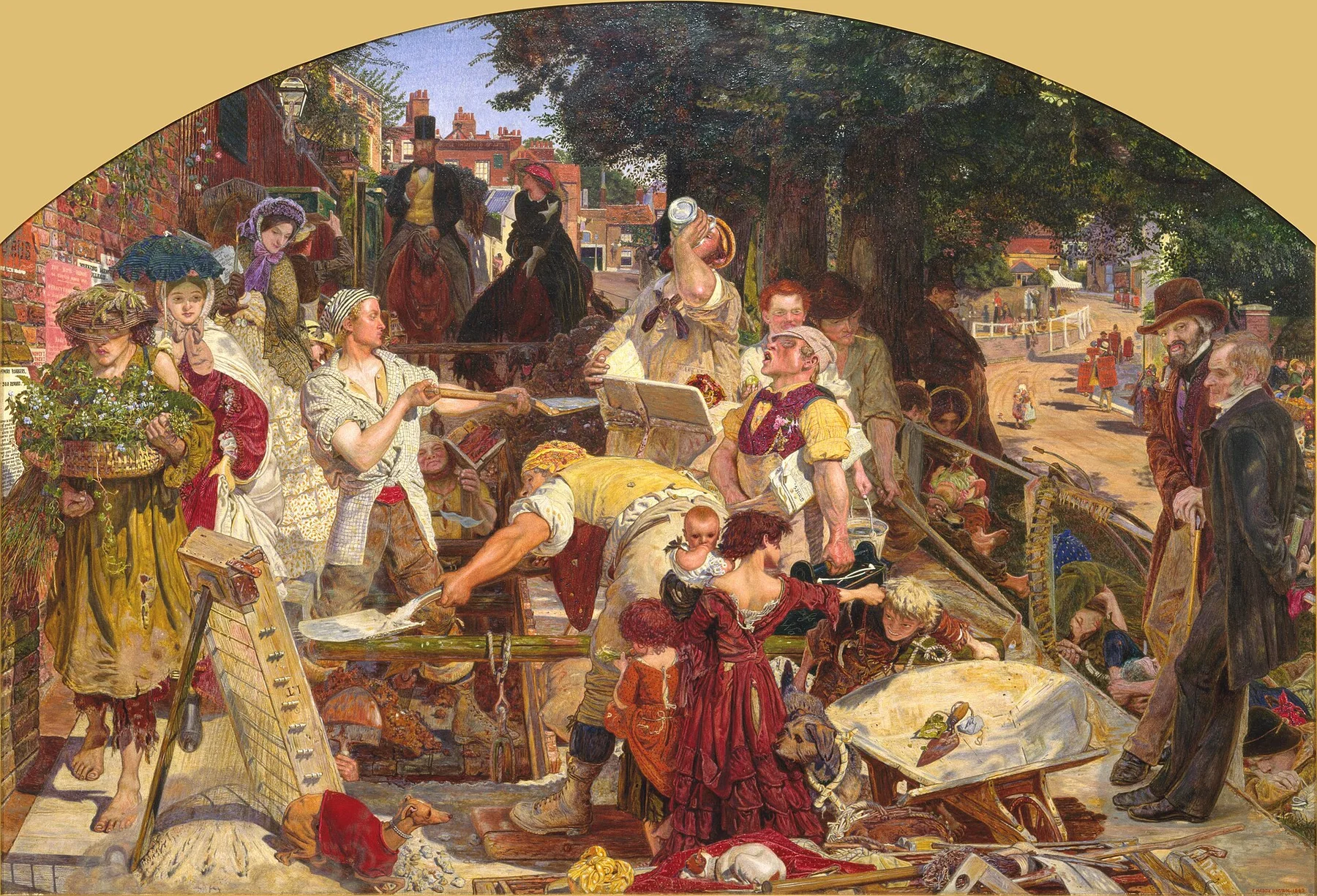
Not every artist in this wider orbit escaped into legend. In the Birmingham version of Work, Brown packs physical labour, wealth, poverty and observation into one street. A shovel points across the foreground; riders wait behind the excavation; children occupy the space at our feet.
Birmingham’s account explains that different figures represent different relationships to work. The painting offers plenty to inspect, but it is not an unfiltered photograph of class relations. Brown arranges bodies and implements into an argument. Compare its dense social detail with Millais’s dense plants: painstaking attention can serve radically different subjects. This smaller 1863 Birmingham painting should not be silently substituted for the better-known Manchester version when discussing dates or dimensions.
Waterhouse: Penelope keeps working
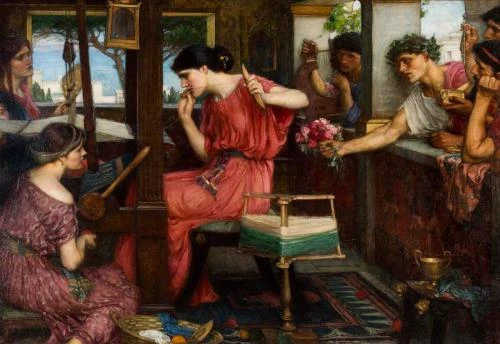
Waterhouse’s Penelope and the Suitors brings an ancient story into an intricate working interior. The loom establishes a boundary: Penelope and her attendants occupy one side, while insistent visitors crowd the opening on the other. Flowers extend towards her, but her body remains turned towards the work.
The image is small, so use it to compare the arrangement rather than to claim tiny painted details. Red clothing holds the centre, and the loom’s upright bars give structure to a crowded room. Beside The Lady of Shalott, weaving becomes a particularly revealing connection. One heroine has left her textile work behind; another remains at it. Their situations differ even when the painter returns to related props.
Leighton: a neighbour, not a founding member
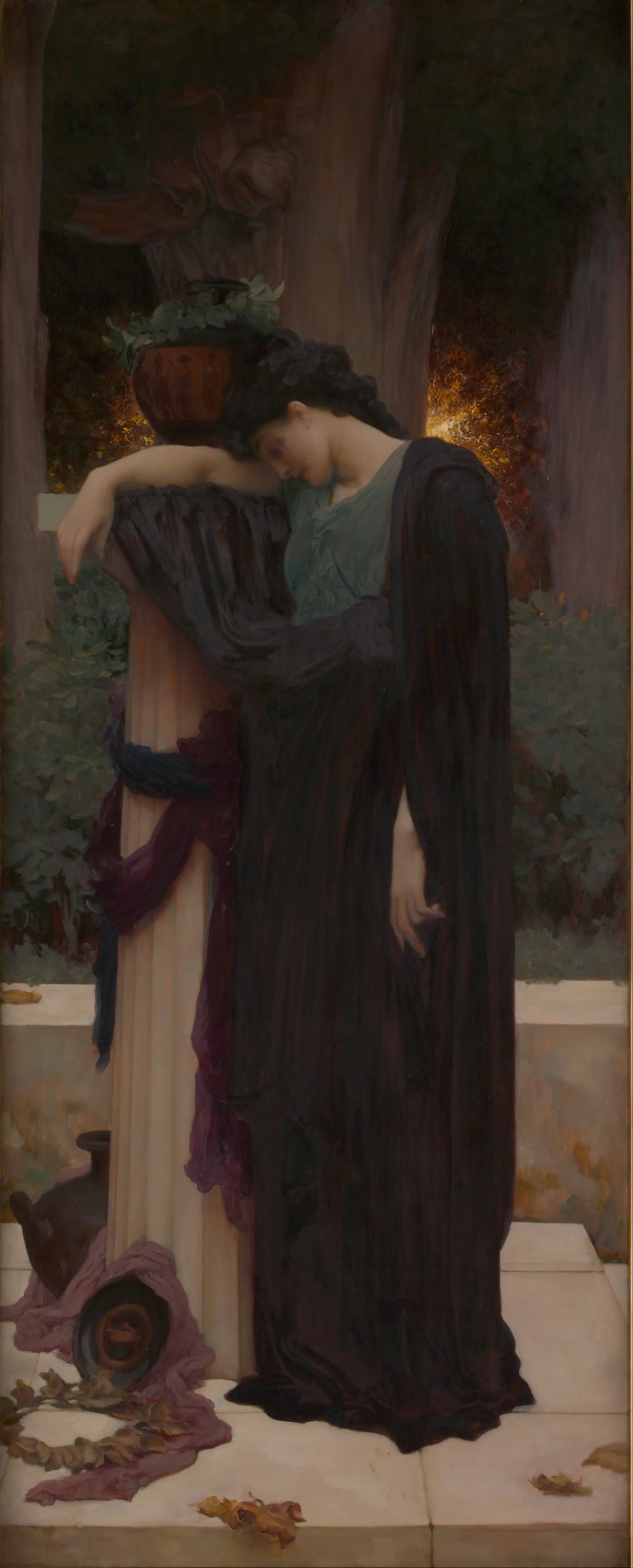
Leighton’s Lachrymae supplies a useful boundary. Its classical setting and concentrated bodily gesture sit beside Pre-Raphaelite interests without making Leighton a Brotherhood member. His artist guide follows that distinct career.
The Met connects the title with tears and the setting with mourning. Visually, the narrow format does much of the work. Tree trunks, the column and the hanging robe establish verticals; the bent neck and resting arm interrupt them. Compared with Brown’s many competing actions, nearly everything leads back to one bodily weight. The painting can feel closely related in intensity while remaining different in artistic allegiance.
How to recognise the family without flattening it
Return to three visible decisions: what receives detail, where the story pauses, and how the figure occupies the surface. Those questions distinguish Millais’s early naturalism, Rossetti’s close-up abundance, Burne-Jones’s suspended music and Waterhouse’s staged narratives more effectively than hair colour or costume alone.
For the different institutional challenges posed by these painters and their French contemporaries, continue with Pre-Raphaelites vs Impressionists. For an available-artwork browsing route, use the collection directory; it is not a complete inventory of the pictures discussed here. The historical family is wider than any shop category, and its most interesting members rarely fit one formula.
Editorial record
About this article
- Author
- Publisher
- GeMarkt
- Published
- Reviewed
- Internal source & rights check. Conducted by GeMarkt Research Review. This is an internal editorial check—not independent peer review.
- Source standard
- Art history source standardPrioritises object records and research sources, distinguishes evidence from interpretation, and states material uncertainty.
Found a claim that needs checking? Report a factual error.