GeMarkt Blog · Practical guide
Is John William Waterhouse’s Art Public Domain? Works and Files
A practical Waterhouse guide with an Aberdeen CC0 image, twelve exact research objects and clear distinctions between paintings, countries and modern files.
Rights check · reviewed
The short answer
Waterhouse’s ordinary EU author term has expired. The illustrated Penelope and the Suitors file has Aberdeen institutional CC0 terms. The guide does not independently establish its U.S. publication history or clear every Waterhouse reproduction.
| What is being checked | Result | Why |
|---|---|---|
| European Union — ordinary author term | Named painter’s own term expired | Waterhouse died in 1917; the ordinary life-plus-70 economic term has elapsed. This calculation does not clear other contributors, later first-publication rights, national moral rights or every country. |
| United States — work-specific publication history | Independent publication chain not established | This guide does not independently establish U.S. publication history for the twelve research objects, including every illustrated work. Provider public-domain designations are attributed, not substituted for first-publication evidence. A dated print can be relevant evidence without resolving every question about its underlying painting. |
| Selected digital files | Exact files with provider CC0 terms | Aberdeen ABDAG003035 is supplied through the institution’s Wikimedia partnership as CC0, consistent with its open-access policy. The exact 500 × 344 source is preserved. The 1600-wide feature is a separately labelled GeMarkt diagram, not a painting. Other collections’ photographs are not covered. |
| Other works, providers and countries | Separate evidence needed | No worldwide or whole-catalogue clearance. Unacquired research rows remain HOLD for display. An engraver, cast, modern photograph, adaptation or edited publication may introduce separate rights. |
Twelve exact research objects; one native 500 × 344 CC0 painting image and an original explanatory diagram. Eleven other objects remain research links, not an approved image pack. No resolution enlargement or historical image generation.
This is a documented research summary, not legal advice. Copyright and moral-rights rules can vary by country and by the history of a particular work.

What we’ll look at
Which Waterhouse painting and which museum file do you mean?
Short answer: Waterhouse’s ordinary EU author copyright term has expired. Some exact museum files are openly reusable, including the Aberdeen CC0 image shown below. That does not make every online reproduction an unrestricted download. This guide does not independently establish U.S. publication history for the listed paintings, including Penelope and the Suitors.
John William Waterhouse lived from 1849 to 1917. His paintings return to women in ancient stories and poetry: waiting, weaving, singing, casting spells or facing danger. Similar costumes and settings make them easy to confuse in a search result. Before asking whether an image is public domain, establish which painting it represents.
The opening graphic is an original explanatory diagram, not a Waterhouse artwork. The actual historical image in this guide comes from Aberdeen’s collection and remains at its small native size.
Stories, not interchangeable pictures
Waterhouse returned to the Lady of Shalott, the woman in Tennyson’s poem, in more than one painting. The familiar boat composition at Tate dates to 1888. The Art Gallery of Ontario holds I am half sick of shadows, 1915. The latter title also comes from the poem, but it is another composition, in another collection—not a detail cut from the boat painting.
Studies create a second trap. The Art Gallery of South Australia holds both a large canvas of The Favourites of the Emperor Honorius and a small oil-on-board study. The canvas is about 119 by 205 centimetres; the study is only 20 by 28 centimetres. Both belong to 1883, with the canvas dated approximately.
A thumbnail can make those objects look equally large and equally finished. The support, dimensions and accession number tell you what the label alone cannot. If you want the finished painting, do not silently substitute the study because its file is easier to download.
Penelope at her loom
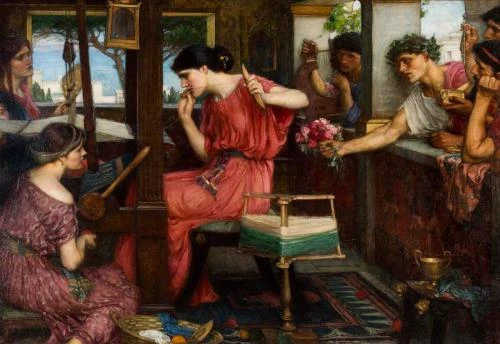
John William Waterhouse, Penelope and the Suitors, 1911–1912. Aberdeen Art Gallery, purchased 1912, ABDAG003035. Museum record. Image: Aberdeen City Council, CC0, via its Wikimedia partnership.
Penelope is the wife of Odysseus in the Odyssey. While he is absent, she delays choosing a new husband by saying that she must finish a burial shroud for his father. She weaves by day and unpicks the work at night. Aberdeen’s account explains the scene through that act of delay.
In the picture, the loom is a large physical barrier. Penelope turns toward her work while men reach in from the right. The offered flowers occupy the space between their faces and her body. Attendants and weaving equipment fill the opposite side. It is a crowded room, but her seated figure remains the visual centre.
The available partnership file is 500 by 344 pixels. It is sufficient to recognise the arrangement, not to inspect every thread or produce a large, sharp poster. We have not enlarged it and invented detail. Its file record identifies Aberdeen City Council as the image source and gives the reproduction a CC0 dedication, consistent with the museum’s open-access collection policy.

Sirens, Circe and a different kind of danger
In the National Gallery of Victoria’s Ulysses and the Sirens, 1891, the threatening creatures have women’s heads and birds’ bodies. They are not mermaids. The museum connects their appearance to ancient Greek imagery. Ulysses is tied to the mast so he can hear their song without abandoning his ship; the crew’s protected hearing lets them continue rowing.
South Australia’s Circe Invidiosa, 1892 offers another tall, single-figure composition. Do not merge it with Oldham’s Circe Offering the Cup to Ulysses, dated 1891. The same mythological character can appear at a different moment, with different objects and a different narrative purpose.
These are useful research examples even though their images are not displayed here. A museum can provide an excellent account of a painting while offering reproduction files on separate, restricted terms. Link to the record when it helps a reader; do not treat the link as a licence to copy the photograph.
Twelve records to explore
Only the Penelope file is acquired and illustrated. The remaining eleven entries are research links, not approved downloads. The two Honorius records are deliberately separate.
| Work | Collection date | Collection or record |
|---|---|---|
| Penelope and the Suitors | 1911–1912 | Aberdeen, ABDAG003035; selected CC0 file. |
| The Danaides | 1906 | Aberdeen, ABDAG003402. |
| Circe Invidiosa | 1892 | Art Gallery of South Australia, 0.106. |
| The Favourites of the Emperor Honorius | About 1883 | South Australia, 0.52; large canvas. |
| Honorius study | 1883 | South Australia, 20114P29; oil on board. |
| Ulysses and the Sirens | 1891 | NGV, p.396.3-1. |
| Diogenes | 1882 | Art Gallery of New South Wales, 720. |
| I am half sick of shadows | 1915 | Art Gallery of Ontario, 71/18. |
| Hylas and the Nymphs | 1896 | Manchester Art Gallery’s collection record on Art UK. |
| Circe Offering the Cup to Ulysses | 1891 | Gallery Oldham’s record on Art UK. |
| Saint Eulalia | 1885 | Tate’s institutional reproduction entry. |
| The Lady of Shalott | 1888 | Tate, N01543; separate from the AGO painting. |
Three rights questions
First, Waterhouse’s own ordinary economic term has elapsed under the EU life-plus-70 rule. This is not a conclusion about every country, later contribution or special first-publication right.
Second, U.S. publication rules require work-specific evidence. The year painted is not necessarily the year copies were published. We do not substitute a modern collection label—or an automatically changing Commons date template—for an independently checked publication history.
Third, check the exact file. The selected Aberdeen reproduction has CC0 terms. By contrast, South Australia’s reproduction service and the NGV’s image-use policy require attention to the proposed use. An old painting and the file offered by a particular provider are separate questions.
A useful file with honest limits
For a source note, keep the artist, full title, date, collection, accession, exact file URL and stated terms. Add the pixel dimensions before choosing a printing size. A clear CC0 label cannot give a small file information it never contained.
If the only available high-resolution version has uncertain terms, keep looking or use a different image. For discussion, a modest but traceable museum photograph can be more useful than a large, unattributed “restoration.” It lets a reader see the actual composition while leaving the unverified parts of the reuse decision visible.
Sources and review method
We checked the artist chronology against museum records, treated each named jurisdiction separately, and recorded the provider policy for the image set. These sources support the legal framework and artist dates used above; the source file for any individual image still needs its own record.
- Penelope and the Suitors, ABDAG003035 — Aberdeen Art Gallery and Museums. 1911–1912 painting, accession, narrative and institutional CC0 designation; direct service intermittently unavailable.
- Open Access Images — Fine Art — Aberdeen Art Gallery and Museums. Institutional CC0 release, checked through the publicly indexed official page.
- Penelope institutional partnership file — Aberdeen City Council via Wikimedia Commons. Exact CC0 reproduction, institutional provenance and native 500 × 344 dimensions; dynamic publication template not accepted as independent U.S. evidence.
- Ulysses and the Sirens, p.396.3-1 — National Gallery of Victoria. 1891 object and bird-bodied sirens; no image acquired from this provider.
- Directive 2006/116/EC, ordinary author term and later rights — EUR-Lex. Ordinary life-plus-70 calculation; first-publication and national moral-rights qualifications.
- 17 U.S.C. Chapter 3, including section 303 — U.S. Copyright Office. Publication and formerly unpublished-work rules; creation and exhibition do not independently prove publication.
Editorial record
About this article
- Author
- Publisher
- GeMarkt
- Published
- Reviewed
- Internal source & rights check. Conducted by GeMarkt Research Review. This is an internal editorial check—not independent peer review.
- Source standard
- Rights guide source standardSeparates the underlying work from the source file, records the review date, and links the evidence used for the conclusion.
Found a claim that needs checking? Report a factual error.