GeMarkt Blog · Practical guide
Is Frederic Leighton’s Art Public Domain? Paintings and Files
Find exact Leighton works and open museum images, with two Met CC0 examples and separate checks for paintings, sculpture, engravings and publication history.
Rights check · reviewed
The short answer
Leighton’s ordinary EU author term has expired. Exact Met files for Lachrymae and Lucia are Public Domain / CC0. This does not independently establish U.S. publication histories or clear every cast, engraving and photograph associated with his name.
| What is being checked | Result | Why |
|---|---|---|
| European Union — ordinary author term | Named painter’s own term expired | Leighton died in 1896; the ordinary life-plus-70 economic term has elapsed. This calculation does not clear other contributors, later first-publication rights, national moral rights or every country. |
| United States — work-specific publication history | Independent publication chain not established | This guide does not independently establish U.S. publication history for the twelve research objects, including every illustrated work. Provider public-domain designations are attributed, not substituted for first-publication evidence. A dated print can be relevant evidence without resolving every question about its underlying painting. |
| Selected digital files | Exact files with provider CC0 terms | Met objects 436869 and 436868 provide the selected CC0 photographs. Exact source JPEGs, API records and master hashes are preserved; modern photos of bronzes and the Dalziel contributors are not cleared by Leighton’s death year. |
| Other works, providers and countries | Separate evidence needed | No worldwide or whole-catalogue clearance. Unacquired research rows remain HOLD for display. An engraver, cast, modern photograph, adaptation or edited publication may introduce separate rights. |
Twelve research records: two displayed paintings, two bronze casts, three engravings after Leighton, four distinct sketchbook leaves and Princeton’s After Vespers. The other ten files are unacquired research references.
This is a documented research summary, not legal advice. Copyright and moral-rights rules can vary by country and by the history of a particular work.

What we’ll look at
Is your Leighton image a painting, a cast or a print made after his design?
Short answer: Leighton’s ordinary EU author copyright term has expired. The two paintings shown here also have exact digital files that The Metropolitan Museum of Art supplies as Public Domain under CC0. That is a useful starting point, not permission for every photograph, cast or modern reproduction bearing his name. This guide does not independently establish the U.S. publication histories of the listed works, including the illustrated paintings.
Frederic Leighton lived from 1830 to 1896. His pictures often bring together flowing drapery, carefully posed bodies and settings that suggest the ancient Mediterranean. But a search for “Leighton art” also returns portrait studies, bronze figures and book illustrations. You need the particular object, not just the surname, to make a sensible rights decision.
Leighton beyond Flaming June
Many people meet Leighton through Flaming June, the orange-robed sleeping figure painted in 1895 and held by the Museo de Arte de Ponce. The Frick’s exhibition account is a useful institutional introduction to that painting. It is not the source of either image displayed here, and its exhibition material should not be mistaken for a general image licence.
Leighton’s career was international. Princeton’s record for After Vespers describes his training in Germany, Italy and France, and his eventual presidency of the Royal Academy. That helps explain why “Victorian British painting” can include Italian settings, classical subjects and figures dressed in clothes from another age.
In After Vespers, the museum connects the setting to the mosaics of Venice’s San Marco. A location suggested by a painting is not necessarily a place documented exactly as it looked. Read the object entry before turning an evocative interior into a historical photograph in your caption.
Lachrymae and the shape of grief
The opening image, Lachrymae, dates to 1894–95. Its Latin title means tears. The Met identifies the woman as a mourner and the objects around her as part of a funerary setting. It leaves the bright light beyond the trees open to interpretation: sunset or a funeral fire.
The painting is unusually tall and narrow. Notice how the tree trunks, column and falling fabric repeat its vertical shape. The woman’s bent head interrupts those upright lines. Her arm rests across the monument, while her other hand hangs beside the dark dress. The physical imbalance makes the still figure feel heavy.
The wreath and scattered leaves sit near the bottom edge. They can disappear if a square thumbnail keeps only the woman’s face and torso. That crop would preserve an attractive figure but lose part of the mourning scene. For a page explaining the work, show the complete image before using a detail.
The original canvas is about 157.5 by 62.9 centimetres. Those measurements also explain why a standard wide banner is a poor fit: the empty-looking spaces above and below the figure are part of the composition, not spare margins supplied for a website designer.
Lucia at a smaller scale
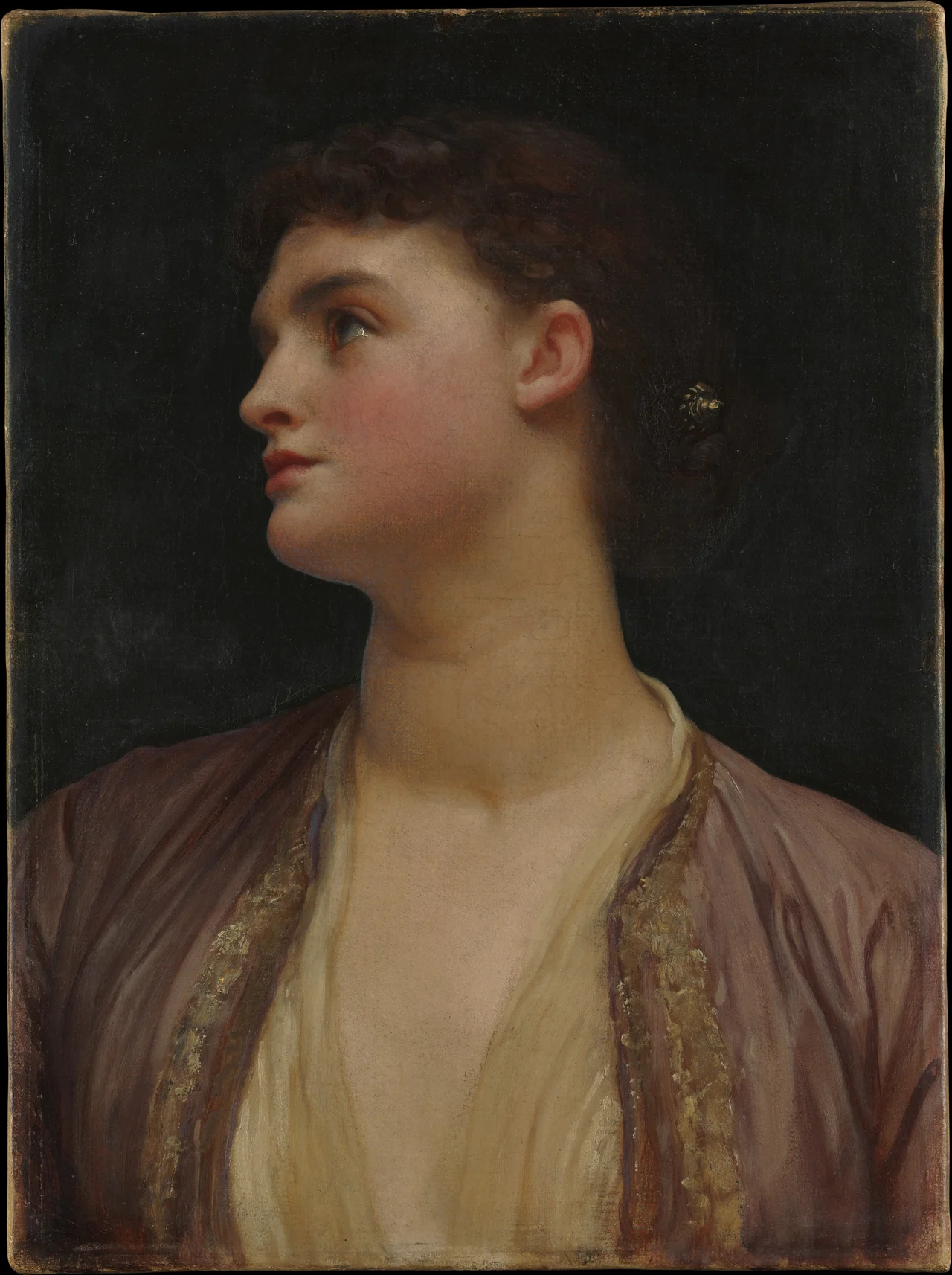
Frederic, Lord Leighton, Lucia, possibly late 1870s. The Metropolitan Museum of Art, Catharine Lorillard Wolfe Collection, Bequest of Catharine Lorillard Wolfe, 1887, 87.15.79. Object record. Public Domain / Open Access (CC0).
Lucia directs attention toward one face rather than a complete setting. The tilted chin and raised eye establish a direction beyond the picture. Pale skin and clothing emerge from the dark ground; the purple garment adds colour without competing with the face.
The museum gives the date as possibly the late 1870s. Keep that qualification. This small oil painting measures about 37.8 by 25.4 centimetres, although a browser can make its head look larger than the full figure in Lachrymae.
The supplied photograph includes the painting’s uneven outer edge. Do not assume this makes the file defective. It records the object rather than supplying a ready-made rectangular product graphic. Any later trim should be deliberate and disclosed where relevant, not confused with Leighton’s original boundary.
Twelve records, with different kinds of objects
The two illustrated paintings are selected files. The other ten records are research links, not ten additional cleared downloads. Four drawings are separate leaves from one sketchbook; the three Bible prints name other makers as well as Leighton.
| Work | Museum date and object type | What to distinguish |
|---|---|---|
| Lachrymae | 1894–95; oil painting | Illustrated Met CC0 file. |
| Lucia | Possibly late 1870s; oil painting | Illustrated Met CC0 file. |
| The Sluggard | Modelled 1886; cast possibly before 1896 | Model, individual bronze and its photograph differ. |
| Needless Alarms | Modelled 1886; nineteenth-century cast | Not another photograph of The Sluggard. |
| Samson Carrying the Gates | 1881; wood engraving | Dalziel Brothers after Leighton. |
| Cain and Abel | 1880–81; wood engraving | A separate Bible Gallery sheet. |
| Samson and the Lion | 1865–81; wood engraving | Preserve the broad catalogue date. |
| Scene in an Italian City | About 1849; drawing | Sketchbook leaf 42.21(1). |
| A Burial Scene | About 1849; drawing | Leaf 42.21(2). |
| An Artist Drawing on a Church Wall | About 1849; drawing | Leaf 42.21(3). |
| A Speaker by a Fountain at Night | About 1849; drawing | Leaf 42.21(4). |
| After Vespers | 1871; oil painting | Princeton’s distinct painting, y1961-17. |
What the rights answer covers
Under the ordinary EU life-plus-70 rule, Leighton’s own economic term has elapsed. That calculation does not settle another contributor’s work, special first-publication rights, moral rights or every country’s rules.
The U.S. rules make publication history important for older works. A museum’s creation date or a Royal Academy exhibition date is not automatically proof that authorised copies were published. The unresolved U.S. branch here is a limit of this research, not a claim that all these works remain protected.
For the selected digital images, the answer is more specific: the Met marks the two records Public Domain and makes the supplied files available through its CC0 Open Access programme. Those designations belong to these files. They do not travel to a modern photographer’s picture of a bronze or a publisher’s newly edited book.
Choose a file that fits the job
Save the accession, source link and rights statement beside the downloaded file. For a sculpture, add the casting information and photographer or provider. For a print, keep the engraver and publisher; “after Leighton” is an important description, not an optional complication.
Then judge the image at the size you need. The complete Lachrymae works well in a tall space; Lucia is easier to read in a compact portrait-shaped panel. Neither should be stretched to fit a convenient frame. Open access removes a file-use obstacle; it does not make every composition, crop or resolution suitable for every purpose.
Sources and review method
We checked the artist chronology against museum records, treated each named jurisdiction separately, and recorded the provider policy for the image set. These sources support the legal framework and artist dates used above; the source file for any individual image still needs its own record.
- Lachrymae, 96.28 — The Metropolitan Museum of Art. Exact painting, funeral setting, qualified background light interpretation and Public Domain file.
- Lucia, 87.15.79 — The Metropolitan Museum of Art. Second painting, qualified date, medium, dimensions and exact CC0 image.
- After Vespers, y1961-17 — Princeton University Art Museum. 1871 painting, training context, Royal Academy career and Venetian setting.
- Open Access at The Met — The Metropolitan Museum of Art. CC0 applies to exact museum-supplied images designated Public Domain, not unrelated photographs or complete catalogues.
- Directive 2006/116/EC, ordinary author term and later rights — EUR-Lex. Ordinary life-plus-70 calculation; first-publication and national moral-rights qualifications.
- 17 U.S.C. Chapter 3, including section 303 — U.S. Copyright Office. Publication and formerly unpublished-work rules; creation and exhibition do not independently prove publication.
Editorial record
About this article
- Author
- Publisher
- GeMarkt
- Published
- Reviewed
- Internal source & rights check. Conducted by GeMarkt Research Review. This is an internal editorial check—not independent peer review.
- Source standard
- Rights guide source standardSeparates the underlying work from the source file, records the review date, and links the evidence used for the conclusion.
Found a claim that needs checking? Report a factual error.