GeMarkt Blog · Practical guide
Is John Everett Millais’s Art Public Domain? Paintings and Prints
A work-specific Millais guide separating paintings from engravings, with exact Met CC0 files for Portia and a print after Ophelia, plus twelve research records.
Rights check · reviewed
The short answer
Millais’s ordinary EU author term has expired. The selected Met CC0 files show Portia and James Stephenson’s 1866 print after Ophelia, not two autograph paintings. U.S. publication histories and other contributors remain separate checks.
| What is being checked | Result | Why |
|---|---|---|
| European Union — ordinary author term | Named painter’s own term expired | Millais died in 1896; the ordinary life-plus-70 economic term has elapsed. This calculation does not clear other contributors, later first-publication rights, national moral rights or every country. |
| United States — work-specific publication history | Independent publication chain not established | This guide does not independently establish U.S. publication history for the twelve research objects, including every illustrated work. Provider public-domain designations are attributed, not substituted for first-publication evidence. A dated print can be relevant evidence without resolving every question about its underlying painting. |
| Selected digital files | Exact files with provider CC0 terms | Met objects 437092 and 368061 are designated Public Domain / CC0. The second is James Stephenson (1808–1886), after Millais, published by Henry Graves & Co., March 1, 1866; the photograph and caption retain that identity. Dalziel prints remain research-only. |
| Other works, providers and countries | Separate evidence needed | No worldwide or whole-catalogue clearance. Unacquired research rows remain HOLD for display. An engraver, cast, modern photograph, adaptation or edited publication may introduce separate rights. |
Twelve research objects: a painting, a Stephenson reproductive print and ten separate Dalziel Parables proofs after Millais. Only two exact files are displayed; no claim that twelve image candidates are cleared.
This is a documented research summary, not legal advice. Copyright and moral-rights rules can vary by country and by the history of a particular work.

What we’ll look at
Are you using a Millais painting or another artist’s engraving after it?
Short answer: Millais’s ordinary EU author copyright term has expired. The two exact Met files illustrated here are designated Public Domain and supplied under CC0. One shows his painting Portia; the other shows James Stephenson’s engraving after Ophelia. They are not interchangeable types of image. This guide does not independently establish U.S. publication histories for the listed works, including the illustrated objects.
John Everett Millais lived from 1829 to 1896. He is closely associated with Pre-Raphaelite painting, but that label should not make every picture look like the early Ophelia. His later work, portraits and designs for printed books need to be understood on their own terms. The Getty’s artist record provides an institutional starting point for his identity and career.
One artist, more than one kind of image
Imagine finding three versions of Ophelia: a colour photograph, a monochrome sheet with a paper border, and a modern poster with a new background. They may all refer to Millais, but the first records a painting, the second may reproduce a historical print, and the third is a later adaptation.
The monochrome sheet is not necessarily a colour painting with its saturation removed. An engraver can translate painted colours into lines, dots and shaded tones. That creates a different object, with a different maker, medium and publication history. Adding the painter’s death year to all three files hides those differences.
Start with the collection record. Look for “after” in the attribution, then read the medium and maker roles. A museum may place Millais prominently in search results while also crediting the person who engraved or printed the sheet. Keep both names when they belong.
Portia: a character and a model
The opening image is Portia, 1886, an oil painting rather than an illustration cut from a Shakespeare book. Portia is the character in The Merchant of Venice who appears in legal disguise during the courtroom scene.
The Met identifies the model as Kate Dolan, wearing the costume used by the actress Ellen Terry. That distinction matters: the painting’s subject, the person posing and the owner of the costume are not automatically the same woman. The museum also reports evidence of an earlier composition beneath the paint, with the same figure in Greek dress.
Look at the red robe before the face. Its broad folds form most of the painting; the stone setting stays muted. One hand holds a rolled document, while the other rests against the cloth. The upright pose and direct expression convey a figure prepared to speak, not a woman caught unawares in an everyday room.
A tight headshot would lose the paper and much of the costume—the clues that help identify the role. The full composition is more useful when explaining the subject. Its broad areas of paint also offer a different viewing experience from the crowded plants and textiles of Ophelia.
Ophelia as a print
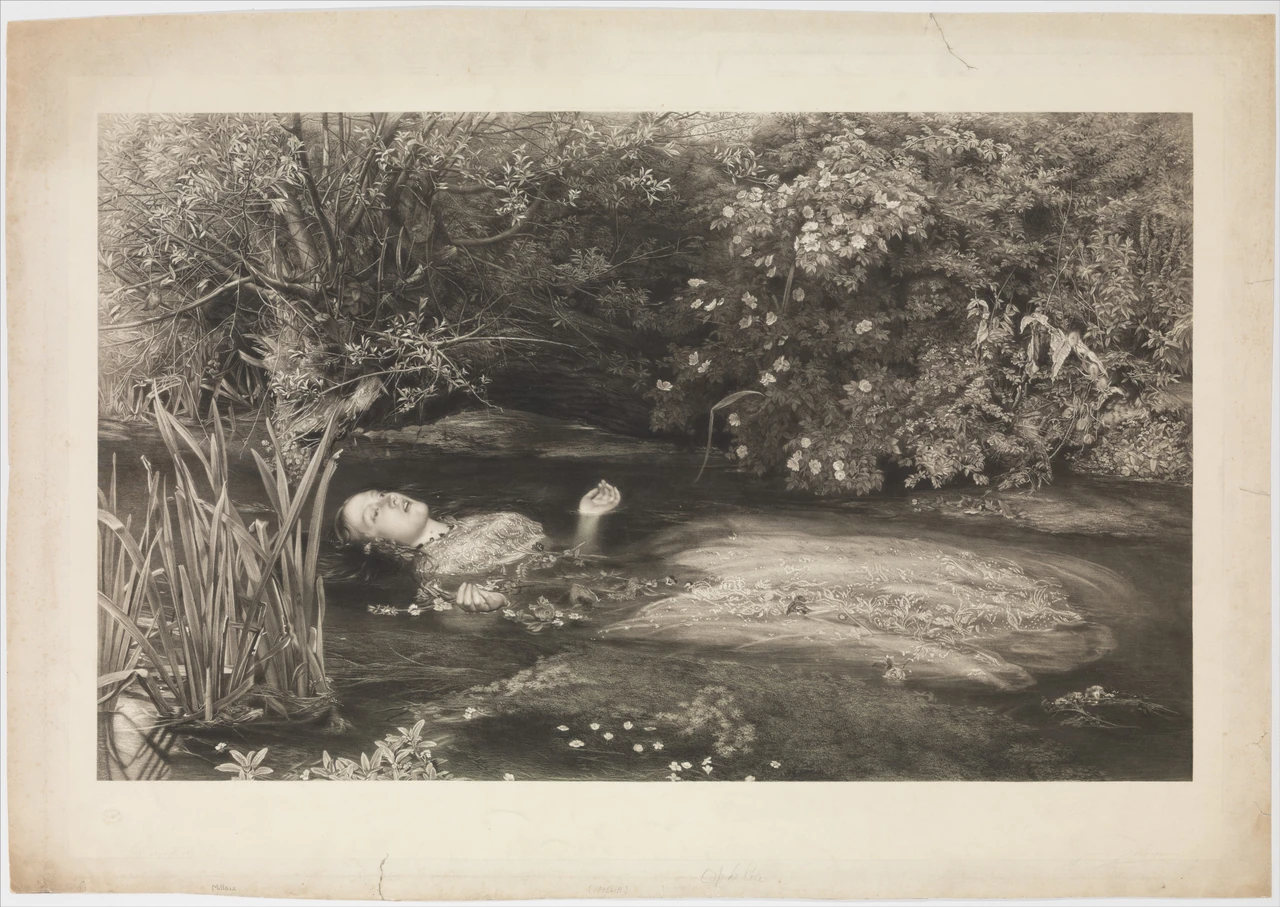
James Stephenson, after Sir John Everett Millais, Ophelia, March 1, 1866; published by Henry Graves & Co. The Met, Elisha Whittelsey Collection, Elisha Whittelsey Fund, 1949, 49.40.282. Record. Public Domain / CC0.
The Met’s record identifies this as a proof using mezzotint, etching and stipple, dated March 1, 1866. These are printmaking methods, not different kinds of paint. The engraver was James Stephenson, who lived from 1808 to 1886; the composition is after Millais’s painting shown at the Royal Academy in 1852.
Here the vegetation and patterned dress must work without the painting’s colours. The dark water isolates the pale face and hands, while fine marks differentiate leaves, grasses and fabric. The broad paper border is part of this photographed sheet. It makes the print’s identity especially clear.
Do not caption this file “Millais, Ophelia, 1851–52, oil on canvas” without explaining the print. That description would send a reader looking for the wrong physical object. Nor should the dated impression automatically be treated as complete proof of every legal question about the underlying painting. It is valuable publication-related evidence, but its exact relationship and legal consequences still need work-specific analysis.
Twelve records to explore
The list deliberately includes individual book illustrations, not just famous canvases. The ten Parables sheets are separate prints engraved and printed by the Dalziel Brothers after Millais. They are research references; only the two files above have been acquired for this guide.
| Object | Museum date and medium | Identification note |
|---|---|---|
| Portia | 1886; oil on canvas | Selected painting file, 06.1328. |
| Ophelia | March 1, 1866; mixed print techniques | Selected Stephenson print, 49.40.282. |
| The Prodigal Son | 1864; wood-engraving proof | Parables sheet 21.68.4(16). |
| The Sower | 1864; wood-engraving proof | Sheet 21.68.4(1). |
| The Parable of the Leaven | 1864; wood-engraving proof | Sheet 21.68.4(2). |
| The Tares | 1864; wood-engraving proof | Sheet 21.68.4(3). |
| The Hidden Treasure | 1864; wood-engraving proof | Sheet 21.68.4(4). |
| The Pearl of Great Price | 1864; wood-engraving proof | Sheet 21.68.4(5). |
| The Unmerciful Servant | 1864; wood-engraving proof | Sheet 21.68.4(6). |
| The Labourers in the Vineyard | 1864; wood-engraving proof | Sheet 21.68.4(7). |
| The Wicked Husbandmen | 1864; wood-engraving proof | Sheet 21.68.4(8). |
| The Ten Virgins | 1864; wood-engraving proof | A separate Parables composition. |
Rights with the makers kept in view
Millais’s own ordinary economic term has elapsed under the EU life-plus-70 rule. That is not a calculation for every later contribution. The Dalziel firm’s name, for example, should not disappear simply because the painter’s dates are easier to find.
In the United States, publication and formerly unpublished-work rules require more than the date a painting was made. Our independent publication research remains unresolved. We report the Met’s own Public Domain designation for the two selected objects, not a worldwide conclusion for the entire catalogue.
The Met’s CC0 policy supplies the file-specific basis for using these images. It does not cover another photographer’s reproduction of the same painting, new commentary in a book, or a newly drawn version found elsewhere.
Download and caption carefully
Keep the accession number and source URL with your image. For Portia, use the painting’s 1886 date. For this Ophelia, include Stephenson, “after Millais,” the 1866 print date and the printing medium. These short details prevent a surprisingly large error: presenting one historical object as another.
Finally, preserve what the file actually shows. Paper borders, plate marks and subtle grey tones tell you that a print is a print. Colourising it or inventing missing detail may produce a new decorative image, but it would no longer be an unaltered record of the object discussed here.
Sources and review method
We checked the artist chronology against museum records, treated each named jurisdiction separately, and recorded the provider policy for the image set. These sources support the legal framework and artist dates used above; the source file for any individual image still needs its own record.
- Portia, 06.1328 — The Metropolitan Museum of Art. 1886 painting, Kate Dolan and Ellen Terry costume distinction, and exact CC0 source.
- James Stephenson after Millais, Ophelia, 49.40.282 — The Metropolitan Museum of Art. Exact 1866 proof, engraver and publisher, combined techniques, paper margins and CC0 file.
- The Prodigal Son, 21.68.4(16) — The Metropolitan Museum of Art. Dalziel-engraved and printed proof after Millais, not an autograph painting.
- Open Access at The Met — The Metropolitan Museum of Art. CC0 applies to exact museum-supplied images designated Public Domain, not unrelated photographs or complete catalogues.
- Directive 2006/116/EC, ordinary author term and later rights — EUR-Lex. Ordinary life-plus-70 calculation; first-publication and national moral-rights qualifications.
- 17 U.S.C. Chapter 3, including section 303 — U.S. Copyright Office. Publication and formerly unpublished-work rules; creation and exhibition do not independently prove publication.
Editorial record
About this article
- Author
- Publisher
- GeMarkt
- Published
- Reviewed
- Internal source & rights check. Conducted by GeMarkt Research Review. This is an internal editorial check—not independent peer review.
- Source standard
- Rights guide source standardSeparates the underlying work from the source file, records the review date, and links the evidence used for the conclusion.
Found a claim that needs checking? Report a factual error.