GeMarkt Blog · Essay
Pre-Raphaelites vs Impressionists: Two Different Rebellions
Compare Brown’s Work with Caillebotte’s Paris Street; Rainy Day to understand two movements, their different institutions and their shared interest in looking.

Pre-Raphaelite paintings often bring to mind jewel-like colour, carefully described plants and stories from literature. Impressionism suggests moving light, modern clothes and visible brushwork. Those associations can help at first. They become less reliable when you place two crowded nineteenth-century streets beside each other.
The movements challenged different conventions, in different countries, through different relationships with exhibitions. They were not two teams fighting the same academy. Nor did one care about stories while the other simply copied an instant of vision. Brown’s Work and Caillebotte’s Paris Street; Rainy Day show why a closer comparison is worth making.
Not the same academy, not the same protest
The Pre-Raphaelite Brotherhood formed in Britain in 1848. Millais, Holman Hunt and Rossetti were central founders. Their challenge concerned accepted models of painting, including the authority attached to idealised figures and established approaches to composition. The National Gallery’s account of Millais traces the friendships behind the group through the Royal Academy Schools.
The first independent exhibition later associated with Impressionism took place in Paris in 1874. Here the crucial alternative was to the official Salon: an exhibition whose jury could accept or reject submissions. The National Gallery of Art’s Paris 1874 exhibition places the independent show alongside that broader artistic world, rather than treating it as a single style suddenly appearing from nowhere.
The dates are twenty-six years apart. London and Paris had different institutions and circumstances. “Rebellion” is a starting question, not a complete explanation.
Looking back could be a way forward
“Pre-Raphaelite” refers to admiration for art before Raphael and the conventions associated with his later followers. It does not mean that the painters lived before him. The V&A’s account of the rediscovery of Perugino shows how older Italian art offered these nineteenth-century artists a resource for making something new.
Their interests also reached beyond an imagined medieval world. The NGA’s Pre-Raphaelite exhibition emphasises precise observation, new subjects and clear colour. Historical reference and close attention to present surroundings could coexist.
That combination matters for Work. Its painter, Ford Madox Brown, was close to the Pre-Raphaelites but never a formal member of the Brotherhood, as the National Portrait Gallery makes clear. His modern street is a useful example from their wider circle, not a founding member’s manifesto.
Two modern streets side by side
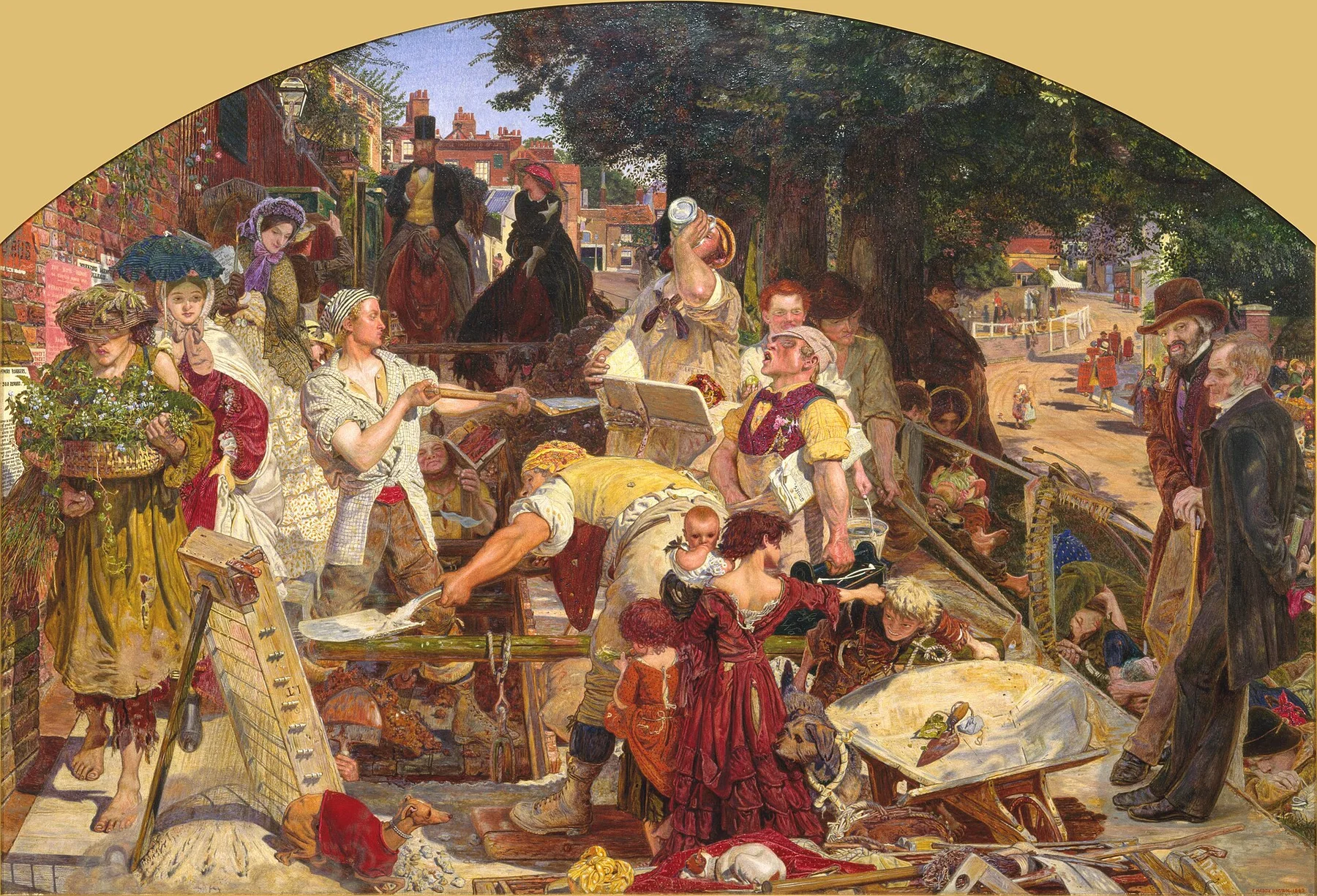

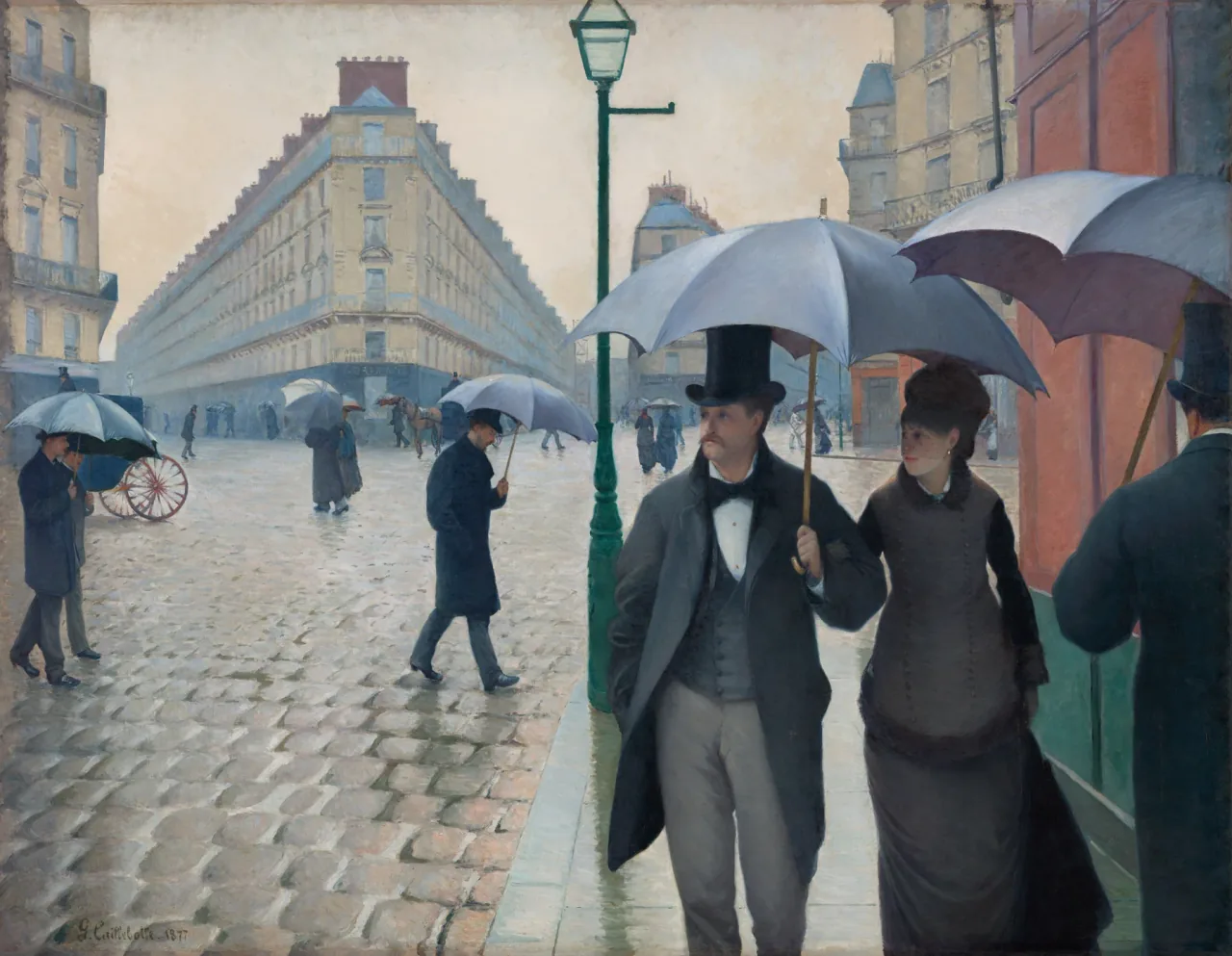
Brown made more than one version of Work. The image here is the smaller painting in Birmingham, not the larger Manchester canvas. The distinction matters even when the compositions look closely related.
Brown turns the street into a social story
Begin with the central workers. Bent backs, raised arms, a spade and a wheelbarrow make manual effort conspicuous. Then follow the figures towards the edges: a flower seller, children, well-dressed visitors on horseback and two men standing apart from the digging.
The Birmingham museum’s account explains that the groups carry different meanings within Brown’s idea of work, including physical labour and intellectual activity. The picture therefore does more than collect things seen on a road. It sorts and connects them.
Look at the girl holding a small child near the foreground. Her task shares the same crowded space as the men’s excavation, even though it is less spectacular. Looking from one task to another can complicate the title: what counts as work, and which kinds receive the most attention?
The tiny plants and clearly differentiated clothes prolong that exploration. Detail becomes a way to keep several social stories available at once. It does not make the scene an unedited photograph of a single afternoon.
Caillebotte makes space for an encounter
Now look at the gaps in the Paris picture. Pedestrians are scattered across a much more open junction. The foreground couple is large enough to feel close, while the partly cut-off figure at the right suggests another person passing just beside us.
The lamppost creates a firm vertical division. Street edges and repeated windows carry the eye into the distance. Umbrellas echo each other, linking people who otherwise appear to be moving separately.
Brown’s crowd offers connected episodes to inspect. Caillebotte’s arrangement can make you feel placed within a passing encounter: close to strangers, without being told their full stories. That is a reading of the visible arrangement, not a claim that we know what each person is thinking.
The Art Institute’s account stresses the painting’s careful compositional control. Its apparently casual street experience is constructed, not proof that the artist painted everything in one hurried sitting outdoors.
Detail versus blur is not enough
Caillebotte is a helpful test of the usual checklist. His buildings have firm structure; coats and umbrellas have substantial forms. This is not the broken, flickering surface people often expect from Impressionism, yet the picture appeared in the third Impressionist exhibition in 1877.
Brown’s precise figures do not make him a passive follower of academic convention. Caillebotte’s comparatively controlled handling does not disqualify him from the independent group. A movement includes relationships, exhibitions and shared problems as well as marks on a surface.
If you want to compare more visibly different brushwork, our Impressionism and Post-Impressionism guide provides another set of examples. Here, keeping two carefully organised pictures together prevents the distinction from becoming too easy.
Different routes to an audience
The early Pre-Raphaelites did not simply refuse the Royal Academy’s walls. Millais exhibited Isabella there in 1849; he eventually became its president in 1896. Criticising an institution’s conventions and exhibiting through that institution were not mutually exclusive.
Caillebotte helped build an alternative route. The Art Institute records his role in funding, organising and installing the 1877 exhibition, alongside showing his own paintings and lending works by colleagues. The exhibition was a practical undertaking, not merely a declaration of artistic independence.
The groups were never single styles
The original Brotherhood and the wider Pre-Raphaelite movement are not identical categories. Brown’s position makes that visible. Later careers changed too: a founder’s mature painting cannot always stand in for what the group did in 1848.
“Impressionist” likewise does not guarantee one subject or finish. The street shown here belongs to the same exhibition network as painters whose surfaces look quite different. Comparing the groups therefore requires both a date and an actual object, not just a recognisable name.
A useful way to remember the difference
For this pair, remember Brown’s street as a dense arrangement of work and social roles, and Caillebotte’s as a carefully built encounter within modern urban space. Both reward close looking; neither is free of planning.
Then keep the institutional distinction beside the visual one. The Pre-Raphaelite circle challenged accepted models while maintaining varied relationships with British institutions. The Impressionist exhibitions created another way to put art before a public in France. Two different rebellions can illuminate each other without becoming the same story.
Editorial record
About this article
- Author
- Publisher
- GeMarkt
- Published
- Reviewed
- Internal source & rights check. Conducted by GeMarkt Research Review. This is an internal editorial check—not independent peer review.
- Source standard
- Art history source standardPrioritises object records and research sources, distinguishes evidence from interpretation, and states material uncertainty.
Found a claim that needs checking? Report a factual error.