GeMarkt Blog · Reference
The National Portrait Gallery–Wikimedia Dispute: What It Did Not Decide
What the 2009 dispute reveals about public-domain paintings, museum photographs and access—and why a legal threat is not a binding court judgment.

A dispute, not a precedent
The National Portrait Gallery–Wikimedia dispute is a useful case study, but it should not be cited as a court ruling that freed museum photographs. Its public record includes a legal threat, a response and arguments about the public domain. Those are not the same thing as a judgment resolving the claims.
The story concerns an old problem in a digital form: a painting can be out of copyright while an institution still claims rights or imposes conditions around the image through which you see it. If those conditions are disputed, the underlying painting’s age does not tell you how the dispute ended.
This guide distinguishes the participants’ positions from current authorities and today’s source-file choices. It is general information, checked on 12 October 2026, not legal advice. No historical portrait is reproduced here; the diagrams explain the questions without assuming permission for a contested file.
What happened in 2009
On 10 July 2009, lawyers acting for London’s National Portrait Gallery sent a letter to Derrick Coetzee, a Wikimedia Commons contributor. The letter, published by its recipient, alleged that he had downloaded more than 3,300 high-resolution images from the Gallery’s website and uploaded them to Commons. It raised claims concerning photographic copyright, database rights, technical protection and website terms.
Those were the Gallery’s allegations, not findings made by a judge. The letter was addressed to an individual contributor; describing it simply as “the Gallery sued Wikipedia” collapses both the parties and the procedural stage.
The Electronic Frontier Foundation’s own account says it represented Coetzee and responded on 20 July. EFF challenged the claims and their cross-border reach. Its account is valuable evidence of the defence position, but it is an advocate’s account rather than a neutral court decision.
What the different sides argued
In its 16 July 2009 statement, the Wikimedia Foundation said the historical paintings were in the public domain and disputed a new copyright in faithful reproductions. It argued for public access to cultural heritage while indicating willingness to discuss a practical compromise.
That position helps explain why the controversy mattered beyond a single download. If a faithful digital surrogate creates a new exclusive right, access to an expired work may remain controlled through the file most readers need. Conversely, the expense of making and distributing good images is a real institutional concern. Neither observation, by itself, decides whether a legal right exists.
For a present-day reader, it helps to resist choosing a conclusion solely from sympathy with either mission. “Digitisation is costly” and “public access is valuable” are arguments about policy and resources. The legal questions still require the applicable tests and evidence.
Why four questions became entangled
The underlying portrait, its photograph, a collection of records and the way someone obtained a file are different subjects of inquiry. It is easy to answer the first question and assume the rest disappear. The dispute shows why that shortcut is unreliable.
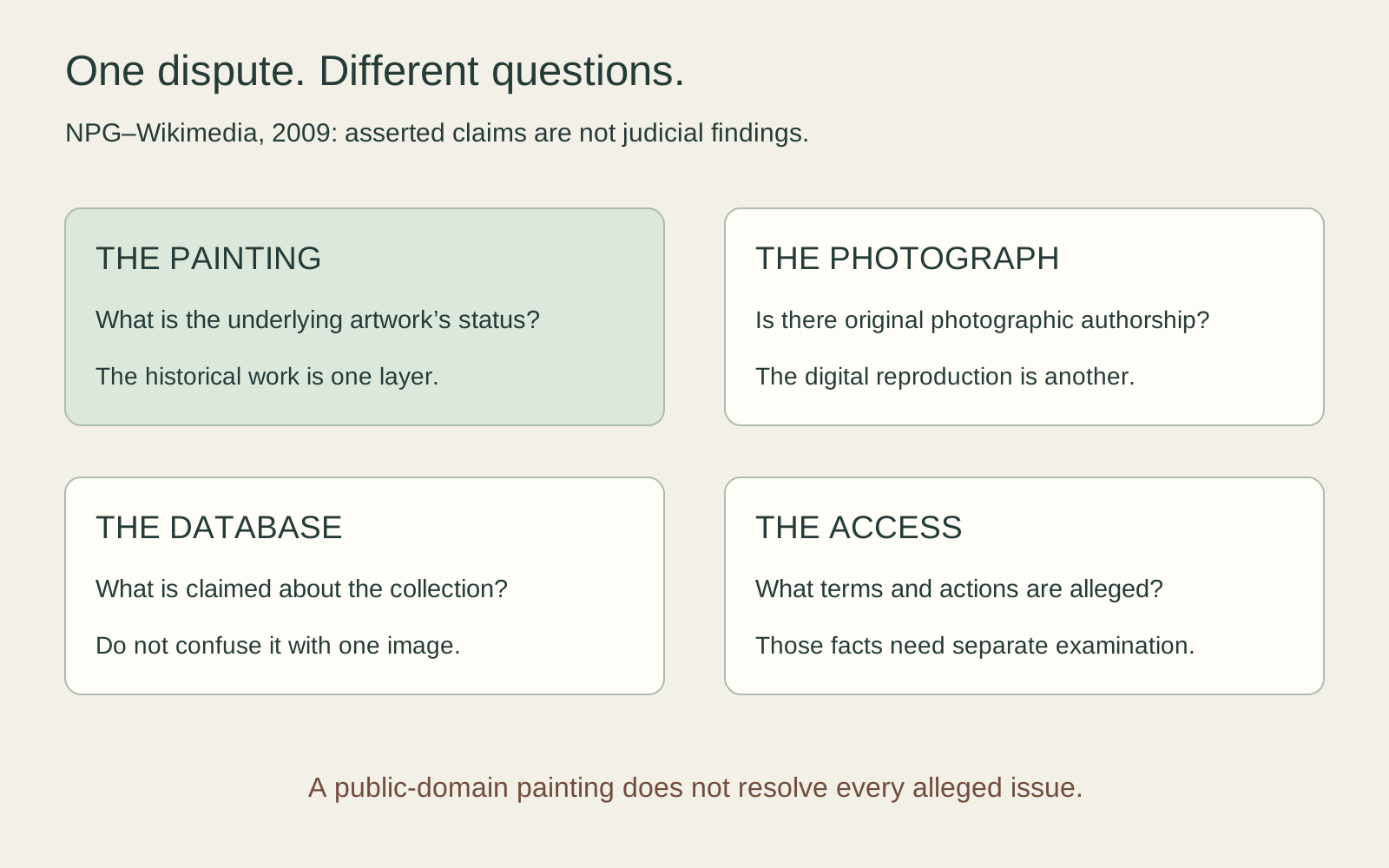
A claim about the originality of a photograph asks what its creator contributed. A claim about a database concerns a collection rather than simply the copyright in each item. Current UK IPO guidance on database rights distinguishes copyright in an original selection or arrangement from the separate database right associated with substantial investment in obtaining, verifying or presenting contents. Eligibility and dates also matter.
A website agreement or a technical-access allegation introduces still other facts. What terms were presented? What was accepted? What was actually done? The 2009 letter asserted answers, but repeating those assertions does not establish that they would prevail. This article is not a method for bypassing an image viewer or extracting a collection.
What the published exchange does not establish
Coetzee’s published account reports that he received no further response after the 2009 reply. That limited account should not be inflated into a judicial victory, a concession on every point or a worldwide licence. A lack of reported further correspondence is not a written judgment explaining which claims succeeded or failed.
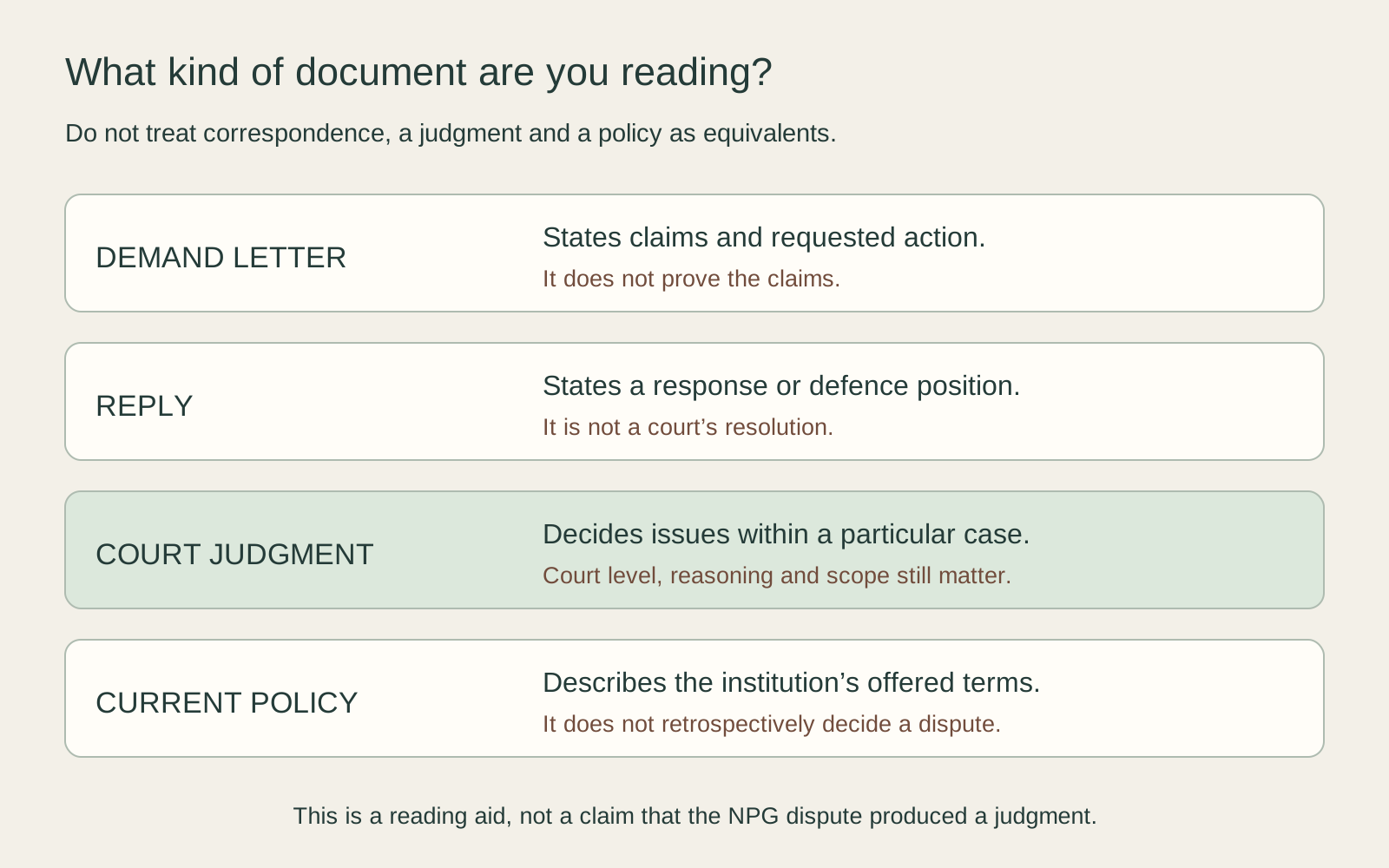
When someone cites this dispute to justify a download, ask which document they mean. A solicitor’s letter can explain the asserted rights. A lawyer’s reply can explain why they were contested. A museum’s current website can explain the licences it offers now. None should be labelled the missing court ruling.
The distinction also prevents the opposite mistake: treating the original demand as proof that a faithful image must be protected. Strongly worded correspondence is evidence that a claim was made, not a substitute for establishing its legal basis.
Read current UK law separately
Today’s IPO image guidance says a merely digitised copy of an older work is unlikely to be original where there is little opportunity for free and creative choices. The qualification matters: it does not classify every photograph, and guidance is not a judgment on this dispute.
In THJ Systems v. Sheridan, 2023, the Court of Appeal discussed originality as the author’s own intellectual creation, expressed through free and creative choices, rather than simply skill and labour. See particularly paragraphs 16 and 26. That case concerned graphical works associated with software, not National Portrait Gallery photographs. It should not be retold as an appeal in the 2009 controversy.
The practical conclusion is to research UK questions through relevant UK sources. A US argument about faithful reproduction does not become binding UK law merely because the image is hosted on an American service. Our UK art-copyright guide provides a separate introduction.
What the Gallery offers today
The Gallery’s current web-use page offers commercial, non-commercial and Creative Commons licensing options through image records. Its free Creative Commons route is described for low-resolution, non-commercial online use. Some images have limited availability. Do not summarise that as “the NPG collection is CC0”.
These are the institution’s present offered terms, not a retrospective verdict on its 2009 demands. A reader wanting a file for a business website should check the particular record and relevant option, rather than borrowing the conditions of a different image or assuming an educational tone makes a commercial site non-commercial.
A practical lesson for image research
Suppose you find a portrait on Commons and want it for an illustrated essay. Open the individual file page. Identify the source, photographer or reproduction history, stated licence and any country-specific public-domain reasoning. Then follow the source link to check that it really refers to the same image. A useful label is evidence to inspect, not a guarantee issued by a court.
Record your planned use beside that evidence. Do you need only an illustration, or also an advertising image and a downloadable print file? If the terms are unclear, ask a precise question or choose a different, clearly documented source. Keep any reply with the original record.
Our guides to checking a Commons file and museum licences and public-domain labels turn that process into manageable steps. The enduring lesson of this dispute is not that museums always win or always lose. It is that the artwork, the file, the access method and the authority of the evidence must not be mistaken for one another.
Editorial record
About this article
- Author
- Publisher
- GeMarkt
- Published
- Reviewed
- Internal source & rights check. Conducted by GeMarkt Research Review. This is an internal editorial check—not independent peer review.
- Source standard
- Rights guide source standardSeparates the underlying work from the source file, records the review date, and links the evidence used for the conclusion.
Found a claim that needs checking? Report a factual error.