GeMarkt Blog · Reference
Copyright on Art in the UK
A practical UK art-copyright guide covering life plus 70, older unpublished engravings, photographs, publication right and the exact image you reuse.

Begin with the work you want to use
UK copyright in an ordinary artistic work by an identified individual usually lasts until the end of the seventieth year after the artist’s death. Older unpublished works, some photographs, foreign-work rules and separate publication rights mean that the familiar shorthand is a starting point, not universal clearance.
This guide addresses UK use and was checked on 12 October 2026. It is general information, not legal advice. A UK answer does not establish permission to distribute an image in every country, and permission to use an underlying painting does not automatically cover any photograph found online.
First identify what you have. Section 4 of the Copyright, Designs and Patents Act 1988 includes paintings, drawings, engravings, etchings, lithographs and woodcuts within graphic works, and separately includes photographs and sculptures as artistic works. The distinction becomes important when you reach older-work provisions. A photograph of an engraving is not simply one undifferentiated “old image”.
Write down the object’s title, creator, medium and accession number where available. For a book illustration, identify the edition and plate too. These details let you attach the legal question to something more precise than a search-result thumbnail.
Count the ordinary term to the end of the year
Section 12 measures the ordinary term from the end of the calendar year of death. For a hypothetical author who died in 1955, that term runs through 31 December 2025; the work leaves that ordinary term on 1 January 2026. The artist’s birthday and the day you bought the image do not change that calculation.
For joint authorship, the relevant surviving author matters. Unknown-authorship works have a different route, potentially based on creation or authorised making available to the public. Do not use that category simply because a download has lost its credit. Crown and Parliamentary copyright also have separate provisions.
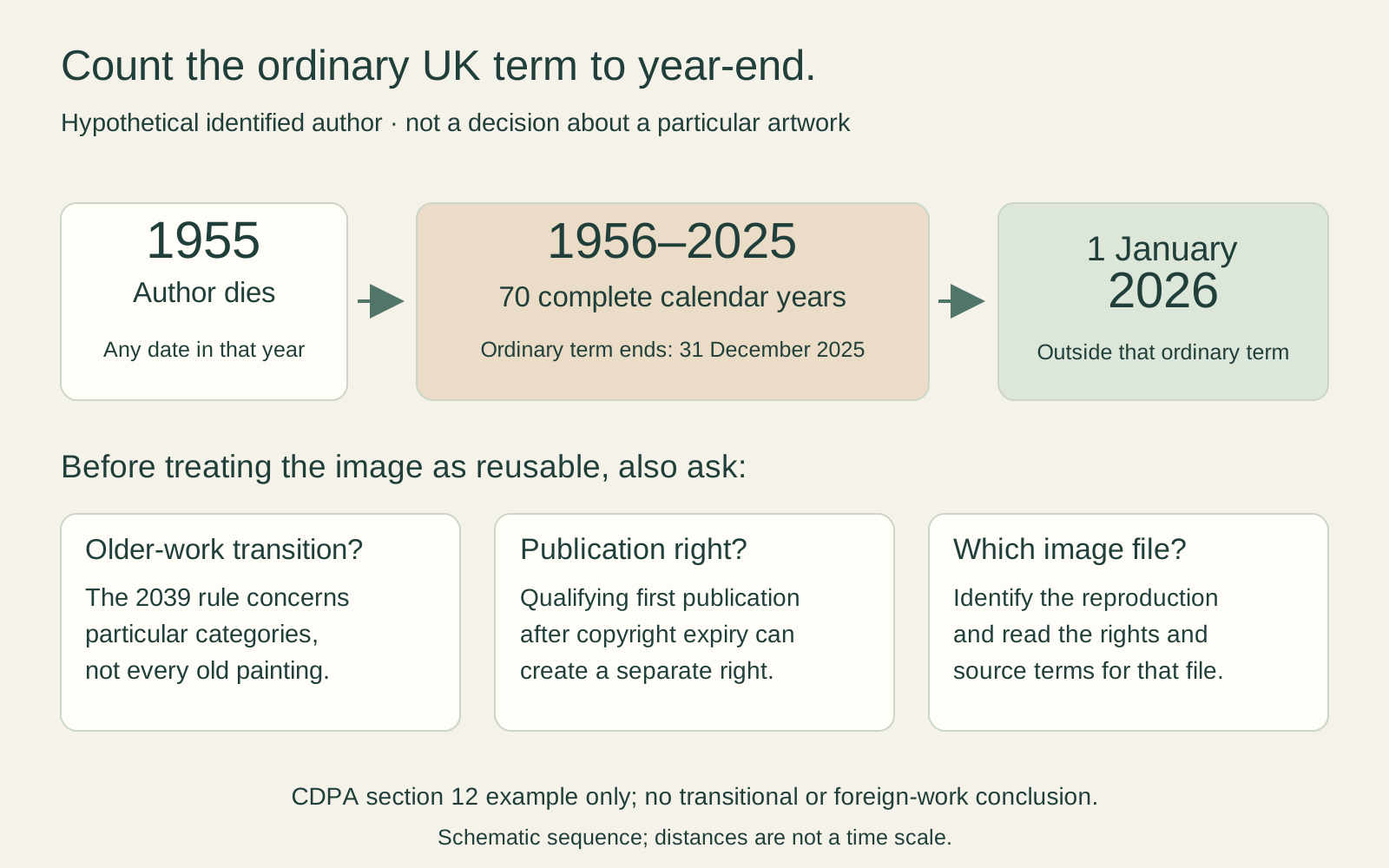
Keep the date calculation beside the rule, not in place of it. “1955 plus 70 equals 2025” is arithmetic. “This object follows the ordinary identified-author rule” is the legal and factual premise that makes the arithmetic relevant.
Treat the 2039 rule as a specific exception
Some old material remains protected through 31 December 2039, even when its creator died long ago. The IPO’s duration notice gives qualifying unpublished engravings by authors who died before 1969 as an example. It also identifies special treatment for unpublished photographs taken between 1 June 1957 and the 1989 commencement. It does not say that every unpublished painting lasts until 2039.
The statutory transition is in Schedule 1, paragraph 12. Its branches depend on the kind of existing work and the facts immediately before the new provisions commenced. Anonymous or pseudonymous works have their own branch. Earlier publication can lead to a different rule; the transition is not a single extra 50 years added to any old object.
Imagine an archive describes a sheet as an unpublished nineteenth-century engraving and supplies its maker’s death date. Do not clear it by counting 70 years alone. Ask the archive what publication history it holds and which transitional provision it considers applicable. Conversely, do not place an ordinary identified-author painting on hold solely because someone has heard the phrase “2039 rule”. Match the category before matching the date.
Publication can mean different things
A museum exhibition, printed reproduction and online image are different events. Under the Act’s general section 175 definition, publication includes issuing copies to the public and, for relevant works, electronic retrieval. Exhibition of an artistic work is not, by itself, publication for that provision.
However, that does not mean an exhibition is irrelevant throughout copyright law. The unknown-authorship rules in section 12 use the wider concept of making a work available to the public, and publication right has its own definition. For pre-1989 transitions, the earlier statutory definitions may also matter. Never move a finding from one rule to another merely because both use everyday language about showing art.
A useful archive request is specific: “Do you have a reference to an authorised reproduction of this plate, and its date?” That is more productive than asking whether the artist was famous or whether visitors could see the work. Record the catalogue edition and page, not just the archive’s home page. If the evidence is only an exhibition listing, call it that.
Check for a separate publication right
An expired author’s copyright is not the only possible right in previously unpublished material. Regulation 16 of the Copyright and Related Rights Regulations 1996 provides a 25-year publication right for qualifying first publication after copyright has expired. Its definition includes forms of making available such as public exhibition and electronic access.
The rule has conditions, including the qualifying publisher and place of first publication. An unauthorised disclosure does not count; where author copyright has ended, the consent of the physical object’s owner is relevant. It is not a fresh right obtained by uploading an old image that was already published. Nor does it extend an unexpired author’s copyright simply because a new edition appears.
For an archive’s newly released image, ask whether publication right is being claimed and what event supports it. A collection’s explanation may resolve the question much faster than trying to reconstruct the entire history from social-media reposts. Check the offered licence if you want to use that release.
Check the photo and the source terms
The IPO’s digital-images notice explains that mere copying does not create fresh copyright. It considers a simply retouched, faithful digitisation unlikely to satisfy the required originality, while acknowledging uncertainty. That is not the same as declaring every museum photograph unprotected.
A photograph of a sculpture can involve choices of angle, lighting and background. A modern artwork that incorporates an old painting can contain new expression. Check the image you will actually reproduce, not merely the age of its subject. An image provider may also impose contractual supply terms, a separate question from whether copyright subsists.
Save the source page and its rights statement with the file. If one provider is ambiguous, look for a clearly documented alternative rather than assuming its small preview and downloadable master share the same terms. Our guide to photographs of paintings explores that distinction without treating every scan as a new artwork.
Permission and fair dealing are different routes
An image still in copyright is not necessarily unusable: a right holder may license your intended use. But a caption saying “credit to the artist” is not permission. If relying on a UK exception, identify the particular exception and meet its conditions.
The government’s exceptions guidance explains fair dealing for purposes including criticism, review and quotation. It is a context-dependent assessment, not an unrestricted U.S.-style “fair use” label. Reproducing an image to analyse it and reproducing it as the thing offered for sale are different uses; permission for one should not be assumed to cover the other.
When the owner cannot be found, the work does not simply become public domain. The UK orphan-works scheme offers a possible licensing route after a diligent search. Its licence is limited in scope and does not establish worldwide permission. For a time-sensitive project, choosing a well-documented alternative may be more realistic than treating an unanswered enquiry as consent.
Keep a UK-specific decision
Before reproducing the image, write a conclusion that names the territory, work and source file. Include the rule used, supporting dates and any permission conditions. For example: ordinary author term checked; no unresolved older-work issue identified; exact file obtained under stated terms. That is a research structure, not a ready-made verdict you can paste against any image.
Foreign works need attention to qualification and country-of-origin rules as well as the familiar term. The current Act addresses these in section 154, section 155 and section 12. A painting’s present location in a British museum does not make its origin British. If these provisions or an older transition determine a valuable commercial use, obtain qualified advice on the specific facts.
Keep good evidence even when the answer seems straightforward. An accession number, dated reproduction and exact source link make a much stronger record than “artist died ages ago”.
Editorial record
About this article
- Author
- Publisher
- GeMarkt
- Published
- Reviewed
- Internal source & rights check. Conducted by GeMarkt Research Review. This is an internal editorial check—not independent peer review.
- Source standard
- Rights guide source standardSeparates the underlying work from the source file, records the review date, and links the evidence used for the conclusion.
Found a claim that needs checking? Report a factual error.