GeMarkt Blog · Essay
Still Life: Fruit, Flowers and Vanitas
Eight still lifes show how flowers, fruit, seafood and ordinary objects become pictures about looking, abundance and time, from Peeters to Cézanne.

At first a still life seems to ask very little of us. There is no unfamiliar myth to untangle, no battle to identify, no sitter whose career we need to know. We can recognise an apple, a glass or a bunch of flowers immediately.
That familiarity is the beginning, not the whole experience. A painter can make those things appetising, precarious, monumental or strange. An arrangement can invite us to admire possessions while reminding us that neither their owner nor their contents will last. Or it can turn a tabletop into a searching experiment in colour and space.
The eight paintings here move between those possibilities. Their differences are clearer when we look at relationships—between objects, surfaces and empty spaces—rather than treating every item as a symbol with one fixed translation.
The small stage of a still life
Still life names a kind of subject: arranged objects become the painting’s main focus. Flowers and food are familiar examples, but books, musical instruments, utensils and manufactured goods also belong. A living animal can enter the arrangement without automatically turning it into a different kind of picture.
Vanitas is a more particular idea within that broad field. Objects point towards life’s brevity and the limits of possessions, pleasure or achievement. A skull makes that question unusually explicit. A drooping flower may contribute to it, but a flower does not turn every picture into a warning about death. Our Still Life vs Vanitas guide explains the distinction more directly.
Here, start with the table edge. Does it bring things close enough to reach? Does a vessel balance safely, or threaten to fall? A seemingly quiet arrangement often contains a surprising amount of action.
Clara Peeters: a bouquet that will not last
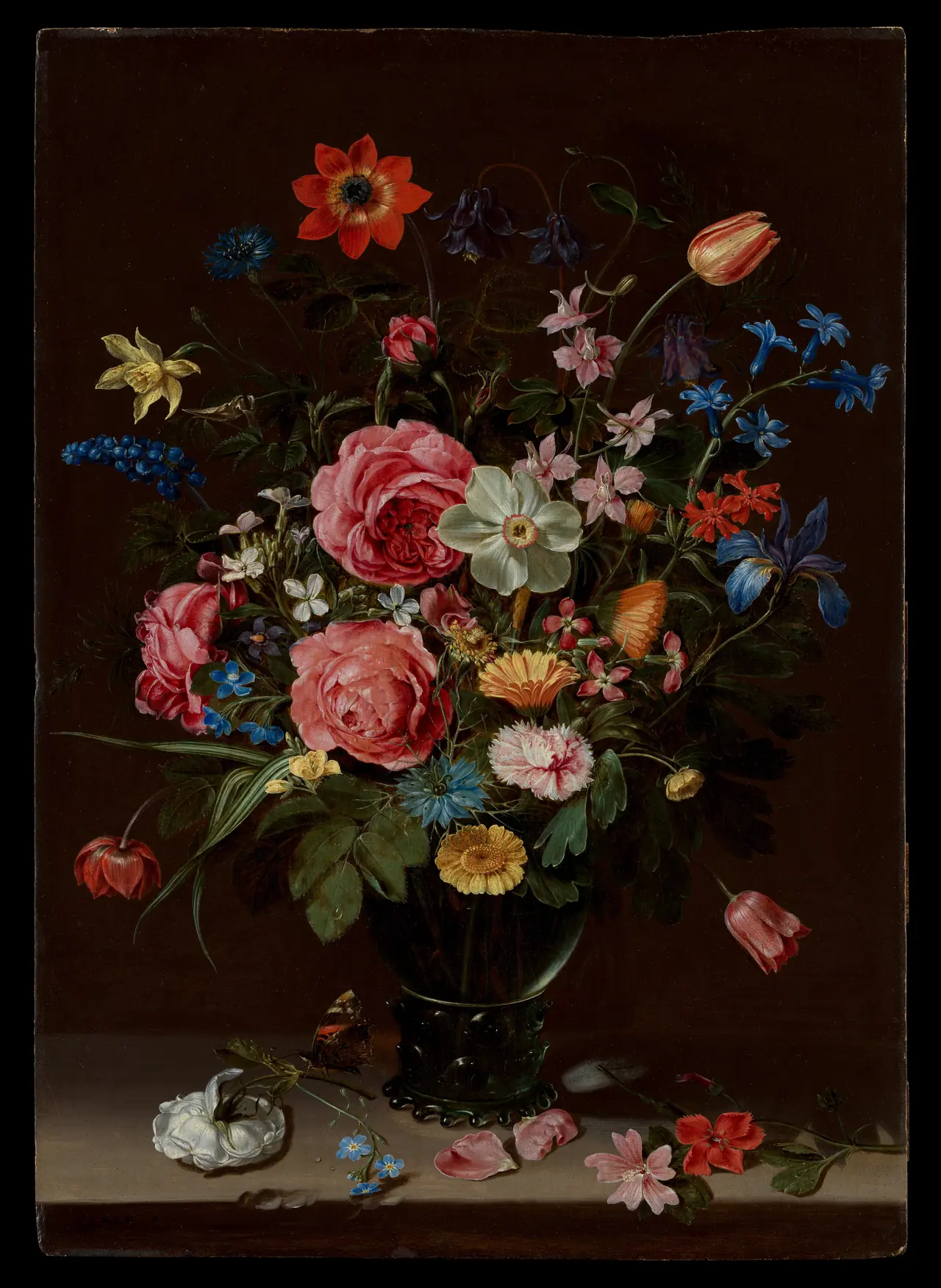
Peeters gives each flower room to be recognised. A red bloom sits high against the dark background; striped tulips reach out at the edges; roses gather nearer the centre. Below, detached flowers and petals have left the arrangement altogether.
The Met’s account draws attention to insect damage, moisture and drooping stems as signs of passing beauty. It also identifies Peeters’s signature on the ledge. The painting asks us to notice natural detail and the skill of the person presenting it.
Look from the upright red flower to the lowered tulip at the right. That shift makes the bouquet more than an evenly attractive pattern. Different directions and stages of flowering coexist. We do not need to assign a separate moral to every species to recognise an arrangement holding change momentarily in place.
Claesz and Heda: two ways to show time
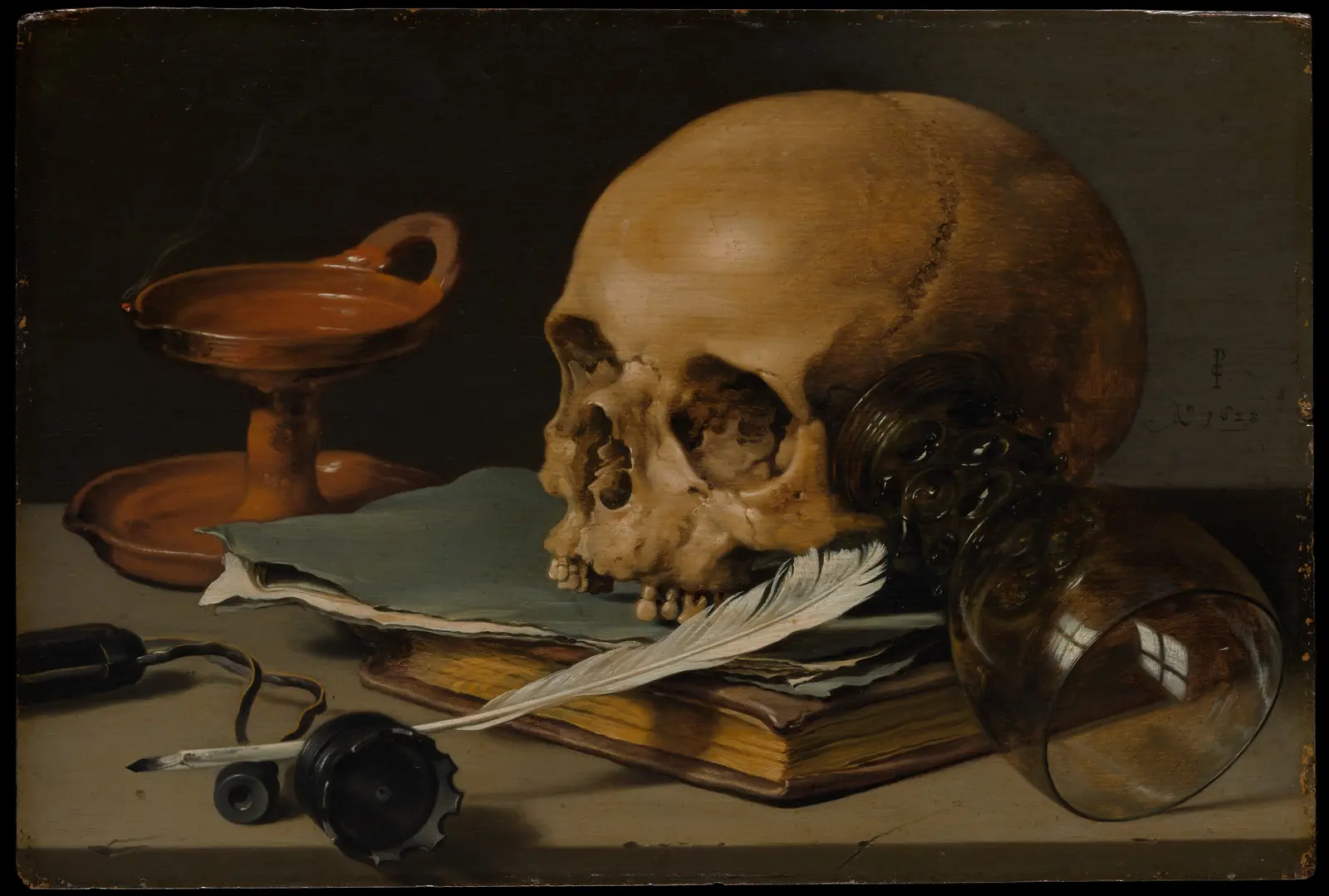
Claesz places the skull where we can hardly avoid it. A white quill cuts across the books below, while the glass lies on its side. The Met reads the skull, failing lamp and toppled vessel as direct reminders of mortality. The low ledge makes the arrangement feel close to our own space rather than safely enclosed in a distant story.
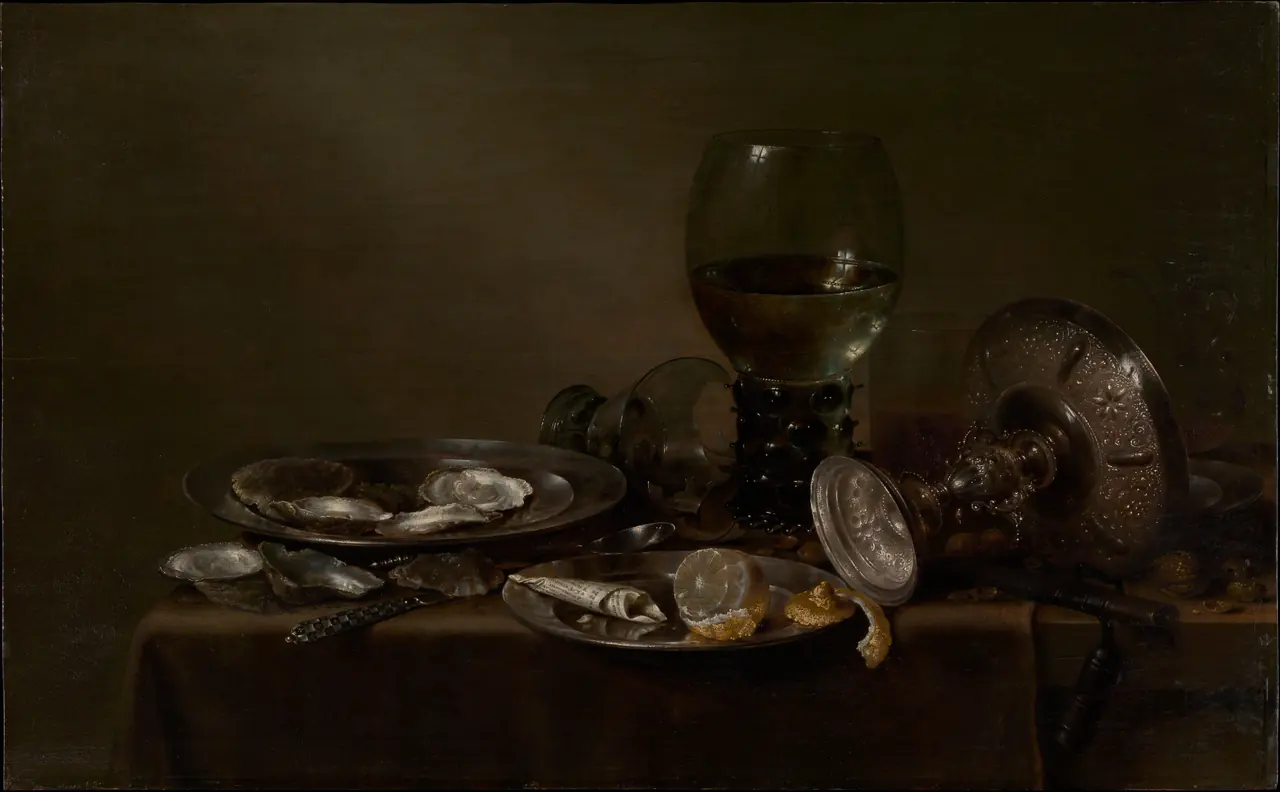
Heda’s table begins with a more inviting offer: oysters, lemon and drink. A tazza is a shallow footed cup; here the silver one has fallen sideways. Its engraved surface catches light differently from the transparent glass and moist shells. The museum identifies broken glass and a paper cone made from an almanac as reminders of passing days.
Both painters work with restrained colour, but one concentrates attention on a skull while the other makes pleasure and disorder coexist. Their common achievement is material specificity. Glass, paper, metal and bone remain distinct even when brilliant colour is largely withheld.
Mignon: an arrangement about to collapse
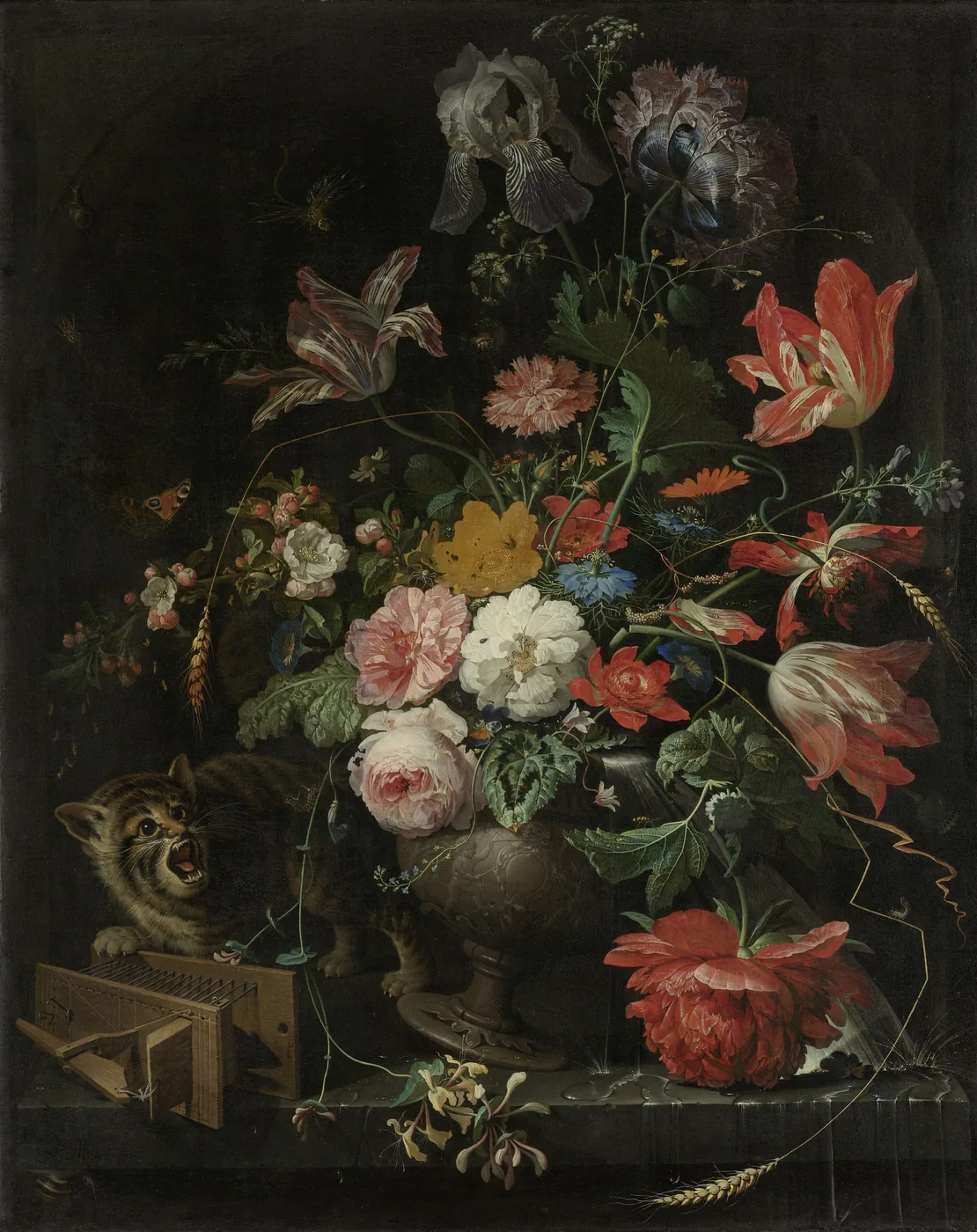

The title tells us to expect an accident. Mignon’s great bouquet leans away from its base while the cat at the lower left is occupied with a mousetrap. The Rijksmuseum explicitly connects the cat’s activity with the upset vase.
That incident changes the rhythm of looking. We can slowly inspect the striped petals, insects and curled leaves, yet the whole structure seems only moments from falling. Still life has acquired a before and an after without needing a human figure.
Compare its outline with Peeters’s bouquet. Both spread intricate shapes into a dark background, but Mignon makes imbalance drive the composition. The fine detail is not separate from the action: the more fragile things we discover, the more consequential the imagined crash becomes. The flowers are also a precarious assembly of weight, stems and supports.
Chardin: the kitchen becomes a major picture
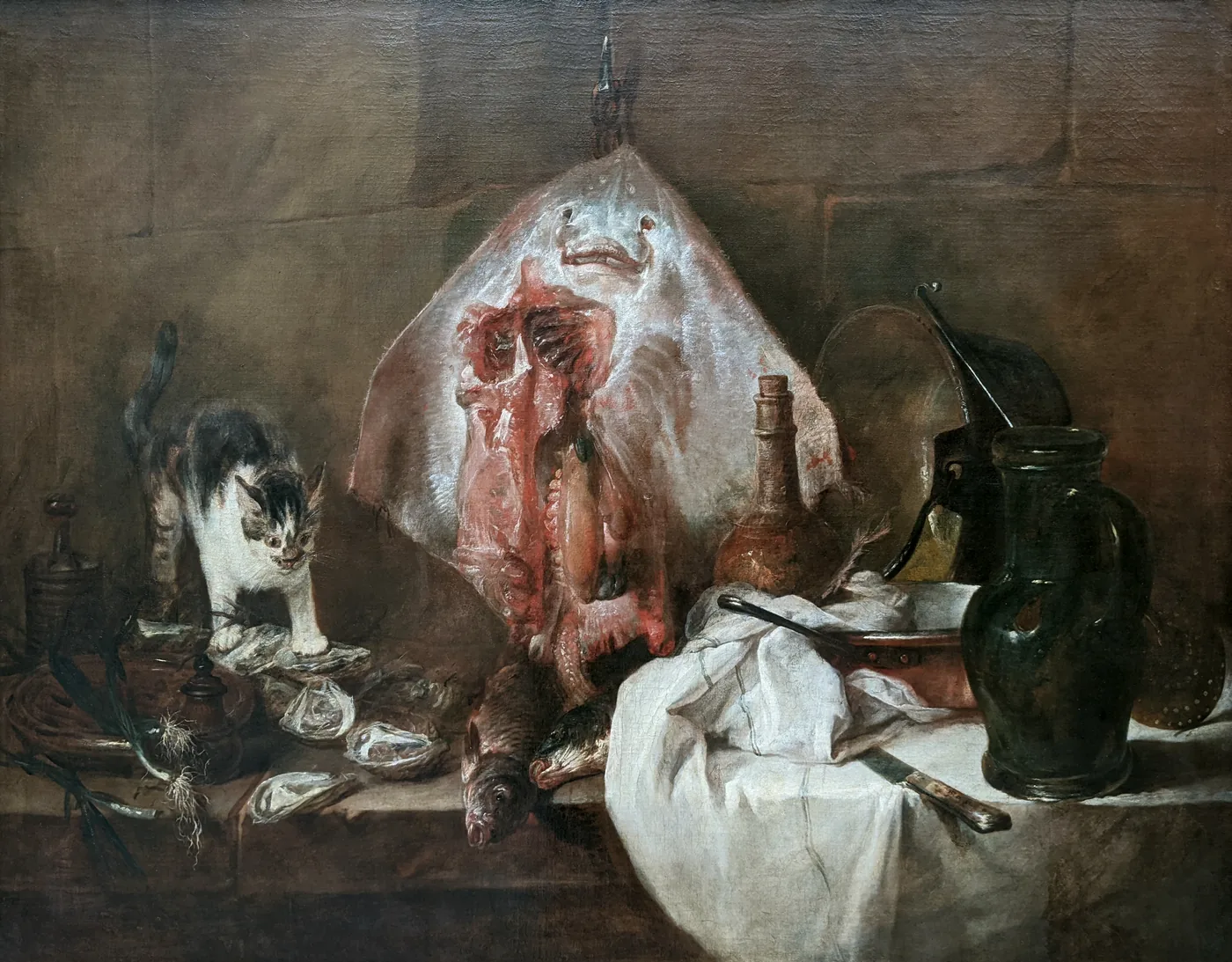

Chardin places a gutted ray at the centre of a broad kitchen scene. Its pale underside hangs above the table, between a tense cat on the left and cookware on the right. This is not an idealised display of flawless delicacies. Wet flesh, rough shells, cloth and metal insist on their differences.
The Louvre records the picture as a reception piece for Chardin’s admission to the Royal Academy in 1728. An everyday subject could therefore carry a serious professional purpose.
Notice how the white cloth at the right answers the ray’s paleness without copying its shape. The central hanging body, the cat’s upright alertness and the dark vessel form competing verticals. Kitchen things have become the structure of an ambitious painting, not merely objects waiting for a cook.
Manet: a different kind of flower painting
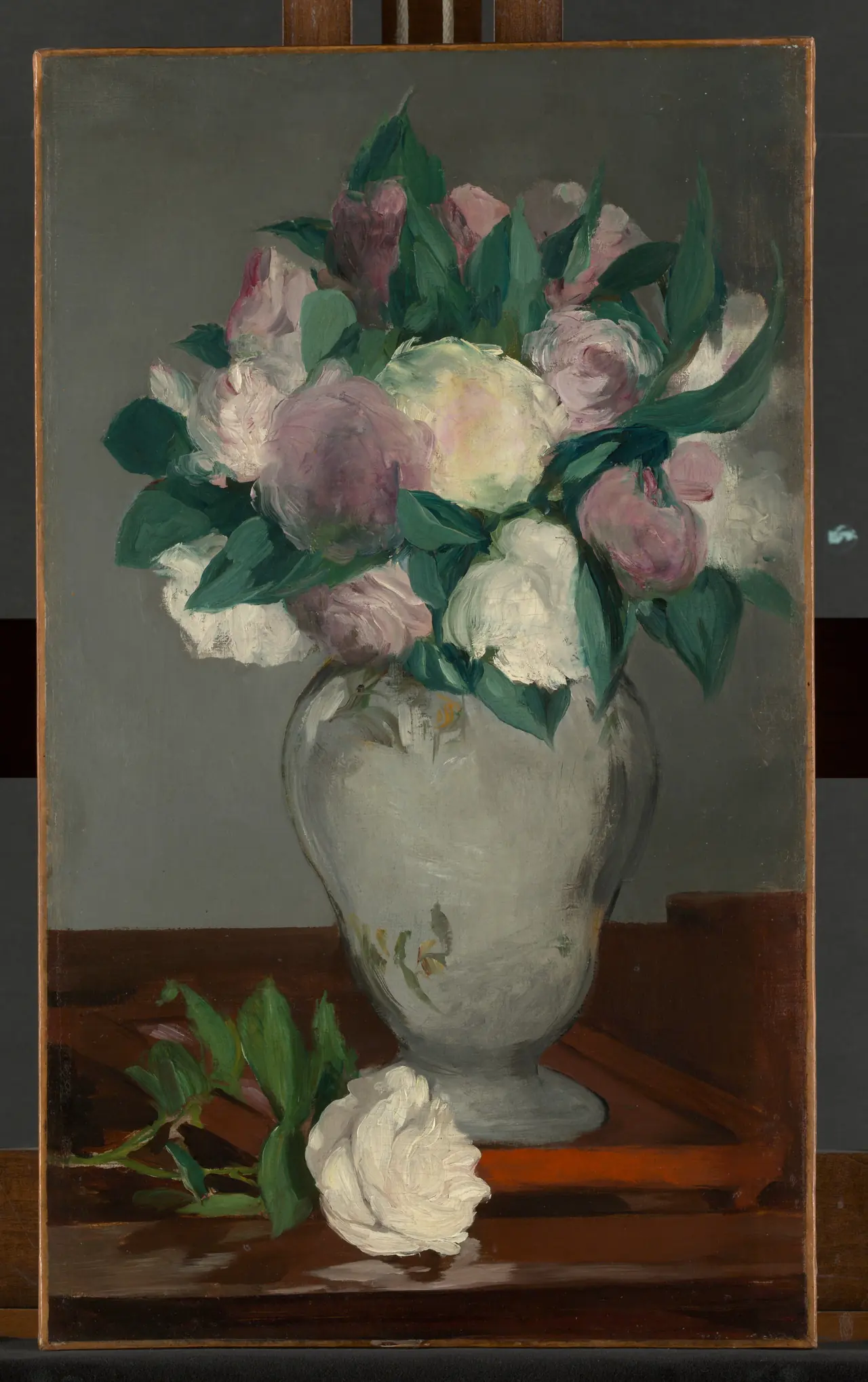
Manet’s petals are much less individually described than Peeters’s. Pale strokes collect into soft flower heads, set against leaves made from broad, dark green shapes. A separate cut stem lies across the table, extending the bouquet’s colours towards the viewer.
The Met identifies this painting with a group of peony pictures from 1864–65 and relates the flowers’ broad forms to Manet’s handling of paint. You can test that connection simply by comparing a leaf edge with a petal: some boundaries are crisp, others merge or break.
This is not a contest in which greater detail automatically means greater observation. Peeters separates many tiny particulars; Manet makes larger touches do several jobs at once. Both approaches require decisions about what the viewer needs to see. For more context, follow our Manet guide.
Van Gogh: yellow without uniformity
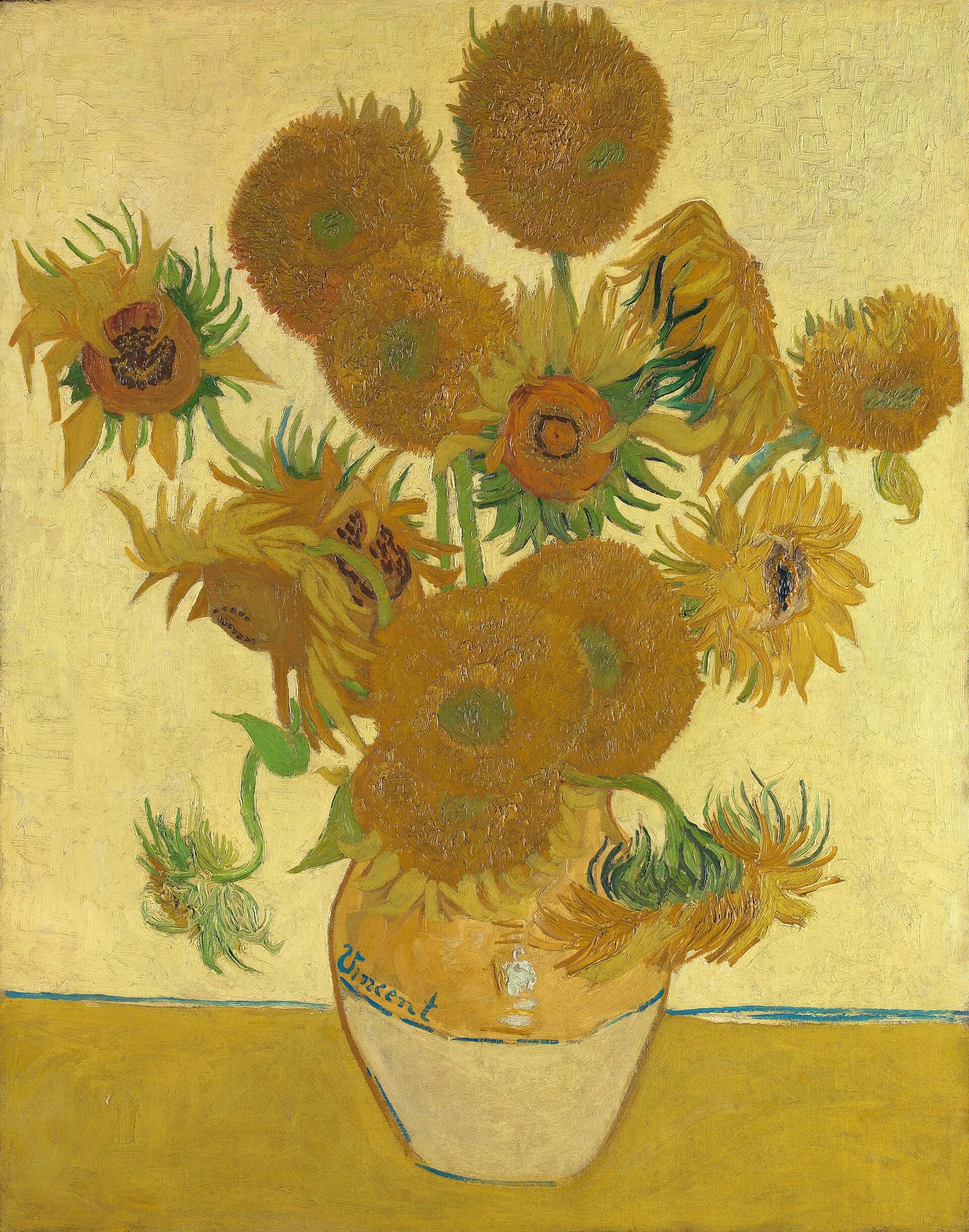

This is the National Gallery’s 1888 canvas, not every painting covered by the name Sunflowers. Its vase, flowers, wall and tabletop share a narrow yellow range, yet they do not collapse into one flat patch.
Seed heads make dense circular centres. Petals reach out in pointed tongues. Green outlines interrupt the yellow, while the vase’s rounded contour gives the arrangement a stable base. Some flowers are fully open; others have lowered their heads. Repeated subject matter still permits considerable variation within one picture.
The National Gallery explains that Van Gogh made sunflower paintings for the Yellow House in Arles. That context enriches the work without reducing every flower to a single symbolic message. Compare it with Manet: both make flowers occasions for visible paint, but their shapes, colour ranges and surface rhythms are markedly different. Continue with our Van Gogh guide for other subjects he explored.
Cézanne: a table built from colour
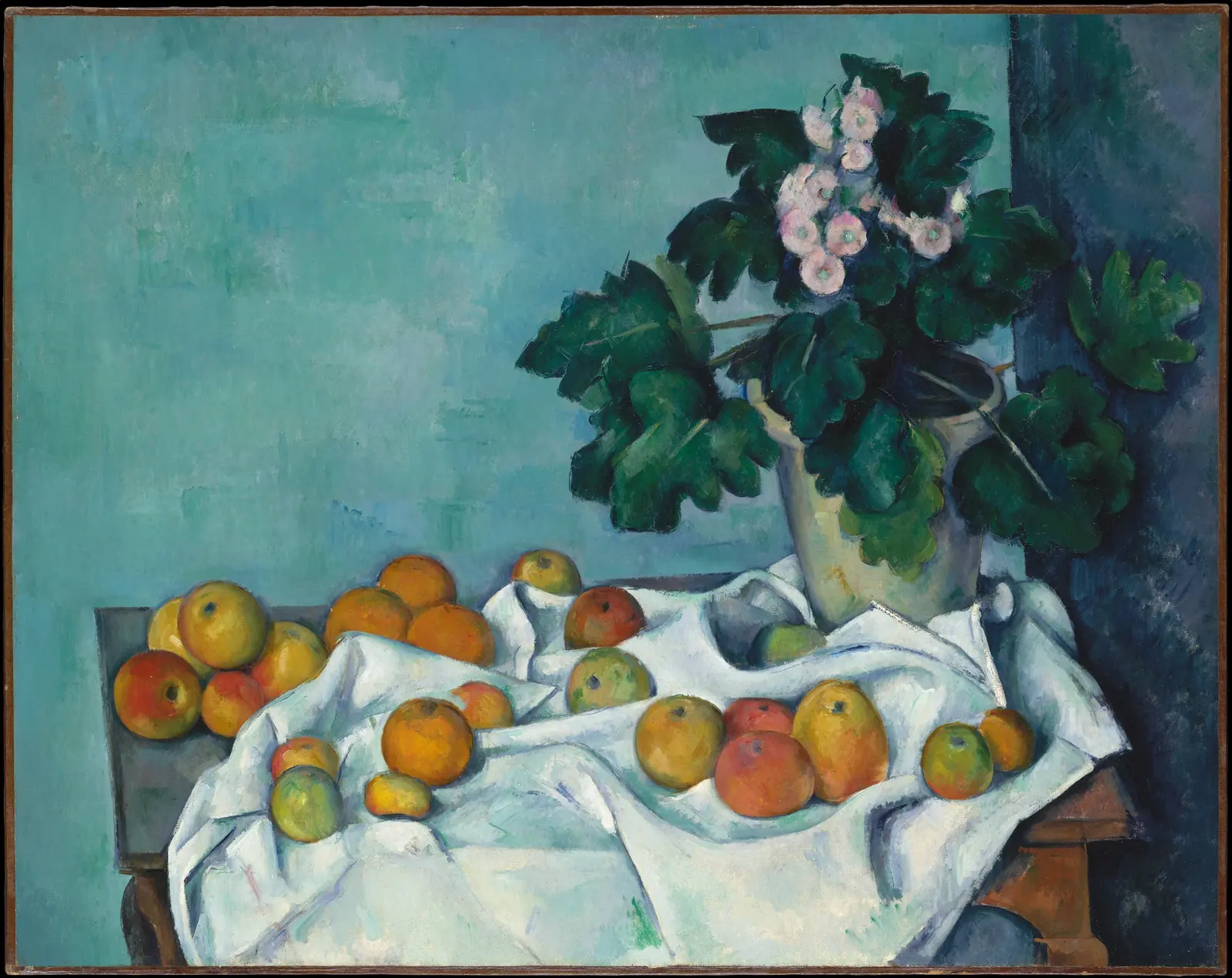
Cézanne spreads apples across a cloth whose folds rise like small ridges. Blue shadows connect those folds to the cool wall. Rounded fruit and angular fabric keep interrupting each other, while the pot and leaves make a heavier mass at the right.
The Met notes that flowering plants were unusual in his still lifes and that this particular painting once belonged to Monet. Here the flowers do not dominate as a spectacular bouquet. Fruit, cloth, furniture, wall and plant all contribute to the arrangement.
There is no need to look for a hidden moral before appreciating that construction. Trace one apple’s edge into a fold, then follow the fold towards another fruit. The objects hold your attention individually, but the painting emerges from their connections. Our Cézanne guide offers further examples of that sustained looking.
Read the relationships, not just the objects
These pictures are not steps in a march from symbolic painting to painting without meaning. Pleasure, skill, mortality and formal experiment overlap. The same flowers can carry evidence of fading and a demonstration of astonishing craft; the same lemon can be food, a colour accent and part of an unsettled table.
On your next encounter with a still life, identify the objects, then temporarily stop naming them. Follow a bright edge, a repeated curve or a patch of darkness. Finally return to the museum’s account of the work. Looking and research make a stronger partnership than a list of universal symbols.
Browse the collection directory to continue by artist or subject. This selection is a route through particular historical paintings, not a claim that every depicted arrangement or museum file is available as a product.
Editorial record
About this article
- Author
- Publisher
- GeMarkt
- Published
- Reviewed
- Internal source & rights check. Conducted by GeMarkt Research Review. This is an internal editorial check—not independent peer review.
- Source standard
- Art history source standardPrioritises object records and research sources, distinguishes evidence from interpretation, and states material uncertainty.
Found a claim that needs checking? Report a factual error.