GeMarkt Blog · Essay
Still Life vs Vanitas
Vanitas is a kind of still life, not its opposite. Compare Cézanne's apples with Pieter Claesz's skull and books to see how objects create meaning.

Vanitas is a kind of still life, not the opposite of still life. A still life makes objects its main subject: fruit, flowers, books, vessels or other things arranged for us to look at. A vanitas still life uses such objects to reflect on passing time, mortality and the limits of worldly possessions or achievement.
A bowl of apples can therefore be a still life without necessarily being a warning about death. A skull can make that warning more obvious, but recognising a vanitas involves the whole arrangement and its context, not spotting one compulsory symbol.
Still life names the subject
In a still life, things that might be background details in another picture take the leading role. Instead of asking who the person is or where the landscape lies, we notice how objects occupy a table, catch light and relate to each other. The National Gallery’s definition gives fruit, flowers and food as typical subjects.
The name does not mean that nothing feels active. A tipped vessel, a precarious stack or a cloth spilling towards the viewer can make an arrangement seem unstable. Nor does it mean that the artist merely copied whatever happened to be on a table. Choosing the objects, their positions and the viewpoint is part of making the picture.
That gives still life considerable range. One painting may invite you to admire a glass surface; another may make ordinary apples seem weighty and strange. Looking closely at familiar things can be a purpose in itself, without a hidden message that must be decoded before the painting becomes worthwhile.
Vanitas adds a question about time
The word vanitas comes from the Latin for vanity or emptiness. Here, vanity is broader than being pleased with your appearance. It concerns the possibility that things people strive for—wealth, status, pleasure or learning—cannot secure them against death. The National Gallery’s vanitas glossary connects the subject with Ecclesiastes and the temporary nature of human life.
In a vanitas, an object may do two jobs. A beautifully painted book is something to admire, but placed beneath a skull it also becomes part of a question: what lasts of a person’s learning? A lamp can demonstrate how convincingly an artist paints metal while its dying wick suggests that time is running out.
The tension matters. These pictures can be visually attractive while asking viewers to reconsider what attracts them. Their pleasure and warning need not cancel each other.
Compare Cézanne and Claesz
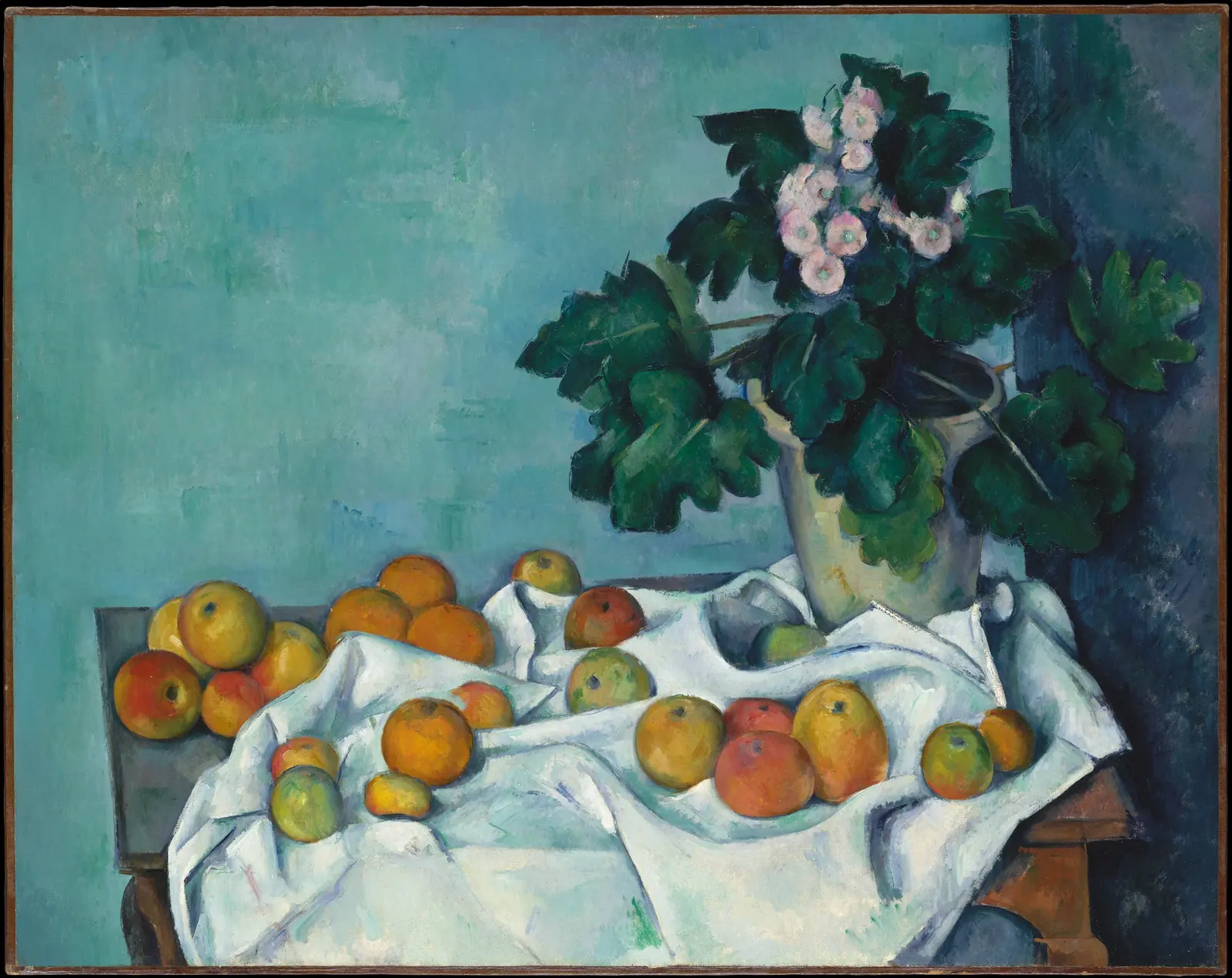
Both paintings bring us close to a group of objects. In Cézanne’s Still Life with Apples and a Pot of Primroses, red and yellow fruit stand against a blue-green wall. The white cloth makes a series of ridges and pockets between the apples. The potted plant rises above them, balancing the spread of fruit across the lower part of the picture.
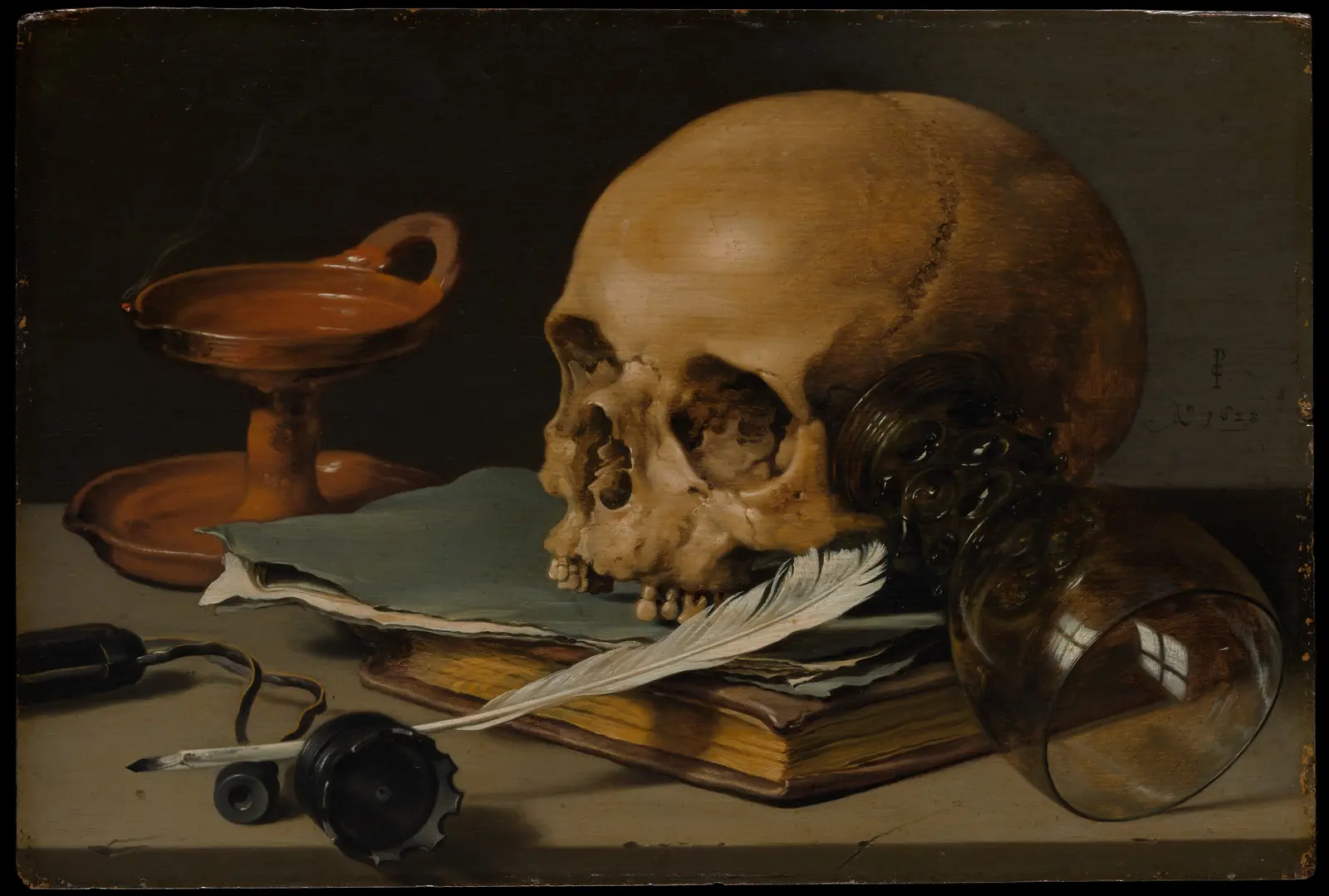
Claesz offers a different encounter. The skull dominates, supported by books and papers. At the left, a thin line of smoke rises from the lamp; at the right, a glass lies on its side. The Met interprets these objects as signs of life’s brevity. It is their combination that makes the mortality reading especially direct.
Cézanne’s apples will also perish in the real world. That fact alone is not a reason to give every fruit painting the same vanitas label. In the comparison here, start with the colour, shape and arrangement Cézanne puts before you, rather than importing Claesz’s message unchanged.
How the objects work together
Try following the brightest shapes in Claesz. The curved forehead of the skull catches your eye, but the long white feather carries it down towards the front of the table. The quill also links the arrangement to writing. Knowledge and bodily death share the same small space.
Then look at the glass. It lies close enough to the edge to feel unsettled, while the skull sits heavily above the books. The contrast between something that seems easily displaced and something solid makes the arrangement more than a list of symbols. Its position helps the object contribute to the picture’s mood.
In Cézanne, follow the cloth instead. A fold can separate two apples, then lead towards another. Rounded fruit and angular folds keep interrupting one another. You can enjoy that movement without deciding that every apple stands for the same idea. These are ways of looking at the visible arrangements, not claims to have recovered every thought their painters had.
Why a symbol dictionary is not enough
It is tempting to treat a still life as a code: book equals knowledge, skull equals death, flower equals beauty. Such associations can be useful starting points. They become unreliable when treated as fixed translations that apply to every picture.
The National Gallery of Art’s scholarly discussion of a vanitas by François van Daellen shows why. Books could suggest meaningful learning and lasting achievement, but also empty display. Their condition, surrounding objects and inscriptions help guide the reading. The same kind of object could support different arguments.
A better question is “What makes this interpretation convincing here?” An inscription may make the message explicit. A combination of skull, extinguished light and timepiece may reinforce it. A museum’s account can explain historical associations that are no longer familiar. None of those requires you to pretend that your first impression was a secret message waiting to be solved.
A simple way to look at still life
First, identify what is actually shown. Distinguish an oil lamp from a candle, or a writing quill from a loose feather. Next, notice what the painter emphasises through light, size and placement. Only then ask how those choices might connect to an idea.
With a proposed vanitas reading, look for several supporting details and check the museum’s explanation. With another still life, leave room for colour, texture, balance and visual surprise to be the main interest. A still life tells you what kind of subject you are looking at; vanitas tells you something more about what the arrangement asks you to consider.
Editorial record
About this article
- Author
- Publisher
- GeMarkt
- Published
- Reviewed
- Internal source & rights check. Conducted by GeMarkt Research Review. This is an internal editorial check—not independent peer review.
- Source standard
- Art history source standardPrioritises object records and research sources, distinguishes evidence from interpretation, and states material uncertainty.
Found a claim that needs checking? Report a factual error.