GeMarkt Blog · Reference
Restored, Colourised and AI-Upscaled Files: Who Owns Them?
Does cleaning, colourising or enlarging an old artwork create new copyright? Separate the original, human changes, AI output and the exact file's terms.

A restored or enlarged file does not automatically become a newly copyrighted artwork. But a creative adaptation can contain protected additions, and the download may carry terms of its own. “Restored,” “colourised” and “AI-upscaled” describe processes, not legal conclusions.
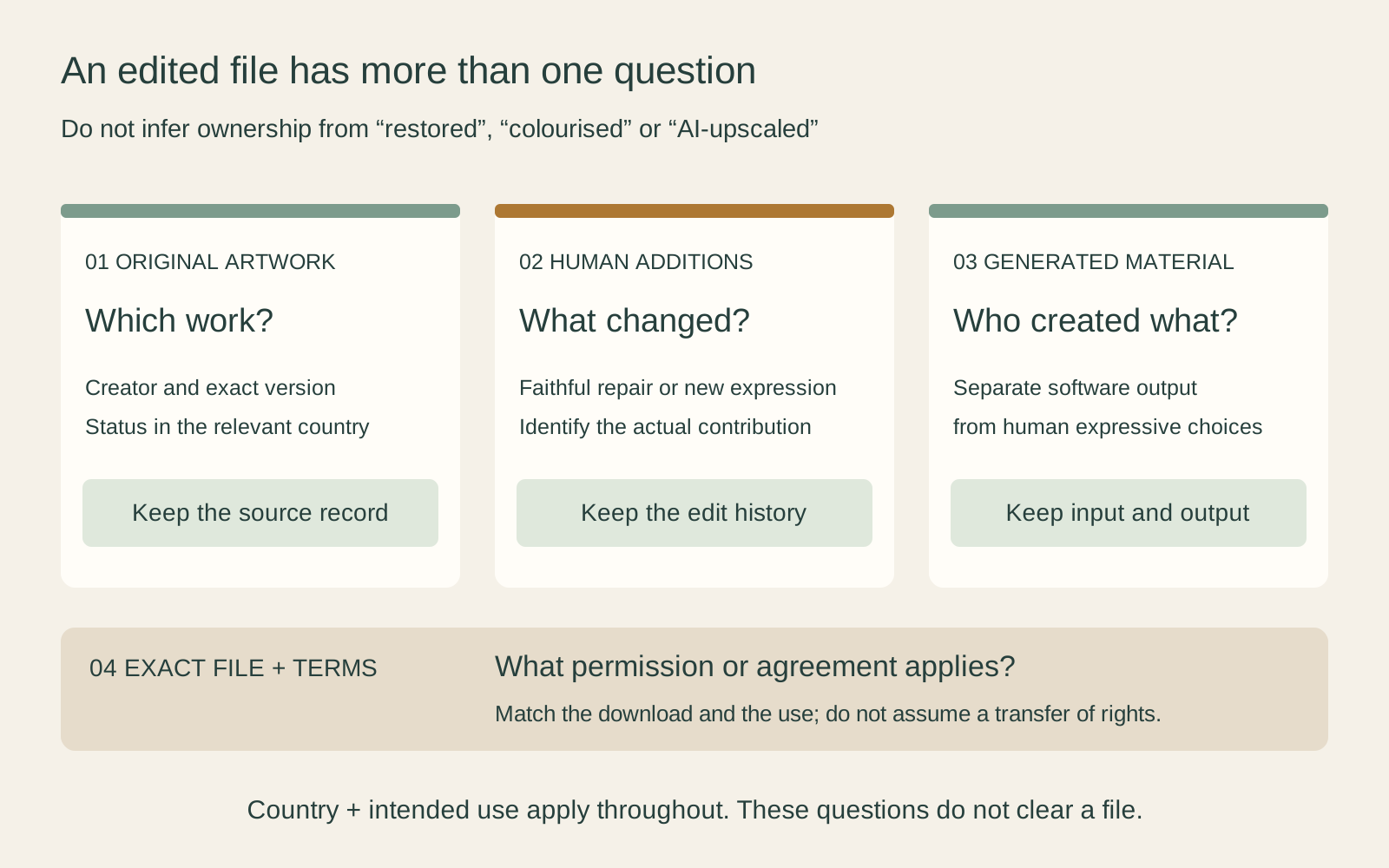
Imagine finding three versions of an old print: a museum scan, a cleaned version sold by a studio and a brightly recoloured version on a sharing site. The studio’s work may be useful. The recolouring may be inventive. Neither fact tells you, on its own, which file you may reproduce or who can license which parts.
The useful question is not simply who owns the JPEG. It is what material you want to use, where you will use it, and what rights or obligations attach to that material. This is general research guidance, not individual legal advice.
Begin with the original and the exact file
Identify the artwork before assessing the edit. Record its creator, title and version, then the territory in which its status matters. A public-domain conclusion in one country should not silently become a worldwide claim. Also distinguish the original artwork from a photograph of it; a creative photograph can raise a separate copyright question.
For the United States, 17 USC §103(b) limits copyright in a derivative work to the author’s contribution, rather than the pre-existing material. A qualifying new adaptation does not give its maker exclusive ownership of the old composition or extend the underlying work’s copyright term.
That distinction leaves room for two different routes. You might obtain permission to use a particular creative adaptation. Or you might return to an independently documented public-domain source and make your own version. Those are not the same as copying somebody else’s added expression because the underlying painting is old.
When cleaning is not new authorship
The US Copyright Office’s Compendium, chapter 300, excludes mere copies from registration. Its examples also include touching up an aged or damaged photograph to restore its original condition without adding an appreciable amount of authorship. Skill, patience and a better-looking result are not substitutes for original expression.
For a cleaned file, ask what changed. Removing a scanner’s dust spots is a different task from inventing missing figures or painting a new background. A seller’s single word “restored” can conceal either process, or a mixture. It is not enough evidence to settle the result.
Do not turn this into the opposite blanket rule, that every file called a restoration must be free to copy. You still need to identify its source, any creative photograph beneath the edit and the actual changes. When that history is unclear, ask for a description or choose a better-documented file.
Colourisation can involve new creative choices
The Copyright Office’s visual-art guidance, section 906.3, distinguishes a mere change of a few colours from sufficiently creative colour work. Its examples allow for protection where an editor contributes an original combination of colours, shades and tones. “It has colour now” is therefore neither an automatic yes nor an automatic no.
For example, putting a uniform blue tint over an engraving and inventing a carefully articulated new colour scheme are different proposals. The relevant assessment concerns the actual expressive contribution, not how many minutes the software ran or whether the result is attractive. Even a protectable treatment would not turn the engraving beneath it into the editor’s exclusive property.
Keep historical accuracy separate too. A modern colour choice is not evidence that the artist used that colour. When presenting an adaptation, describe the change instead of labelling it a recovered original appearance. This helps readers understand what they are looking at without requiring them to inspect a source file.
What AI upscaling does not prove
The US Copyright Office’s 2025 report on AI and copyrightability maintains the human-authorship requirement. Purely generated material is not protected; using AI as an assistive tool does not disqualify an otherwise human-authored work. Sufficiently creative human modifications or arrangement may be protected, with the contribution assessed case by case. Prompts alone, using the technology considered in the report, do not provide sufficient expressive control.
An “AI-upscaled” label does not establish which of those situations applies. Nor does an output’s larger pixel count establish new human authorship. Ask what the person actually created rather than treating the software name as the answer.
Keep the input and output together when assessing fidelity. If the enlarged image contains a stroke, letter or facial detail absent from the input, do not cite that new feature as historical evidence. For practical reproduction decisions, our resolution guide explains why file dimensions and useful detail are different considerations.
Keep the country in the answer
The American guidance above is not a worldwide rule for AI output or edited images. In the UK, the Intellectual Property Office’s digital-image notice considers a merely retouched, faithful digitisation unlikely to satisfy originality where there is little scope for free and creative choice. It also acknowledges uncertainty around digitised older images.
That notice is not a ruling about your selected file and should not be used as a complete UK answer about generative AI. If a commercial project depends on exclusive ownership of an altered image, obtain advice for the relevant country and the actual production process. A supplier’s broad “worldwide copyright” statement is a claim to investigate, not a substitute for that assessment.
Who can license the new contribution
Even when an adaptation qualifies for copyright, check who holds that right. In the US, 17 USC §§201–202 distinguishes initial authorship, works made for hire, transfers and ownership of a copy. The person who sells or delivers a file is not necessarily its author or current copyright owner.
If you commission an edit, agree what you receive: a limited permission, a broader licence or a transfer of specified rights. Ask who can authorise that agreement. A payment receipt or possession of the editable file should not be treated as proof that every right has transferred to you.
Read the download terms separately
Check what the source is offering: a copy to view, a reproduction licence, an editable file, or a transfer of rights. These are not interchangeable purchases. The UK notice also explains that image suppliers can impose contractual conditions on the files they supply, including out-of-copyright images. Whether particular terms bind you is a separate question from whether the underlying art is protected.
An explicit CC0 dedication is useful evidence about rights the person applying it can waive. It does not erase another person’s rights or guarantee every possible use. For the differences between labels, see CC0, Public Domain Mark and museum licences.
If two notices conflict, ask a specific question: “Does this permission cover the edited file I am downloading and the use I have described?” Do not remove a watermark or discard a credit to make an unresolved file look cleared.
A practical record for an edited file
Keep the unedited source, its record and the edited output in separate files. Add a short note identifying the changes, the people or tools involved, the applicable permission and the countries assessed. Retain any correspondence clarifying the scope. That record is much easier to reconstruct now than after files have been renamed and passed between collaborators.
For a hypothetical colourised botanical plate, the note might identify the historical plate, link the original scan, name the modern colour treatment and specify the permission for that treatment. It should not silently present the modern colours as the illustrator’s own. For an enlargement, record the original dimensions as well as the output dimensions.
When the available evidence does not support the proposed use, select another source or obtain permission. Paying for a polished file can be worthwhile, but the price does not answer the rights question. Neither does the fact that another copy is downloadable for free.
Editorial record
About this article
- Author
- Publisher
- GeMarkt
- Published
- Reviewed
- Internal source & rights check. Conducted by GeMarkt Research Review. This is an internal editorial check—not independent peer review.
- Source standard
- Rights guide source standardSeparates the underlying work from the source file, records the review date, and links the evidence used for the conclusion.
Found a claim that needs checking? Report a factual error.