GeMarkt Blog · Reference
Does a Photo of a Painting Have Its Own Copyright?
A faithful copy and a creative photograph are different questions. Understand the US, EU and UK rules, then check the exact art image you want to use.

Sometimes. A creative photograph can have its own copyright, even when the painting it shows is public domain. A faithful reproduction intended only to copy the painting raises a different originality question. The country, the particular image and the way you obtained it all matter.
That distinction is useful when two websites show the same old painting but give different reuse instructions. One might offer a straight collection scan; another might show a photographer’s view of the painting inside a gallery. Their subject is the same. Their photographs are not.
This is a general guide to separating those questions, not a legal opinion clearing your planned use. If a disputed file is central to a commercial project, get advice for the relevant country or choose a clearly licensed alternative.
Start with the photograph, not just the painting
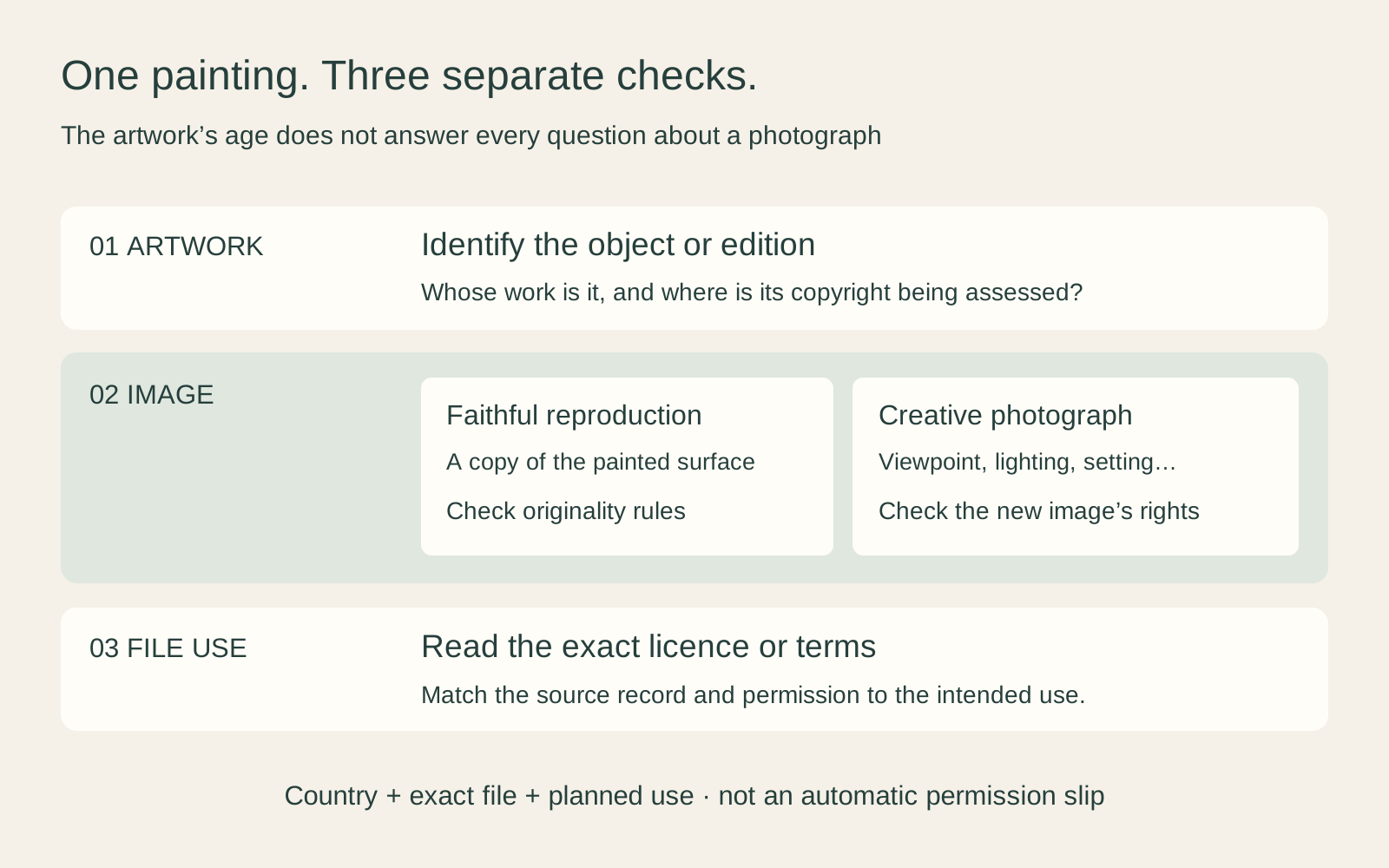
Look at what fills the image. Is it a flat, straight-on copy of the painted surface? Or does it include a deliberately chosen viewpoint, gallery lighting, people, reflections or a staged arrangement? Those differences tell you what to investigate; they are not an automatic copyright test.
The US Copyright Office’s guidance for photographers explains that original photographs can be protected from creation. It identifies choices such as angle, subject positioning, lighting and timing as possible sources of photographic creativity. Registration is not what first brings that protection into existence.
Keep three records separate. First, identify the underlying artwork. Second, identify the photograph or scan, including its maker and source where known. Third, record the licence or access terms relevant to that file. “The painter died centuries ago” answers none of the last two questions by itself.
What the US distinction means
The Copyright Office’s Compendium, section 313.4(A), distinguishes original authorship from mere copying. An exact photographic reproduction of a public-domain painting does not acquire copyright just because making it required care, equipment or expense. The Office cites the federal district-court decision in Bridgeman Art Library v. Corel in that discussion.
This is not a claim that every photograph of old art is unprotected, or that one American decision governs the world. The issue is whether the image contains protectable original authorship, rather than simply reproducing an existing work. A scan does not become an original creative work merely because its resolution is high.
Section 313.4(B) also distinguishes mere touch-ups from original contributions. Correcting damage or restoring detail is not automatically new authorship. Do not turn that into a promise about every heavily altered image: an inventive collage or newly painted reconstruction is a different proposition.
For a practical file choice, distinguish “a faithful reproduction with a documented source” from “something found online that looks like a reproduction.” The second description leaves the file’s origin unanswered. Missing provenance is not proof of freedom.
What the EU rule covers
Article 14 of Directive (EU) 2019/790 addresses reproductions of visual art after the artwork’s protection has expired. Member States must ensure that the resulting material is not protected by copyright or related rights unless it is itself original in the sense of the author’s own intellectual creation.
The two limits are important: the artwork’s term must have expired, and an original new image is not excluded from protection. This is not a rule that every museum photograph, visitor snapshot or contemporary artwork is free to use.
For a particular project, check the applicable national implementation and any separate obligations. A copyright rule about reproductions does not, by itself, answer questions about a photography agreement, access to a building or a different legal basis claimed for use of cultural property. Nor should an EU rule be silently applied to a market outside the EU.
Why the UK needs its own check
The UK Intellectual Property Office’s notice on digital images says simply making a copy does not create new copyright. It considers it unlikely that a merely retouched, digitised image of an older work will meet the originality requirement where the maker has little scope for free and creative choices.
That is useful official guidance, not a binding judgment about your chosen file. The notice also acknowledges uncertainty around older images. Read the British question on its own terms instead of treating “Europe” as a single answer or assuming the EU directive is the UK rule.
If you cannot establish what the image maker contributed, say so in your research notes. An unresolved question is a reason to investigate or select a clearer source, not a reason to describe the entire artist’s work as forbidden.
Where museum terms fit
A rights notice and a copyright conclusion are related but not identical. A notice may describe the artwork, a photographer’s rights, the museum’s licensing service or conditions attached to obtaining a file. Work out which one you are reading before accepting or challenging it.
Some institutions make this easier through an explicit open-access policy. The Met’s Open Access information identifies qualifying public-domain artwork images available under CC0. That is a useful route to a documented file, not a statement that every item on the museum’s website has the same status.
Our guide to CC0, Public Domain Mark and museum licences explains the different labels. When the record contains conflicting statements, ask the source to clarify the specific download. Do not assume that a broad website footer overrides a clear item-level statement, or that an item title silently waives every website condition.
Three everyday examples
Imagine a collection page supplies a straight-on painting image, identifies the work and expressly attaches an open-use statement to the download. Save that record with the file. The evidence is more useful than a search-result thumbnail because you can connect the permission to an identifiable source.
Now imagine a travel photographer shows the same painting at the end of a dim corridor, with visitors silhouetted in front. Do not substitute the old painting’s public-domain status for permission to use that photograph. The image includes a new composition beyond the painted surface.
Finally, imagine a shop advertises a framed print in a furnished room. Copying its photograph is not the same as finding a reusable reproduction of the artwork. It includes a product presentation. If you need an artwork file, go back to a documented collection source rather than extracting it from another seller’s image.
Make a file-specific decision
Before publishing, write a short note that another person could follow: the artwork’s identity, the relevant country, the exact image source, the evidence for reuse and the intended use. Keep a dated copy of the rights statement and a link to its terms. If you alter the image, record what changed and any required credit.
Use our source-file checking guide when working through a Commons record; the repository’s name alone is not a licence. For the caption itself, see how to credit a public-domain artwork.
The useful conclusion is specific: this file, from this source, under these conditions, for this use. It is much stronger than either “old art has no rules” or “all photos are copyrighted.”
Editorial record
About this article
- Author
- Publisher
- GeMarkt
- Published
- Reviewed
- Internal source & rights check. Conducted by GeMarkt Research Review. This is an internal editorial check—not independent peer review.
- Source standard
- Rights guide source standardSeparates the underlying work from the source file, records the review date, and links the evidence used for the conclusion.
Found a claim that needs checking? Report a factual error.