GeMarkt Blog · Practical guide
Red Flags on Free Public Domain Image Sites
Learn when a free art download needs a closer look: missing sources, mismatched licences, altered scans and claims that do not describe the actual file.

Pause when a free art image has no traceable source, its licence contradicts the original record, or the downloaded picture is not the one described. None of those signs automatically proves wrongdoing. They mean you need a better answer before putting the image on a website, product or printed handout.
A beautifully organised download site can be a useful starting point. It can also separate a picture from the information that made it reusable. The aim is not to avoid every small website or assume that every museum image is unrestricted. It is to connect a particular file to a particular permission or public-domain finding.
A free download is not a complete answer
“Free” might describe the price, the ability to view the picture, or permission for a limited use. Those are different things. The Library of Congress explains that making material available online does not, by itself, mean visitors can freely reuse it elsewhere.
Write down what you want to do first. A private reference folder, an illustrated article and a print sold to customers are different uses. If the page never explains which uses its promise covers, keep looking.
A download button is therefore a delivery tool, not the conclusion of a rights check. The same applies to a large pixel count, an elegant museum logo or a search-engine filter. None tells you which person or institution supplied this exact image.
Follow the picture back to an item
A useful source link reaches an individual catalogue or file record. A link to a museum’s home page is not enough to identify a painting, print impression or photograph. Look for the artist, title, date, object number and the institution or collection holding the object.
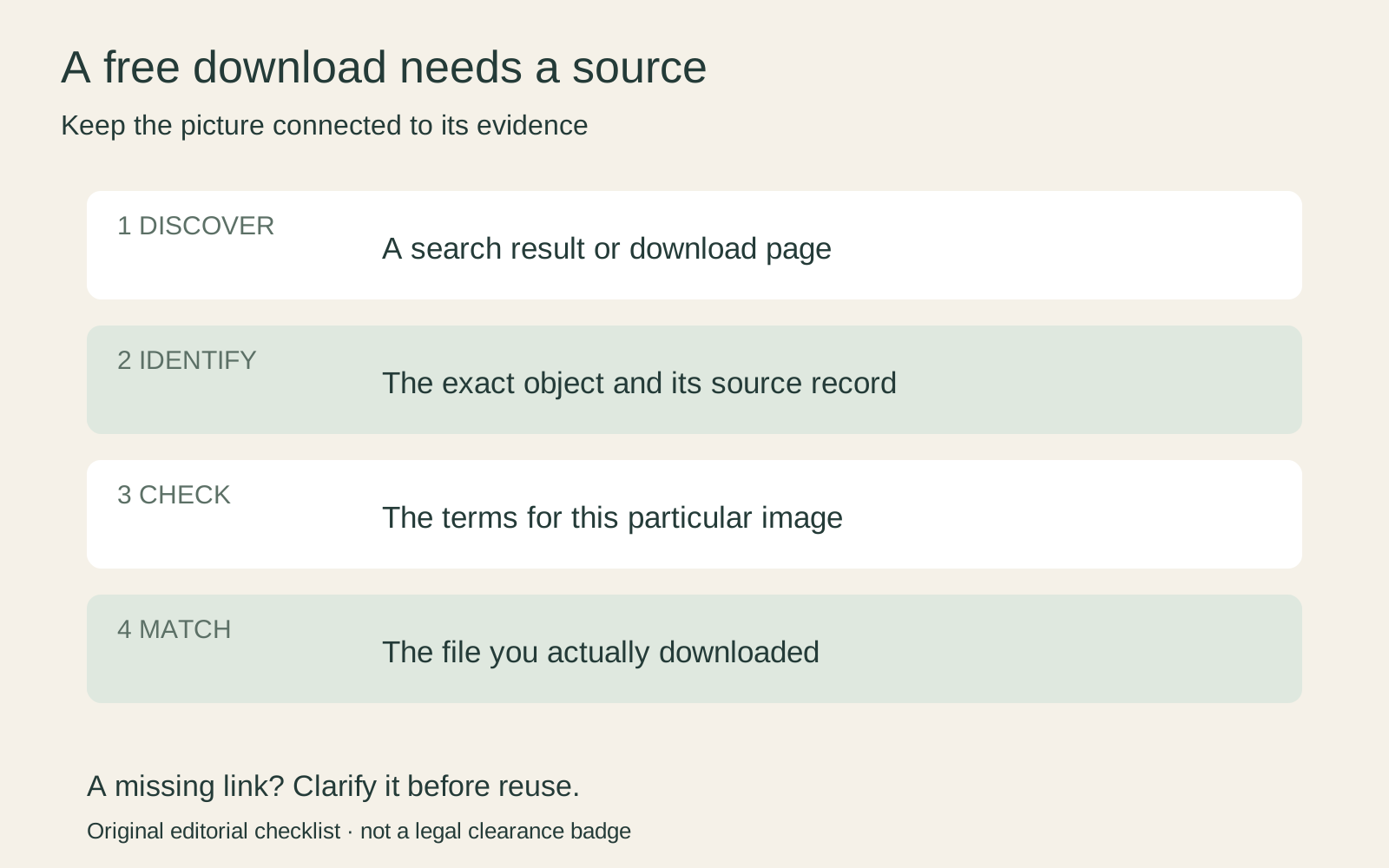
Try this small test: could another person find the same item using the information you have saved? If all you have is “vintage botanical art” and a filename, the answer is probably no. Search distinctive lettering, a plate number or the credited illustrator. A reverse-image search can suggest leads, but follow those leads to their records.
Wikimedia Commons can help connect copies with sources, but its own general disclaimer warns that information is not guaranteed. Treat a repost as a research lead until its relevant claims connect to evidence. Our Commons file guide shows what to examine on that page.
Read the label that applies to the file
Check whether the rights statement describes the photograph, the historical artwork, the catalogue text or the whole collection. A page can contain more than one kind of material. Permission to copy descriptive data does not necessarily cover every image beside it.
Two commonly confused labels illustrate the problem. CC0 is a tool for giving up rights to the extent the law allows; it cannot waive rights the person applying it does not hold. The Public Domain Mark identifies a work considered free of known copyright restrictions. It is not a fresh permission from a copyright owner.
A Creative Commons licence with NC means something else again. CC BY-NC 4.0 permits specified reuse under conditions including attribution and a noncommercial restriction. It is not an unrestricted commercial-use licence, and “Creative Commons” alone does not identify the conditions.
If a download site says “public domain” but its source says “noncommercial use only”, do not silently choose whichever statement suits you. Check whether they concern the same file and whether a separate permission explains the difference. For more detail, see CC0, Public Domain Mark and museum licences.
Compare the picture with the record
Open both images at a comfortable size. Compare the edges, orientation, lettering and important details. Is one a different edition? Has a signature vanished? Are dark areas filled with invented-looking detail? A mismatch is worth understanding even when both files are legitimately reusable.
An old illustration and a new photograph of a framed illustration are also different images. The photograph might include lighting, perspective, surroundings and a photographer’s creative choices. Do not transfer the rights label of a flat scan to that separate photograph without checking.
Modern editing needs a clear description. A colourised version should not quietly stand in for an originally monochrome print. An enlarged file should not be presented as a new high-resolution scan if it merely stretches the same pixels. Whether a particular alteration attracts copyright is a separate, fact-dependent question; for an art reproduction, accuracy matters even where copyright is not the obstacle.
Do not confuse payment with permission
A fee is not, on its own, a warning sign. A provider may charge for preparing a file, making a new photograph, supplying a print or administering a permitted use. Equally, paying for a download does not answer every rights question.
The BnF’s reproduction guidance is a useful example of why the details matter: it distinguishes reproduction services and commercial reuse, including conditions affecting reproductions of public-domain documents. Do not assume that every archive follows the same policy.
Ask what the charge includes and what the written terms allow. If someone offers “exclusive ownership” of a familiar old painting, ask them to identify exactly what is exclusive: a new design, a particular photograph, a service, or something else. Keep the answer with the file. Avoid treating a sales slogan as a substitute for defined terms.
Check the country and the proposed use
“No known copyright restrictions” is a scoped finding, not a promise covering every legal issue in every country. Even the Public Domain Mark’s deed notes possible differences between jurisdictions and other rights.
Names, logos, living people’s likenesses and suggestions of endorsement can raise questions beyond an artwork’s copyright. A museum credit should identify a source, not imply that the museum recommends your product. When those issues matter to a substantial commercial project, get advice about that use rather than collecting more generic “free image” badges.
You need not add a page of legal language to every caption. You do need to know which conclusion supports the particular use. See our guide to the US publication rule if a site treats a painting’s creation date as its publication date.
Decide what to do next
Use three practical outcomes. Continue when the object, exact file and applicable terms match your use. Clarify when a missing or contradictory detail could change that answer. Choose another file when a suitable, better-documented source is available.
For example, if a repost lacks a licence link but points to a clearly identified institutional download, obtain the file from that source and keep its record. If the institution supplies a different photograph, reassess that photograph rather than carrying over the repost’s claim.
Save the item URL, download source, relevant terms, access date and a short note about changes you made. That modest record is more useful than a folder called “copyright free”. It lets you return to the right evidence when a question arises.
Editorial record
About this article
- Author
- Publisher
- GeMarkt
- Published
- Reviewed
- Internal source & rights check. Conducted by GeMarkt Research Review. This is an internal editorial check—not independent peer review.
- Source standard
- Rights guide source standardSeparates the underlying work from the source file, records the review date, and links the evidence used for the conclusion.
Found a claim that needs checking? Report a factual error.