GeMarkt Blog · Practical guide
Library and Archive Sources for Botanicals, Maps and Prints
Find botanical plates, maps and historical prints in library collections, then check the edition, image quality and reuse terms before choosing a file.

Start with a book collection for a botanical plate, a map collection for a historical place, and a print catalogue for a particular edition. Libraries often preserve the surrounding pages that an image search leaves out. Those pages can tell you who drew, engraved or published a picture—and which version you are looking at.
The best source is not necessarily the one with the biggest download button. It is the one that lets you identify the object, understand the applicable terms and obtain a usable image. The collections below are starting points for that process, not blanket permission to reproduce everything they hold.
Choose the source for the object
A botanical picture may be a drawing, a hand-coloured engraving from a book, or a later reproduction. A map may be one sheet in an atlas rather than a complete wall map. A print’s engraver and publisher may be different people from the artist whose painting it follows.
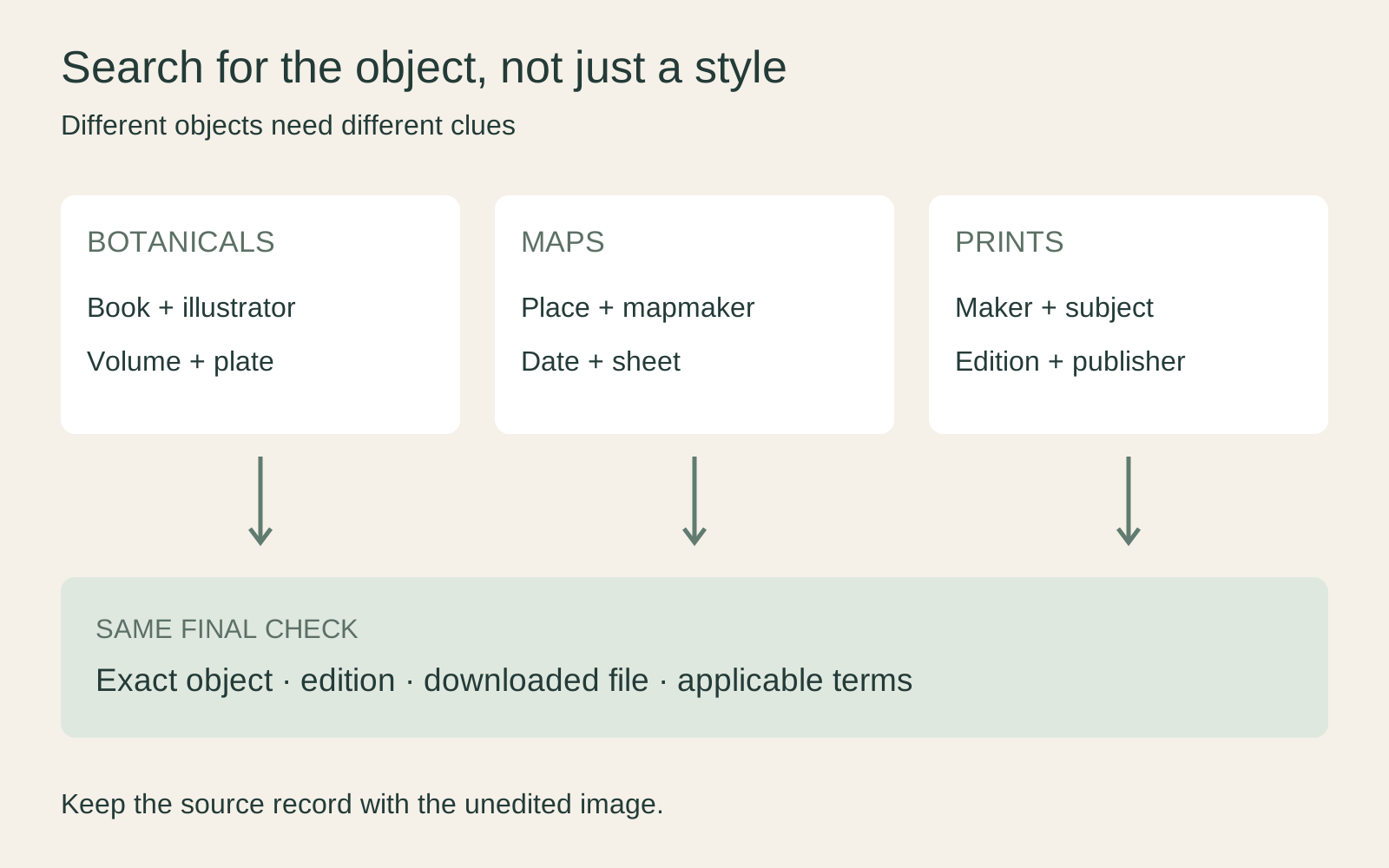
Build your first search from two useful facts, not a string of decorative adjectives. Try an illustrator plus a book title, a city plus a date range, or a printmaker plus a named subject. If the result is sparse, broaden one part at a time.
Once you find something promising, inspect the title page and neighbouring plates where available. Do not assume that the year printed elsewhere in a bound volume dates every illustration in it.
Botanicals and natural history in BHL
The Biodiversity Heritage Library is a natural starting point for digitised books about plants and animals. Search by the author, title or scientific name, then inspect the particular volume. The same title can exist in more than one edition or library copy.
BHL’s copyright and reuse guidance directs readers to each volume’s copyright information and holding institution. It includes both public-domain works and copyrighted material made accessible under permission. Some of that latter material carries a noncommercial licence; online access is not a commercial-use clearance.
For a decorative botanical print, note the book, volume, plate number and credited illustrator or engraver. Preserve the surrounding caption in your research copy even if the finished design uses only the image. A modern common plant name alone may not lead back to the historical plate.
BHL does not claim new copyright over its digitisation of public-domain works, but its guidance also asks users to consider the law where they will reuse the material. Follow the exact volume record rather than assigning one status to the entire collection.
Maps at the Library of Congress
For maps, begin with the Library of Congress Geography and Map collections. Place names, publication dates and named mapmakers are useful search terms. Compare the territory shown with what the catalogue says: a map’s publication date and the period it depicts need not be the same.
The General Maps rights statement permits reuse of the division’s digitised collections unless a Rights Advisory says otherwise. Read that advisory on the item you choose; do not stop at the collection-level statement.
The Library’s general copyright guidance explains where to find Rights and Access information. The presence of an object in the catalogue is not itself permission for a new use.
Check whether the image includes the whole sheet. A missing legend, scale or second panel might turn a beautiful map into an incomplete reproduction. Fold lines and faded areas can be features of the physical copy; record any cleanup you make instead of presenting a reconstructed version as an untouched scan.
Prints and illustrations at NYPL
NYPL Digital Collections offers books, maps, photographs and prints. Its public-domain collection page describes reuse and the available high-resolution downloads for designated material.
Use the public-domain search option, then open the individual item. NYPL’s collection guidance describes that designation in terms of no known US copyright restrictions. Other items may have different or unresolved rights. Do not turn a filtered result into a worldwide legal guarantee.
For a print, keep the maker and publisher fields alongside the title. A later print after a painting can have a different production date and different credited contributors. Looking at the entire sheet, including its printed lettering, often makes the distinction easier to understand.
A public-domain catalogue description and a downloadable image are separate pieces of a useful record. Save both, rather than relying on a screenshot of the search results.
Smithsonian records and open images
The Smithsonian Open Access programme is another useful route into collection records and images. Its FAQ tells users to look for the CC0 designation on the asset. Not every Smithsonian image is part of that programme.
A catalogue number helps distinguish one object from another; an image credit may identify the photographer or the person who supplied the object. Neither field should be silently turned into the historical artist’s name.
For a library plate or natural-history illustration, compare the image with the record’s description before using it. A related exhibition photograph is not automatically the same open asset. The programme’s CC0 permission is useful because it is attached to identified material, not because it clears every result containing the institution’s name.
Gallica and the BnF
Gallica is the digital library associated with the Bibliothèque nationale de France and its partners. It can be valuable for French books, prints and historical documents. Search the publication title and named contributors, then inspect the edition and the institution supplying the item.
The BnF’s reproduction policy distinguishes noncommercial and qualifying academic uses from commercial reuse. It describes authorisation and fees for commercial uses, including reproductions of public-domain documents. Those conditions are separate from whether the old artist’s copyright has expired.
Do not infer that an accessible scan or an available technical download means all uses are unrestricted. Read the item’s applicable terms and ask the relevant institution when the proposed use is unclear. If your project needs an uncomplicated open file, a different library’s separately documented copy may be more suitable; check that copy on its own terms.
Keep the edition with the image
Imagine finding two versions of the same flower: one has delicate printed lettering, the other has a vivid white background and no caption. They might be different historical copies, different scans, or a modern edit of one source. The difference is not necessarily a defect, but it changes what you can accurately say about the picture.
Compare the full page, plate number, publisher and visible marks. Keep an unedited reference download. If you crop the plate for a design, retain the original and describe the crop where it matters. Do not invent a printmaker because a famous naturalist’s name appears on the book.
A high-resolution file still needs a visual check at the intended output size. Tiny lettering, fine hatching and pale colour can expose weaknesses that a thumbnail hides. Our high-resolution art guide explains how to separate pixel dimensions from reproduction quality.
A short record before you download
For each chosen image, keep the institution, stable item link, title, creators, edition or publication date, plate or catalogue number, file source and relevant reuse terms. Add the date you checked them and a note about any changes.
You do not need to write an essay about each download. A small record makes it possible to recover a lost credit, replace a file consistently or explain why one edition was chosen over another.
If you discover an attractive image on a reposting site first, use it as a lead. Then follow our free-image warning signs and Commons checking guide to connect the picture with its evidence. The goal is a file you can use confidently for the particular project, with its history still attached.
Editorial record
About this article
- Author
- Publisher
- GeMarkt
- Published
- Reviewed
- Internal source & rights check. Conducted by GeMarkt Research Review. This is an internal editorial check—not independent peer review.
- Source standard
- Rights guide source standardSeparates the underlying work from the source file, records the review date, and links the evidence used for the conclusion.
Found a claim that needs checking? Report a factual error.