GeMarkt Blog · Essay
How We Choose Source Files for GeMarkt Blog Artworks
Follow a real Great Wave image from its museum record to a GeMarkt article, separating object identity, file permission, useful detail and publication checks.

For a GeMarkt Blog illustration, a source file needs an identifiable artwork, a usable rights basis and enough faithful detail for the explanation. The largest or most colourful download does not automatically win. A clear record of what the file shows matters more than an impressive filename.
This is an account of our documented editorial checks, illustrated by the image used in our Great Wave story. It is not a claim that every shop product has undergone the same production procedure, a physical sample test or comparison with the original in a museum. Those would require different evidence. Here, the question is how a picture earns its place beside an article.
Choose the object before the download
The name of an artwork is a starting point, not a complete identity. A painting can have several versions; a print can survive in many impressions; an illustrated book can have different editions. If the text discusses one of these, the image should not silently substitute another.
For The Great Wave, our example is the Art Institute of Chicago’s impression 1925.3245. The institution’s record identifies a colour woodblock print dated 1830/33, from the Clarence Buckingham Collection. That number ties the caption to a particular sheet rather than to every image carrying Hokusai’s title.
This choice also limits the writing. A visible mark in this sheet does not prove that the same mark appears in all impressions. Research about a different institution’s print must remain attributed to that object. Choosing the file and choosing the scope of the explanation are therefore connected decisions.
The practical test is simple: could a reader follow our source and find the work we are actually showing? If a title leads to a series, we need the individual object. If the download shows only a detail, we need to say so before treating its edges as the artist’s composition.
Keep the permission with the picture
A museum’s expertise about a work and permission to reproduce a file are separate matters. An excellent collection essay can be a source for the text while its accompanying photograph is unsuitable for reuse. A search result displaying the image does not resolve that question.
The Chicago example has an existing CC0 image record in GeMarkt’s source documentation, and the museum’s current object data still marks the work as public domain. Crucially, that record identifies the same image used here. Chicago’s technical documentation warns that its image service also contains images that are not public domain. Access to a file is not permission by itself.
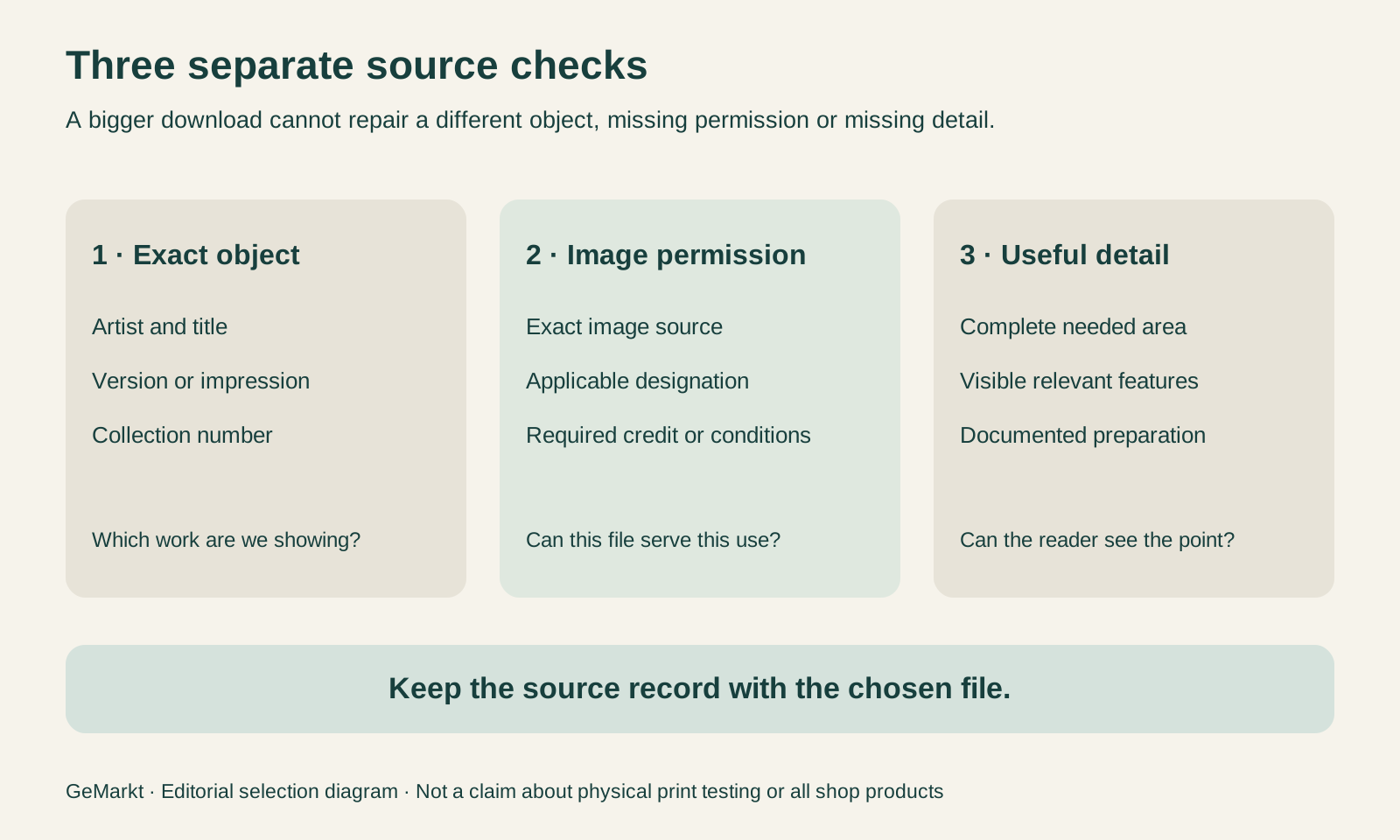
The same distinction guides other sources. The Met’s Open Access programme applies CC0 to designated eligible images; it is not a blanket licence for every photograph on its website. We retain the particular source and rights statement instead of shortening every case to “found at a museum.” A condition that affects publication cannot be repaired by a nicer caption.
Follow one Great Wave file
Here is the real illustration, not a simulated example. You can see the print’s inscription, the three boats, the small mountain and the complete image supplied in our existing web file.
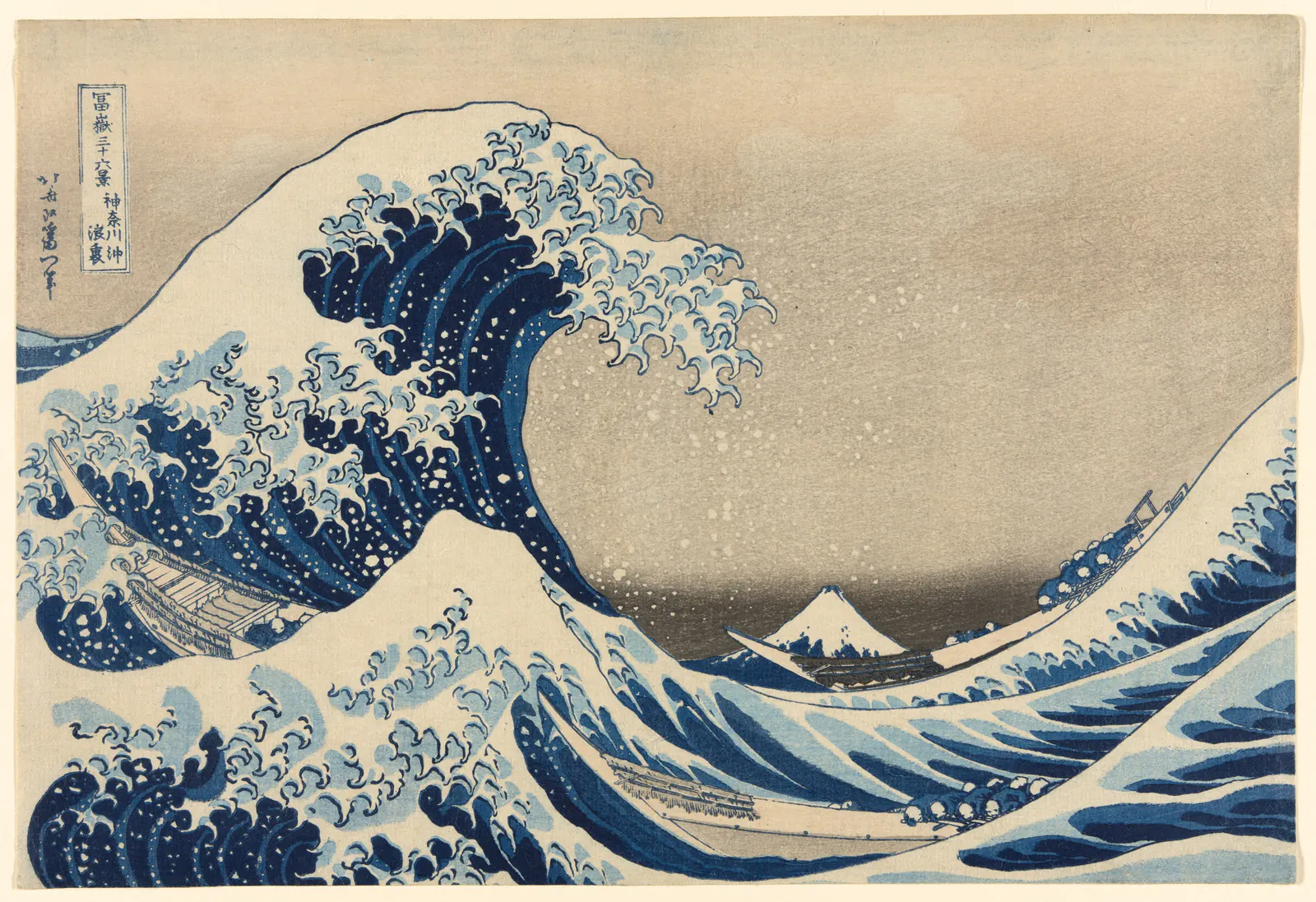
Our retained source information connects the museum’s image identifier to its download and to this 1600 × 1097 pixel web illustration. The museum’s image manifest independently connects that identifier to the same object number. This is a traceable relationship, not proof supplied by a filename containing “Hokusai.”
The original preparation record describes a proportional reduction without cropping. Reusing that already checked file does not require another round of colour adjustment or sharpening. Its current dimensions describe the Blog illustration, not the largest file the institution might hold and not a specification for a product offered in the shop.
Choose enough detail for the explanation
The file has a job. In the Great Wave story, the relationship between the boats, wave and mountain matters. A whole composition helps the reader understand that relationship; a close view helps locate a small feature. Neither is a substitute for the other.
We inspect the actual displayed image, including its boundaries and important details, rather than relying only on dimensions. A large file can still contain blurred lettering, a missing edge or an earlier crude enlargement. A small preview can be adequate for an overview but inadequate for a paragraph that depends on reading a tiny inscription.
This is a judgement about the explanation, not a universal pixel threshold. If the detail cannot be seen reliably, the sensible options are to find a better permitted source, change the illustration or narrow the claim. Making the existing blur larger would not make the caption more defensible. The separate high-resolution file guide covers the search process in more depth.
Preserve the picture before preparing the page
Our Great Wave story labels its display crops and links them back to the full image. That lets the reader tell a selected detail from a complete work. The reusable source file itself remains unchanged. A different layout need not become a different version of the artwork.
For editorial use, we distinguish routine delivery preparation from changes that affect what the image tells the reader. Selecting a smaller display size is not the same as removing an inscription, extending a painted sky or replacing an uncertain face with a generated one. Those operations can change the evidence even when the finished page looks polished.
Colour deserves particular restraint. The Met’s account of colour fidelity describes measured capture and the role of reference targets. Looking at a download on our screen is not equivalent to that institutional imaging work. We cannot establish the original object’s colour simply by preferring a brighter reproduction, and we do not describe that preference as museum-grade calibration.
Keep a record that survives a redesign
For this example, the useful record includes the object number, institution, source image address, rights statement, local file dimensions and documented preparation. The site also records a digital fingerprint of the file. That fingerprint can show whether the stored bytes changed; it cannot authenticate the historical artwork or decide whether an interpretation is correct.
Keeping these details together prevents a common mistake: replacing an illustration while leaving the previous file’s credit underneath. If the source changes, the identity and permission need checking again. A new photograph of the same painting is still a new file, with its own record.
The reader-facing version should be lighter. The caption needs the identity and relevant credit, with a working route to the source. Necessary licence conditions remain visible; storage details need not overwhelm the artwork. Our editorial standards in practice explain the wider review process and its limits.
Know where editorial checking stops
A traceable illustration supports an article. It does not certify paper, ink, canvas texture, screen accuracy or the appearance of a delivered print. A product’s production file and physical result need their own assessment; neither inherits approval merely because the Blog discusses the same painting.
That boundary is useful to readers. You can ask which object is shown, where its image came from and what was changed, without accepting a vague quality slogan. When an image or caption appears inconsistent, send its article link and the conflicting source to contact@gemarkt.com. The value of keeping a source record is that another person can follow it—and that a specific mistake can be corrected.
Editorial record
About this article
- Author
- Publisher
- GeMarkt
- Published
- Reviewed
- Internal source & rights check. Conducted by GeMarkt Research Review. This is an internal editorial check—not independent peer review.
- Source standard
- Blog source standardNames the editorial responsibility, keeps evidence close to material claims, and records meaningful revisions.
Found a claim that needs checking? Report a factual error.