GeMarkt Blog · Essay
Packaging: Tubes, Boxes and Framed Shipments
What one documented GeMarkt print range says about packaging, how a print's size differs from its parcel, and what to check before opening or gifting it.

The package should follow the product you choose, not just the picture printed on it. In the Starry Night listing linked from GeMarkt, unframed paper posters are described as typically arriving rolled in a tube. A framed print is a different object, with different packing needs.
This guide uses that one documented range, checked on 13 October 2026. It combines the listing’s information with separately labelled supplier guidance. It is not a claim that we have opened, drop-tested or measured every parcel, or that every GeMarkt product uses identical packaging.
Start with the format on your order
Our saved Starry Night setup, dated 10 October 2026, contains four product families: rolled paper, framed paper, stretched canvas and framed canvas. The print-partner account explains that evidence and its limits. The important point for unpacking is simpler: a paper finish, a frame and a stretched canvas are not interchangeable names.
Before ordering, keep the full selection together: artwork, format, size and frame finish where applicable. “The large Van Gogh” will not identify the package as reliably as “the 20 × 16 inch framed paper version.” A room photograph can help you choose the image, but it is not a list of everything inside the parcel.
For the current offer, start at The Starry Night product page and follow its checkout link. If an essential packing detail remains unclear, ask about that exact option rather than assuming another customer’s photograph represents yours.
A rolled poster is an unframed sheet
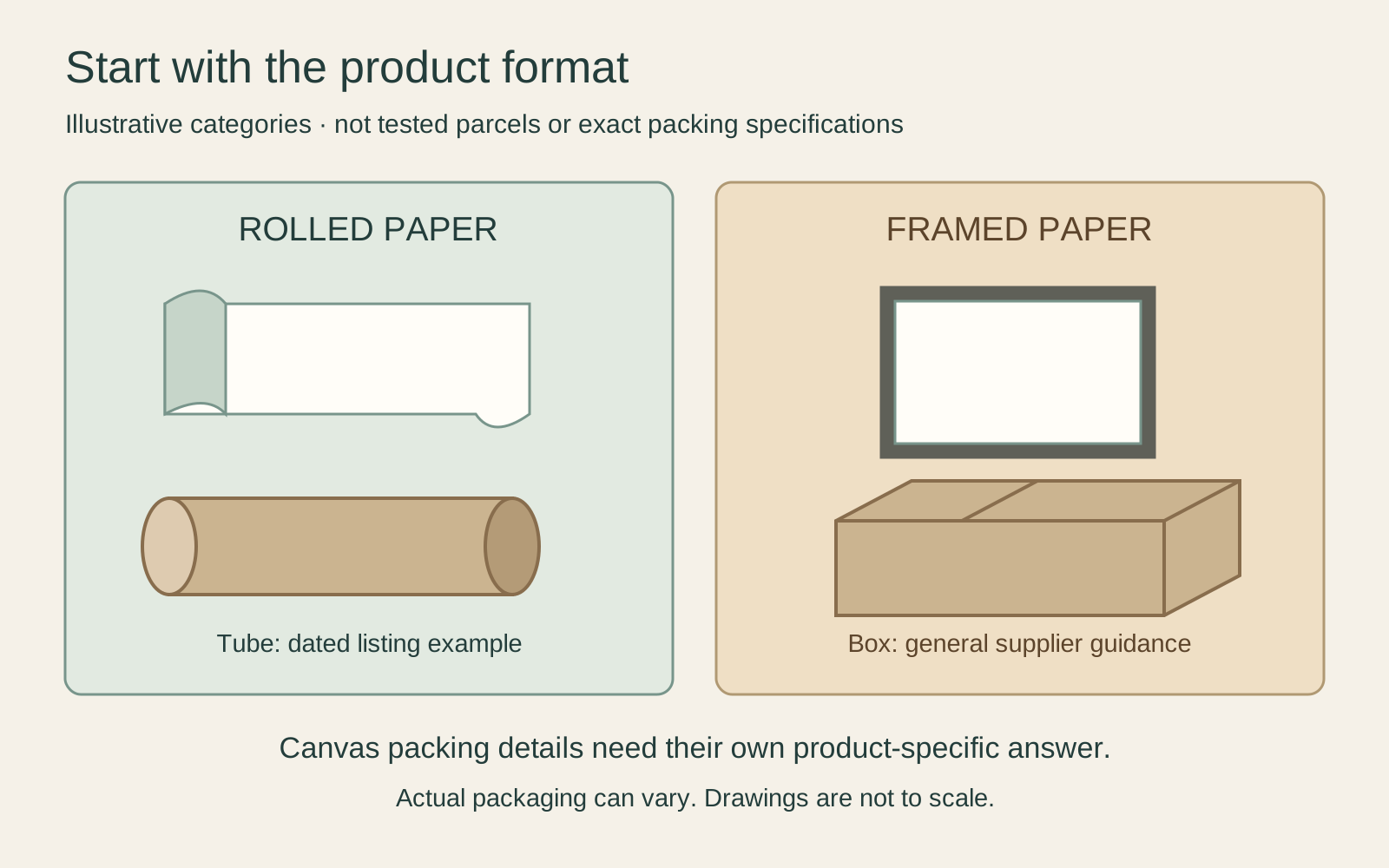
The live Starry Night listing says unframed paper posters are typically rolled, enclosed in a sleeve and sent in a tube. “Typically” matters: this is the listing’s description, not an unconditional promise of one tube shape or an independently verified specification for the sleeve material.
Printify’s separate packaging guide describes poster tubes that may be circular or triangular. It also states that actual packaging can vary and change. A triangular outer container is therefore not, by itself, evidence that a poster has been folded.
An unframed sheet still needs an appropriate frame or other display arrangement after arrival. Do not buy a rolled poster for someone who needs a finished picture on the wall that afternoon without considering that extra step. The package protects a product in transit; it does not convert an unframed purchase into a framed one.
Framed paper and canvas are different objects
Printify describes protective cardboard boxes for framed posters. That statement does not establish the precise carton, inserts or corner protection used for every provider, destination and size. The Starry Night listing also describes packaging for its framed paper and canvas options, without supplying a complete packing specification for each.
Distinguish the object inside before making an unpacking plan. A framed paper print has paper within a frame; a stretched canvas has fabric carried on a supporting structure. Adding an outer frame to a canvas creates another finished product. The word “framed” alone does not tell you the glazing material, overall depth or how the back should be supported.
This is why the illustrations here show categories rather than a supposedly exact cutaway of our packaging. They cannot certify unseen cushioning or a universal canvas-box design. If those details affect your purchase, request information for the selected product rather than treating an illustration as a packing photograph.
Print size is not parcel size
A useful example appears in the supplier’s Framed Paper Posters size guide. Its horizontal 20 × 16 inch option lists an outer frame width of 21.89 inches, a height of 18.03 inches and a depth of 0.75 inches. These are product measurements, not shipping-box measurements.
The outside frame is therefore 1.89 inches wider and 2.03 inches taller than the nominal poster dimensions. Those differences are overall differences, not measurements of the visible frame face on each side. Nor do they establish how much of the paper remains visible behind the frame.
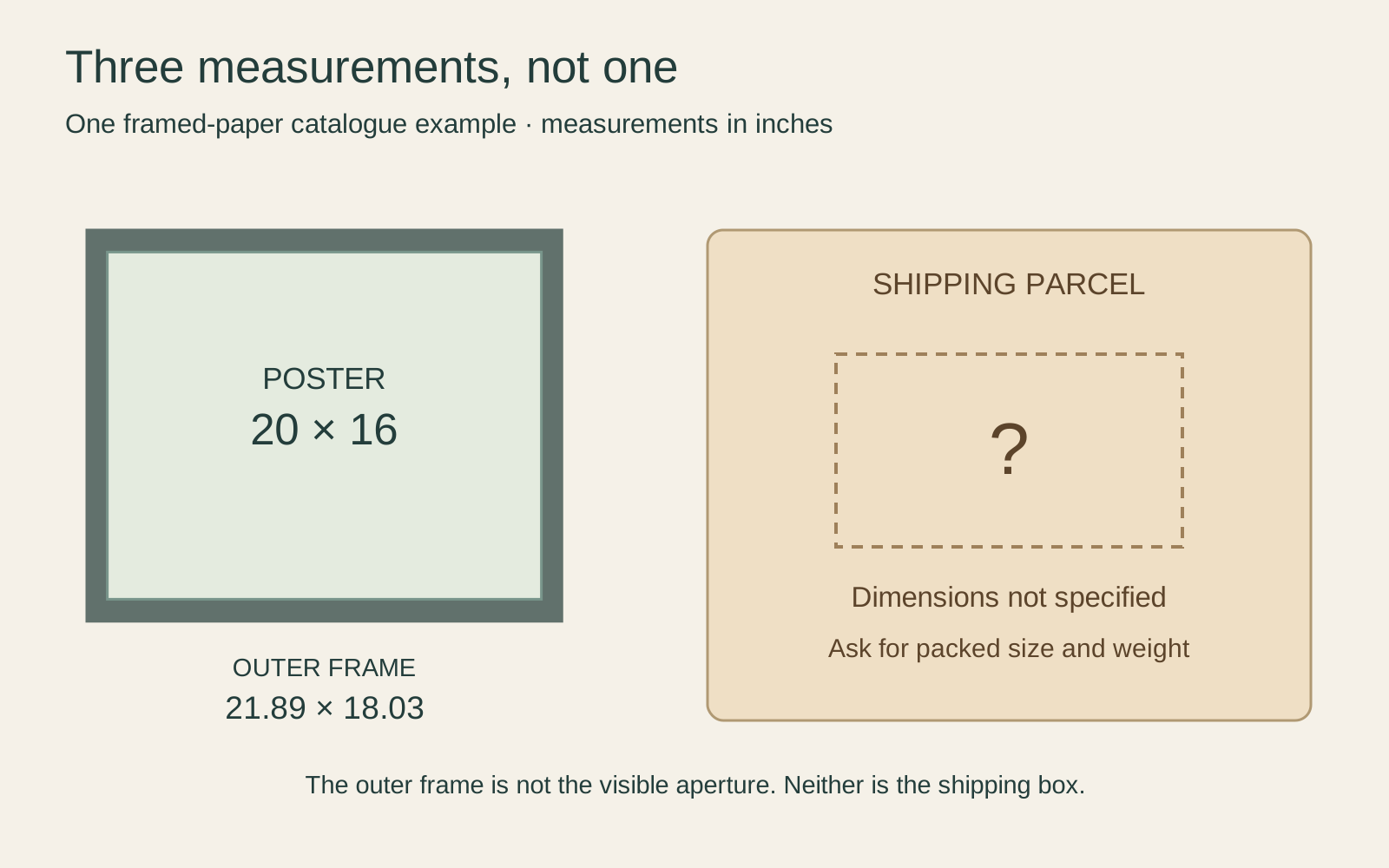
This distinction helps with more than wall planning. If a parcel must fit a locker, a car boot or a restricted reception area, ask for packed dimensions and weight. Neither the artwork’s dimensions nor the frame’s measurements answer that question. Do not add an arbitrary allowance and treat the result as a confirmed carton size.
Prepare a place before opening
Choose a clear surface where the whole item can be supported, rather than balancing a large package on the edge of a crowded table. Move drinks, food and anything that could mark the surface. The Library of Congress’s paper-care guidance recommends clean hands and a clean workspace, and warns against putting damaging attachments such as tape directly on paper.
Keep cutting tools away from the contents. Follow any enclosed opening instructions, and stop rather than pulling harder if something seems caught. A helper can be useful for an awkward object, but this is not a lifting-weight recommendation or a claim that every size is manageable by one person.
For a rolled sheet, allow time to read the care instructions before trying to make it flat. Our rolled-poster guide distinguishes gentle curvature from damage and explains why heat, steam or force are not sensible shortcuts. An unfamiliar crease is a reason to ask a question, not to experiment with an iron.
Check before you discard the packaging
Keep the order information nearby so you can compare what arrived with what you selected. Check the artwork, orientation, format and size before deciding where it will hang. If you ordered a frame finish, check that too; a matching picture alone does not establish that every option is correct.
Retain the packaging while you make that initial inspection, provided it is safe to do so. If you notice a problem, photographs of the outside, protective layers and affected part can make your explanation clearer. Do not handle sharp or broken material simply to produce a photograph. Keeping evidence is practical advice, not a promise that particular photographs automatically qualify an order for a remedy.
The shipping container also should not be assumed to be a long-term conservation enclosure. If the print will remain unframed for a while, consider the separate advice on storing unframed prints.
Ask different questions for a gift
Shipping protection and gift presentation are different requirements. A container can be appropriate for transport without being something you want to place, unopened, at a celebration. Do not assume gift wrapping, a handwritten note or particular exterior branding unless the selected offer confirms it.
Think through where the parcel will go first. If you receive it, you can check the contents before handing it over, but must allow time and retain suitable protection for the next journey. If it goes directly to the recipient, tell them whether to expect a sheet needing a frame or a finished framed object. A surprise should not depend on an ambiguous format name.
For a very large gift, ask about packed dimensions before choosing the delivery address. A beautiful print is less convenient if the recipient has no practical place to receive or store its container.
When the parcel needs a closer look
If something appears wrong, describe the issue before attempting a repair. Include the ordered format and relevant photographs through the purchasing channel, without putting private order information in a public review or social post.
Etsy’s contact guidance distinguishes a pre-purchase seller message from the Help with order route in Purchases for an existing order. Use the route attached to your actual purchase. This article does not set a new GeMarkt refund policy, a response deadline or a guaranteed outcome.
The useful expectation is specific: know the product you selected, distinguish its measurements from its parcel, and ask about the packing detail that matters to you. A packaging description should help you prepare for a delivery without pretending that transit can never go wrong.
Editorial record
About this article
- Author
- Publisher
- GeMarkt
- Published
- Reviewed
- Internal source & rights check. Conducted by GeMarkt Research Review. This is an internal editorial check—not independent peer review.
- Source standard
- Blog source standardNames the editorial responsibility, keeps evidence close to material claims, and records meaningful revisions.
Found a claim that needs checking? Report a factual error.