GeMarkt Blog · Essay
Building a Public Domain Catalogue Without Legal Shortcuts
How GeMarkt records exact artworks, image permissions and unresolved questions, with a real example of choosing a different Modigliani rather than guessing.

A useful public-domain catalogue is a collection of specific, checkable decisions, not a list of artists assumed to be safe. The work, the country, the particular image and its intended use all matter. When one of those remains uncertain, a larger download or a more confident description does not supply the missing answer.
At GeMarkt, the clearest documented examples come from building our Blog’s artwork and image records. This account explains those editorial practices and what another catalogue builder can learn from them. It is not a certificate for every shop product, a claim of worldwide clearance or legal advice for your business.
Make the entry more specific than the title
A title such as Reclining Nude sounds precise until a search returns several different paintings. Likewise, a woodblock design can exist in many impressions, and a botanical illustration may come from more than one edition. Selecting the image before identifying the object can attach accurate information to the wrong picture.
Our records therefore connect a work to an institution’s object number where one is available. Artist, title, date, medium and collection help establish the match. For prints and books, the edition or individual sheet may be just as important as the familiar design name.
This is useful even before rights enter the discussion. A later engraving after a painting is not the painting itself. A photograph of a bronze cast should not carry the dimensions of a monumental marble. A complete image and a detail also need different descriptions. The catalogue should make these distinctions easier to notice, rather than hide them behind one attractive thumbnail.
Keep country and publication evidence together
An artist’s death date can help answer a duration question, but it does not supply a universal result. The UK government’s ordinary rule for artistic works is seventy years after the author’s death; its guidance also notes that older works can require further checking. That is a UK starting point, not permission for every market.
For the United States, publication history can change the analysis of older art. The Copyright Office’s visual-art guidance distinguishes public display alone from publication and explains that authorised distribution or offering of an original or copies can matter. The duration provisions also distinguish older published works from certain previously unpublished works. A painting’s creation year should not silently replace those facts.
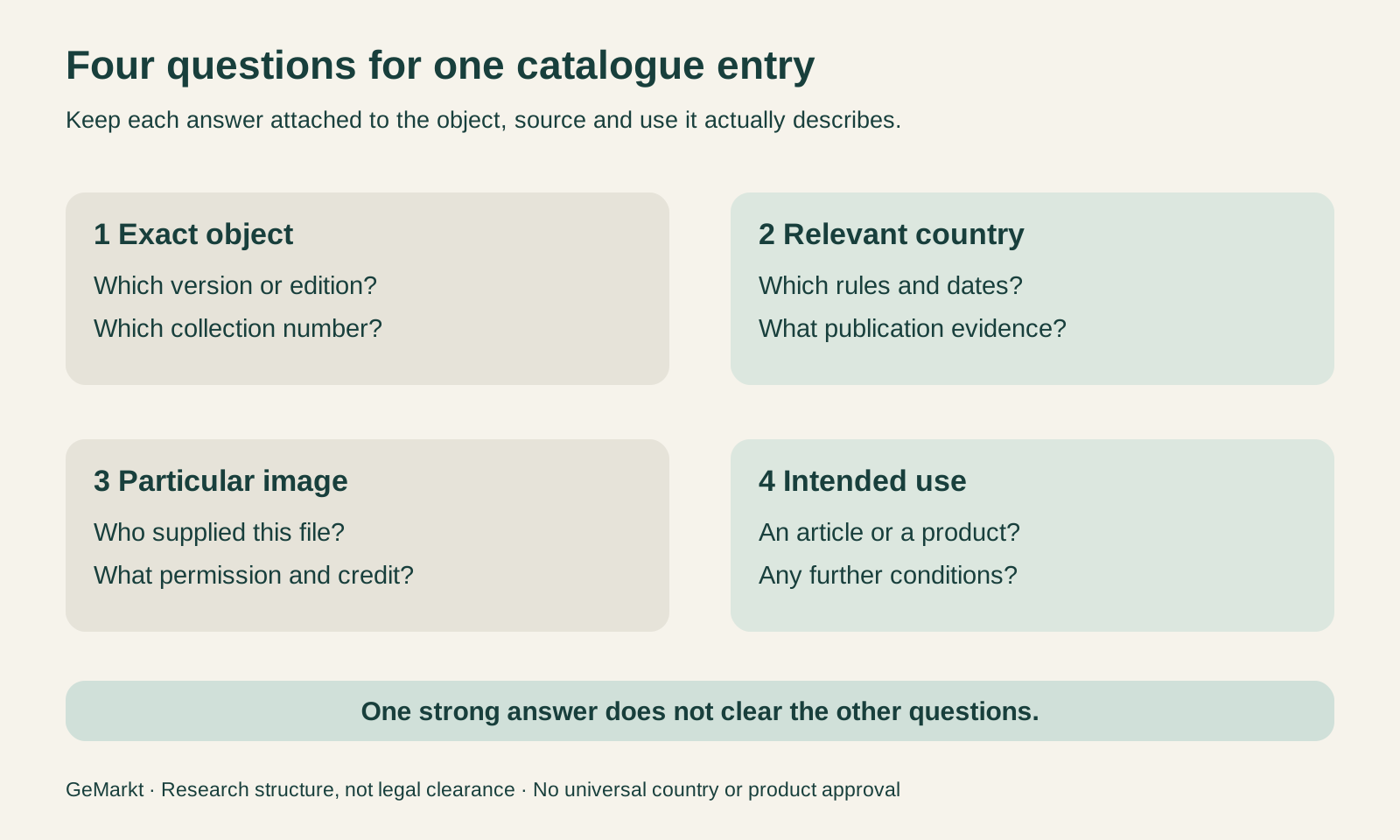
In practical terms, record what a date describes. “Painted in 1917,” “shown in 1928” and “reproduced in a 1929 catalogue” are different statements. A bibliography can point towards a useful publication without proving that we have inspected it or established all relevant circumstances. Our work-specific guides keep that distinction visible.
Match the permission to the file
The institution holding an artwork may offer one image openly while restricting other photographs. A third-party photograph can have a separate licence. Its availability in a search result says little about permission to reuse it.
CC0 concerns the rights of the party making the dedication, to the extent legally possible. It does not erase another person’s rights or create an endorsement. A Public Domain Mark is different: it records an assessment of status, with jurisdiction and other-rights qualifications. We retain the actual statement instead of flattening both into “free image.”
A useful file record includes its source page, download identity, applicable statement, necessary attribution and any stated conditions. If the picture is replaced, the replacement needs its own check. It cannot inherit permission merely because the two images show the same painting.
This also keeps credit honest. A museum record may establish a date without supplying the photograph used on our page. Naming the museum as the photograph’s source in that situation would make the chain less accurate, not more authoritative.
Learn from a different reclining nude
Our Modigliani work check provides a concrete example. During its preparation, a candidate image of the Met’s Reclining Nude, accession 1997.149.9, had an earlier Met-attributed CC0 history but a conflicting public-domain signal in the institutional data checked at that time. We did not settle that conflict by choosing the statement we preferred.
Instead, the article explicitly selected a different painting: Nude on a Blue Cushion, 1917, National Gallery of Art, 1963.10.46. The NGA’s current object page identifies that work and marks its media as public domain. The linked Open Access policy supplies CC0 terms for qualifying images, while preserving limits concerning rights the Gallery does not hold.
That is a change of the example, not a finding that the rejected picture became reusable. The title and opening identify the selected NGA painting so a reader cannot reasonably transfer its file permission to every Nu couché. The earlier candidate remains documented as unused.
The important lesson is not “choose whichever museum says yes.” It is that a legitimate alternative must have its own identity and a scope that fits the article. If changing the object would make the explanation misleading, the right alternative is to stop that article until its evidence improves.
Give unresolved work a real place to wait
An unresolved entry should not disappear into an unlabelled folder, nor should it become a public page merely because the prose is finished. In our editorial queue, held candidates retain their research and a reason why they have not advanced.
For example, the proposed Three Ages of Woman rights article was held because the basis for GeMarkt’s own proposed image display had not been established. Warning readers about commercial reproduction would not answer that question for our page. This describes our decision to wait; it does not claim that the painting has perpetual copyright or that every use by everyone is forbidden.
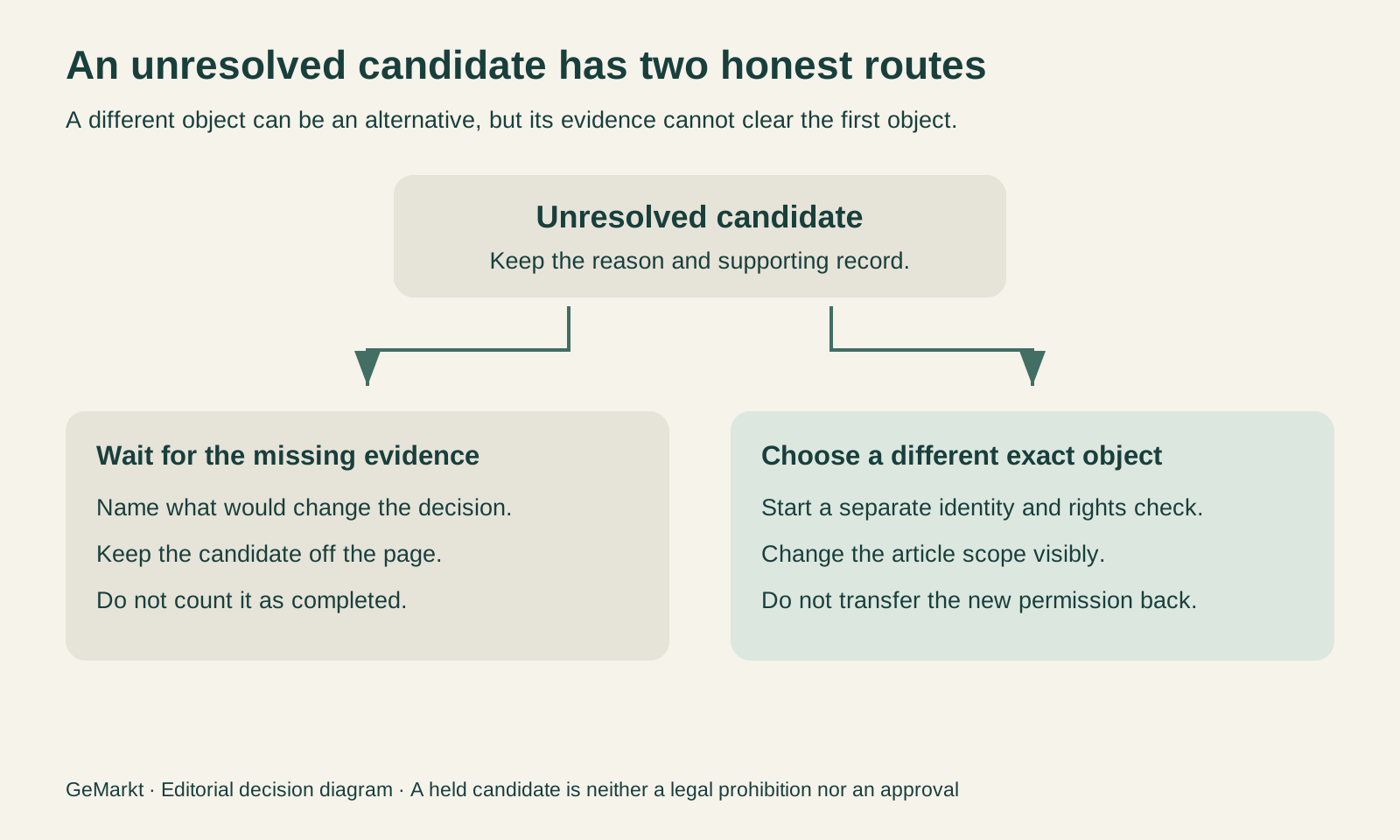
The record needs a meaningful next step: an applicable permission, a reliable publication record, clarification of which object is shown, or another specifically identified piece of evidence. “Check later” is less useful than explaining what would actually change the decision. A held topic is not counted as completed.
Keep the record when the page changes
Our editorial image records retain source addresses, rights text, dimensions and file fingerprints. A fingerprint helps detect whether stored bytes changed; it does not authenticate the historical object or pronounce on copyright. Its value is continuity: a later redesign should not silently replace a checked file with an unrelated copy.
We also distinguish a labelled display crop from the complete source. If the discussion points to a small detail, readers need a route back to the whole composition. Our source-selection account follows one real image through those checks.
Keep dates attached to the decision they describe. A recent page update need not mean every old source was freshly examined. Equally, a changed institutional notice deserves attention rather than an automatic rewrite of the retained history. The record should allow a reviewer to understand both what was relied on and what has changed.
Separate a good article from a cleared product
An explanatory article and a commercial reproduction are different proposed uses. A bounded discussion may explain why a U.S. publication question remains open; that discussion must not become a product badge announcing unrestricted worldwide use. The picture selected for a small web illustration may also be unsuitable for a large physical print.
Our editorial standards and copyright policy describe those boundaries. For a substantial commercial use with unresolved questions, obtain advice or permission appropriate to the actual work, territory and use. A catalogue grows more reliably when its records remain specific—even when that means a smaller selection today.
Editorial record
About this article
- Author
- Publisher
- GeMarkt
- Published
- Reviewed
- Internal source & rights check. Conducted by GeMarkt Research Review. This is an internal editorial check—not independent peer review.
- Source standard
- Blog source standardNames the editorial responsibility, keeps evidence close to material claims, and records meaningful revisions.
Found a claim that needs checking? Report a factual error.