GeMarkt Blog · Essay
Our Editorial Standards in Practice
See how GeMarkt identifies artworks, places useful images, separates evidence from interpretation and explains what its internal review labels mean.

An art article should help you look, understand and check—not simply sound certain. At GeMarkt, that means identifying the particular work being discussed, making the relevant image visible and linking important claims to evidence that can support them. A beautiful page is not a substitute for any of those things.
Our editorial standards set out the policy. Here is what it means in practice, using an actual print in our Great Wave story and a small bronze by Rodin. These examples also explain the limits of our review labels. Internal checking is not the same as museum endorsement, academic peer review or legal advice.
Start with the object in front of you
An artist and title are sometimes not enough. A print can survive in many impressions; a sculpture can exist at different scales and in different materials. The illustration has to match the claim, rather than stand in for every object with a familiar name.
Take Rodin’s The Kiss. The National Gallery of Art record identifies the bronze shown here as accession 1942.5.15, measuring 24.7 cm high. It distinguishes the model’s date, 1880–1887, from the casting date, about 1898–1902. Those dates describe different events. Combining them into one unexplained “made in” date would lose useful information.
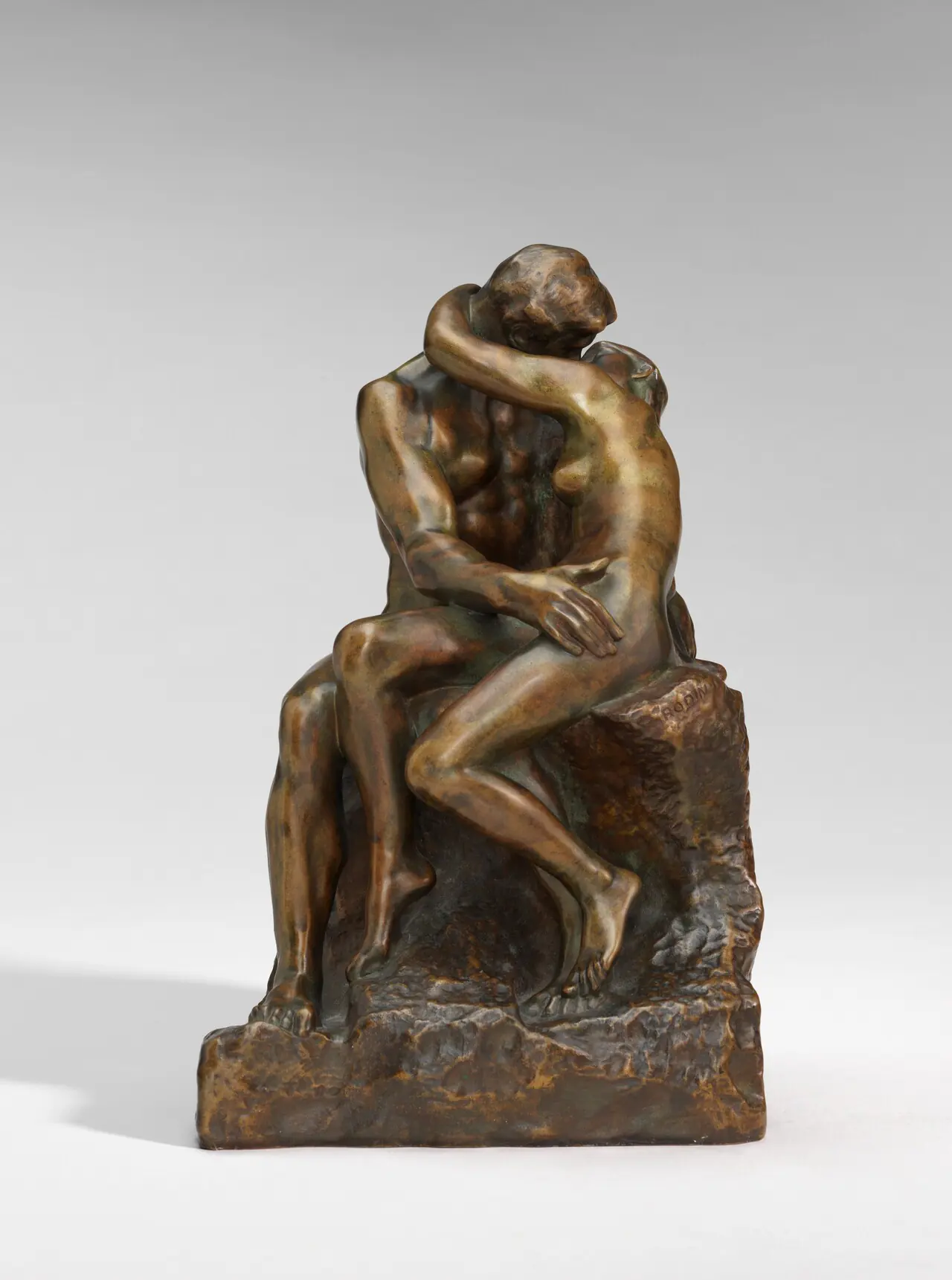
Scale matters to the story too. This photograph can help us discuss the figures’ arrangement, but it must not silently become a photograph of a much larger marble. Naming the material and object gives the reader a way to catch that mistake. The same discipline applies to a preparatory drawing, a later engraving after a painting, or a detail from a larger work.
Put the picture beside the point
Our Great Wave story uses the Art Institute of Chicago’s impression, 1925.3245, rather than an unspecified internet copy. Its full composition belongs beside the discussion of how the wave, boats and distant mountain relate to one another.
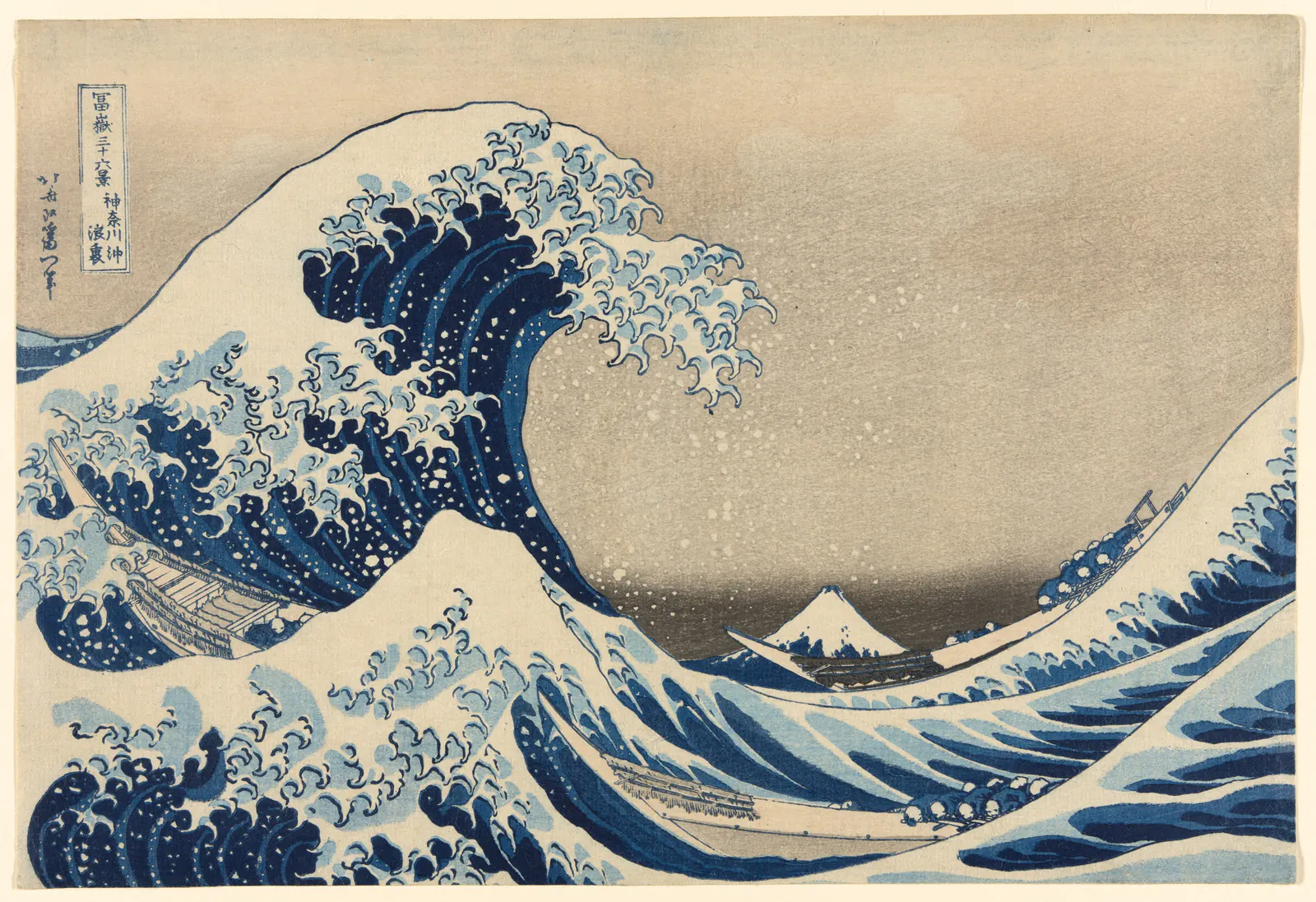
Look at how small Fuji is beside the breaking water. Describing that relationship while showing only an enormous cropped wave would make the explanation harder to test. A detail can help you find the mountain, but the whole sheet supplies its setting.
The story therefore uses labelled close views alongside the relevant passages and retains access to the full image. A crop is a reading aid, not a newly discovered version of the print. Its caption should say what you are looking at, without pretending that the edge of the crop was the artist’s original boundary.
This is also why an image link alone is not enough when a paragraph depends on seeing a detail. The reader should not have to leave the explanation, search another page and guess which feature the author meant.
Distinguish what we see from what we know
Some statements can be checked directly against the image: a boat sits under the curling wave; a figure’s arm crosses another figure’s body. Others concern history, intention or meaning and need a different kind of support. Seeing something in a picture does not tell us what its maker privately thought.
For example, calling the small mountain a visual counterweight is an interpretation of the composition. Claiming that a named disaster caused the artist to make the print would require historical evidence. A vivid story does not become documented simply because it fits the picture well.
Evidence also has a scale. Research about pigment in one surviving impression should not turn into a claim that every impression received the same laboratory examination. Our Great Wave article explicitly keeps research on another museum’s sheets separate from the Chicago sheet illustrated here. That limit preserves what the research actually tells us.
When sources disagree, the useful response is not a vote among websites. A catalogue describing the object itself may answer a question that a general biography does not. Where the disagreement changes the interpretation, readers need to see it rather than receive a falsely neat conclusion.
Keep the image permission separate
A source can be excellent for an artwork’s history without licensing its photograph for our page. Conversely, a reusable image file can have a poor or incomplete caption. Those are separate checks, and one does not repair the other.
The Rodin example makes the distinction concrete. The NGA marks this object’s media as public domain and provides it through its Open Access policy. That supplies a basis for using this particular institutional photograph. It is not a reason to take a different photographer’s image of another cast, or to imply that the NGA endorses GeMarkt.
For the reader, a useful image credit identifies the work, the holding institution or file source and the relevant licence. Necessary photographer attribution and licence conditions stay visible. Technical delivery details need not interrupt the discussion, but removing clutter must not remove a credit that the licence requires.
Explain what review does and does not mean
GeMarkt uses AI-assisted research and drafting. A separate AI-assisted reading can identify a mismatch between a caption and a record, question an unsupported conclusion or catch a broken reference. It remains an internal check, not an external expert’s approval. Repetition by another model is not a second historical source.
The names GeMarkt Editorial and GeMarkt Research Review describe responsibilities within our publishing process. They are not invented scholars’ names. A review date indicates a recorded review, not a guarantee that a specialist personally examined every sentence or that a rights conclusion will remain unchanged forever.
Technical checks serve a different purpose again. They can detect a missing image, an invalid link or inconsistent page information. They cannot decide whether an interpretation is persuasive. A page can pass those checks and still need a factual correction. GeMarkt remains responsible for the published result, including mistakes that automation misses.
Make the page usable without a purchase
An image should contribute information, not merely break up a long page. Its text alternative should help readers who cannot see it understand its relevant content. The W3C guidance on informative images makes that relationship between purpose and description explicit. “Art image” tells a reader almost nothing about a comparison between a wave and a mountain.
The same reader-first principle applies to commercial links. GeMarkt publishes articles and sells products; a link to our own shop is not independent endorsement. A source explaining a painting must still make sense if you never buy a print. A product option, price or delivery statement needs its own current evidence, not authority borrowed from a museum citation.
Leave a clear route for corrections
If something appears wrong, send the article address, the specific claim or image and any supporting source to contact@gemarkt.com. An accession number, a page reference or a photographer’s credit is more useful than a general warning that “the internet says otherwise.” Copyright concerns also have a route through our copyright policy.
A material correction should leave the reader with the corrected claim and appropriate updated information. Smaller spelling or link repairs do not always need a separate public note. An updated date is not a complete archive of every edit, and an internal review label is not a request to stop questioning the page. The point of these standards is to make a claim easier to examine—and easier to correct when necessary.
Editorial record
About this article
- Author
- Publisher
- GeMarkt
- Published
- Reviewed
- Internal source & rights check. Conducted by GeMarkt Research Review. This is an internal editorial check—not independent peer review.
- Source standard
- Blog source standardNames the editorial responsibility, keeps evidence close to material claims, and records meaningful revisions.
Found a claim that needs checking? Report a factual error.