GeMarkt Blog · Essay
How We Use AI in Research and What Human Oversight Means
What AI helps with in GeMarkt research, how a separate review can improve a claim, and why human-set rules do not mean a human expert checked every sentence.

GeMarkt uses AI-assisted research, drafting and separate internal review. That does not mean a human historian or lawyer has checked every article. Human-set editorial rules and authorisation determine what the work may do; factual claims still need evidence that readers can inspect. Those responsibilities should not be collapsed into the reassuring but vague phrase “human checked.”
This account describes our documented Blog workflow. It explains where automation is useful, how one real review changed a sentence, and what our review labels do not promise. It is not an announcement of an expert panel, a measured accuracy rate or a system that can reliably certify its own work.
Use AI to organise the question
An art question usually contains several smaller questions. “Is this painting public domain?” may involve identifying a particular version, finding its history, separating a photograph from the underlying work, and deciding which country’s rules are relevant. AI can help turn that broad request into a manageable research plan.
It is also useful for proposing search terms, locating likely collection records, comparing a draft’s structure with its stated purpose and making dense prose easier to follow. These are working aids. A plausible title, date or bibliography generated along the way remains a lead until it is checked.
The distinction matters because fluency can hide errors. NIST’s Generative AI Profile, section 2.2, describes confident false output as confabulation; its suggested actions include checking sources and citations. That is a reason for scrutiny, not a certification of GeMarkt or a claim that following a checklist eliminates mistakes.
The practical benefit comes from spending less effort rearranging information and more effort on the questions that can change the answer. Finding three versions of a painting is useful. Quietly combining their dates, dimensions and owners into a single imagined object is not.
Go from an answer to its evidence
Our editorial standards state that AI output is not a source. For a museum object, the supporting record should identify the work actually discussed. For an image, the credit and permission should apply to the actual file. For a legal proposition, the source should support that proposition rather than merely mention copyright.
Opening a link is only the beginning. The useful question is whether its relevant passage says what the sentence claims. An exhibition date does not automatically establish publication. A record of one cast cannot identify all casts. A page about a museum’s open-image programme does not necessarily release every image on its website.
Our source-file account gives a concrete example using an identified Great Wave impression. Its image, collection number and source record remain connected. This lets a reader check the relationship without accepting an AI’s confidence as a substitute.
Access limits matter too. If a source could not be opened, we should not describe it as fully read. A catalogue citation may remain a lead, and a search result may be narrower than the original document. The conclusion should fit the evidence actually available, rather than the evidence we hoped to find.
Ask a separate reviewer to challenge the claim
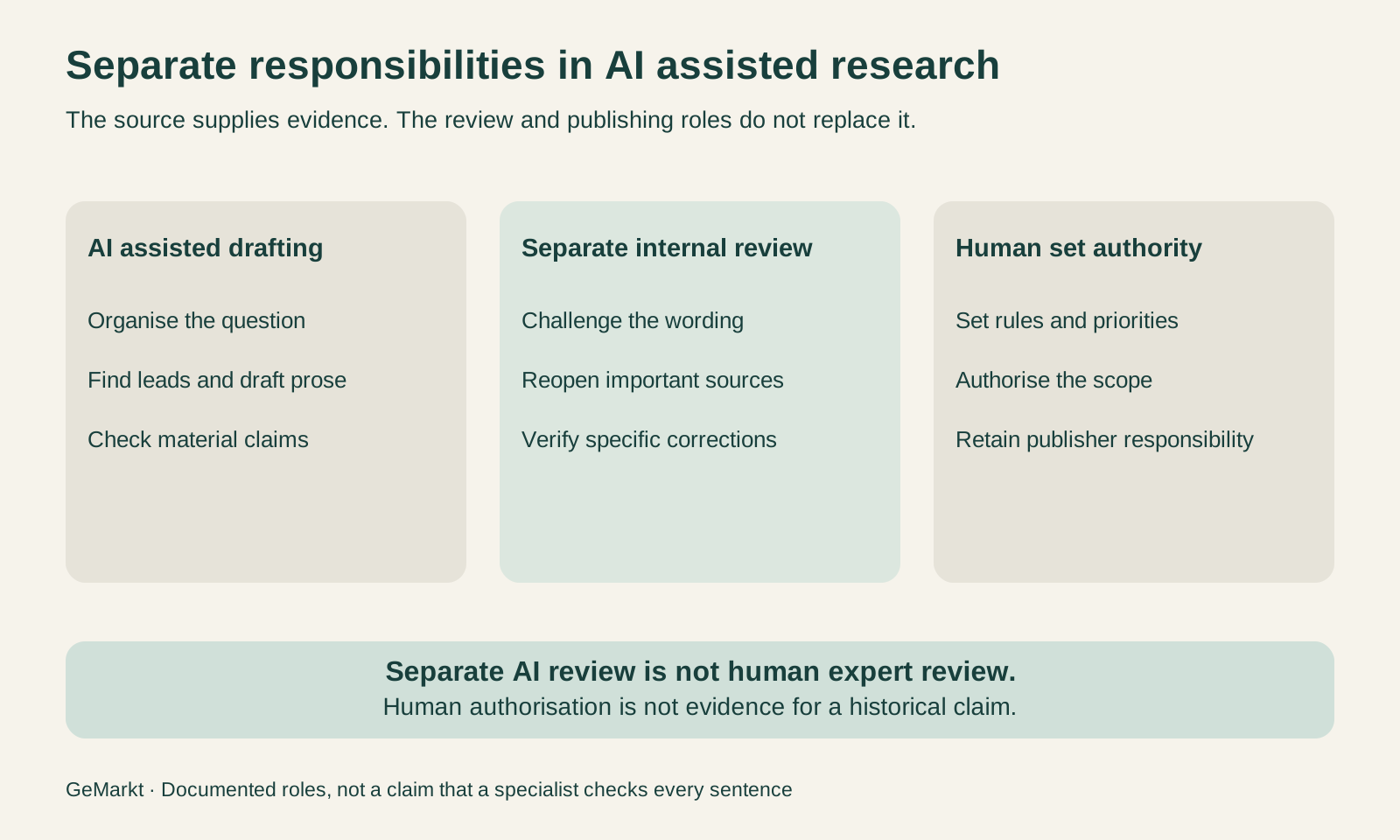
In the documented recent article batches, a different AI-assisted reviewer reads the complete draft, checks important sources and examines the actual images. That is separate from the drafting task, but it is still an internal AI-assisted check. Two models agreeing are not two independent historical witnesses.
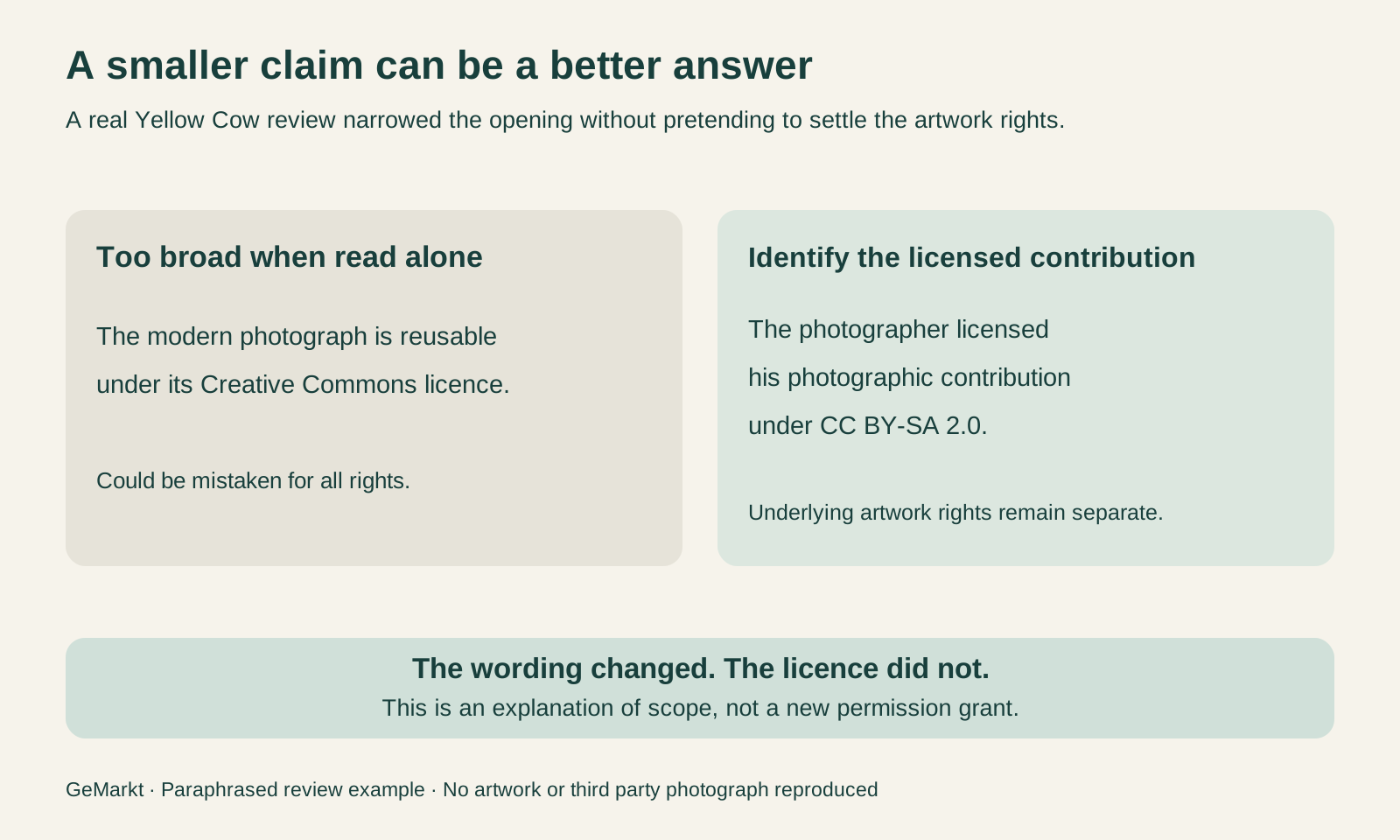
A real example appears in our Yellow Cow rights guide. An early opening described the modern photograph as reusable under its Creative Commons licence. The later text already preserved an unresolved question about the underlying artwork, but a reader stopping after the first sentence could miss that boundary.
The separate reviewer asked for the opening to say that the photographer had licensed his photographic contribution. The author made the correction and the reviewer checked the revised wording. The licence had not changed; the sentence’s scope had. This is a modest but meaningful improvement, not proof that every question about the painting was solved.
A review is most useful when it reports a specific mismatch and verifies the fix. “Looks good” is less informative than identifying which object, passage, calculation or licence was checked. The resulting record also needs to distinguish actual checks from things the reviewer did not do.
Distinguish human authority from human fact checking
The human role established in our project is setting the publishing rules, choosing priorities and authorising the scope of work and live changes. That authority is important, but it is not equivalent to checking each caption, reading each cited archive or giving a legal opinion.
Our internal labels, GeMarkt Editorial and GeMarkt Research Review, identify publishing responsibilities. They are not names invented for scholars, and they do not imply external academic peer review. Where the check was AI-assisted, calling it independent means independent of the drafting task—not independent of GeMarkt or performed by a human specialist.
If a particular decision needs a qualified person, their actual contribution must be obtained and described accurately. Until then, we should narrow the statement, seek the missing evidence or leave the item unpublished. Adding a human-sounding label cannot complete a review that never happened.
Let technical checks do their own job
Software can perform useful, repeatable checks. Our article preparation records include tests for missing images, inconsistent metadata, broken internal references and unexpected changes to stored files. A file fingerprint can establish that a checked illustration has not silently been replaced.
Those results have limits. A working image address does not prove that the caption identifies the right painting. Matching file bytes do not establish a rights conclusion. A page that opens successfully can still contain an unsupported interpretation. Technical checks help preserve and deliver the work; they do not supply its historical evidence.
Visual inspection has its own scope as well. Looking at the actual illustration can reveal a cropped inscription or a mismatch between text and image. It does not establish a physical print’s colour accuracy, a sitter’s thoughts or the authenticity of an unknown object. We do not convert a screen check into a claim of museum examination or product testing.
Preserve uncertainty in the first answer
Readers often arrive with a specific question and little time. That makes the opening especially important. A confident “yes” followed by a distant exception is not a useful answer if the exception changes what the reader can do.
The Yellow Cow correction illustrates the better pattern: identify which contribution the licence covers, then explain the remaining question. Other distinctions deserve the same treatment. “The museum lists this date” is not “we inspected the original publication.” “This is a proposed comparison” is not “we tested the product.” A calculation based on an assumed size should identify that assumption.
Keeping those distinctions does not require making every paragraph defensive. Often a few precise words do the work. The aim is to remove false certainty while preserving a readable explanation, not to bury the reader under the entire research history.
Keep corrections open after publication
GeMarkt remains responsible for what appears under its name. AI involvement is neither a guarantee nor an excuse. A reader who finds a doubtful caption, source or conclusion can contact contact@gemarkt.com with the article address, the specific passage and useful supporting evidence.
Our corrections policy distinguishes substantive revisions from smaller spelling or link repairs. A review date marks recorded checking, not perpetual accuracy. A changed source or a well-supported correction can require another look.
The standard is therefore practical: let tools assist, retain evidence, identify who or what performed the check, and keep the published claim no broader than its support. Human oversight is meaningful when its actual role is clear—not when it is used to suggest a level of expert scrutiny the record does not show.
Editorial record
About this article
- Author
- Publisher
- GeMarkt
- Published
- Reviewed
- Internal source & rights check. Conducted by GeMarkt Research Review. This is an internal editorial check—not independent peer review.
- Source standard
- Blog source standardNames the editorial responsibility, keeps evidence close to material claims, and records meaningful revisions.
Found a claim that needs checking? Report a factual error.