GeMarkt Blog · Practical guide
How to Spot a Low-Quality Reproduction
Check composition, detail, printing defects and product evidence before buying an art reproduction, without confusing an old painting's texture with a bad print.

A good reproduction should show the intended work clearly, disclose its crop and materials, and arrive without avoidable printing or handling defects. A grand-sounding paper description or a beautiful room mockup cannot establish those things by itself.
Start with the picture, then inspect how it has been reproduced. An old painting may contain cracks, worn passages and deliberately rough brushwork. Those features are not automatically faults in the print. Equally, extra sharpness and brighter colour do not automatically make a reproduction more faithful.
Identify the picture you are buying
Check the title, artist and version before comparing quality. Some artists painted several closely related compositions. A different arrangement of flowers or figures may identify another work rather than a bad reproduction of the one you expected.
When a museum collection record is available, use it to establish the composition and basic identity. Ask the seller which source image was used, especially if the listing promises a specific version. An answer that names the institution and object is more useful than “from a high-resolution archive.”
Keep three questions separate: is this the intended artwork, is the reproduction well made, and is the source file legitimately usable? A convincing-looking print does not answer the last question. Our guide to checking an art listing helps separate the supplied object from the artwork name.
Compare the complete composition
Look at all four edges, not only the central subject. Have a signature, a boat, a strip of sky or the end of a branch disappeared? Does a figure look wider than in the reference? Compare recognisable shapes rather than relying on the overall mood of the image.
A crop can be a deliberate, attractive product choice. The problem is an undisclosed crop presented as the complete work. A listing should show the result for the selected size, since different proportions may remove different areas.
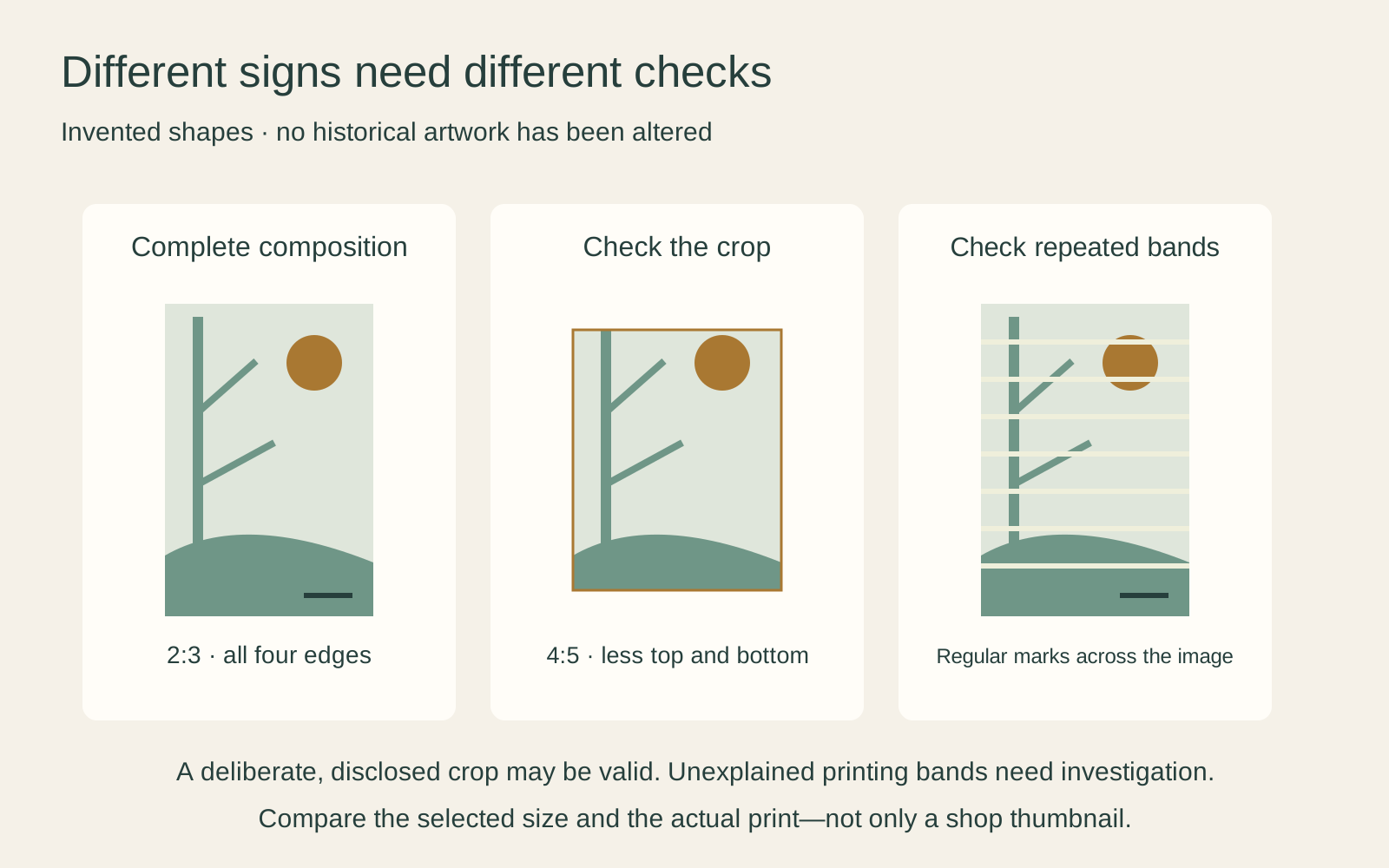
For example, fitting a portrait-shaped 2:3 image into a 4:5 image area cannot preserve both the complete picture and an edge-to-edge fill without changing something. The seller must crop, introduce borders, or distort the proportions. Ask which treatment applies; do not assume the small square shop thumbnail describes the delivered sheet.
Look at detail at the proposed size
A small web image can conceal a weak source file. Ask for a close detail from the actual reproduction, ideally showing a face, lettering or a fine edge at a meaningful print scale. A close-up of a generic paper surface proves little about your chosen image.
Adobe’s explanation of print resolution distinguishes the file’s pixel dimensions from the pixels placed in each printed inch. Changing the resolution label without adding image data does not create more original detail.
For illustrative arithmetic, a 2400 × 3600 pixel file gives 200 pixels per inch at 12 × 18 inches, but 100 at 24 × 36 inches. Neither number alone decides whether you will like the result. The source detail, printing method, surface and viewing distance matter; there is no universal rule that every satisfactory art print must be 300 PPI.
If the purchase is large or expensive, a physical sample or a detail printed at the intended scale is more informative than repeated assurances that the file is “HD.” See image resolution and print size for the calculation.
Separate printing faults from painted texture
Inspect broad light areas and smooth transitions as well as busy brushwork. Repeated straight stripes running across unrelated parts of the image deserve investigation. Epson calls white or dark lines in a print banding and identifies several possible equipment or setup causes. That does not let a buyer diagnose the exact cause from one photograph.
Compare the suspicious mark with the source. If a crack follows the paint surface in both, it may be part of the photographed object. If uniform stripes cut through sky, clothing and background only in the print, ask the seller to inspect the production result.
Do not rub, scrape or clean a suspected fault to see whether it disappears. A scratch, ink loss and a photographed mark require different responses. Record what you can see before altering the object; a problem visible from your normal viewing position matters more than an imagined requirement to survive unlimited digital magnification.
Judge colour with sensible expectations
A screen is not a paper proof. Compare prints under the same reasonable viewing conditions, not one under a warm lamp and another in a bright window. Avoid making an expensive decision from a phone photograph whose exposure and white balance have changed automatically.
Ask whether the listing image is a product photograph, a digital preview or a room mockup. Each can be useful, but they answer different questions. A mockup shows a proposed setting; it does not demonstrate the colour of an actual delivered print.
Be wary of colour claims that cannot be explained. “More vibrant than the original” may describe an intentional redesign, not faithful reproduction. Decide which you want. Our guide to screen and print differences explains why a modest difference is not, by itself, proof of poor production.
Ask what the material claims mean
Specific information is more useful than a chain of flattering adjectives. Ask for the paper or canvas product, printing process and surface finish. If longevity is claimed, ask which tested combination and conditions support it rather than assuming the paper name guarantees the finished image’s life.
Do not rank all papers by thickness. A heavier sheet may feel substantial, but that cannot establish image detail, accurate cropping or careful printing. Nor does a named fine-art paper excuse scratches or poor finishing.
Canson’s handling guidance warns that rubbing another sheet against its coated print surface can cause abrasion. This is a reminder that handling is part of the delivered result, even when the materials themselves are reputable. It is not a claim that every GeMarkt print uses Canson paper.
Inspect the delivered object
Open the package on a clear, dry surface following the supplied instructions. Photograph damaged packaging before discarding it. Check the selected size, finish and image against the order confirmation before arranging framing or mounting.
Look for creases, crushed corners, scratches, unexplained marks and uneven cutting. For a framed item, also check whether the assembly matches the listing and whether anything is loose. Keep your hands away from exposed image surfaces and stop if broken glazing creates a hazard.
If something is wrong, send an overall photograph and one clear detail with the order reference and a plain description. “A pale horizontal stripe crosses the entire middle of the image” is easier to investigate than “bad quality.” Follow the seller’s actual reporting process; do not assume every shop offers the same remedy or deadline.
Ask for the evidence that resolves the doubt
Match the question to the concern. Missing edges require a crop preview. Fine detail requires a suitably scaled detail or sample. Unclear materials require a specification. A suspected printing defect requires inspection of the physical print, not another lifestyle mockup.
If the seller cannot clarify something important, pause the purchase. You need not prove fraud or identify the printer’s technical fault to decide that the evidence is insufficient for you. A worthwhile reproduction is one you can understand before buying and enjoy at its intended size afterwards.
Editorial record
About this article
- Author
- Publisher
- GeMarkt
- Published
- Reviewed
- Internal source & rights check. Conducted by GeMarkt Research Review. This is an internal editorial check—not independent peer review.
- Source standard
- Buying guide source standardSeparates measured or first-hand evidence from general guidance and keeps practical limits visible.
Found a claim that needs checking? Report a factual error.