GeMarkt Blog · Practical guide
Reading an Art Listing: Sizes, Paper and Frames Explained
Learn which dimensions belong to the image, sheet and frame, what material terms describe, and how to tell what an art listing actually includes.

An art listing becomes much easier to read when you attach every claim to a particular part of the purchase. A size might describe the image, the paper or the frame. “Matte” might describe a paper surface; a “mat” is a different physical component. “Canvas” does not tell you whether it arrives stretched or rolled.
Read the page as a description of an object, not just an attractive image. By the end, you should be able to tell someone what will arrive, how large it will be, and what remains to be done before displaying it. If you cannot, the missing detail deserves a question.
Translate the title into an object
Begin with the product noun. “Art print” usually needs more explanation: printed on what, supplied in which form, and with what included? “Digital download” means a file rather than a physical print. An original painting’s title can identify the reproduced image without saying anything about the materials of the reproduction.
Read the selected option beside the title. A listing may offer paper, stretched canvas and framed canvas under one heading. A photograph of one format does not establish that every option has the same construction or included parts.
Check the number of objects too. “Set” can describe several prints, while a photograph might show several alternative designs sold individually. For a multi-piece composition, ask whether the dimensions refer to each piece or the complete arrangement, and whether the stated total includes gaps.
Attach each size to the right part
Imagine a print with a 20 × 30 cm image on a 30 × 40 cm sheet. The sheet sits behind a 40 × 50 cm mat, inside a frame measuring 44 × 54 cm externally. All four pairs of numbers describe the same purchase, but they answer different questions.
The image size tells you how large the actual picture appears. The sheet size matters to printing and fitting. The mat’s outside size helps define the framing package. The frame’s outside size tells you the wall area the object occupies. In this example, the image is less than half the outside frame’s width, despite being the same object in the listing.
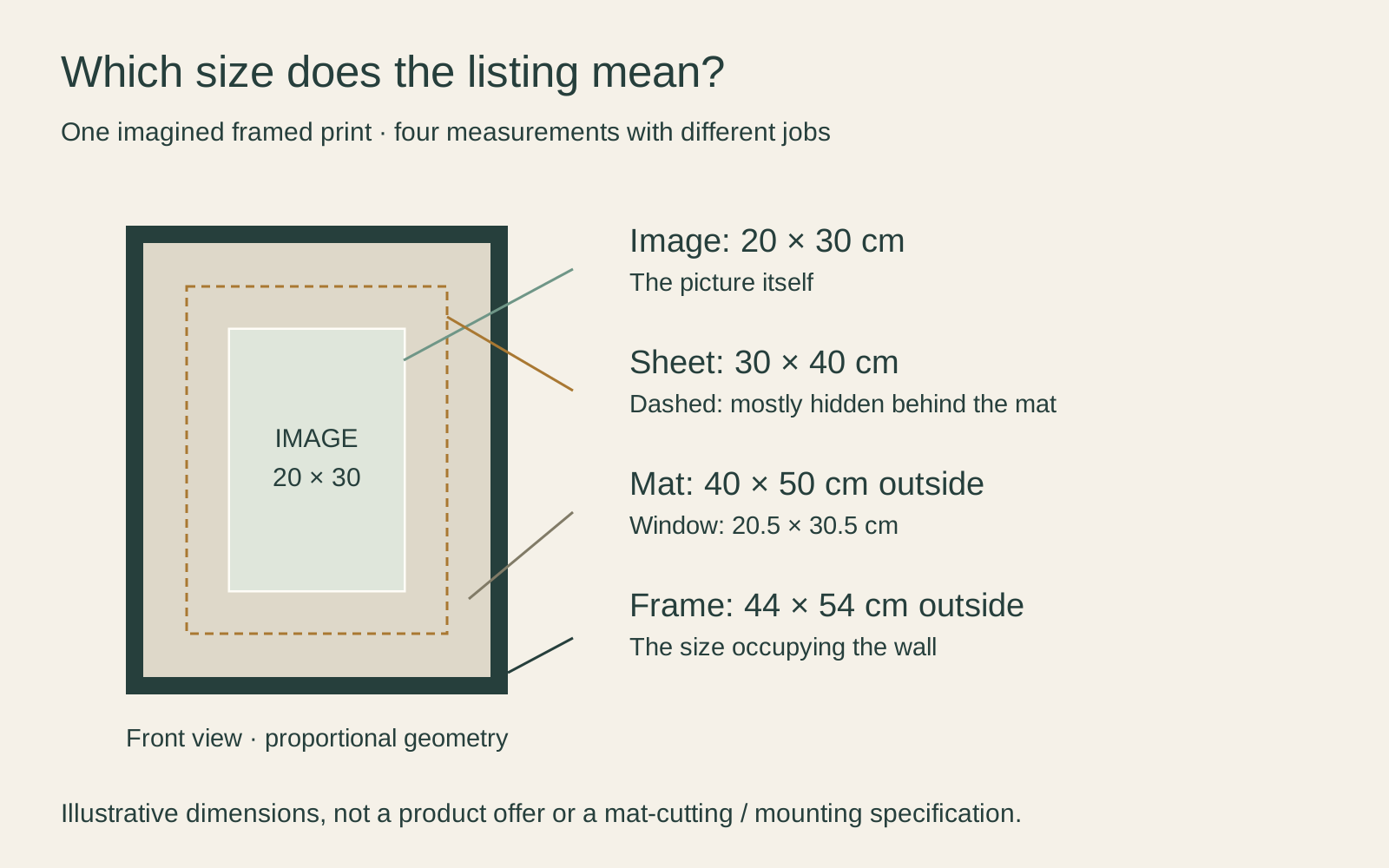
If a page says only “40 × 50”, ask which part it means and confirm the unit. Do not assume inches, centimetres, image size or outside size from the room photograph. The print-size reference guide helps with conversions once the measurement has been identified.
Separate a paper border from a mat
A white area may be unprinted paper around the image. It may instead be a separate board with an opening cut in it: a window mat, also called a mount in some framing contexts. The photograph can make these look similar, but they are not the same item.
In the illustrated example, the sheet has a 5 cm border around the 20 × 30 cm image. Most of that sheet border is hidden behind the mat. The slightly larger 20.5 × 30.5 cm mat window reveals a 2.5 mm strip of paper on each side of the image. These are example dimensions, not a standard border requirement.
Ask whether a pictured white surround is included and what creates it. A border printed as part of a file will become part of the paper print; it does not turn into a separate mat when ordered. If that distinction changes the appearance you want, resolve it before choosing a frame.
Read paper and print terms together
Paper descriptions may name the maker, product, composition, surface and weight. Each answers a different question. A matte surface describes appearance, not a complete durability specification. A weight stated in grams per square metre describes mass per area; it does not, on its own, identify thickness, texture or the quality of the image.
Look for a description tied to the selected format. “Fine-art paper” is less informative than a named paper with a stated surface and printing process. Equally, a long list of technical numbers is not useful if it belongs to another product option.
For a concrete manufacturer example, Printful lists both 189 g/m² paper weight and 0.26 mm paper thickness for its Enhanced Matte Paper Framed Poster. It records them separately because they are different measurements. Those figures apply to that product, not to all matte prints. Printful’s specification.
Use the detail to compare suitable products, not to select the biggest number. If the choice is mainly about how the surface looks, our matte, satin and fine-art paper guide takes that question further.
Check what the frame description includes
“Black frame” gives a colour, not the whole construction. Look for the frame material and profile, any front cover, the mat and backing, and whether the print arrives fitted. Glazing is the framing term for the transparent front cover; it might be glass or acrylic, but it should not be guessed from a reflection in a mockup.
For paper objects, the Library of Congress’s preservation guidance specifies separation between the object and the glazing, using an appropriate mat or spacers. A paper border alone does not provide that physical spacing. Library of Congress matting and framing guidance.
A framed canvas has a different construction from a glazed paper print. If the canvas sits inside an outer frame, ask how the canvas itself is supported and which edges remain visible. Do not assume that a frame includes glazing, or that “ready to hang” specifies fixings suitable for every wall.
Distinguish file details from physical details
For a download, you need to know which files and proportions are included, not the shipping weight of a framed example. For a physical print, you need the supplied dimensions and materials, not just the size of the digital source.
Adobe defines pixel dimensions as the image’s total pixel counts along its width and height, while pixels per inch describe how densely those pixels are assigned to a print. Therefore “300 PPI” without pixel or print dimensions does not tell you how large a file can print. Adobe’s explanation.
Ask for an answer relevant to your order: can the supplied file support the intended output, or what physical print is supplied? You should not need to reconstruct the seller’s production workflow simply to understand the item.
Inspect the selected image not just the setting
Look for a straight-on view of the chosen size. A painting may need different crops to fill differently proportioned sheets, or it may retain the complete image with borders. Neither arrangement is explained by a room photograph alone.
Check where the image ends, whether any text or signature is cut off, and whether a border is part of the print. With canvas, ask what appears on the sides. If a size preview changes the composition, decide whether you actually prefer that version rather than treating it as a purely numerical choice.
Finally, separate styling props from order contents. Lamps, furniture, adjacent artworks and decorative frames in a scene are context unless the listing explicitly includes them.
Ask one question that resolves the order
Instead of asking “Is this good quality?”, ask about the uncertainty you have found. For example: “For the 30 × 40 cm paper option, is that the whole sheet, how large is the image, and is the pictured mat included?” That gives the seller something precise to answer.
Then reread the selected option and final summary. A clear listing should let you describe the purchase without borrowing assumptions from its photographs. When the object, dimensions and included components agree, you can return to the more enjoyable question: whether this is the picture you want in your home.
Editorial record
About this article
- Author
- Publisher
- GeMarkt
- Published
- Reviewed
- Internal source & rights check. Conducted by GeMarkt Research Review. This is an internal editorial check—not independent peer review.
- Source standard
- Buying guide source standardSeparates measured or first-hand evidence from general guidance and keeps practical limits visible.
Found a claim that needs checking? Report a factual error.