GeMarkt Blog · Practical guide
Is Kandinsky’s Art Public Domain? Check the Work and File
Start with exact Kandinsky works: a documented U.S. example, two Lenbachhaus CC0 images, and separate checks for publication, books and later reproductions.
Rights check · reviewed
The short answer
The answer depends on the work and file. AIC identifies 1919 U.S. publication for Cannons; Lenbachhaus supplies the two illustrated files under CC0. The ordinary EU/UK painter term has elapsed, but the illustrated paintings’ independent U.S. publication chains are not established here.
| What is being checked | Result | Why |
|---|---|---|
| European Union — ordinary author term | Ordinary painter term expired after 2014 | Kandinsky died in 1944. The ordinary life-plus-70 calculation has elapsed; national exceptions, moral rights, other contributors and later first-publication rights are not waived by that calculation. |
| United Kingdom — ordinary painting term | Ordinary painter term expired after 2014 | The ordinary life-plus-70 artistic-work rule has elapsed. Special rules for certain old unpublished texts, engravings or photographs must not be applied indiscriminately to paintings or ignored for other material. |
| United States — independent publication history | Check the exact work, not its creation year | This guide does not independently establish U.S. publication histories for the illustrated paintings. Institutional public-domain or CC0 designations are attributed. Neither a pre-1931 creation date nor a post-1930 date proves the outcome by itself. |
| Selected digital files | Two exact museum-supplied CC0 files | Lenbachhaus GMS 446, Color Study: Squares with Concentric Circles (1913), and GMS 66, Improvisation 26 (Rowing) (1912), carry exact-object CC0 1.0 terms. Original JPEGs and complete object HTML are preserved with hashes. No permission is inferred for unacquired AIC or other files. |
| Other works, editions and providers | Research links are not cleared downloads | Ten unacquired records remain HOLD for display. No whole-catalogue or worldwide clearance. Modern editions, translations, adaptations and photographs need their own evidence. |
| United States — Cannons only, attributed institutional finding | AIC identifies 1919 U.S. publication | The Ryerson & Burnham Libraries’ official record expressly connects a 1919 U.S. publication of Improvisation No. 30 (Cannons) with U.S. public-domain status. This guide did not independently inspect that plate. The finding does not extend to either illustrated Lenbachhaus painting. |
Twelve exact research records; two selected Lenbachhaus CC0 files and ten research-only display HOLDs. The AIC Cannons finding is attributed institutional evidence, not inspection of its historical publication plate or a clearance of every Kandinsky.
This is a documented research summary, not legal advice. Copyright and moral-rights rules can vary by country and by the history of a particular work.

What we’ll look at
Which Kandinsky work, and which digital image, do you want to use?
Short answer: Some exact Kandinsky works and image files have a clear public-domain basis; his entire output should not receive one blanket “yes.” The Art Institute of Chicago identifies a 1919 U.S. publication supporting the U.S. public-domain status of Improvisation No. 30 (Cannons). The two different works illustrated here have files supplied under CC0 by Lenbachhaus. Their independent U.S. publication histories are not established by this guide.
Kandinsky lived from 1866 to 1944. His ordinary EU and UK life-plus-70 author term has elapsed, but that is not a worldwide clearance. Start with the particular painting, print or book you have found, then check the country and the reproduction you intend to use.
Start with a particular work
The Art Institute’s library account offers a useful concrete example. It identifies a U.S. publication of Cannons in 1919 and expressly connects that publication with the work’s U.S. public-domain status. This is an attributed institutional finding; we have not independently inspected that historical plate.
The painting’s collection record dates the canvas to 1913. Those two years do different jobs: one dates the making of the painting, the other provides publication evidence. Neither is the museum’s accession number, 1931.511. A number beginning with 1931 is not proof that the painting was first published then.
Kandinsky’s titles can also be misleadingly similar. An Improvisation, a numbered Composition and a plate from Small Worlds are not interchangeable names for any colourful abstract picture. Keep the full title, date and collection number together before making a claim or ordering a reproduction.
A colour study, not a perfect grid
The opening image is the work often called Color Study: Squares with Concentric Circles. Lenbachhaus records it under the German title Farbstudie – Quadrate mit konzentrischen Ringen: 1913, watercolour, gouache and crayon, just 23.9 by 31.5 centimetres.
It is not a huge oil painting or a computer-generated colour chart. The rings wobble, edges bleed, and some colours nearly cover the ones underneath. Twelve roughly square spaces let you compare similar shapes with different neighbours. A pale centre surrounded by red behaves differently from a dark centre surrounded by yellow.
Try looking at one square, then the square immediately beside it. The activity is simple: what appears to advance, recede, brighten or become heavy? You do not need to assign a fixed symbolic meaning to every colour to notice the differences.
The complete sheet matters. A close crop of one circle may be attractive, but it removes the comparison that the rows make possible. A digital redraw with perfectly circular rings would change the visible work, even if it kept approximately the same palette. The image here preserves the museum file’s irregular boundaries and paper edge.
A boat inside an improvisation
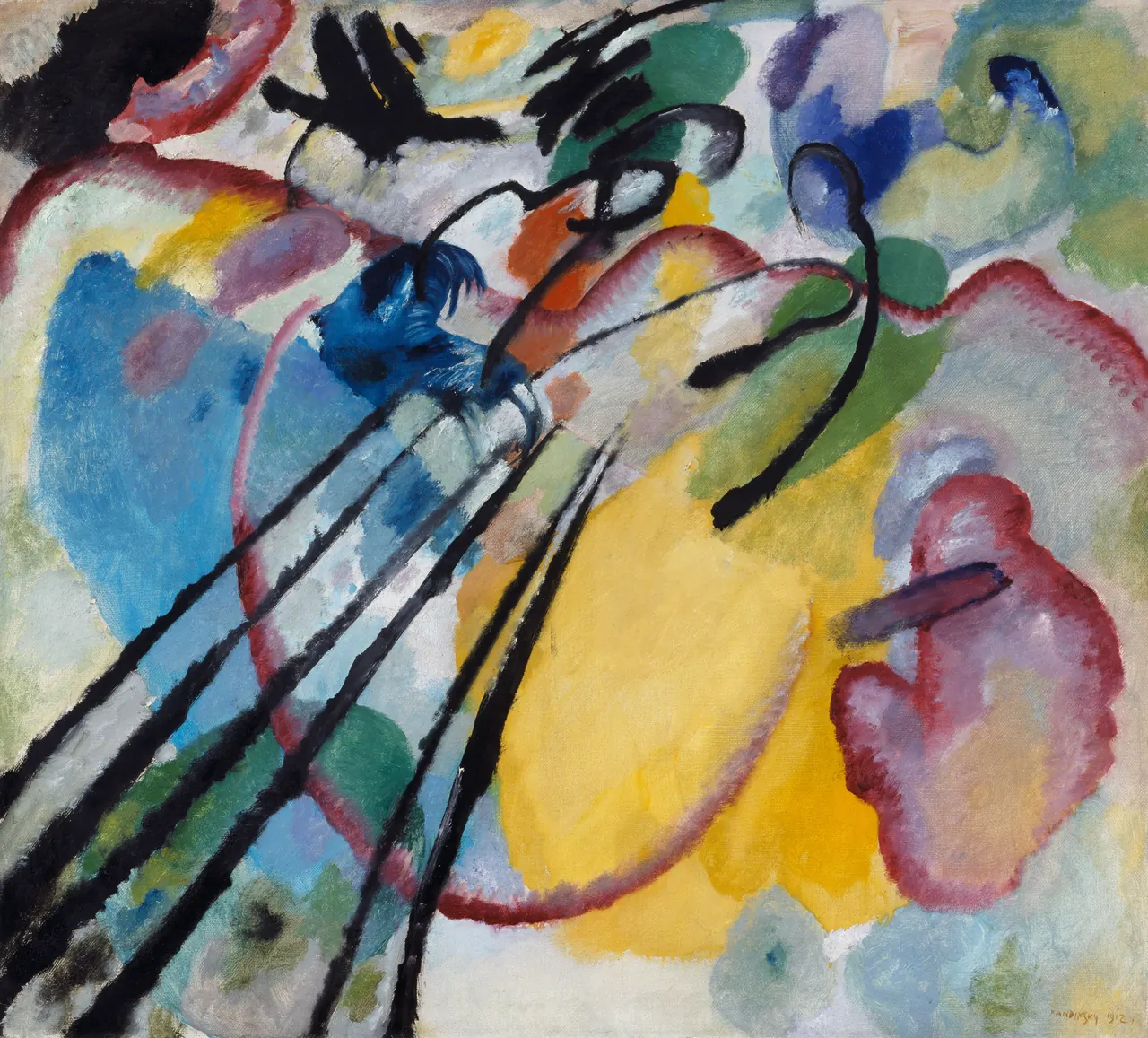
Wassily Kandinsky, Improvisation 26 (Rowing), 1912. Lenbachhaus, Munich, Gabriele Münter Stiftung 1957, GMS 66. Exact object and CC0 file.
In Improvisation 26 (Rowing), Lenbachhaus identifies a boat with extended oars and figures bent forward. The subtitle gives you a foothold without turning every patch of colour into a labelled object.
Follow the long black strokes rising from the lower left. Then look at the curved outline above the broad yellow area. The marks suggest movement across the surface, rather than the measured depth of a harbour view. Blue does not stay neatly inside a strip of water; colour and outline often move independently.
This is an oil painting measuring 97 by 107.5 centimetres. A website can display it at the same width as the small colour study, hiding a substantial difference in physical size and surface. They are useful companions because they show two different ways of organising colour: repeated compartments in the study, and intersecting gestures in the painting.
Twelve records to start from
These are twelve identified research objects, not twelve approved image downloads. Only the two Lenbachhaus files are reproduced here. The Art Institute’s public-domain flags are reported as provider metadata; a missing flag is not itself a legal ruling that a painting remains protected.
| Work and institutional record | Recorded date | What the record helps distinguish |
|---|---|---|
| Improvisation No. 30 (Cannons) | 1913 | Separate institutional evidence of 1919 U.S. publication. |
| Landscape with Two Poplars | 1912 | A named landscape, not a generic abstract composition. |
| Painting with Green Center | 1913 | A separate Chicago canvas with its own record. |
| Painting with Troika | January 18, 1911 | Keep the museum’s unusually precise date. |
| Houses at Murnau | 1909 | Earlier architectural subject; image not acquired here. |
| Klänge | 1907–12; published 1913 | A book: production and publication dates differ. |
| Small Worlds V | 1922 | Plate five; no public-domain image flag in checked metadata. |
| Small Worlds IV | 1922 | Plate four, not a second title for plate five. |
| The Green Line | 1938 | Later work; U.S. branch unresolved here. |
| Gray Spots | July 1934 | Later work; file permission not established here. |
| Squares with Concentric Circles | 1913 | Illustrated Lenbachhaus CC0 file, GMS 446. |
| Improvisation 26 (Rowing) | 1912 | Illustrated Lenbachhaus CC0 file, GMS 66. |
What changes between countries
The ordinary EU term runs for the author’s life plus seventy years. For a painter who died in 1944, that ordinary calculation ended with 2014. It does not remove national exceptions, moral rights or rights arising from the first lawful publication of previously unpublished material.
The UK’s ordinary artistic-work rule also uses life plus seventy years. Do not extend that simple answer indiscriminately to every item in an archive: the UK duration notice identifies special rules for some old unpublished material, including engravings. Its 2039 rule is not a general extension for all old paintings.
In the United States, Circular 15A states that works published there before January 1, 1931 are public domain. That is the 2026 cutoff for publication, not a licence for everything painted by 1930. Foreign publication and formerly unpublished works can require further analysis. Apart from the attributed Cannons finding, this guide does not independently establish U.S. publication histories for the listed works.
Books, prints and the file you download
A historical Klänge page, a recent translation and a newly designed edition are different things. Identify the edition and the page or plate; do not copy a publisher’s modern introduction because Kandinsky’s own author term has ended. Likewise, a modern exhibition photograph may include more than a faithful view of the painting.
For the two illustrated files, Lenbachhaus explicitly supplies CC0 terms. Keep its object link, accession and file record with your download. That makes the provider’s permission traceable without pretending it settles every legal question in every country.
Finally, check the image itself. Preserve the complete composition for identification, label any detail crop, and avoid stretching circles into ovals. A clear source answers where the image came from; careful presentation lets a reader see what Kandinsky actually made.
Sources and review method
We checked the artist chronology against museum records, treated each named jurisdiction separately, and recorded the provider policy for the image set. These sources support the legal framework and artist dates used above; the source file for any individual image still needs its own record.
- Farbstudie — Quadrate mit konzentrischen Ringen, GMS 446 — Lenbachhaus. Exact 1913 work on paper, dimensions and supplied CC0 image.
- Improvisation 26 (Rudern), GMS 66 — Lenbachhaus. Exact 1912 painting, boat/rowing interpretation, dimensions and CC0 image.
- Copyright Law: Publishing Artwork and the Public Domain, case 3 — Art Institute of Chicago, Ryerson & Burnham Libraries. Attributed finding for 1919 U.S. publication of Cannons; 2008 foreign-formalities discussion not presented as current blanket rule.
- Improvisation No. 30 (Cannons), 1931.511 — Art Institute of Chicago. 1913 painting identity and accession; current API preserved. Image request denied and not bypassed.
- UK Copyright Notice: Duration of copyright — UK Intellectual Property Office. 2039 exceptions apply only to specified categories, not all unpublished paintings.
- Directive 2006/116/EC, author term and later publication rights — EUR-Lex. Ordinary life-plus-70 calculation; national exceptions and later first-publication rights remain separate.
- How long copyright lasts — UK Intellectual Property Office. Ordinary artistic-work term, not a universal answer for every kind of archival material.
- Duration of Copyright, Circular 15A, April 2026 revision — U.S. Copyright Office. Pre-January-1931 U.S. publication cutoff in 2026; publication is not the painting date.
- 17 U.S.C. Chapter 3, including section 303 — U.S. Copyright Office. Conditional treatment of formerly unpublished works; no blanket 2047 conclusion.
Editorial record
About this article
- Author
- Publisher
- GeMarkt
- Published
- Reviewed
- Internal source & rights check. Conducted by GeMarkt Research Review. This is an internal editorial check—not independent peer review.
- Source standard
- Rights guide source standardSeparates the underlying work from the source file, records the review date, and links the evidence used for the conclusion.
Found a claim that needs checking? Report a factual error.