GeMarkt Blog · Practical guide
What “Museum Quality” and “Archival” Really Mean
Turn vague print-quality claims into useful questions about paper, ink, framing and display. Understand why a paper certificate is not a whole-print guarantee.

“Museum quality” and “archival” are not enough information to choose a print. Ask what the words describe: the paper, the ink-and-paper combination, the frame materials, or a tested finished product. A useful answer identifies the material and explains the evidence behind the claim.
That does not mean every seller using those words is misleading you. It means two listings can use similar language while giving you very different amounts of information. Your task is to find out what you would actually receive.
Ask what the claim describes
Start by replacing an adjective with a question. “Archival paper” invites “Which paper, and what specification supports that?” “Museum-quality framing” invites “Which mount, backing, glazing and attachment method?” A claim about accurate colour needs a different answer again.
The Library of Congress’s guidance on storing books cautions that “archival,” when applied to housing materials, has no meaningful definition by itself. That is a warning to inspect specifications, not a claim that every use of the word in every country has the same legal status.
For an inexpensive reproduction, you may reasonably accept a simpler description than you would for an irreplaceable drawing. But a low price does not turn missing information into evidence, and a high price does not supply it automatically. Decide what you need to know before choosing what you are prepared to spend.
Separate the paper from the print
The support is only part of the object. A paper can have documented permanence properties without establishing the performance of the image printed onto it. Keep the identity of the paper and the printing system as separate questions.
In its 2025 paper age-resistance certificate, Hahnemühle names paper standards but also states that print permanence depends on ink and environmental conditions. It explicitly does not guarantee print permanence under all the differing conditions of use. The certificate is not a licence to promise that any image printed on that paper will remain unchanged for a century.
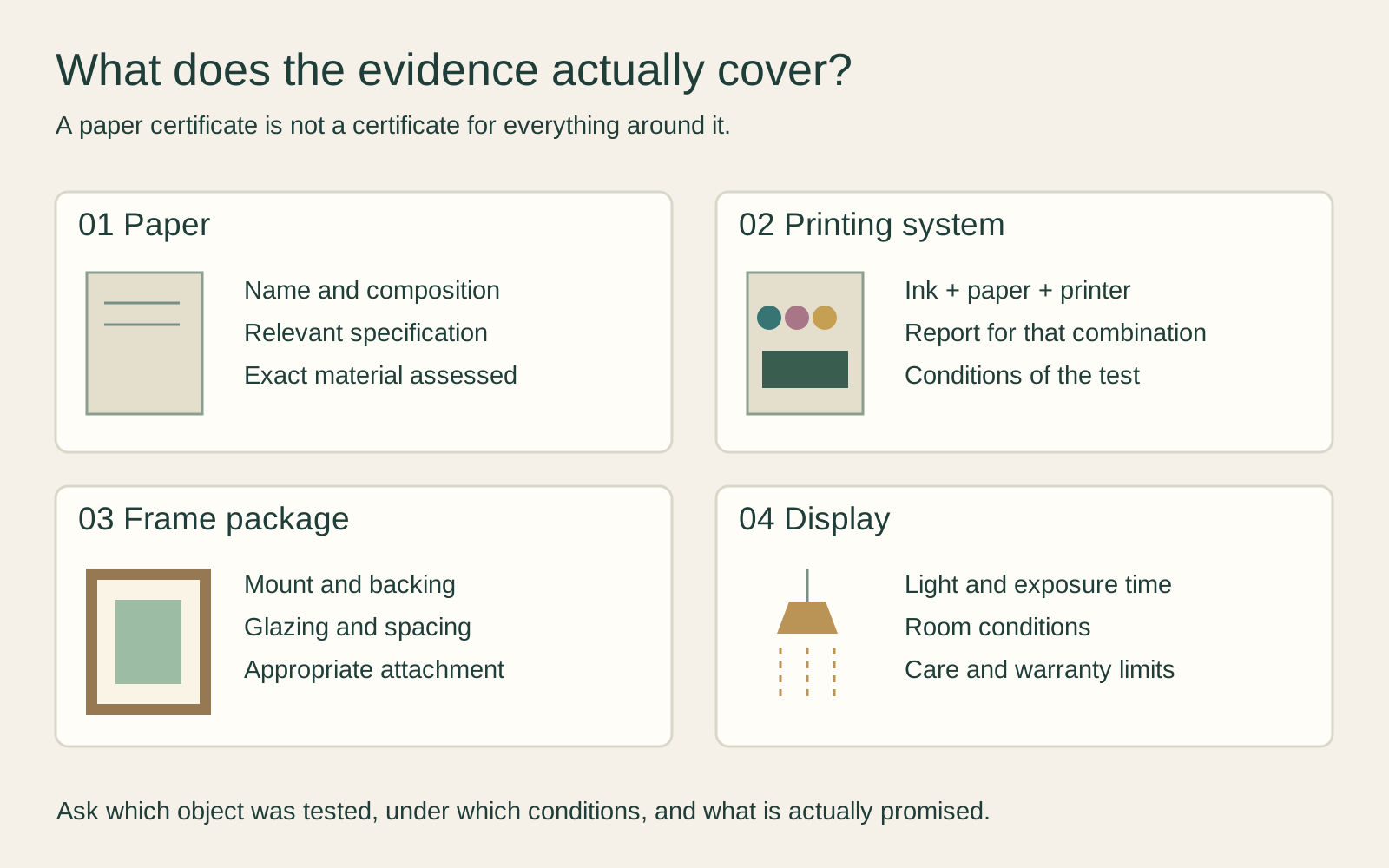
If a listing cites a standard, ask which material was assessed and where the supporting document can be read. Do not assume a code printed beside the paper’s name certifies colour accuracy, every ink combination, or the assembled frame. You need not memorise standards to notice when the evidence describes a smaller part than the sales claim does.
Read longevity claims with their conditions
“Lasts 100 years” sounds simple because it leaves several questions unanswered. Does it mean display or dark storage? Which ink and paper were tested? What light, temperature and humidity were assumed? What amount of visible change counted as the end point?
Epson’s print-permanence summary explains the interaction of ink formulation, paper, printer operation and storage or display conditions. We use it for that system-level point, not as a current ranking of brands or a universal test protocol. Its older product comparisons should not be transferred to an unidentified print today.
A test report, a manufacturer’s guidance and a seller’s warranty are also different things. Ask to see the actual warranty if a purchase depends on a guarantee. Do not convert a laboratory estimate into a promise about a sunny wall, or confuse a refund term with proof of material permanence.
If no result exists for the specific combination, an honest description can say so. “The paper has this specification; we do not have a lifespan test for the finished print” is more useful than an unsupported number.
Check the framing materials too
Ask about what touches or surrounds the print, not just the attractive front moulding. The Library of Congress’s preservation-framing guidance includes both cotton rag and chemically purified, lignin-free wood-pulp matboard among suitable options. “Not cotton” therefore does not, on its own, prove that a board is unsuitable.
The important purchase question is the actual specification of the board and its suitability for the object. The same guidance treats chemically stable frame components and separation from glazing as parts of preservation framing. A decorative mat colour tells you none of those things by itself.
You do not need to dismantle an existing frame to investigate. Ask the supplier or framer for a written description. For a valuable or original work, ask a conservator about its particular needs before changing an old mount or attaching anything to it.
Look for image quality separately
A durable support and a satisfying reproduction are not the same achievement. Examine whether the image has the composition you wanted, whether the source version is identified, and whether the chosen size keeps important detail legible. None of those decisions is settled by the word “archival.”
Imagine a beautifully specified paper carrying a low-resolution image with a caption cut off. The paper certificate cannot repair that purchase. Conversely, a pleasing temporary poster is not automatically a conservation object just because its colours look good on arrival.
Our resolution and print-size guide explains the file question. When looking at a reproduction, also distinguish the artwork’s original dimensions from the new sheet size and the image area printed on it. Material quality does not tell you which of those measurements the listing has supplied.
Compare two quotes with better questions
Suppose two hypothetical quotes offer the same image and sheet size. Quote A says “museum quality, archival, premium.” Quote B identifies the paper, ink type, print dimensions, framing components and care instructions, but gives no lifespan number. B provides more things you can check; this example does not prove that its unseen product is better.
Ask both sellers the same short questions: What exactly is the paper? What printing process and ink are used? What is included in the frame? Is there a relevant permanence report? What care conditions and warranty exclusions apply?
Then compare the actual answers against your purpose. A changeable rental-room print, a family photograph and an original work need not receive identical budgets or treatment. If a supplier cannot answer a question essential to your decision, postpone that purchase rather than filling the gap with an assumption.
Keep a record you can use
Save the product description, named materials, invoice and care information together. If you reframe the print later, those details can help the framer distinguish the known material from a guess. A screenshot of a slogan is much less useful than a specific paper name and an identified print process.
Good evidence still needs sensible display. Our guide to sunlight and fading explains why a protective specification does not make a sunny position harmless. Buy the image you want with the clearest relevant information you can obtain; treat impressive language as the beginning of a question, not the end of one.
Editorial record
About this article
- Author
- Publisher
- GeMarkt
- Published
- Reviewed
- Internal source & rights check. Conducted by GeMarkt Research Review. This is an internal editorial check—not independent peer review.
- Source standard
- Buying guide source standardSeparates measured or first-hand evidence from general guidance and keeps practical limits visible.
Found a claim that needs checking? Report a factual error.