GeMarkt Blog · Essay
Vermeer vs Rembrandt
Put Vermeer's Young Woman with a Water Pitcher beside Rembrandt's Aristotle to compare light, gesture, texture and two very different kinds of stillness.

A woman holds a window with one hand and a pitcher with the other. A man rests his hand on a sculpted head. Neither figure looks straight at us. Put these two paintings together and the usual “quiet Vermeer versus dramatic Rembrandt” shortcut starts to unravel: both pictures are remarkably still.
Vermeer and Rembrandt differ here in how they organise attention. Vermeer makes a figure’s ordinary action part of a precisely arranged room; Rembrandt gathers attention around a face, a hand and an encounter with the past. Light matters to both, but it does different work.
The short answer
Johannes Vermeer (1632–1675) worked in Delft. Rembrandt van Rijn (1606–1669), a generation older, established his major career in Amsterdam. The Met’s Vermeer essay describes a small output made for a relatively limited circle of patrons; its Rembrandt essay describes a prolific painter, teacher, draughtsman and printmaker.
Those different careers help explain why two famous pictures cannot represent everything either artist did. The comparison below concerns a domestic interior by Vermeer and an imagined encounter with an ancient philosopher by Rembrandt—not two portraits of equally placed sitters.
| Look at | Vermeer: Young Woman with a Water Pitcher | Rembrandt: Aristotle with a Bust of Homer |
|---|---|---|
| Main setting | A recognisable room beside a window | A dark space around a figure and a bust |
| Main gesture | Hands connect window, body and pitcher | One hand touches Homer’s sculpted head |
| Light | Describes surfaces across the room | Concentrates attention on selected forms |
| Subject | An everyday domestic action | An imagined ancient philosopher |
| Scale | 45.7 × 40.6 cm | 143.5 × 136.5 cm |
Two quiet figures side by side
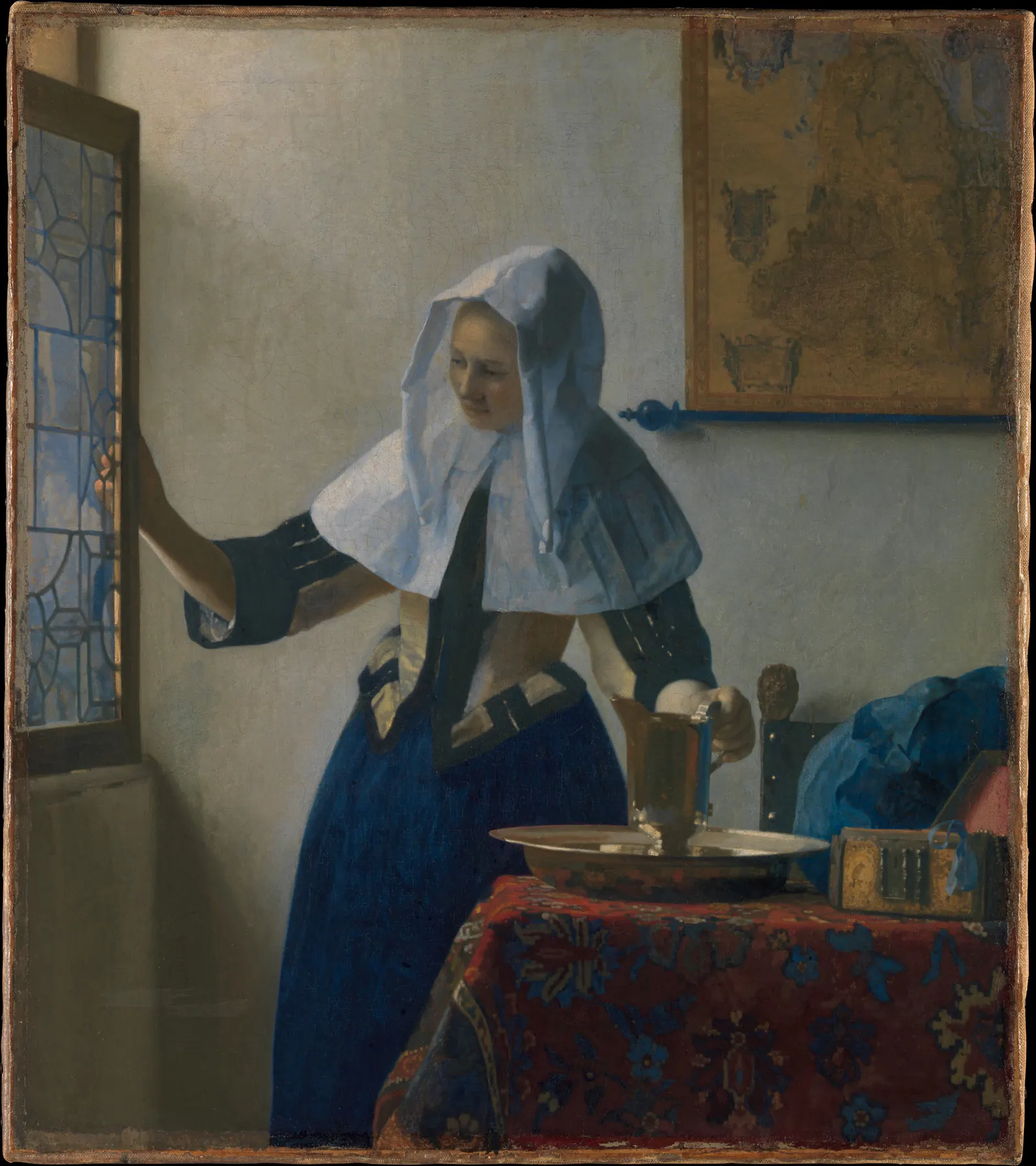

Vermeer connects a person to a room
Start with the woman’s hands. One holds the open window; the other rests at the pitcher’s handle. Her arms link an opening in the wall with objects on the table. The action is small, but it extends across the composition.
Now follow the straight edges: window frame, map, table. They give the room a framework around the softer forms of clothing and body. The patterned table covering is busy, yet the large pale wall above it gives the eye somewhere to rest.
The Met interprets the scene as part of a woman’s morning washing, with linen protecting her clothes and hair. That context explains the pitcher and basin without requiring us to invent her name, her thoughts or a detailed story about the rest of her day.
The picture lets an ordinary action become absorbing. It does not need a major event to hold our attention; relationships between hands, light and objects are enough.
Rembrandt connects a person to another mind
In Rembrandt’s picture, the hand on the bust establishes a different kind of contact. This is not two men meeting in a room. Homer lived centuries before Aristotle, and appears as a sculpted head rather than a living companion.
The Met’s reading of the painting connects the encounter with fame and lasting achievement. Aristotle wears a medallion of Alexander the Great, his powerful pupil; the museum suggests that worldly success may be weighed against Homer’s literary legacy. That is an interpretation, not a quotation from the figure’s mind.
Look at what the composition supplies even before that explanation. A living hand lies on a still head. Pale sleeves and gold stand out against dark clothing. The face is not shown in a broad public smile. These visible relationships make reflection plausible without spelling out one compulsory message.
Light organises the question
In the Vermeer, the window is visible. Light reaches the head covering, wall, metal and cloth differently, making you aware of their surfaces. You can explore a room rather than only isolate a face.
In the Rembrandt, the source of light is not pictured as an open window. Bright passages pick out Aristotle’s face, the bust, the sleeves and the chain, while large areas remain dark. The space supports those connections without becoming an equally detailed subject of its own.
Try an uncomplicated comparison: look away, then return to each image and notice the first three things you find. In the Vermeer they may be spread across the room. In the Rembrandt they may cluster around the figure and his contact with Homer. Your own order can differ; the point is to notice how the painting offers it.
Calling this “good lighting” misses the distinction. The question is what the light encourages you to connect.
Smooth-looking and tangible paint
Vermeer’s pitcher appears to have reflective metal edges. Rembrandt’s chain appears to catch light in repeated bright touches. Both make paint describe another material, but the relationship between illusion and visible brushwork is different.
The Met’s Rembrandt record specifically notes his substantial buildup of paint. In the reproduction, the pale sleeve and bright chain remain visibly worked rather than uniformly smoothed. Vermeer’s surfaces generally read more quietly at this scale, but quietness should not be confused with a photograph or an automatic copying process.
The Vermeer essay emphasises invented compositions and carefully judged relationships. It also cautions against exaggerating the explanatory role of the camera obscura, an optical device that projects an image. A possible interest in optics does not replace the painter’s decisions about what to include and how to paint it.
The actual sizes change the encounter
On a phone, both pictures can fill roughly the same rectangle. In reality, the Rembrandt is more than three times the Vermeer’s height. The dimensions in their captions matter.
The small Vermeer can invite close, concentrated looking; the much larger Rembrandt can make the figure a more substantial presence before you. These are possible effects of scale, not instructions for how every visitor must feel.
Reproductions also flatten texture and change the relationship between a picture and the surrounding room. Use them to follow the composition, but do not conclude that equal screen sizes mean equal physical experiences.
Two careers, not two fixed personalities
Vermeer did not paint only domestic rooms. The Met’s account includes early religious subjects, outdoor views and later allegory. Rembrandt’s range likewise extends far beyond the solitary, richly dressed thinker shown here: portraits, biblical scenes, drawings and prints all belong to his work.
Their differences therefore cannot be reduced to “Vermeer paints women, Rembrandt paints men” or “Vermeer is calm, Rembrandt is emotional”. Such labels discard too many pictures before we have looked at them.
Nor does a painted face give reliable access to the artist’s own mood on a particular day. It is safer—and more rewarding—to explain how a gesture, a light passage or a surrounding space shapes the experience of a specific work.
How to compare another pair
Begin with the action, then the light, then the actual size. Ask which visible details support your interpretation and which details need information from the museum record.
If a picture of a face makes you wonder whether it represents a known sitter, portrait versus tronie explains why that distinction matters. The Vermeer and Rembrandt guides provide more objects and sources to explore. You do not have to choose one painter over the other to see what each makes possible.
Editorial record
About this article
- Author
- Publisher
- GeMarkt
- Published
- Reviewed
- Internal source & rights check. Conducted by GeMarkt Research Review. This is an internal editorial check—not independent peer review.
- Source standard
- Art history source standardPrioritises object records and research sources, distinguishes evidence from interpretation, and states material uncertainty.
Found a claim that needs checking? Report a factual error.