GeMarkt Blog · Essay
Portrait vs Tronie
A portrait represents a particular person; a tronie explores a face or character. Compare Rembrandt and Vermeer without confusing a model with a sitter's identity.


A portrait is made to represent a particular person. A tronie explores a face, expression or character without making that person’s identity its main purpose. That is why the Mauritshuis calls Vermeer’s Girl with a Pearl Earring a tronie, even though she feels as present as someone you might meet.
The distinction is about the kind of picture, not whether a real person posed for it. A portrait can idealise its sitter. A tronie can be painted from a living model. And a portrait whose sitter’s name has been lost does not automatically become a tronie.
A portrait presents a particular person
A portrait connects the image to an individual: this artist, this family member, this ruler or this friend. It may record an appearance, commemorate someone, communicate status or present the identity the person wants others to see. The National Gallery of Art’s portraiture guide treats portraits as representations of both individuals and their social worlds.
That does not make every portrait a neutral record. Clothing, pose, setting and the treatment of the face all shape the encounter. A carefully chosen coat can be as important to the image as a carefully described nose.
Nor must a portrait be a paid commission. A self-portrait represents the artist and can serve many purposes besides satisfying a customer. The important relationship is between the picture and the person it sets out to present, not one fixed method of ordering or paying for it.
A tronie explores a face or character
In discussions of seventeenth-century Dutch painting, tronie is used for a character head or figure that gives the painter room to explore expression, costume and the effects of paint. The National Gallery of Art’s study of Gerrit Dou describes these pictures as figure studies, often sold independently but sometimes used in preparing other paintings. A tronie is not automatically an unfinished exercise.
Think of the difference between “this is a portrait of this person” and “look at this person-like presence the artist has created.” The second does not mean the face is generic or unconvincing. Quite the reverse: a particular turn of the head or glance may make a tronie feel remarkably alive.
The term is useful precisely because a compelling face can invite the wrong question. Wanting to know the name of Vermeer’s girl is understandable. Her unknown biography is not necessarily the subject the painting was intended to communicate.
Rembrandt and Vermeer side by side
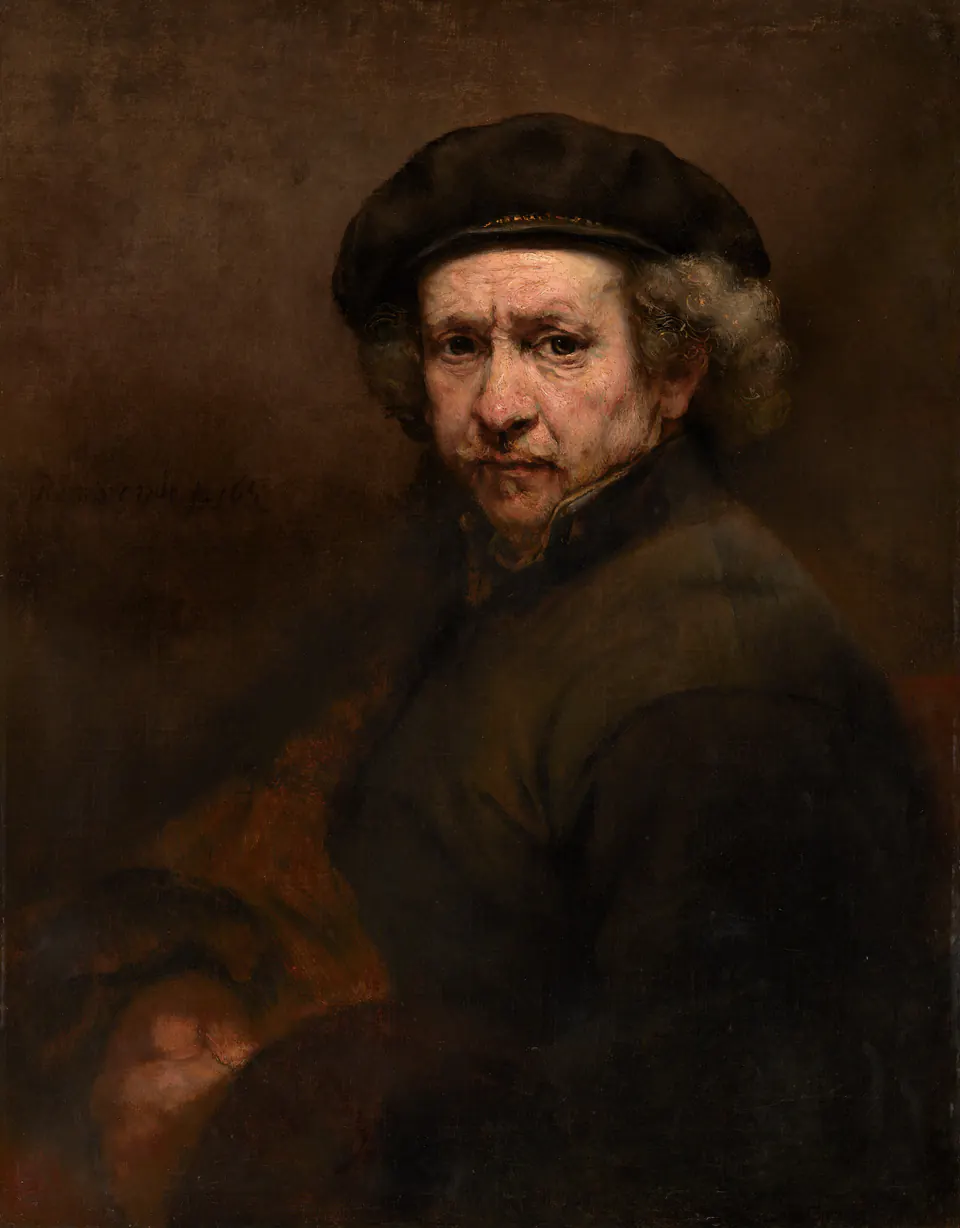
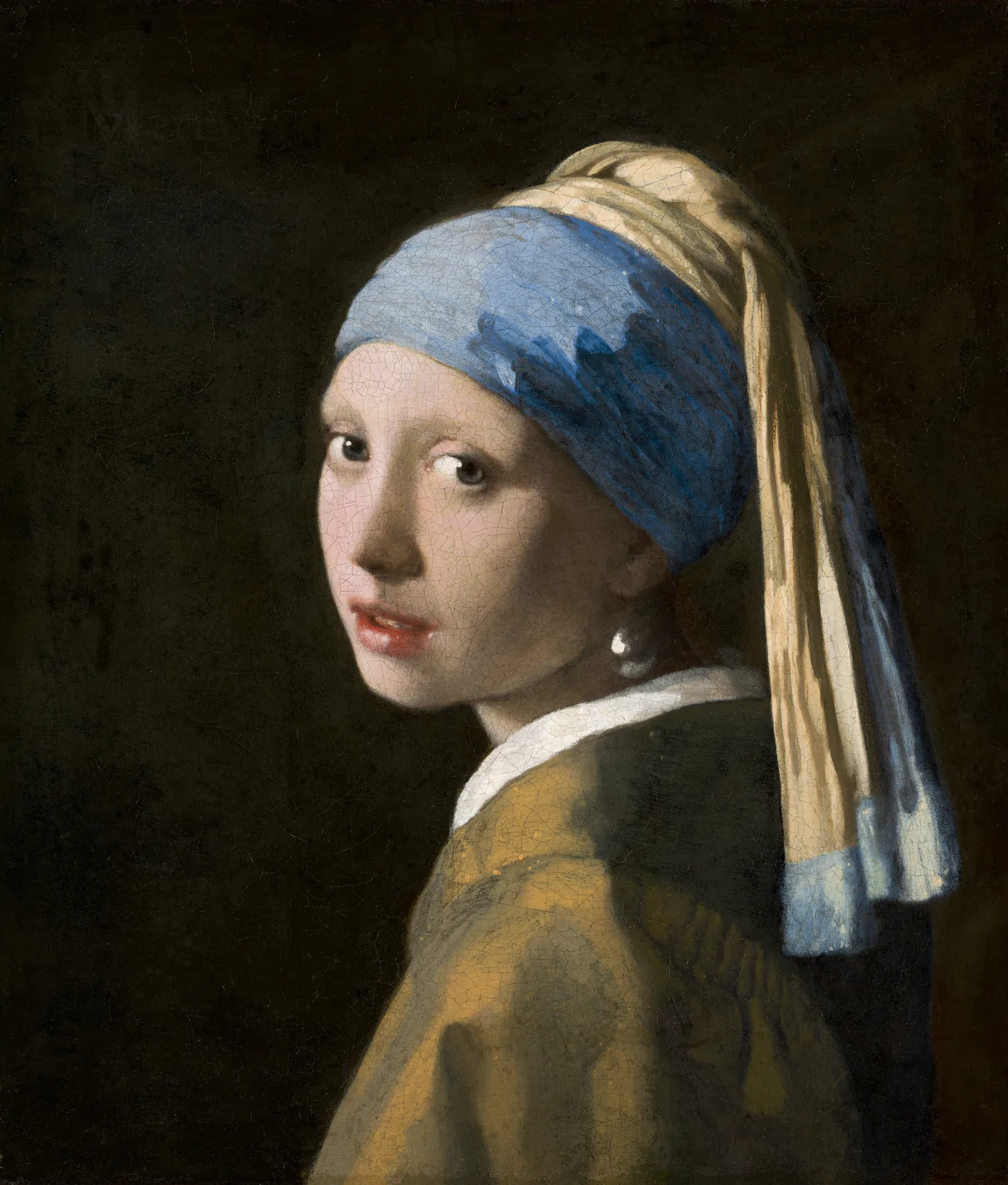
Both figures turn towards us against dark backgrounds. Rembrandt’s cap and coat nearly merge with the surrounding browns, concentrating attention on his face. Vermeer’s blue and yellow head covering makes a much brighter shape above the face, while the earring draws the eye down towards the white collar.
The National Gallery of Art identifies the first as Rembrandt’s 1659 self-portrait. Here, recognising the individual is part of understanding the work. But knowing his name does not give us direct access to his feelings. The painted expression remains something the artist constructed, not a recorded statement of his thoughts that day.
The second is the Mauritshuis’s example of a tronie. Her costume and luminous face support an imagined presence rather than the public identity of a named sitter. This does not make her less human. It changes the kind of information we should expect the picture to provide.
A real model does not settle the question
An artist needs something to work from, and a real model can help with the angle of a head, the fall of light or an expression. That model may then play a character in the finished picture. The person who sat and the identity the artwork presents are not necessarily the same thing.
The Mauritshuis notes that Rembrandt sometimes used his own face for tronies. A recognisable artist’s face is therefore not, on its own, proof that every such picture should be read as a self-portrait in the same sense. The work’s presentation and documented purpose matter.
This distinction also keeps fiction in its place. A novel or film may give Vermeer’s girl a name and a detailed life. That can be an engaging story, but it cannot establish the sitter’s identity. For the painting’s history and what its surface reveals, see our Girl with a Pearl Earring story.
Costume and a missing name are not enough
An unusual hat is a clue, not a classification system. Real sitters can wear elaborate or historical dress. Equally, a restrained face in plain clothing might still belong to a character study. Do not try to identify a tronie by wardrobe alone.
The Rijksmuseum’s Young Woman in Fantasy Costume, painted by Rembrandt in 1633, shows the value of a fuller explanation. Its clothing recalls earlier centuries, and the museum relates the face to goddesses and heroines in his work. The record preserves an older title that called it a portrait, possibly of Saskia, while its current account identifies a tronie. Reading the explanation is more informative than choosing whichever title sounds most certain.
Conversely, “Portrait of an Unknown Woman” can still be the appropriate title for a painting intended as an individual likeness. Losing a name over time changes our knowledge of the sitter; it does not by itself change the original purpose of the picture.
What the distinction changes when you look
With a portrait, ask how the person is presented: approachable or distant, formally dressed or informal, connected to a place or isolated against a background. Then check which details the museum can connect to that individual’s life. Avoid turning every shadow or wrinkle into a psychological diagnosis.
With a tronie, give more attention to the character the painting creates. Follow the light, the expression and the materials. Ask how a tilted head or bright piece of clothing holds your attention without requiring a life story behind it.
Neither category tells you how moving a picture must be. Rembrandt’s portrait and Vermeer’s tronie both sustain a face-to-face encounter. The distinction simply helps you separate recognising a person from experiencing a vividly painted presence—and enjoy each without asking it to prove the wrong thing.
Editorial record
About this article
- Author
- Publisher
- GeMarkt
- Published
- Reviewed
- Internal source & rights check. Conducted by GeMarkt Research Review. This is an internal editorial check—not independent peer review.
- Source standard
- Art history source standardPrioritises object records and research sources, distinguishes evidence from interpretation, and states material uncertainty.
Found a claim that needs checking? Report a factual error.