GeMarkt Blog · Practical guide
UV-Protective Glazing: Is It Worth It?
Decide when UV-filtering glazing is worth the extra cost, which specifications to ask for and why even protected prints need a sensible place on the wall.

UV-filtering glazing is often a worthwhile extra for a print you want to keep, but it is not a way to make a sunny wall safe. Buy a documented specification that suits the object, then control where and how long you display it. Pay separately for reduced reflections if that improves the view in your room.
Glazing is the clear sheet in front of a framed picture, usually glass or acrylic. Two apparently identical frames can contain very different products. Conversely, the more expensive-looking option may cost extra mainly because it reflects less, rather than because it offers a higher level of ultraviolet filtering.
Start with what you want to keep
Consider the object before the upgrade price. A favourite reproduction that you hope to live with for decades deserves a different discussion from a readily replaceable seasonal poster. A signed print, a family photograph or a work with handwritten additions may have value that buying another copy cannot replace.
Make that distinction without assuming that low purchase price means low personal importance. A print given by someone you love may matter much more than its receipt suggests. Equally, spending heavily on every inexpensive decorative sheet is not an obligation.
Tell the framer what the object is and how long you intend to display it. If it is original, old, fragile or unusually valuable, obtain advice appropriate to its materials. The question is then preservation of that particular object, not simply which glass option sounds best.
Understand what the filter can do
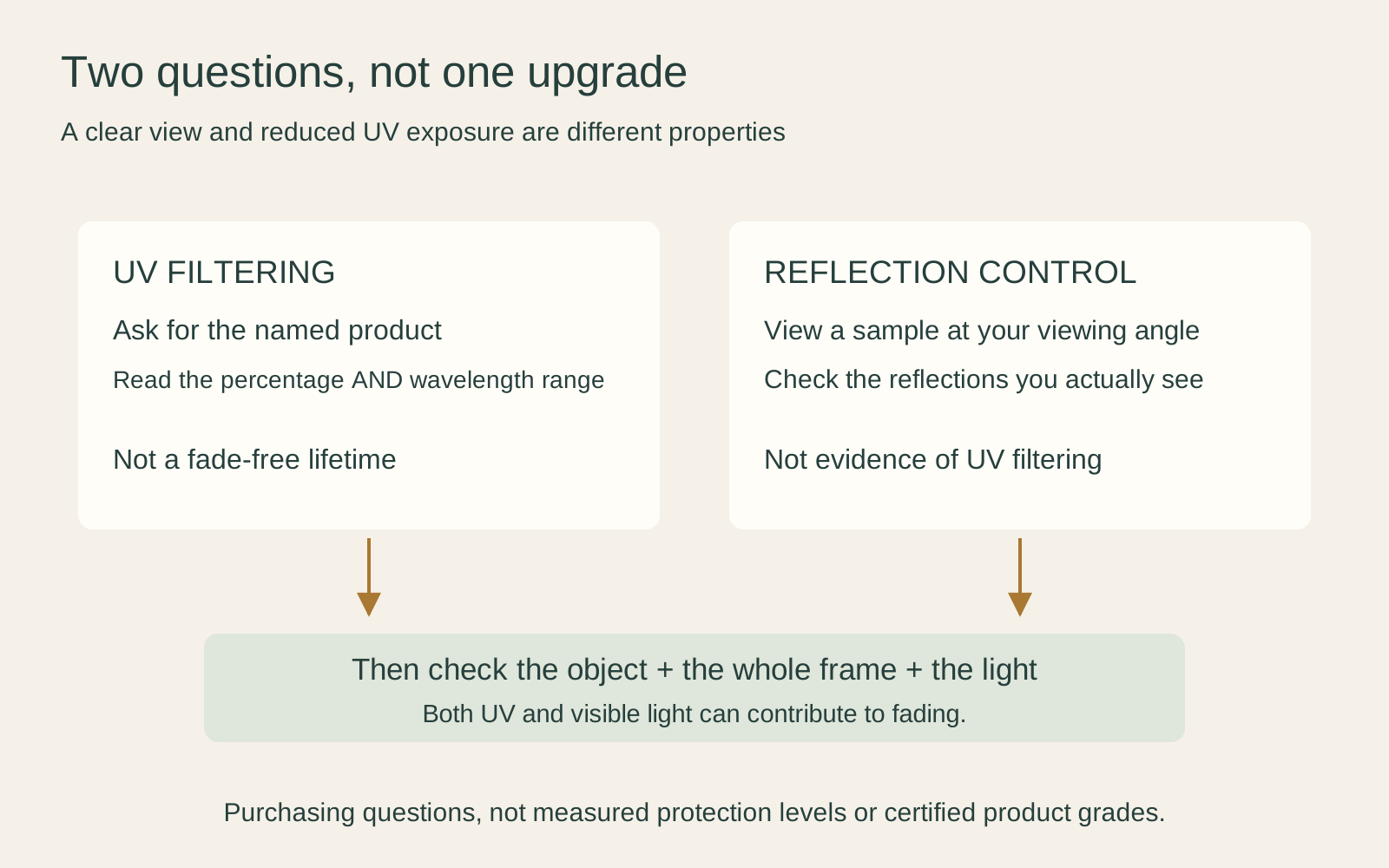
Ultraviolet radiation is invisible to us but can damage paper and other materials. A suitable filter reduces the UV reaching the object. It does not turn the rest of the light into harmless illumination: the Canadian Conservation Institute explains that both UV and visible light can cause fading.
That is why “99% UV protection” does not mean “99% less fading,” let alone a guaranteed number of years without change. The label describes filtering over a specified range. It does not measure the response of every possible ink, paper and coating in your home.
Existing fading is not reversed by fitting new glazing. Think of the upgrade as reducing one future exposure, not repairing earlier damage. If a print is already discoloured, photograph its condition and discuss what is realistic before paying for a new frame around it.
Separate protection from reflections
A UV specification concerns radiation passing through the glazing. An anti-reflective treatment concerns the reflections you see on its surface. One sheet can offer both, but you should not infer one property from the other.
For a practical example, Tru Vue’s Conservation Clear Glass lists UV filtering while retaining ordinary reflections; its technical table gives 8% double-sided reflection. This is a named manufacturer’s specification, not a description of every product sold as conservation glass.
View samples at the angle from which you will actually see the print. A dark image opposite a bright window may make reflections particularly distracting. If the reflection bothers you but the existing UV specification is already suitable, you are considering a visibility upgrade. That can be worth paying for, without pretending it is the same question as preservation.
Read the number and the wavelength range
Ask for the product name, its UV-filtering figure and the wavelengths covered. Nanometres, abbreviated nm, describe wavelength here. A percentage without a range leaves out part of what was tested.
Conservation Clear’s current technical information says that it blocks up to 99% of UV between 300 and 380 nm. Keep all those words together when comparing it with another product. Do not shorten the claim to “blocks all damaging light.” The CCI similarly recommends examining technical specifications rather than treating an isolated percentage as a complete description.
You do not need a laboratory at home. You need the framer to identify the actual sheet being fitted and connect its claims to the manufacturer’s documentation. A remembered label on an old frame is less useful than an invoice with the precise product name.
Compare the extra cost not the label
Request two itemised quotations for the same frame size, mount, backing and fitting, changing only the glazing. Otherwise a thicker moulding or a different mounting method can make the comparison misleading.
For an invented example, a complete framing quote of 100 currency units and an otherwise identical UV-filtering quote of 125 differ by 25. If a third quote adds reflection control and totals 160, that is another 35 above the UV option. These figures are arithmetic, not market prices or a suggested budget.
Ask yourself what each difference buys. Does 25 feel reasonable to reduce an avoidable risk to an object you want to keep? Does another 35 materially improve how you see it? There is no universal percentage of the artwork price that makes either answer correct.
Decide what the room still needs
Look at the intended wall during the day before ordering. A morning check can miss an afternoon sunbeam. If direct sun crosses the picture, choose another position or control the light; do not use upgraded glazing as the reason to ignore the problem.
The Library of Congress describes light damage as cumulative and generally irreversible. This makes unnecessary display time worth considering too. Leaving an illuminated picture on view in an empty room provides exposure without a viewing benefit.
In an ordinary home, sensible changes may be straightforward: close a blind during the brightest period, move the work away from the window, or switch its light off when you leave. Our guide to sunlight and fading helps you assess the position before choosing equipment.
Check the whole frame
Good glazing is one part of the assembly. It does not make an unsuitable adhesive, backing or mounting method suitable. The Library of Congress framing guidance treats the enclosure as a system and calls for separation between paper and the glazing.
If you are replacing only the front sheet, ask the framer to check the existing fit and materials rather than assuming the old assembly can remain untouched. For loose or powdery original media, even the choice between glass and acrylic needs object-specific advice.
Also consider the practical handling of the finished frame. Its size, position and weight still matter. See glass, acrylic or no glazing for the broader material decision; a UV percentage does not answer all of it.
Leave with a written specification
Keep the product name, UV range, relevant care instructions and framing details with the receipt. This helps if you later move the picture, clean the glazing or replace a broken sheet. Someone else should be able to identify what was fitted without guessing from its appearance.
For a valued paper print in a sensible location, documented UV filtering is a reasonable protection upgrade to consider. Reflection control is an additional viewing choice. Neither removes the need to manage light, and neither supplies a fade-free lifetime. The best purchase is the one whose purpose you can explain in a sentence.
Editorial record
About this article
- Author
- Publisher
- GeMarkt
- Published
- Reviewed
- Internal source & rights check. Conducted by GeMarkt Research Review. This is an internal editorial check—not independent peer review.
- Source standard
- Buying guide source standardSeparates measured or first-hand evidence from general guidance and keeps practical limits visible.
Found a claim that needs checking? Report a factual error.