GeMarkt Blog · Essay
The Card Players: Five Paintings, One Theme
Identify Cézanne’s five Card Players canvases, compare the Met and Barnes versions side by side, and see why their sequence is not a simple countdown.

A man in a blue smock sits on the right. Opposite him, another player bends over his cards. A table holds them apart and draws them together. It is easy to remember Cézanne’s Card Players as one picture, until another reproduction introduces a third player, a standing spectator or a child.
There are five separate paintings, not five crops of the same canvas. This guide maps the five and compares two in detail: the versions at the Metropolitan Museum of Art and the Barnes Foundation, reproduced side by side below. The other three are identified through their collection or scholarly records; they are not illustrated here. That distinction lets us look closely without pretending that one photograph represents the whole series.
Five canvases not five copies
The paintings belong to Cézanne’s work of the 1890s. All use oil on canvas, but their dimensions and arrangements differ substantially. The collection name is often the quickest way to distinguish them when a caption gives only the shared title.
| Version and record | Date given by the source | Height × width | Composition |
|---|---|---|---|
| Met, New York, 61.101.1 | 1890–92 | 65.4 × 81.9 cm | Three seated players and a standing observer |
| Barnes, Philadelphia, BF564 | 1890–1892 | 135.3 × 181.9 cm | The larger group, with a child behind the table |
| Musée d’Orsay, Paris, RF 1969 | 1893–1896 | 47 × 56.5 cm | Two players |
| Courtauld, London, P.1932.SC.57 | Around 1892–96 | 60 × 73 cm | Two players |
| Private collection, catalogue FWN 685 | 1892–96 | 97 × 130 cm | Two players |
The dates are ranges, not a timetable of successive sittings. The Courtauld’s dimensions and accession are also recorded in the Société Paul Cezanne catalogue, which uses the broader date range 1891–96. Small differences between catalogue dates should not turn into a confident claim about which painting followed which.
The Met and Barnes paintings side by side
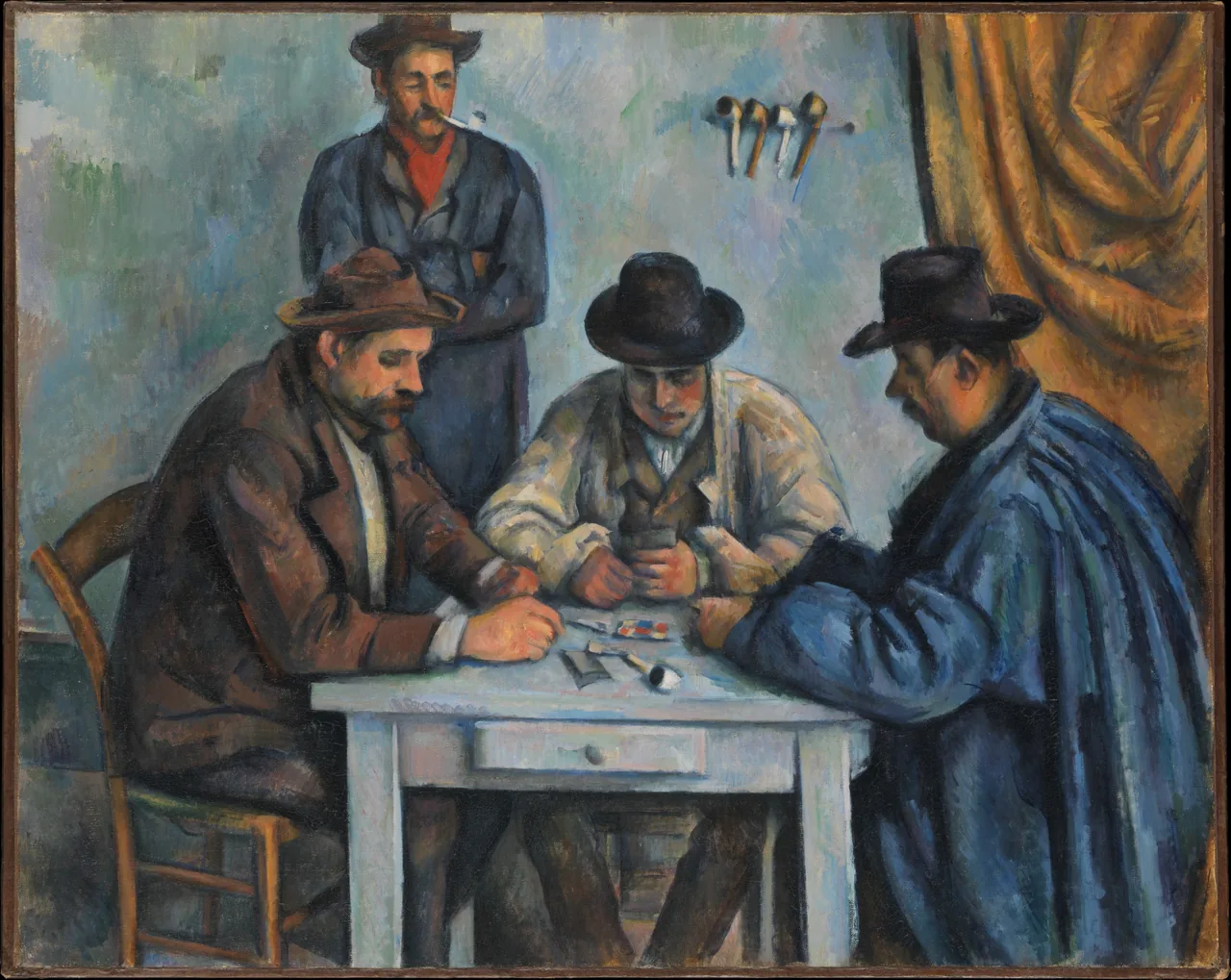
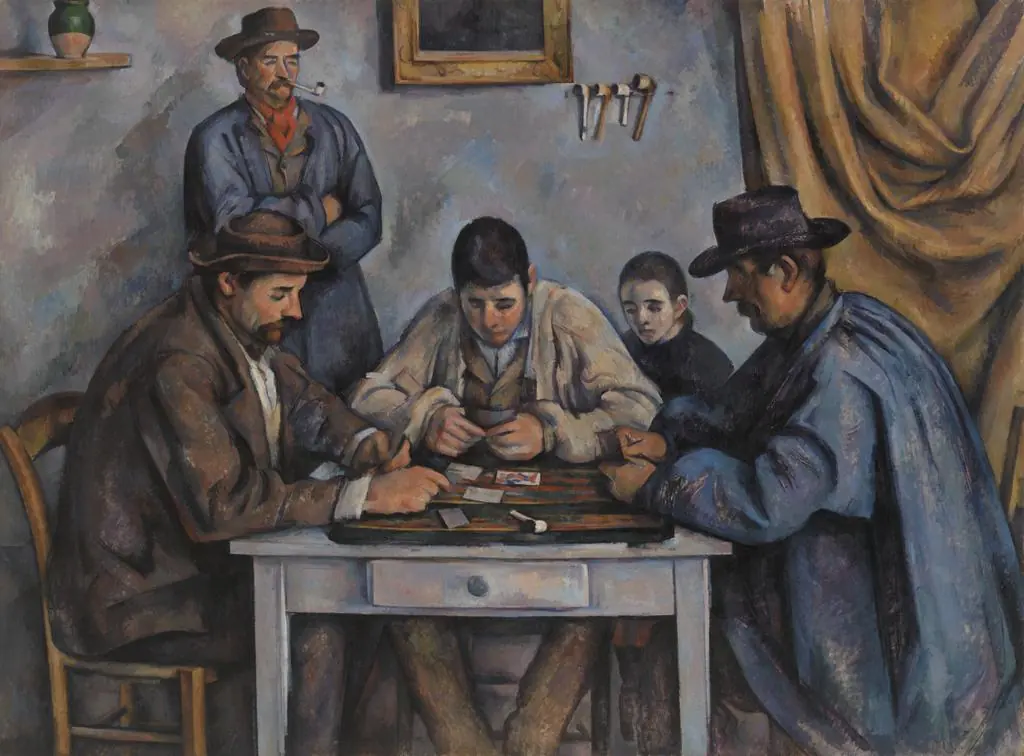
At first, the two pictures seem almost interchangeable. The blue-clothed player occupies the right side; a brown-clothed player leans in from the left; a third sits between them. The man at the back folds his arms. Four pipes hang on the wall, and a heavy curtain fills the upper-right corner.
Now let your eyes move between the pictures rather than choosing a favourite immediately. The shared arrangement makes small differences unusually visible. Cézanne has not simply added more wall around an unchanged group. He has altered the relationships within it.
Follow the hats and the table
In the Met painting, the central seated figure wears a dark, broad-brimmed hat. It makes a strong horizontal shape above his downturned face. In the Barnes version, that hat has disappeared: the dark hair and exposed forehead make the head look smaller and more vulnerable between the two outer players.
The table changes just as decisively. At the Met it is a cool, pale surface, with a conspicuous drawer and rounded knob beneath. At the Barnes, a dark patterned covering interrupts the light tabletop. Cards, hands and the pipe lie across this busier surface. Follow the near edge: it remains a firm boundary, but the patchwork above it makes the middle of the picture less empty.
Neither arrangement provides a tidy view of every card. We cannot reconstruct the game’s rules or announce a winner. What we can follow is the distribution of attention: faces turn down, arms lean in, and the outer players form a broad enclosure around a small activity.
The extra figure changes the circle
The Barnes painting introduces a child between the central player and the man in blue. The small face appears in a gap that is open wall in the Met version. It creates another spectator inside the group, distinct from the standing adult behind it.
Look above the players as well. The Barnes includes a framed picture and a little shelf with a vessel. These objects establish a more furnished interior. At the Met, the expanse of blue-grey wall feels broader, even though the canvas is much smaller.
That is a visual effect, not a biography. The child’s presence does not, by itself, identify a family relationship or explain why anyone is there. The composition gives us a watching figure; it does not give us a narrated domestic event.
These pictures are not the same size
The matching display widths on this page are for comparison, not a representation of the paintings’ physical scale. The Barnes canvas is more than twice as wide and twice as high as the Met canvas. In front of the originals, that difference would strongly affect how the bodies meet your own.
The Barnes describes its work as the largest of the five, giving ordinary farmworkers the imposing scale associated with more prestigious subjects. You can test the effect in the reproduction by attending to shoulders, knees and coats: the figures occupy space through substantial blocks of colour rather than quick gestures alone. Barnes collection record.
Why the sequence is not a countdown
It is tempting to order the series by counting people: five, then four, then two. That would mistake a convenient visual pattern for established chronology.
The Met’s technical research distinguishes the multi-figure group from the three two-player canvases. It reports broad agreement that the former came earlier, while dates and ordering within the groups have been debated. Examination using X-rays and infrared imaging helped challenge assumptions about size and sequence, including the relationship between the smaller Met canvas and the larger Barnes painting.
The important point is not that uncertainty makes comparison impossible. It makes comparison more interesting: you can identify a change without inventing a precise day, motive or linear march towards perfection.
Three paintings concentrate on two players
The Paris, London and privately held canvases each concentrate on a pair. The Courtauld’s account connects its sitters to workers from Cézanne’s father’s estate and describes their absorption in the game. Removing onlookers changes what a picture asks us to follow: less a group around an event, more the relationship across a table.
The Orsay record draws attention to the bottle as a central dividing axis. Its small canvas is not a reduced print of the Courtauld work; the paintings have different dimensions and their own histories. The private version is larger than either and is catalogued separately as FWN 685. Its current catalogue identifies a private collection in Qatar, without naming an owner. There is no need to attach a sensational sale story to understand its place in the five.
Studies are part of the work not extra versions
Cézanne also made individual figure studies. The Courtauld’s exhibition account distinguishes those portraits and drawings from the five group compositions. A painting of one seated man may help explain the working process without becoming a sixth Card Players.
The Met’s object account describes how Cézanne built its composition from studies of local farmhands. This helps explain why a scene that initially looks like a moment caught in passing rewards such close attention to placement. The figures were assembled and adjusted in paint, not simply recorded like people in a snapshot.
What to look for next
Start with the hats, then the tabletop, then the gaps between heads. Finally, look at the wall. This order moves from an obvious difference towards the quieter spaces that hold the composition together.
For a broader introduction, continue with the Cézanne artist guide or compare his construction of form with Seurat’s different method. For reuse questions, the work-specific Card Players guide separates the Met canvas from other versions and their files. Recognising a painting is the first step; recognising that a familiar title can belong to several paintings is the next.
Editorial record
About this article
- Author
- Publisher
- GeMarkt
- Published
- Reviewed
- Internal source & rights check. Conducted by GeMarkt Research Review. This is an internal editorial check—not independent peer review.
- Source standard
- Art history source standardPrioritises object records and research sources, distinguishes evidence from interpretation, and states material uncertainty.
Found a claim that needs checking? Report a factual error.