GeMarkt Blog · Essay
Cézanne vs Seurat: Building Form vs Building with Dots
Look closely at Cézanne's Mont Sainte-Victoire and Seurat's La Grande Jatte to see how patches, dots, outlines and repeated shapes organise a painting.

Cézanne’s mountain seems to emerge from fitted patches of colour. Seurat’s riverbank shimmers with tiny touches. This is an easy difference to remember, but it leaves out something important: the dots also build solid figures, and Cézanne’s broad marks can make a surface flicker.
Both artists use colour to organise a picture. In the pair below, Cézanne makes us follow relationships between larger patches and directions; Seurat combines finely divided colour with exceptionally clear silhouettes. The comparison becomes more interesting when we look past the size of the brushmark to the whole design.
Both artists build form
Paul Cézanne (1839–1906) and Georges Seurat (1859–1891) belong to different generations. They also pursued different approaches after the first Impressionist exhibitions. Neither is adequately described as someone who abandoned observation for a formula.
“Form” simply means the apparent shape and volume of things in a picture: how a tree seems to have a trunk, a hill seems to slope, or a person seems to occupy space. Dots are one kind of mark. Setting form against dots therefore compares a goal with a means of achieving it, rather than two mutually exclusive activities.
Keep that distinction in mind as you move between the paintings. Ask both what the marks are like and what they let you recognise.
A mountain and a riverside afternoon
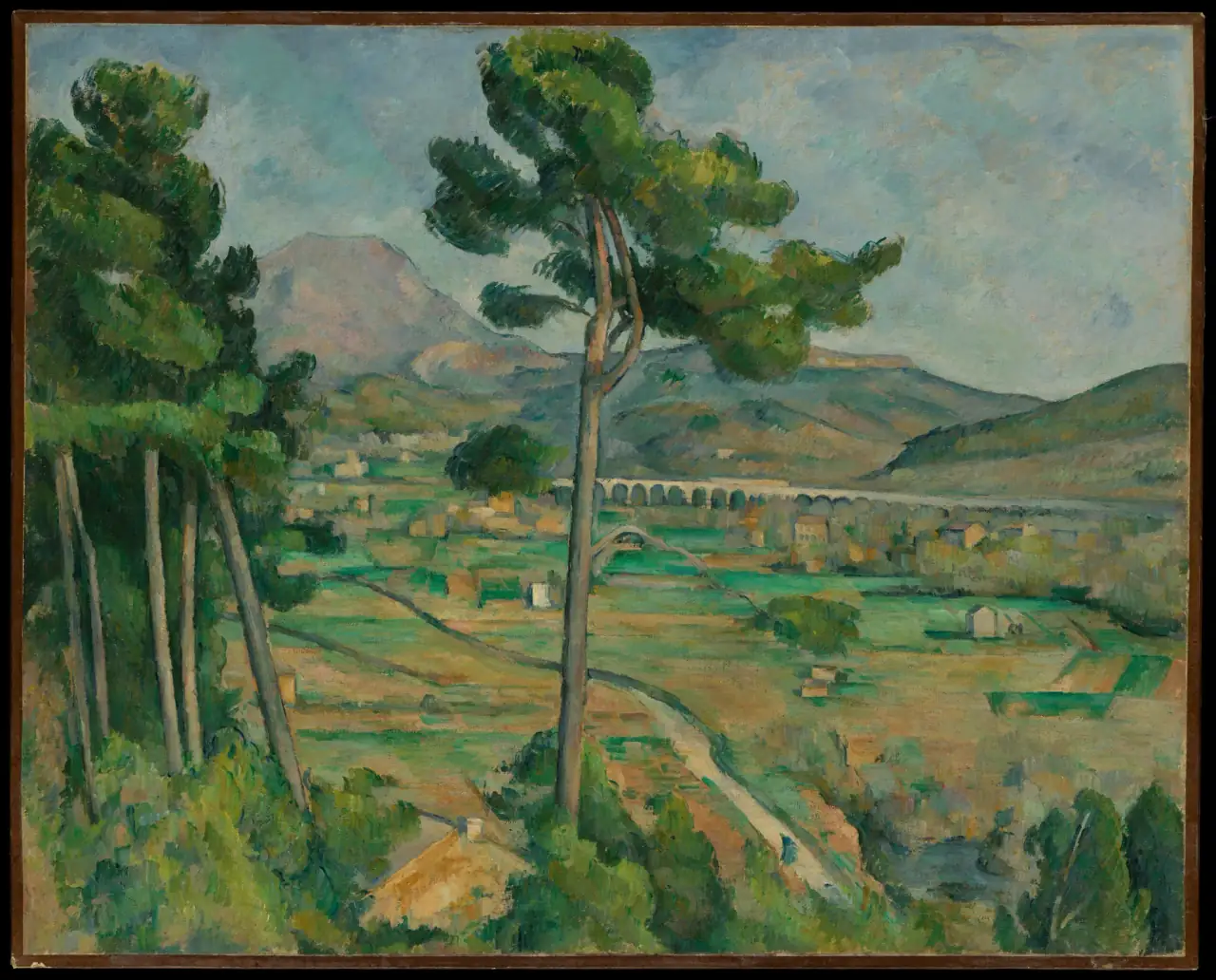
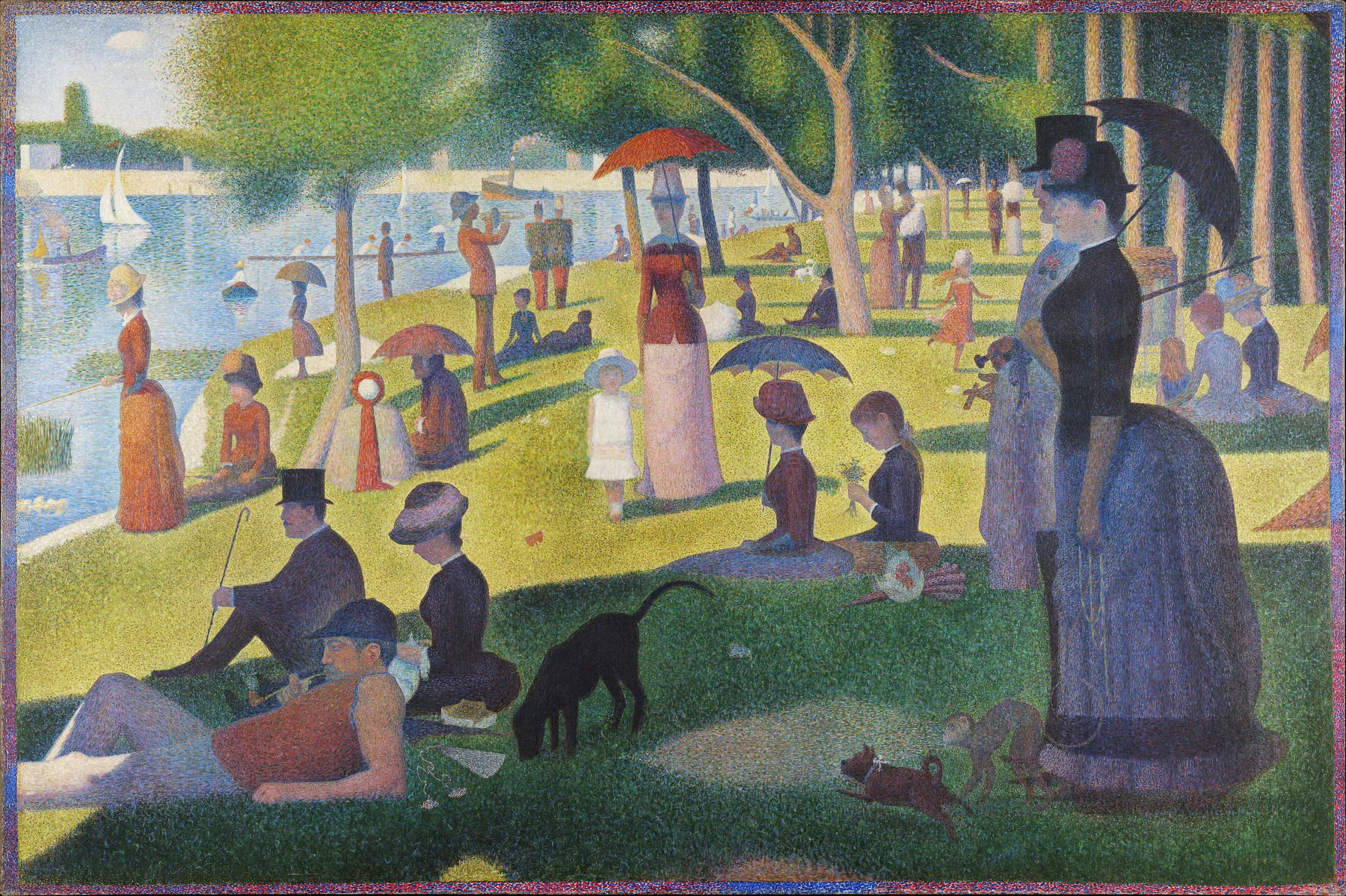

These pictures are not displayed at a shared physical scale. Seurat’s canvas is more than three metres wide; Cézanne’s is a little over eighty centimetres. Keeping that difference in mind helps prevent a phone-sized image from becoming our whole idea of either work.
Cézanne’s patches make the land hold together
First locate the pale mountain at the upper left. It is not the largest object in the picture. A foreground pine cuts across the view, while darker trees crowd the left edge. The mountain has to be discovered through this nearer framework.
Look down from it into the fields. Greens, ochres and pale building shapes meet without every boundary becoming a hard drawn line. Some marks extend sideways, while others tilt or stand upright. Their changing directions prevent the ground from becoming one smooth sheet.
The Met’s Cézanne essay explains his use of neighbouring colour variations to build volume, often called constructive brushstrokes. In plain language, one patch helps make sense of the patch beside it. You do not need to name every pigment to see that process at work.
The row of arches is a railway viaduct, not an ancient Roman ruin. The object record places the view near Aix-en-Provence. That small identification matters: modern infrastructure belongs inside this apparently timeless landscape.
Seurat’s dots belong to larger shapes
Begin far enough away that the tiny touches merge into a readable gathering. The standing pair at the right make a tall, dark block. Parasols introduce repeated curves, and the trees repeat upright lines. Across the lawn, bands of shade divide people who otherwise share the same place.
Now move closer. The lawn is no longer just green or yellow. Small touches interrupt one another, and an area that looked even at a distance becomes visibly restless. The Art Institute describes both dots and dashes, not a surface made from one mechanically repeated point.
Yet the people do not dissolve into noise. Their profiles and clothing remain strongly shaped. Notice the curved back of the foreground woman’s skirt and the narrow upright body beside her. Those silhouettes carry the design across viewing distances. Fine colour and large structure are working together.
What pointillism and divisionism mean
Pointillism names the use of small dots of paint. Divisionism describes separating colours into distinct touches instead of fully mixing them on the palette. The terms overlap in Seurat’s work, but they describe different aspects of the method.
The Met’s account of Neo-Impressionism relates the approach to contemporary colour theories. Seurat and artists around him expected neighbouring colours to create a more luminous effect in the viewer’s perception. That was an artistic ambition informed by scientific ideas, not a guarantee that every pair of dots produces one predictable colour.
A digital reproduction introduces another surface between us and the paint. Screen resolution, image size and viewing distance change how easily the marks remain separate. Treat “the dots mix in your eye” as a useful introduction, not a substitute for looking at the actual arrangement.
Compare how the pictures make distance
Cézanne places a large tree immediately before a broad view. Its trunk interrupts the far valley rather than politely framing it from one side. The interruption keeps reminding us that we are looking through a painted foreground, not through an invisible window.
Seurat also gives us a strong foreground, but fills it with people whose sizes step down towards the distant shore. A small white-clad child near the centre looks conspicuous among darker adults. Boats and tiny figures along the river offer further measures of distance.
Both pictures contain repetitions: arches and fields in one, trees and parasols in the other. Repetition helps us travel across them. The difference is not geometry versus no geometry; it is the particular rhythm each artist makes from the chosen subjects.
Planning is not the opposite of looking
La Grande Jatte grew through numerous preparatory studies and about two years of work. The Art Institute’s exhibition account places its public debut at the final Impressionist exhibition in 1886. The painted border was added later, in 1888–89. Its title’s “1884” is not the completion date of everything visible now.
This long development matters when the scene seems to preserve one idle afternoon. The finished gathering is a composition assembled and reconsidered over time, not a single instant neatly transferred from the riverbank.
Cézanne’s canvas also invites sustained comparison rather than a quick recognition test. Follow one field boundary, then another, and watch how their directions meet. The picture’s organisation is available to us through looking; we do not have to imagine the artist mechanically filling a diagram.
Why size changes the experience
A small reproduction favours the immediately legible silhouette. A larger view lets the marks interrupt that first impression. With Seurat, that shift can be dramatic; with Cézanne, it reveals the uneven joins that keep the landscape active.
Neither response is wrong. They are different parts of the work. If you choose a reproduction for a room, preserve the composition’s proportions and leave enough viewing distance for the whole arrangement. A close detail can show technique, but it cannot replace the entire picture when the subject is how the parts relate.
A simple way to compare another pair
Start with three questions: what is the largest shape, what changes when you move closer, and which marks connect near and far? These questions work before you know the movement labels.
For a comparison where a shared environment produced different results, continue with Hokusai vs Hiroshige. Here, the central lesson is already visible: Cézanne’s patches and Seurat’s dots are not rival shortcuts. They are parts of different systems for making a flat surface hold a world.
Editorial record
About this article
- Author
- Publisher
- GeMarkt
- Published
- Reviewed
- Internal source & rights check. Conducted by GeMarkt Research Review. This is an internal editorial check—not independent peer review.
- Source standard
- Art history source standardPrioritises object records and research sources, distinguishes evidence from interpretation, and states material uncertainty.
Found a claim that needs checking? Report a factual error.