GeMarkt Blog · Reference
Is Cézanne’s The Card Players Public Domain?
Five paintings share the title. Start with the Met’s 1890–92 version, its CC0 image and the difference between a painting date and U.S. publication evidence.

The short answer
Yes for the Met’s identified version: the museum marks The Card Players, 1890–92, accession 61.101.1, public domain and provides its image through Open Access. That is a practical, file-specific answer. It is not a claim that every online image called The Card Players has identical permissions.
Cézanne made five paintings of the subject, alongside preparatory work. This guide selects the Met canvas with three seated players and a standing observer. It records the institution’s public-domain assessment and open-file policy, but does not independently establish the canvas’s early authorised publication history for a U.S. legal conclusion.
First choose one of the five paintings
Search results often favour a composition with two men facing each other across a table. The painting shown here has four figures in all. Both can be correctly called The Card Players. They are different paintings, not alternative crops of one enormous original.
The Met’s collection record identifies its work as oil on canvas, 65.4 × 81.9 cm, dated 1890–92. The record connects it to Cézanne’s series and to studies of local farmhands. Museum, date, dimensions and accession together identify this object more reliably than the English title alone.
If you are writing about another version, change the identification before reaching for a download. A file permission attached to the Met object does not migrate to a photograph of a canvas elsewhere. Nor can the sale price, owner or exhibition history of one version safely be copied into the caption of another.
The distinction matters even when the pictures look similar on a phone. Count the figures first, then look at the wall, table and arrangement of hands. These are quick visual checks, not specialist connoisseurship.
How to recognise the Met version
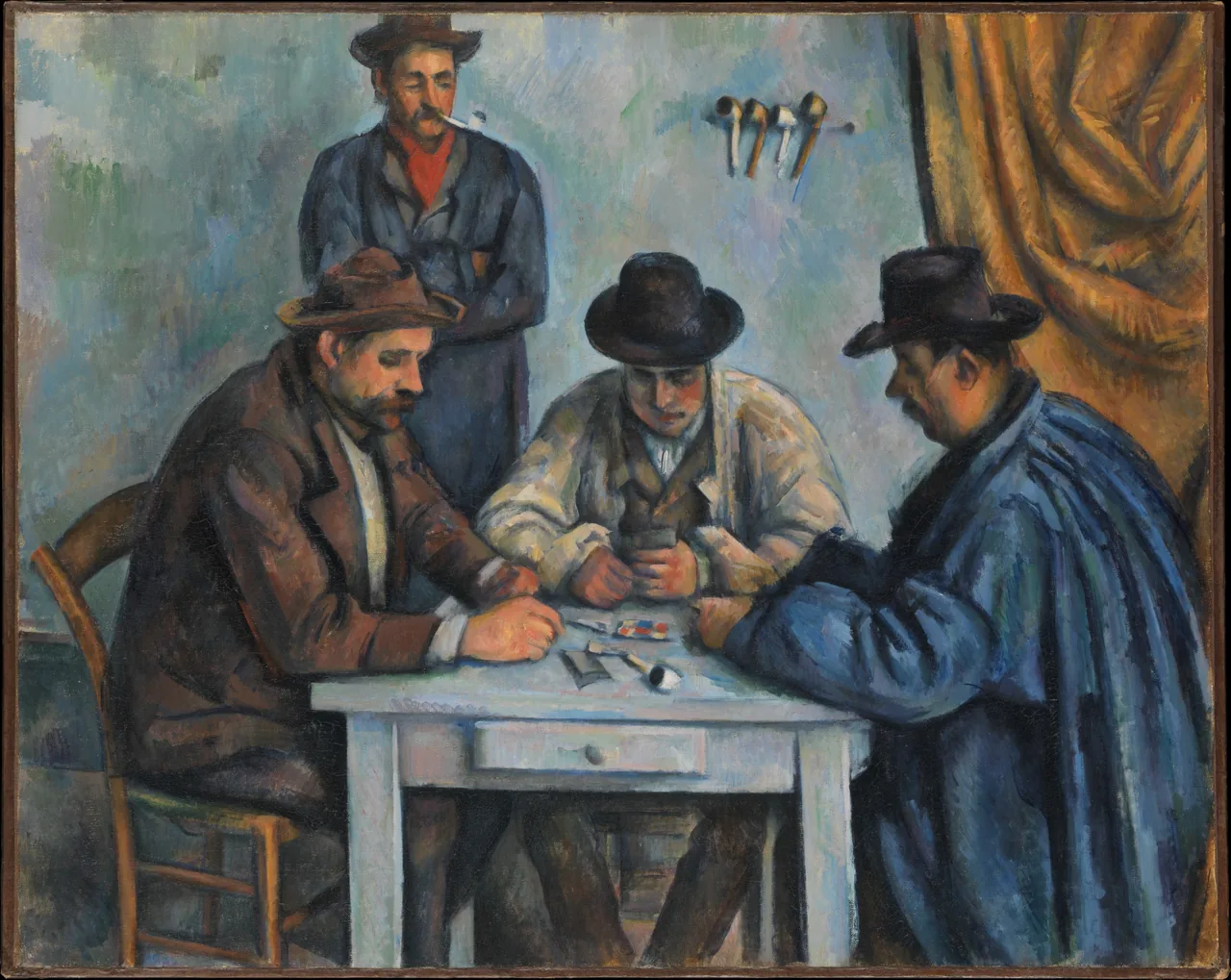
The man at the left wears a brown jacket and holds cards close to the tabletop. Opposite him, a large blue-coated figure occupies much of the right side. Between them, another seated man bends over his hand. A fourth man stands at the back, above the left player.
Four pipes hang high on the pale wall. An ochre curtain gathers at the right. The table has a visible drawer and legs, and a pipe lies on its surface. These details are useful landmarks when a file has been resized, renamed or placed in a new layout.
They also reveal a mislabelled crop. A close-up containing only the two outer seated men could be mistaken for a separate two-player composition. Check where the middle figure, observer and curtain have gone. Missing people are not a minor colour difference between scans.
The full image reproduced here includes the complete arrangement and the narrow outer edge visible in the museum’s file. It has not been expanded with invented wall or floor to fit a different aspect ratio.
The game and the shapes around it
The cards create a small, bright activity near the centre, but the surrounding bodies occupy far more space. The right-hand blue sleeve forms a broad slope towards the table. The left-hand jacket and bent arm answer it from the other side. The men seem substantial even though their clothing is broken into patches of changing colour.
Look at the contrast between those large shapes and the small white cards. You can recognise the game without being able to reconstruct the exact state of play. A caption does not need to invent a winner, a wager or an argument to make the scene engaging.
The standing observer introduces another kind of attention. His position lets you see someone watching people who are themselves looking down. It gives the composition a quiet social structure without turning it into a single dramatic incident.
For a reader interested in how Cézanne builds a picture, the table edge is worth retaining. It connects the figures while leaving the legs and chairs partly exposed below. A reproduction trimmed just under the hands changes that balance into a row of faces and jackets.
What the date does and does not establish
Cézanne died in 1906. His ordinary life-plus-70 author term has expired under the EU framework. This is about economic copyright in the historical work, not a declaration that every related photograph or modern design is free of conditions.
The Copyright Office’s duration guide explains why older U.S. rights questions can depend on publication. In 2026, qualifying works published before 1931 are beyond the ordinary 95-year publication term. A creation date on a museum label does not demonstrate that publication occurred then.
For this exact canvas, the evidence presented here does not independently document that early publication chain. The Met’s designation remains an attributed institutional finding. It should not be rewritten as “we proved publication in 1890”. Equally, the gap is not proof of active copyright.
Exhibition alone does not establish publication. An authorised sale or distribution of the original or copies can be relevant, as the Copyright Office’s visual-art guidance explains. This guide has not reconstructed which historical events qualify under the rules applicable to this canvas. That distinction matters for a series whose versions followed different routes through collections.
The Met file and its open permission
The object page visibly labels this painting Public Domain. The Met’s image policy makes eligible Open Access images available under CC0, including commercial reuse. The image selected here is the museum’s primary image for object 435868, accession 61.101.1.
That provides a clearer practical route than downloading a product photograph from a shop that happens to sell the painting. The shop image might add a room, frame, lighting or mockup. Those additions are not Cézanne’s work, and the Met’s permission does not cover them.
Start from the source file if you want to make your own layout. Preserve its proportions and keep a copy of the museum record. If you later use an X-ray, annotated diagram or a page from a recent catalogue, check that item separately rather than assuming the open painting image covers the whole publication.
CC0 also does not supply evidence for unrelated claims. It does not certify your printer’s colour accuracy, the quality of a material, or a supposed connection between your product and the museum. Those statements need their own basis.
Cropping and comparing without mixing versions
A detail of the hands can explain the game’s visual centre. A detail of the blue coat can show how adjacent colour patches suggest volume. Introduce either with the whole painting and label the crop as a detail of 61.101.1. Readers should not have to guess which canvas they are studying.
For a comparison across the series, identify each museum or owner beside its image. Do not use a common caption that collapses five paintings into one date and one size. If you have a permitted file for only one version, discussing the others with links is more honest than filling the gap with unidentified copies.
Avoid equalising every image into the same shape. A comparison can make differences in format visible instead of hiding them. White space around a smaller or differently proportioned work is often more informative than an undisclosed crop.
A clear answer for your own project
For the image on this page, a useful credit is Paul Cézanne, The Card Players, 1890–92. The Metropolitan Museum of Art, Bequest of Stephen C. Clark, 1960, 61.101.1. Public Domain / CC0. Credit remains useful identification even where permission does not require it.
Keep three things together: the selected painting’s record, the exact downloaded file and the permission attached to it. Then describe your output accurately as a reproduction, detail or adaptation. You can make a confident decision about this image without pretending that one title settles every painting and every file in the series.
Editorial record
About this article
- Author
- Publisher
- GeMarkt
- Published
- Reviewed
- Internal source & rights check. Conducted by GeMarkt Research Review. This is an internal editorial check—not independent peer review.
- Source standard
- Rights guide source standardSeparates the underlying work from the source file, records the review date, and links the evidence used for the conclusion.
Found a claim that needs checking? Report a factual error.