GeMarkt Blog · Practical guide
Is Grant Wood’s Art Public Domain? American Gothic and Other Works
American Gothic has a specific U.S. copyright history. Explore Wood’s paintings and prints without treating one answer as permission for his entire catalogue.
Rights check · reviewed
The short answer
American Gothic is public domain in the United States according to the Art Institute library’s finding that protection lapsed in 1958. It did not first become free in 2026. Wood’s ordinary EU/UK author term has elapsed; the guide does not clear his other works or every reproduction.
| What is being checked | Result | Why |
|---|---|---|
| European Union — ordinary author term | Ordinary named-artist term has elapsed | Wood died in 1942; the ordinary life-plus-70 author term has elapsed. National exceptions, moral rights, later first-publication rights and other contributors remain separate. |
| United Kingdom — ordinary artistic-work term | Ordinary artist term has elapsed | This is the ordinary artistic-work term, not clearance of specific older unpublished material or another contributor’s work. |
| United States — American Gothic only | Museum reports a 1958 lapse, not a new 2026 expiry | The Ryerson and Burnham Libraries report first publication in 1930, a missed renewal and an ineffective 1980 application. This is an attributed institutional finding; no independent inspection of the original renewal register is claimed. |
| United States — other eleven research objects | Individual publication and renewal histories unresolved | This guide does not independently establish U.S. publication or renewal histories for the remaining objects. December Afternoon was made in 1940 and published in 1941; neither Wood’s death nor American Gothic’s result answers for every later print. |
| Selected digital file | One exact Commons faithful reproduction | The exact Grant DeVolson Wood - American Gothic.jpg file carries the Public Domain Mark and a public VRT permission notice. Private correspondence was not accessed. Its version history records a 2012 colour adjustment. This is not an AIC CC0 file: the current AIC API is_public_domain flag is false. |
| Other works, contributors and files | Eleven research examples remain display HOLDs | No local approved images for the other eleven objects. This is not a conclusion that each underlying work is protected. Nan Wood Graham’s hand-colouring of the Fruits impression requires its own consideration. |
Twelve exact research objects, one selected faithful reproduction and eleven display HOLDs. American Gothic’s museum-reported renewal history is separate from the current AIC API file flag and from other Wood works. Fruits includes hand-colouring by Nan Wood Graham; no whole-catalogue or worldwide clearance.
This is a documented research summary, not legal advice. Copyright and moral-rights rules can vary by country and by the history of a particular work.


What we’ll look at
Does American Gothic’s copyright answer apply to the Grant Wood work you want?
Short answer: American Gothic is public domain in the United States: the Art Institute of Chicago’s library dates that status to 1958, following a missed renewal. It did not first become free in 2026. That finding does not clear all Grant Wood paintings, later lithographs or digital files. Wood’s ordinary EU and UK author term has elapsed, but the particular work, other contributors and reproduction still matter.
You probably know the pitchfork before you know the artist. Wood’s wider work offers much more: rolling farmland, carefully arranged trees, black-and-white prints and drawings whose materials are easy to misidentify online. The useful starting point is a named object, not a folder labelled “Grant Wood public domain.”
One famous picture, one specific answer
The Ryerson and Burnham Libraries’ copyright exhibition says American Gothic was published in 1930 and entered the U.S. public domain in 1958. It explains that a renewal application filed in 1980 arrived too late. This guide reports that institutional finding; it does not claim a separate inspection of the original renewal register.
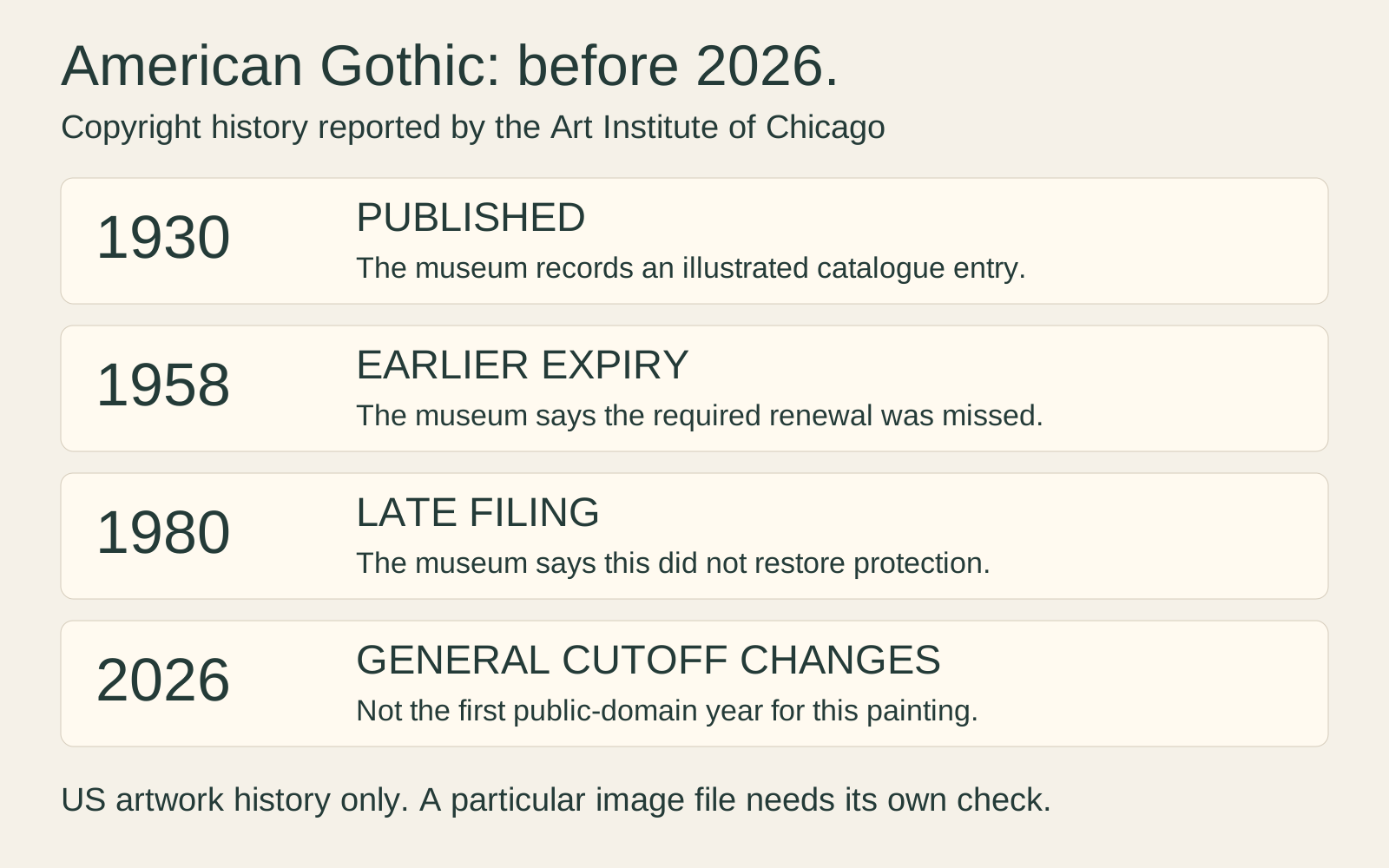
GeMarkt explanatory diagram. The painting’s specific renewal history matters more than a generic “1930 plus 95 years” calculation.
This is a good example of why a calendar shortcut can produce a misleading headline. A maximum term is not a promise that every work remained protected for the entire period. Conversely, one painting’s missed renewal does not prove that all the artist’s other works missed theirs.
Look past the pitchfork
The Art Institute’s object record identifies the painting as oil on Beaver Board, not canvas. Its two figures represent a farmer and his daughter; Wood used his sister and dentist as models. The house’s pointed window helps explain the title’s architectural reference.
Try looking without deciding whether the people are admirable, forbidding or funny. Three pitchfork prongs rise before the man. Related vertical lines run through his clothing, the wall behind him and the window above. The woman’s face turns sideways while his faces forward. Their different directions keep the picture from becoming a perfectly balanced emblem.
The upper window is small but important. Remove it in a tight crop and the two people lose part of the visual structure connecting them to the house. Remove the lower pitchfork handle and the tool becomes less commanding. A full reproduction lets you follow those relationships rather than simply recognise a famous pair of faces.
Even the areas that seem plain reward attention: the little flowerpot, the pale roof edge, the repeated boards. Wood uses ordinary things to hold an unusually exact arrangement together. That precision helps the image survive parody, but a parody is not a reliable source for the painting’s original details.
Wood beyond American Gothic
Wood lived from 1891 to 1942. The Whitney’s account of his decorative arts traces work in metal, jewellery and other crafts, including the shop he established with a fellow craftsman in 1914. His interest in designed objects continued alongside painting. It is a useful background for looking at repeated contours and carefully fitted shapes, rather than imagining he merely copied whatever appeared before him.
The National Gallery of Art’s New Road, from 1939, offers a landscape counterpart. The museum identifies a road near Solon, Iowa. Follow the pale route through the farmland and compare its curves with the compact shapes of trees and buildings. A road both guides your eye and divides the land into readable parts.
Other objects change the medium entirely. The Pump in Chicago is a crayon-and-graphite drawing, not a lithograph. December Afternoon has two relevant dates: made in 1940, published in 1941. Fruits is a lithograph with watercolour added by Nan Wood Graham. Those distinctions can disappear when image sites shorten every caption to an artist and a year.
Twelve objects to explore
These are twelve research records, not twelve approved downloads. Only the American Gothic file shown here has been selected for this guide. The remaining eleven images are not supplied locally; their absence does not, by itself, mean the underlying works are protected.
| Work | Date and useful distinction | Exact record |
|---|---|---|
| American Gothic | 1930; oil on Beaver Board | Chicago 1930.934 |
| Loch Vale | 1927; oil on canvas | Chicago 2000.307 |
| December Afternoon | 1940, published 1941; lithograph | Chicago 1982.1531 |
| Family Doctor | 1940; lithograph | Chicago 1962.316 |
| Fertility | 1939; lithograph | Chicago 1991.672 |
| Midnight Alarm | 1939; lithograph | Chicago 1982.1566 |
| In the Spring | 1939; lithograph | Chicago 1972.176 |
| July Fifteenth | 1938; lithograph | Chicago 1983.782 |
| The Pump | 1937; black crayon and graphite | Chicago 1983.868 |
| Portrait of Second Lieutenant Wayne McMillen | 1918; drawing with white gouache | Chicago 1972.435 |
| Fruits | 1939; impression hand-coloured by Nan Wood Graham | Chicago 2016.398 |
| New Road | 1939; oil on canvas mounted on hardboard | NGA 1982.7.2 |
For a print, save the accession number as well as the title. Another impression can differ in paper, colouring or annotations. Graham’s additional work on Fruits, for example, deserves its own authorship and term check; Wood’s death cannot answer for every contribution to that sheet.
Three different rights questions
First ask about country. The ordinary EU author term and UK artistic-work term are life plus 70 years. That ordinary term has elapsed for Wood himself. National exceptions, other contributors and later rights are separate questions—not reasons to declare the entire catalogue cleared worldwide.
Next ask about publication. The U.S. Copyright Office’s 2026 guidance places works published in the United States before January 1, 1931, in the public domain. A painting date is not a publication date. This guide does not independently establish U.S. publication and renewal histories for the other eleven objects. Older unpublished material can follow different rules.
Finally ask about the file. The reproduction above comes from a specific Wikimedia Commons file, marked as a faithful two-dimensional public-domain reproduction, with a public permission notice. It is not presented as an Art Institute CC0 download: the museum’s current API does not flag its own American Gothic file as public domain. Keep those source statements distinct.
Choosing a reproduction
Keep a record of the object, the image provider and the exact file used. The Commons file has its own version history, including a colour adjustment recorded in 2012. A usable reproduction is not necessarily a colour-calibrated reference to the physical painting.
For a wall print, inspect the window, clothing and faces at the intended size before ordering. Enlarging a small preview cannot recover brushwork that the file never contained. Prefer the whole composition unless a detail is clearly labelled as a crop.
The strongest conclusion is narrow and useful: American Gothic has a documented U.S. public-domain history and an identifiable reproduction here. For another Wood work, begin again with its own museum record, publication evidence and file—not with the pitchfork’s fame.
Sources and review method
We checked the artist chronology against museum records, treated each named jurisdiction separately, and recorded the provider policy for the image set. These sources support the legal framework and artist dates used above; the source file for any individual image still needs its own record.
- American Gothic copyright renewal record, 1980 — Art Institute of Chicago, Ryerson and Burnham Libraries. Specific 1930 publication and 1958 U.S. lapse finding; late renewal did not restore protection.
- American Gothic, 1930.934, official API record — Art Institute of Chicago. Exact object, models, support, 1930 catalogue reference and current non-open API image flag; that flag is not rewritten as a legal determination.
- Grant DeVolson Wood - American Gothic.jpg — Wikimedia Commons. Exact faithful reproduction, public permission notice and source/version history; private VRT evidence not accessed.
- Grant Wood: Decorative Arts — Whitney Museum of American Art. Craft background, 1914 shop and continued decorative practice; no image acquired.
- New Road, 1982.7.2 — National Gallery of Art. 1939 painting, medium and Iowa setting; no downloadable image acquired or rights claim inferred.
- Fruits, 2016.398 — Art Institute of Chicago. Exact lithograph impression hand-coloured by Nan Wood Graham; the additional authorship is preserved.
- Copyright in the EU — European Union, Your Europe. Ordinary life-plus-70 term; not worldwide clearance or every national exception.
- How long copyright lasts — UK Intellectual Property Office. Ordinary artistic-work term, with older-material and other-contributor questions kept separate.
- Duration of Copyright, Circular 15A, April 2026 — U.S. Copyright Office. Publication cutoff, renewal and conditional older-unpublished rules; creation date is not publication evidence.
Editorial record
About this article
- Author
- Publisher
- GeMarkt
- Published
- Reviewed
- Internal source & rights check. Conducted by GeMarkt Research Review. This is an internal editorial check—not independent peer review.
- Source standard
- Rights guide source standardSeparates the underlying work from the source file, records the review date, and links the evidence used for the conclusion.
Found a claim that needs checking? Report a factual error.