GeMarkt Blog · Practical guide
Is Hilma af Klint’s Art Public Domain? Start with the Work
A published Hilma af Klint illustration offers a clear starting point, while her abstract paintings require separate publication and image-file checks.
Rights check · reviewed
The short answer
The checked 1912 book illustration has a usable public-domain basis, not the whole catalogue worldwide. Af Klint’s ordinary Swedish author term elapsed in 2015. The twelve linked research objects retain unresolved independent U.S. publication histories and separate file checks; no Foundation private-use image is reproduced.
| What is being checked | Result | Why |
|---|---|---|
| Sweden — ordinary author term | Ordinary term ended in 2014 | Section 43 gives life plus seventy through year end; 1944 death produces ordinary expiry from 1 January 2015. Moral rights and independent publication/image rights are separate. |
| EU — first publication and country rules | Do not stop at the death date | Directive 2006/116 Article 4 and Swedish section 44a recognise qualifying first lawful publication or communication after expiry. No blanket 25-year extension is assigned; each object’s history and national rules need review. |
| UK — work category matters | Ordinary artistic term versus older exceptions | The IPO’s 2039 rules are not a blanket extension for paintings; older engravings, notebooks or other specified material need the appropriate route. |
| United States — displayed 1912 illustration | Dated published edition checked | The Umeå title/illustrator credit, 1912 imprint and matching plate support the old published-work branch; the ordinary maximum 95-year term has elapsed. This is independent of the missing-U.S.-tag warning on Commons. |
| United States — twelve research objects | Publication histories unresolved | The 1912 book evidence is not transferred to HaK016–358 or NMG733/1892. Creation dates, 1892 bequest and 1928/1986 exhibitions do not automatically establish publication. Section 303’s 2047 floor is conditional, not catalogue-wide. |
| Selected image file | One traceable historical illustration | Umeå’s exact 1912 volume is designated free of known copyright restrictions; Commons identifies the extracted scan with Public Domain Mark 1.0. Picture, signature and caption match the library leaf. PDM is not CC0 or a worldwide warranty. |
| Other image files | Twelve image checks remain unresolved | Foundation low-resolution files remain private-use only and were not downloaded. Nationalmuseum’s designated-PD etching record is linked without a locally usable inspected file; no inaccessible image was bypassed. |
The twelve research objects listed below still require separate image and publication checks. One additional illustrated-book record, Umeå University Library node 563425, supplies the displayed image. Its title page credits ten drawings to Hilma af Klint and its imprint dates the second edition to 1912. This does not clear the twelve other files.
This is a documented research summary, not legal advice. Copyright and moral-rights rules can vary by country and by the history of a particular work.

What we’ll look at
Which Hilma af Klint work was published, and which image can you actually reuse?
Short answer: Some Hilma af Klint images have a usable public-domain basis; others need more investigation. The illustration shown here was printed in a verified 1912 book and comes through an openly designated library scan. Her death in 1944 does not, by itself, settle the U.S. status of her abstract paintings or make every modern photograph freely reusable.
The distinction is practical. A dated book with a named illustrator gives you evidence of publication. A painting labelled “1907” gives you a creation date. Both can be old, but they answer different copyright questions. Begin with the object and the particular file, not the artist’s name alone.
A working artist as well as an abstract pioneer
Hilma af Klint (1862–1944) trained at Stockholm’s Royal Academy of Fine Arts and worked in naturalist portraiture and landscape. She also made published illustrations. Moderna Museet’s biography records her veterinary illustrations in a 1901 surgical book: careful observation was part of her professional practice, not merely a stage to discard.
From 1906 she developed The Paintings for the Temple. Spiritual inquiry and the group known as The Five helped shape that work. Her abstract series explored systems and relationships rather than simply abandoning recognisable subjects. Reading the series names and numbers matters: a single attractive spiral detached from its sequence tells only part of the story.
Her reception was uneven, not wholly secret. Moderna records exhibitions of naturalist work during her lifetime, the Altarpieces in London in 1928, and the abstract paintings reaching a wider audience in Los Angeles in 1986. Those distinctions prevent the misleading claim that nobody had seen any af Klint art before the 1980s.
A real published example
The Umeå University Library record identifies Laura Fitinghoff’s Lille Lapp-Natti och hans fostersystrar, second edition, published by Hökerberg in Stockholm in 1912. It names Hilma af Klint as a contributor and describes the work as free from known copyright restrictions.
The scanned title page explicitly credits ten drawings to her. The following imprint page gives Stockholm and 1912. This is stronger evidence than an unsourced upload date: the drawings appear in an actual historical edition. The book’s original title contains period language; it is retained here for bibliographic identification, not offered as present-day terminology for Sámi people.
The image below is the harvest illustration associated with page 83. Its Commons file record traces it to Umeå’s digitisation. Comparison with the library’s full scanned leaf confirms the scene, signature and printed caption. The Commons extraction turns the sideways illustration upright and removes outer book margins; it is not a photograph of an oil painting.

Look at the potato harvest
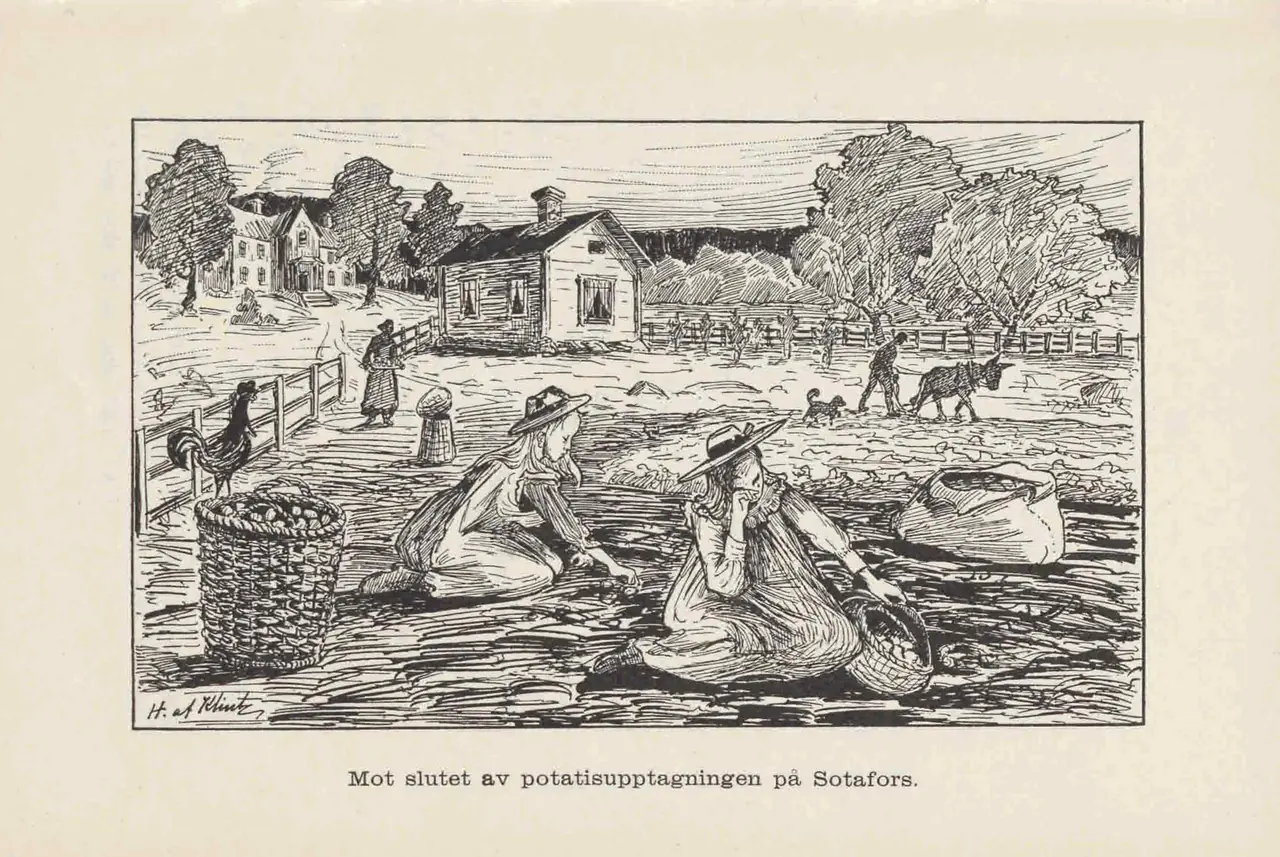
Two seated figures anchor the foreground. A deep basket on the left and an open sack on the right give their pause a setting: this is a place where work has been happening, not a pair of isolated portraits. Behind them, smaller figures, a dog and a horse continue the activity across the yard.
Follow the different kinds of line. Dark, closely packed marks describe the basket’s woven surface. Longer horizontal strokes run through the ground. Diagonal hatching gathers in the trees, while the little central building has clearer edges and lighter walls. Af Klint makes texture and distance with changes in line rather than colour.
The composition also rewards looking beyond the central figures. The chicken at the left fence and the larger house in the distance make the scene feel inhabited. Crop down to the two girls and you lose those connections. Keep the border, signature and caption when using this particular historical reproduction: they help explain what kind of image it is.
It is a useful counterweight to the familiar image of af Klint as a painter of enormous coloured forms. A book illustration has a different job: it accompanies someone else’s story and must remain legible on a small printed page. That does not make it evidence about the appearance or rights of The Ten Largest.
Twelve works to identify
These twelve research records are not twelve cleared downloads. The first eleven link to the Foundation’s selected works; its HaK numbers distinguish individual images within series. The last is an early Nationalmuseum etching. None of their files is reproduced in this guide; the independently checked book illustration above is a separate example.
| Work or series | Date | Exact record |
|---|---|---|
| Primordial Chaos, Group I | 1906–07 | HaK016 |
| Eros, Group II | 1907 | HaK031 |
| The Large Figure Paintings, Group III | 1907 | HaK042 |
| The Seven-Pointed Star, Group V | 1908 | HaK049 |
| Evolution, Group VI | 1908 | HaK082 |
| The Ten Largest: Childhood | 1907 | HaK102 |
| The Ten Largest: Adulthood | 1907 | HaK108 |
| The Tree of Knowledge | 1913–15 | HaK137 |
| The Swan, Group IX | 1914–15 | HaK149 |
| Altarpieces, Group X | 1915 | HaK187 |
| The Atom Series, No. 6 | 1917 | HaK358 |
| Barn and Three Trees | 1887 | Nationalmuseum NMG733/1892 |
The etching is a particularly useful reminder that collection dates have their own meaning. Its record gives a bequest in 1892. That is not, without further evidence, the date when copies were published. Likewise, a series title should not substitute for the individual inventory number when requesting a photograph.
What life plus seventy does and does not answer
Swedish law, section 43, gives the ordinary term through the seventieth year after the author’s death. For af Klint, that calculation ends in 2014, with ordinary term expiry from 1 January 2015. It is not a worldwide rule.
The EU term directive separately recognises a 25-year right for a qualifying first lawful publication or communication of a previously unpublished work after copyright has expired. Sweden has a corresponding provision in section 44a. Whether it applies requires the particular work’s history; it is neither an automatic extension for every af Klint nor something a new scan automatically acquires.
The UK’s guidance also distinguishes ordinary artistic terms from older unpublished-material rules. Its special 2039 provisions are not a blanket extension for paintings. A notebook, an engraving and a painting should not be treated as interchangeable categories.
The U.S. publication question
The checked 1912 edition supplies a publication basis for this illustration. Its ordinary maximum 95-year U.S. published-work term has elapsed. That conclusion does not depend on pretending that the Commons page’s missing-U.S.-tag warning is an affirmative clearance; the dated library copy supplies the additional evidence.
Other works require a different inquiry. Section 303 of the U.S. Copyright Act deals with qualifying works created before 1978 but then neither published nor federally copyrighted. It includes a minimum through 31 December 2047 when the work was published by the end of 2002. That is a conditional rule, not a statement that all af Klint paintings remain protected until 2047.
Nor does the 1986 exhibition alone prove legally relevant publication of every object in it. Identify an authorised distribution or other legally sufficient publication event for the exact work. The twelve linked research objects remain unresolved on that independent U.S. question here; the book illustration cannot answer it for them.
Choosing a file with a traceable history
The Foundation’s image policy limits its downloadable low-resolution files to private use and assesses publication requests separately. We have not downloaded those files for this article. That policy concerns the source being offered; it should not be inflated into proof that the Foundation controls every independently sourced historical reproduction everywhere.
For the displayed illustration, retain both the library record and the exact Commons description. The Public Domain Mark identifies a status assessment, not a CC0 waiver or a warranty for every country. The supplied extraction preserves the complete picture and printed caption; our version adds no new crop or invented colour.
Finally, keep the claim as specific as the evidence: Hilma af Klint, a drawing printed in this 1912 edition, rather than “all Hilma images are free”. You can appreciate her abstract work through the linked collection records while choosing a different, properly documented image for your own publication.
Sources and review method
We checked the artist chronology against museum records, treated each named jurisdiction separately, and recorded the provider policy for the image set. These sources support the legal framework and artist dates used above; the source file for any individual image still needs its own record.
- Lille Lapp-Natti: exact 1912 second-edition metadata — Umeå University Library. Title, author, illustrator, publisher, Stockholm 1912, second edition and open status; not Foundation imagery.
- Title page credits ten drawings to Hilma af Klint — Umeå University Library. Actual credited historical edition, visually inspected with following 1912 imprint.
- Full leaf containing the harvest illustration — Umeå University Library. Exact illustration/caption/signature match to Commons extraction, not a different book or painting.
- Lille Lapp-Natti 1912, p. 83 — Wikimedia Commons. Exact supplied image, Umeå provenance and PDM; missing-U.S.-tag warning remains explicitly disclosed.
- Biography: Hilma af Klint — Moderna Museet. Training, naturalist/illustration practice, 1906 Temple work, 1928 display and 1986 wider reception; not publication clearance.
- Selected Works — Hilma af Klint Foundation. Eleven exact preserved HaK identities; current HTML metadata verified, images not acquired.
- Image Rights — Hilma af Klint Foundation. Private-use low-resolution terms and separate publication requests, not a universal ruling on independent historical copies.
- Barn and Three Trees, NMG733/1892 — Nationalmuseum. Twelfth preserved research object; 1887 etching / 1892 bequest, designated-PD photo unavailable as selected master.
- Copyright Act 1960:729 — Swedish Parliament. Sections 43/44a distinguish ordinary author term and first-publication rights.
- Directive 2006/116/EC — EU legislation archived by legislation.gov.uk. Articles 1, 4, 8: ordinary term, qualifying first publication and calendar calculation.
- Duration of copyright — UK Intellectual Property Office. Ordinary artistic term and category-specific older unpublished material.
- U.S. Copyright Act Chapter 3 — U.S. Copyright Office. Older published term and conditional section 303 minimum; no blanket 2047 claim.
Editorial record
About this article
- Author
- Publisher
- GeMarkt
- Published
- Reviewed
- Internal source & rights check. Conducted by GeMarkt Research Review. This is an internal editorial check—not independent peer review.
- Source standard
- Rights guide source standardSeparates the underlying work from the source file, records the review date, and links the evidence used for the conclusion.
Found a claim that needs checking? Report a factual error.