GeMarkt Blog · Practical guide
Is Giuseppe Arcimboldo’s Art Public Domain? Faces, Seasons and Versions
Look closely at Arcimboldo’s composite faces, distinguish twelve museum objects and check the country, painting version and exact public-domain image source.
Rights check · reviewed
The short answer
The displayed NGA image is supplied under CC0; the Nationalmuseum image carries an institutional public-domain release and Public Domain Mark. Arcimboldo’s ordinary EU/UK artist term has elapsed. The guide does not independently establish U.S. publication histories or clear every photograph, adaptation or later-discovered work.
| What is being checked | Result | Why |
|---|---|---|
| European Union — ordinary author term | Ordinary named-artist term has elapsed | Arcimboldo died in 1593. The ordinary life-plus-70 term has elapsed, but national exceptions, moral rights, later first-publication rights and separate contributors still require attention. |
| United Kingdom — ordinary artistic-work term | Ordinary artist term has elapsed | A term conclusion is not permission for every photograph, adaptation or older unpublished work. |
| United States — all twelve research works | Independent publication histories unresolved | The guide reports the two providers’ image designations without asserting independently closed publication chains. Four Seasons in One Head was described in a 1591 text and rediscovered in modern times; a description is not automatically an authorised reproduction. Conditional older-unpublished rules remain separate. |
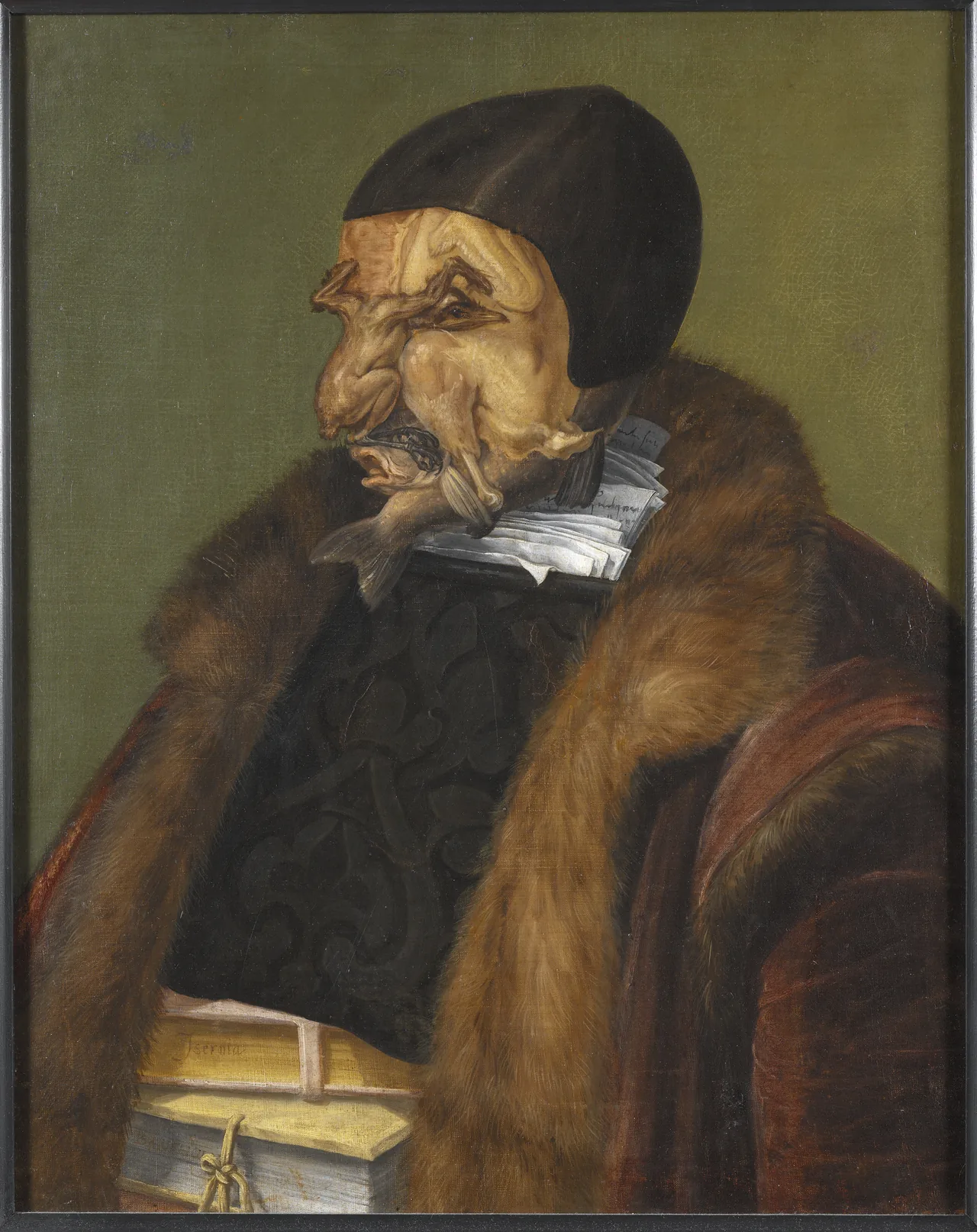
| Selected digital files | One NGA CC0 and one Nationalmuseum PDM file | NGA 2010.77.1 is the exact NGA image hosted on Commons. Nationalmuseum NMGrh 1227 was supplied through its Wikimedia partnership; photo Hans Thorwid, with an institutional public-domain release. Public Domain Mark is not CC0; the Commons missing-U.S.-tag warning is not concealed or treated as independent U.S. clearance. |
| Other works and files | Ten display HOLDs and version-specific conditions | No local image was acquired for the other ten records. Vienna and Louvre versions, museum photographic credits, restoration states, uncertain sitter identities and attributed authorship are kept separate. A research HOLD is not a finding that the old painting remains protected. |
Twelve exact research objects, two selected historical images and ten display HOLDs. The 1563 Vienna and 1573 Louvre Seasons are different paintings. The Jurist’s sitter remains possibly Ulrich Zasius, and the KHM portrait remains attributed to Arcimboldo. Neither the 1591 written description nor the 2007 exhibition is silently converted into proof of publication.
This is a documented research summary, not legal advice. Copyright and moral-rights rules can vary by country and by the history of a particular work.

What we’ll look at
Which Arcimboldo version are you seeing, and what does its image source actually permit?
Short answer: The two Arcimboldo reproductions shown here have institutional open designations: an NGA image under CC0 and a Nationalmuseum image marked public domain. Arcimboldo’s ordinary EU/UK artist term has long elapsed. This does not clear every photograph, modern adaptation or later-discovered work; independent U.S. publication histories remain unresolved in this guide.
A fruit face may look easy to recognise, but identifying the painting takes more care. Arcimboldo repeated subjects, made different series and inspired copies. “Summer by Arcimboldo” is not yet a precise image description. The museum, date and version determine which picture you are actually looking at.
A face and its ingredients
Arcimboldo worked at the Habsburg court in the sixteenth century. His composite heads use fruit, flowers, animals or manufactured objects to build recognisable human features. Seen from a distance, a head emerges; closer up, the ingredients reassert themselves. Neither reading quite cancels the other.
The effect is more structured than a random pile. Objects must perform two jobs at once: remain recognisable and occupy a plausible place in a face. A branch becomes a nose, a page becomes part of a collar, a fruit becomes a cheek. The point where those readings meet is where much of the humour sits.
These were also courtly pictures. The Kunsthistorisches Museum’s account of the Seasons and Elements explains their connections with imperial power and the cycles of nature. Their wit belongs to a particular world of patrons and learned entertainments, not simply to a modern taste for surreal images.
Four seasons in one head
The opening image is Four Seasons in One Head, dated about 1590 by the National Gallery of Art. It is one painting combining the seasons, not a collage we have made from four separate pictures.
The tree trunk gives the face an aged, uneven surface. Knots and cut branches behave like features, while the eye and mouth sit in darkness. The head does not dissolve into a cheerful basket of fruit: much of it remains rough, woody and rather uncomfortable to look at.
Now follow the living things around it. Grapes cluster at the left; fruit and ivy rise at the right; cherries hang beside the ear. Flowers appear across the chest, and grain follows the shoulders. Fresh growth gathers around a body that looks old. That tension makes the picture more than an exercise in spotting vegetables.
The NGA notes a description in Gregorio Comanini’s Il Figino, published in 1591, and identifies the painting as a late work. It also records the picture’s modern rediscovery and its first public presentation in the 2007 retrospective. Those are different kinds of evidence. A sixteenth-century description is not automatically proof that an authorised reproduction of the painting was distributed then.
The dark background is important. It lets the small bright forms emerge without filling every gap. A heavily brightened file can flatten the contrast, making the head look like a uniformly lit arrangement rather than a face partly concealed in shadow.
The lawyer and the books
_-_Nationalmuseum_-_15897.jpg)
The first impression is a formal portrait: cap, gown, fur collar. Then the face becomes difficult to keep human. The pale forms are birds and fish; the white pieces below the chin are papers rather than a conventional ruff. Books occupy the lower body.
The objects help describe a profession as well as a face. Pages and volumes make learning visible, while the animal features interrupt the dignity of official dress. It is tempting to turn this immediately into a fixed story about a corrupt lawyer. The image does not establish that story by itself.
Nationalmuseum’s title keeps the sitter’s identification cautious: possibly Ulrich Zasius. Keep the “possibly”. A confident filename or a shop description is not stronger evidence than the institution’s qualified attribution of the sitter.
This reproduction came to Commons through Nationalmuseum’s partnership with Wikimedia Sverige. Its public-domain notice includes the photograph, credited to Hans Thorwid. That exact provenance matters more than a generic “free Arcimboldo image” label attached to an unrelated scan.
Repeated seasons, different paintings
The 1563 Summer and Winter in Vienna are not the same objects as the four paintings dated 1573 in the Louvre. The Louvre’s record for Summer distinguishes its canvas support from the earlier Vienna paintings on wood and connects the later series with a diplomatic gift to the Elector of Saxony.
That distinction changes what you should compare. Look at the support, inscriptions and emblems, not only the general arrangement of fruit. A date copied from another Summer can attach the wrong history to an otherwise recognisable image.
Restoration also changes the files available online. The Louvre’s 2024 account explains work on its four Seasons. Earlier photographs with decorative borders and newer photographs should not be silently presented as interchangeable records of an untouched original state. Record which reproduction you use.
Twelve objects, not one template
The two illustrated files are selected examples. The remaining ten entries are research links with no reviewed local display image. A shared subject does not merge the objects, and an “attributed to” label must remain visible.
| Object or version | Date | Institutional record |
|---|---|---|
| Four Seasons in One Head | c. 1590 | NGA 2010.77.1 |
| The Lawyer, possibly Ulrich Zasius | 1566 | Nationalmuseum NMGrh 1227 |
| Summer, Vienna version | 1563 | KHM GG 1589, institutional series account |
| Winter, Vienna version | 1563 | KHM GG 1590, institutional series account |
| Fire | 1566 | KHM GG 1585 |
| Water | 1566 | KHM GG 1586, institutional series account |
| Spring, Louvre version | 1573 | Louvre RF 1964 30 |
| Summer, Louvre version | 1573 | Louvre RF 1964 31 |
| Autumn, Louvre version | 1573 | Louvre RF 1964 32 |
| Winter, Louvre version | 1573 | Louvre RF 1964 33 |
| Vertumnus | Late sixteenth century | Skokloster’s object account |
| Portrait of an Archduchess, possibly Margaret; attributed to Arcimboldo | c. 1563 | KHM GG 4509 |
Old painting, current file
Arcimboldo died in 1593. The ordinary EU and UK artist terms have long elapsed. That is a bounded term conclusion, not permission to copy every modern book page, creative photograph or Arcimboldo-inspired illustration.
For the United States, the ordinary publication term has elapsed for works published through 1930. But creation, a written mention and exhibition are not interchangeable with publication. Copyright Office guidance also explains a possible term through 2047 for certain older, previously unpublished works first published between 1978 and 2002. This guide does not independently establish the publication chains of the twelve objects; it reports the selected providers’ image designations.
The NGA open-access policy and the exact Commons-hosted NGA file support the opening image. Nationalmuseum’s institutional release supports the second. CC0 and the Public Domain Mark are different tools; neither implies museum endorsement of a product. KHM’s reproduction-request conditions and the Louvre’s modern photographic credits are not replaced by those two other institutions’ policies.
How to keep the joke visible
Choose a file that retains the full head and the objects below it. A face-only crop can discard the books or flowers that explain the subject. Save the collection title and accession alongside the image, and keep uncertain identities uncertain. Arcimboldo rewards a second look; a good reproduction should leave enough detail—and enough darkness—for that second look to happen.
Sources and review method
We checked the artist chronology against museum records, treated each named jurisdiction separately, and recorded the provider policy for the image set. These sources support the legal framework and artist dates used above; the source file for any individual image still needs its own record.
- Four Seasons in One Head, 2010.77.1 — National Gallery of Art. c. 1590 painting, 1591 description, modern rediscovery, exact object and public-domain image designation.
- Four Seasons in One Head, exact NGA file — Wikimedia Commons / National Gallery of Art. Exact file provenance, full-size source and CC0 designation.
- The Lawyer, possibly Ulrich Zasius, NMGrh 1227 — Nationalmuseum via Wikimedia Commons institutional partnership. 1566 object, qualified sitter identity, Hans Thorwid photograph and institutional public-domain release; PDM distinguished from CC0.
- New Year’s Menu for the Emperor — Kunsthistorisches Museum. Exact Vienna Seasons/Elements, dates and imperial context; no permission inferred for a local download.
- L’Été, RF 1964 31 — Musée du Louvre. 1573 canvas version distinguished from the 1563 Vienna object on wood.
- Les Saisons d’Arcimboldo: une restauration — Musée du Louvre. 2024 restoration and historical borders; reproduction states are not silently interchangeable.
- Free Images and Open Access — National Gallery of Art. Policy supporting the designated NGA image, not all other institutions’ files.
- Copyright in the EU — European Union, Your Europe. Ordinary life-plus-70 term; national exceptions and other contributors are separate.
- How long copyright lasts — UK Intellectual Property Office. Ordinary artistic-work term, not clearance of every older unpublished work or photograph.
- Duration of Copyright, Circular 15A, April 2026 — U.S. Copyright Office. Publication-based term and conditional older-unpublished rules. Creation, description and exhibition are not publication evidence by themselves.

Editorial record
About this article
- Author
- Publisher
- GeMarkt
- Published
- Reviewed
- Internal source & rights check. Conducted by GeMarkt Research Review. This is an internal editorial check—not independent peer review.
- Source standard
- Rights guide source standardSeparates the underlying work from the source file, records the review date, and links the evidence used for the conclusion.
Found a claim that needs checking? Report a factual error.