GeMarkt Blog · Reference
Public Domain vs Creative Commons vs Royalty-Free
Public domain describes status, Creative Commons supplies licences, and royalty-free describes a licensing model. Learn what each means for an art image.

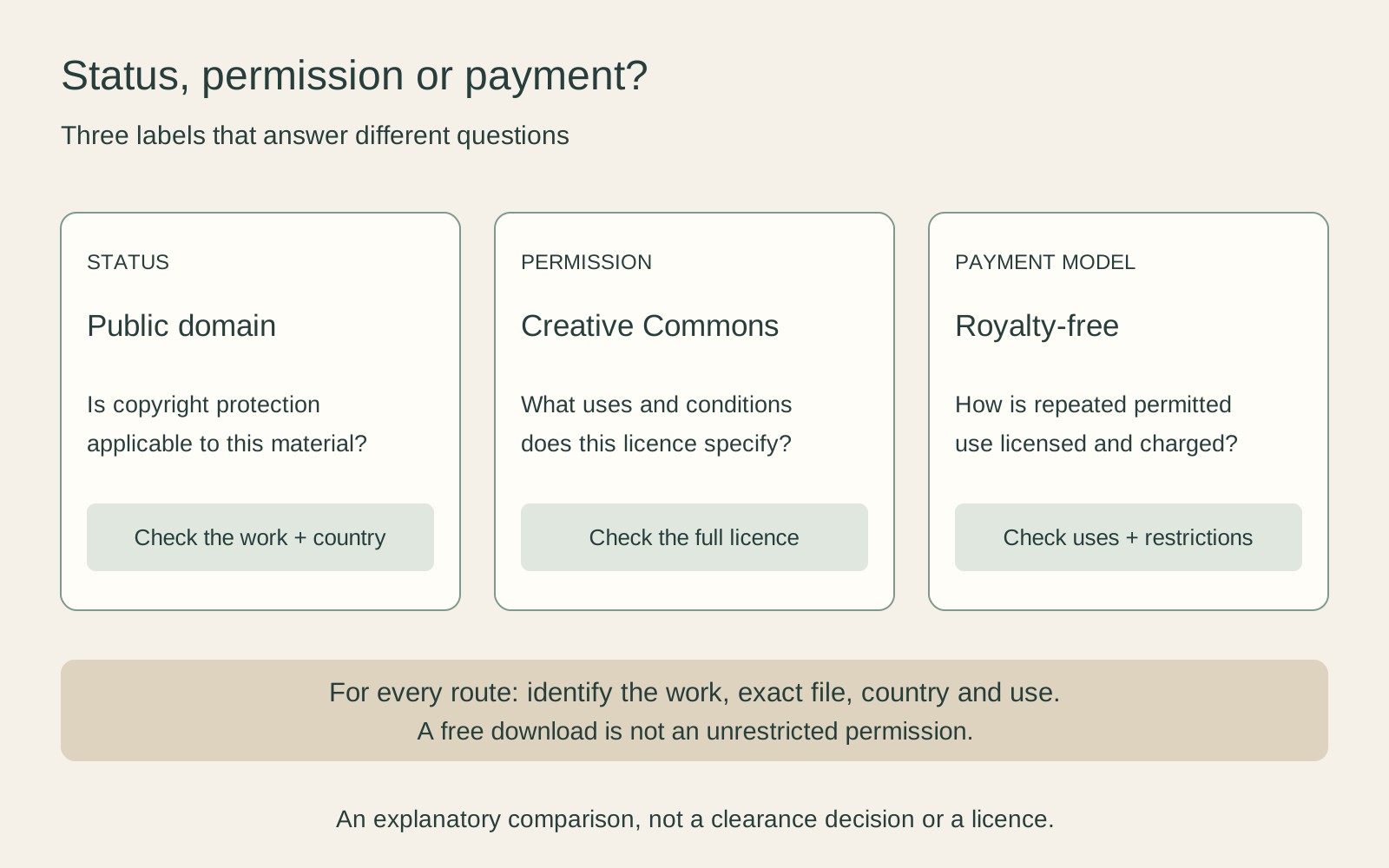
Public domain describes a work’s copyright status. Creative Commons licences give permission under stated conditions. Royalty-free usually describes a licensing arrangement without a fresh royalty for each permitted use. None of these phrases means “anything on this page can be used however you like.”
This matters when choosing an image for a blog, a printed invitation or a product. A file can cost nothing and still prohibit your intended use. Another can be sold for a download fee while the underlying historical artwork remains public domain. Price is not a shortcut to permission.
The aim here is to help you read the labels correctly. It is not a legal clearance for a particular file or country. Where the use is commercially important and the terms are unclear, ask the rights provider or a suitably qualified adviser before proceeding.
Three terms answer three questions
| Term | Main question it answers | What it does not establish by itself |
|---|---|---|
| Public domain | Is this material protected by copyright in the relevant country? | Rights in another photograph, a trademark or a different country |
| Creative Commons licence | What uses has the licensor permitted, and on what conditions? | Whether an unidentified uploader owned the rights they purported to license |
| Royalty-free | How is repeated permitted use licensed and charged? | Unlimited uses, free download, ownership or permission to resell the file |
These are not three levels on a single freedom scale. Read each label for the job it does. A royalty-free stock photograph may still be copyrighted; a Creative Commons licence may permit commercial reuse without a fee. You need the actual terms to tell them apart.
Public domain is a copyright status
The US Copyright Office’s explanation of copyright includes works that were never protected and works whose protection ended, whether through expiry or failure to satisfy an earlier required formality. Public domain is not a special price category, and an online download does not acquire that status merely because it is easy to save.
Be precise about the material and territory. “An old painting” might describe the underlying composition, while the file you found is a recent staged photograph of it. A claim about the painting does not automatically settle the photograph. Nor does a conclusion for one country establish the same answer everywhere.
For artwork research, identify the specific object or edition before using an artist’s death date or a publication date. A series title can cover works made or published at different times. See Public Domain Is Not a Free-for-All for a broader explanation of those boundaries.
Creative Commons is not one permission
The Creative Commons licence overview describes six licences built from different conditions. Saying “it is Creative Commons” leaves out the part that tells you what you can do. Record the complete abbreviation and version, such as CC BY 4.0 or CC BY-NC-ND 4.0.
Under CC BY 4.0, sharing and adaptation can include commercial purposes, with appropriate credit, a licence link and an indication of changes. The permission cannot be withdrawn while you comply with its terms. Do not credit the creator in a way that implies endorsement.
CC BY-SA 4.0 adds ShareAlike: if you distribute an adaptation, your contribution must use the required same or compatible licence. The CC FAQ distinguishes adapting a work from including it in a collection. Do not assume that every unrelated word or photograph on a page must be relicensed merely because an image uses ShareAlike.
CC BY-NC 4.0 restricts use primarily intended for commercial advantage or monetary compensation. “I am a small business” is not a substitute for checking that condition. Where the boundary matters, seek separate permission rather than inventing an exception based on your size.
CC BY-ND 4.0 allows sharing, including commercially, but not distribution of adapted material under that licence. A mere file-format change is not itself an adaptation. Cropping, recolouring or combining an image can raise a different question; do not treat all edits as equivalent.
The licences give no guarantee that every other permission is covered. A photograph may include somebody else’s work, an identifiable person or a mark. Match the licence to the material its provider was entitled to license. Attribution is a condition of many permissions, not a replacement for permission.
Royalty-free is not restriction-free
Adobe Stock’s explanation illustrates the model: a licence fee can cover repeated uses without further payment for each use, subject to the licence restrictions. Its free collection also grants licences rather than transferring ownership. Royalty-free therefore does not necessarily mean either “paid” or “public domain.”
Look especially at merchandise, redistribution and editorial-only conditions. The Adobe Stock licence comparison distinguishes Standard and Extended permissions. A Standard licence does not cover merchandise whose main value is the asset itself; an Extended licence can permit that use, while still forbidding distribution of the standalone file. Editorial-only assets have separate limits, even under an Extended licence.
That is one provider’s structure, not a universal rule for every image library. Read the agreement attached to your asset. If a service uses words like “standard,” “premium” or “unlimited,” find out what they modify: download quantity, resolution, reproduction numbers or actual permitted uses. They are not interchangeable promises.
Where CC0 and the Public Domain Mark fit
CC0 is a Creative Commons tool for relinquishing the affirmer’s copyright and related rights as far as possible, rather than one of the six condition-based licences. It does not waive rights belonging to somebody else or guarantee that every proposed use is lawful.
A Public Domain Mark describes an assessment of status; it is not the same operation as applying a waiver. Our separate guide to CC0, Public Domain Mark and museum licences explains what to look for on an institutional download page.
Keep the original wording in your records. Do not silently rename CC BY as CC0, or call a paid museum licence “public domain” because the painting is old. The terms beside the file are evidence to understand, not badges to simplify until they lose their meaning.
Choose for the use you actually have
Write your intended use before searching. “Illustrate a historical article with an unchanged image and credit” is more useful than “use commercially.” “Offer the picture as a downloadable file” is different again. The more specifically you describe the project, the easier it is to identify a missing permission.
Then compare files, not just artworks. A well-documented institutional download may be a better choice than a larger anonymous copy. For a specific CC image, check the full licence. For a stock asset, check the licence tier and any editorial designation. If you cannot meet a condition, choose another file or obtain a separate agreement.
Save the evidence with the file
Keep the source URL, creator credit, complete licence or rights statement, date checked and any purchase or permission record. Name the saved image clearly enough that you can match it to those notes months later. Record changes when they matter to the licence and caption.
Before release, make one final check: does the evidence cover this exact file and this intended use? A confident label is less useful than a modest, traceable answer. For a practical caption structure, continue with how to credit a public-domain artwork.
Editorial record
About this article
- Author
- Publisher
- GeMarkt
- Published
- Reviewed
- Internal source & rights check. Conducted by GeMarkt Research Review. This is an internal editorial check—not independent peer review.
- Source standard
- Rights guide source standardSeparates the underlying work from the source file, records the review date, and links the evidence used for the conclusion.
Found a claim that needs checking? Report a factual error.