GeMarkt Blog · Reference
Public Domain Day 2027: What to Check for Pollock, Nolde and Feininger
Why 1956 deaths point to a 2027 life-plus-70 milestone, and what still needs checking for Pollock, Nolde and Feininger by country, work and image file.

A date to prepare for, not a permission already granted
Pollock, Nolde and Feininger all died in 1956, making 1 January 2027 an important ordinary life-plus-70 milestone. It does not follow that every work by all three artists will first become free in every EU country on that day. National transitions, the treatment of foreign works, publication history and the chosen image can change the answer.
This guide is written as of 13 October 2026, before the date arrives. Its purpose is to help you prepare a defensible work-specific check, not to announce that a future expiry has already happened. It is general information, not legal advice or clearance for a catalogue, website or product.
The distinction is worth making before an appealing annual headline turns into a production deadline. Researching a work now is different from publishing a reproduction in reliance on a term that has not yet ended.
Why these three artists appear on the calendar
The institutional records establish the common death year. MoMA lists Jackson Pollock as 1912–1956 and Lyonel Feininger as 1871–1956. The Nolde Stiftung’s chronology records Emil Nolde’s death on 13 April 1956.
Those dates explain why the artists belong in a 2027 planning conversation. They do not establish the history of each painting, print, drawing or manuscript. A date on an artist biography is one input; it is not an inventory of cleared reproductions.
Start with the individual object. Record the full title, medium, date and institutional identifier. Two similarly titled drawings are not interchangeable, and the page for a painting does not necessarily describe the photographic file someone has uploaded elsewhere. This basic identification work is useful regardless of which country’s term you later calculate.
How the ordinary seventy-year calculation works
Germany provides a clear statutory example. Section 64 of its Copyright Act sets the ordinary term at seventy years after the author’s death; section 69 supplies the calendar-year calculation. For a 1956 death, the seventy complete following years are 1957 through 2026. Under that ordinary route, protection finishes at the end of 31 December 2026.
That is why the relevant new-day date is 1 January 2027, not an anniversary during 2026. It is also why adding seventy to the date printed beside an artwork is the wrong operation. The rule starts with the author’s death, not the work’s creation.
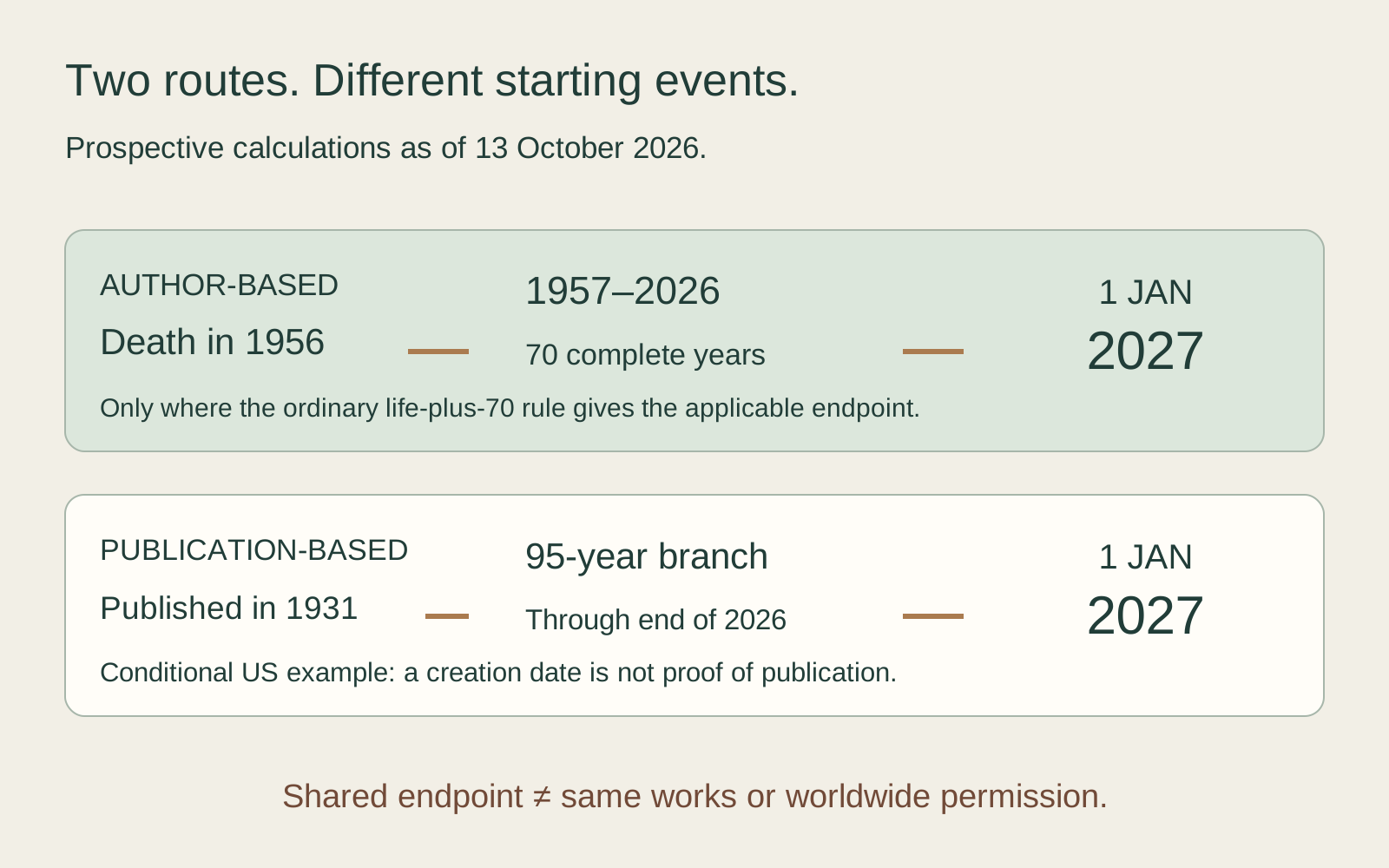
The diagram places a US publication calculation alongside it to make the difference visible. Sharing an endpoint does not mean the two routes apply to the same works. Before calculating, you must choose the legally relevant starting event.
Why the EU is not one blanket verdict
The EU framework does not erase every longer historical term. Spain’s fourth transitional provision preserves the older duration for authors who died before 7 December 1987. Its government’s public-domain explanation identifies the general older term as eighty years. Where that term applies, a 1956 death points to 2037, not 2027; applicability to a particular foreign work still needs checking.
France needs care too. Its 2007 Monet judgment rejects simply stacking wartime extensions onto the harmonised term, while preserving a longer period already running on 1 July 1995. This is a reason to check the relevant history, not to add an identical war allowance to every artist.
There is another distinction for international works. Article 7 of Directive 2006/116 provides a comparison-of-terms framework where the work originates in a third country and its author is not an EU national, subject to specified qualifications. A relevant work may therefore have a different endpoint, or may already be out of protection. Do not assume that a familiar nationality label settles country of origin or the applicable treaty analysis.
For a project spanning several markets, a country-by-country result is more useful than a single “EU: yes” entry. If those rules materially affect the planned use, obtain advice on the exact works and territories.
The US calendar has a different starting point
The United States does not free every work by an artist seventy years after their death. For an older work in the ninety-five-year statutory branch, the ordinary calculation for a 1931 publication reaches the end of 2026. Sections 304 and 305 of the US statute provide the duration and year-end framework.
A 1950 painting does not become a 1931 publication because its creator died in 1956. Equally, “made in 1931” is not proof of publication that year. This guide makes no US clearance finding for the three artists’ individual works.
Publication and registration evidence belong in a separate record. So do questions about restoration, renewal or a work that remained unpublished. Our US publication guide explains why a dated object label is often only the beginning of that research.
Unpublished material and new contributions need their own checks
An unfamiliar drawing discovered in an archive deserves more than an artist-level date calculation. Under Article 4 of the EU term directive, a qualifying first lawful publication or communication of a previously unpublished work after copyright expiry can attract a separate twenty-five-year protection. The conditions matter; the rule does not mean every new scan restarts the artist’s copyright.
The same directive leaves national moral rights outside its term rules. A deadline for economic rights should therefore not be treated as permission to misattribute or casually misrepresent a work.
Also distinguish the artwork from later additions. A recent essay, translation, page design or creatively composed photograph may introduce other authors. You may need only the artwork, not those additions. Finding a well-documented standalone image can make that distinction easier to manage than extracting an illustration from a modern book.
Prepare a work-specific record before January
Here is a practical research sequence, not an official clearance form. First choose the actual object and intended use. Then identify the countries involved and record the rule and evidence for each conclusion. Finally, trace the exact image file you intend to publish.
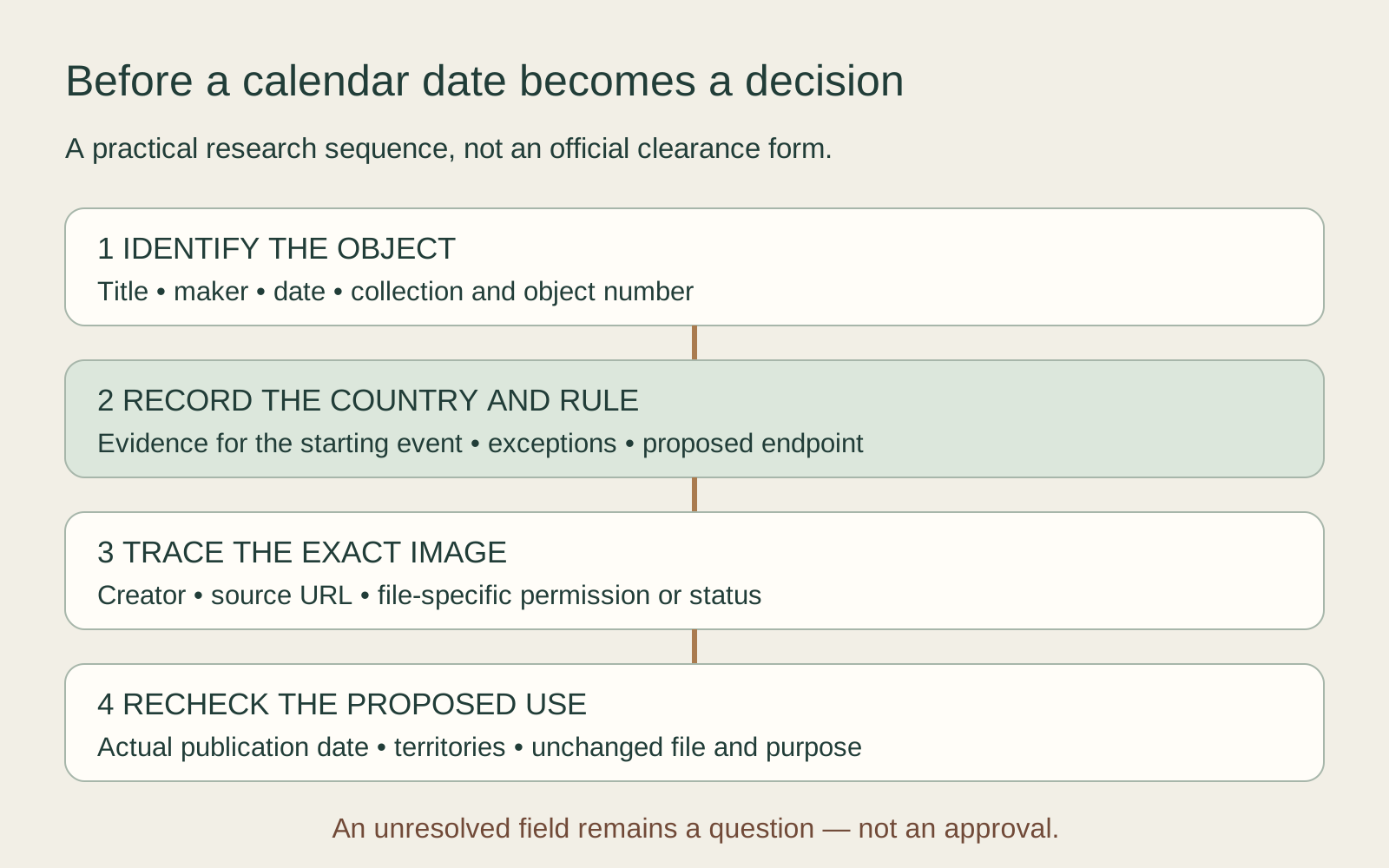
Consider a hypothetical publisher preparing a small illustrated booklet. “Pollock, 2027” is not a usable image specification. The editor needs the exact object, source, file, distribution territories and proposed reproduction. An unresolved field is a question to investigate, not an invitation to fill it with the most convenient assumption.
Keep institution statements with their context. MoMA’s artist pages, for example, include an image-licensing contact route; they do not offer a general CC0 release of every displayed file. A record can be authoritative evidence for an artist’s dates without supplying permission to reproduce its images.
What to recheck when 2027 arrives
Revisit the underlying rule and the source record rather than relying solely on a saved headline. Confirm that the proposed use, file and territories still match the research. If a museum changes an image’s status, save the specific new statement; do not assume a change happened automatically at midnight.
For the file-language side of that review, see CC0, public-domain marks and museum licences. It helps distinguish an artwork-term conclusion from a source’s statement about a digital reproduction.
Public Domain Day is a useful occasion to find newly available art. Its value is greater when the announcement tells readers exactly what has changed—and leaves unresolved questions visible rather than turning anticipation into permission.
Editorial record
About this article
- Author
- Publisher
- GeMarkt
- Published
- Reviewed
- Internal source & rights check. Conducted by GeMarkt Research Review. This is an internal editorial check—not independent peer review.
- Source standard
- Rights guide source standardSeparates the underlying work from the source file, records the review date, and links the evidence used for the conclusion.
Found a claim that needs checking? Report a factual error.