GeMarkt Blog · Practical guide
Picture Hanging Hardware Explained
Understand picture hooks, D-rings, wire, cleats and rails, and learn why the frame, fittings and wall must be assessed together before hanging art.

Picture-hanging hardware has two jobs: connect to the picture and connect to the building. A D-ring belongs to the frame side; a wall hook receives it or another suitable hanger. Screws, anchors and the wall behind them complete the connection. Choosing one impressive-looking component does not settle the rest.
This is a guide to recognising those parts and asking useful questions about them, not a set of installation instructions. The right arrangement depends on the complete framed object, the supporting wall and the exact manufacturer’s conditions. An old fitting or unlabelled packet needs identification, not an optimistic weight estimate.
Start with the frame and the whole connection
Weigh the complete assembly, including glazing and backing, and record its outside dimensions. Then establish what the frame was designed to hang from. A decorative edge or paper backing is not automatically an attachment point. If the frame is cracked, distorted or poorly joined, ask a framer to assess it before choosing wall hardware.
The Canadian Conservation Institute’s painting care guidance identifies loose devices, worn wire and failure at the wall as causes of falls. It also notes that lighter works can suffer from insufficient attention to hanging. “Only a small picture” is therefore not a useful substitute for checking its fittings.
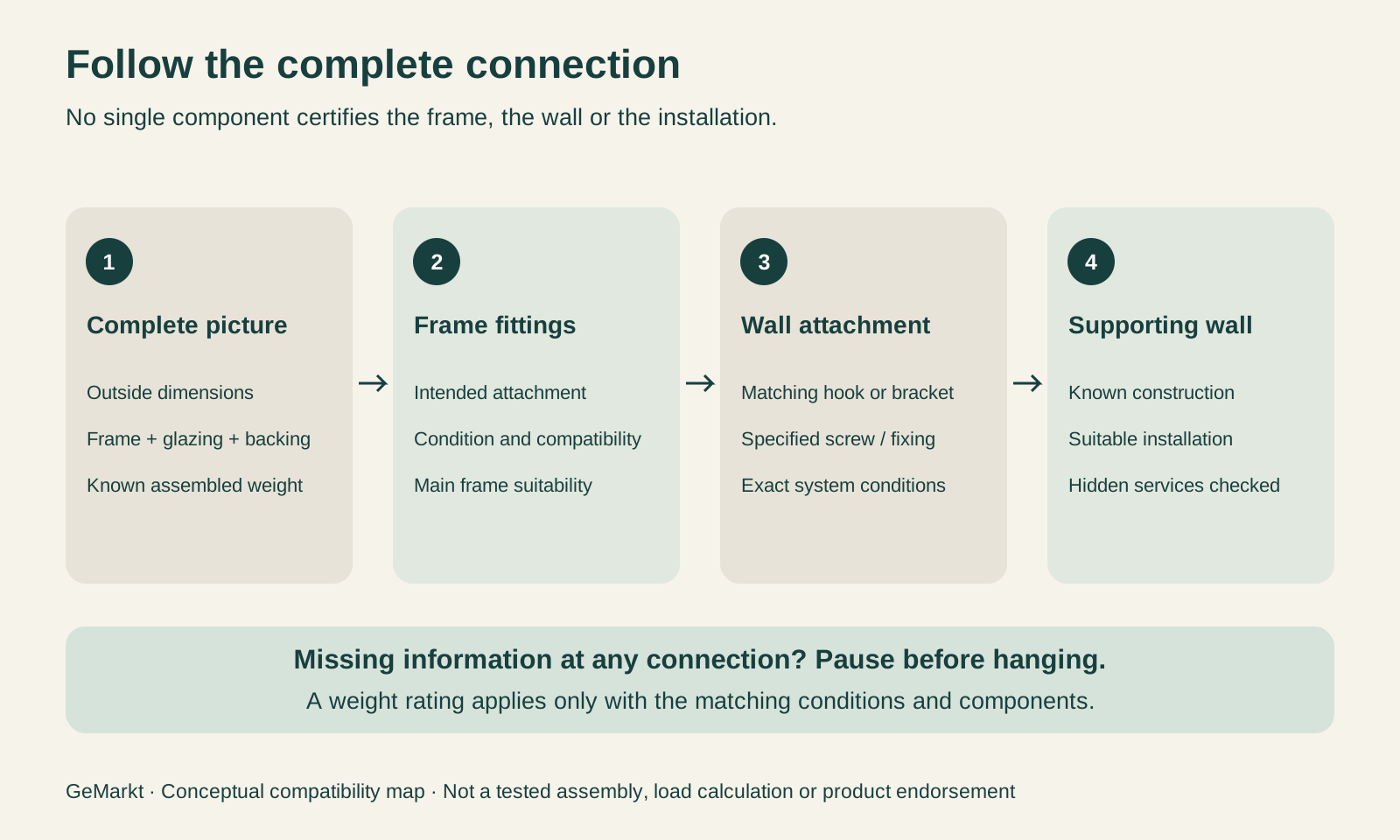
Check compatibility in both directions. A hook must suit the object that rests on it, but it also needs an appropriate connection to the wall. A technically suitable wall fixing cannot repair weak hardware on the back of a frame. Keep the whole assembly in view when discussing a purchase.
Recognise rings, screw eyes and wire
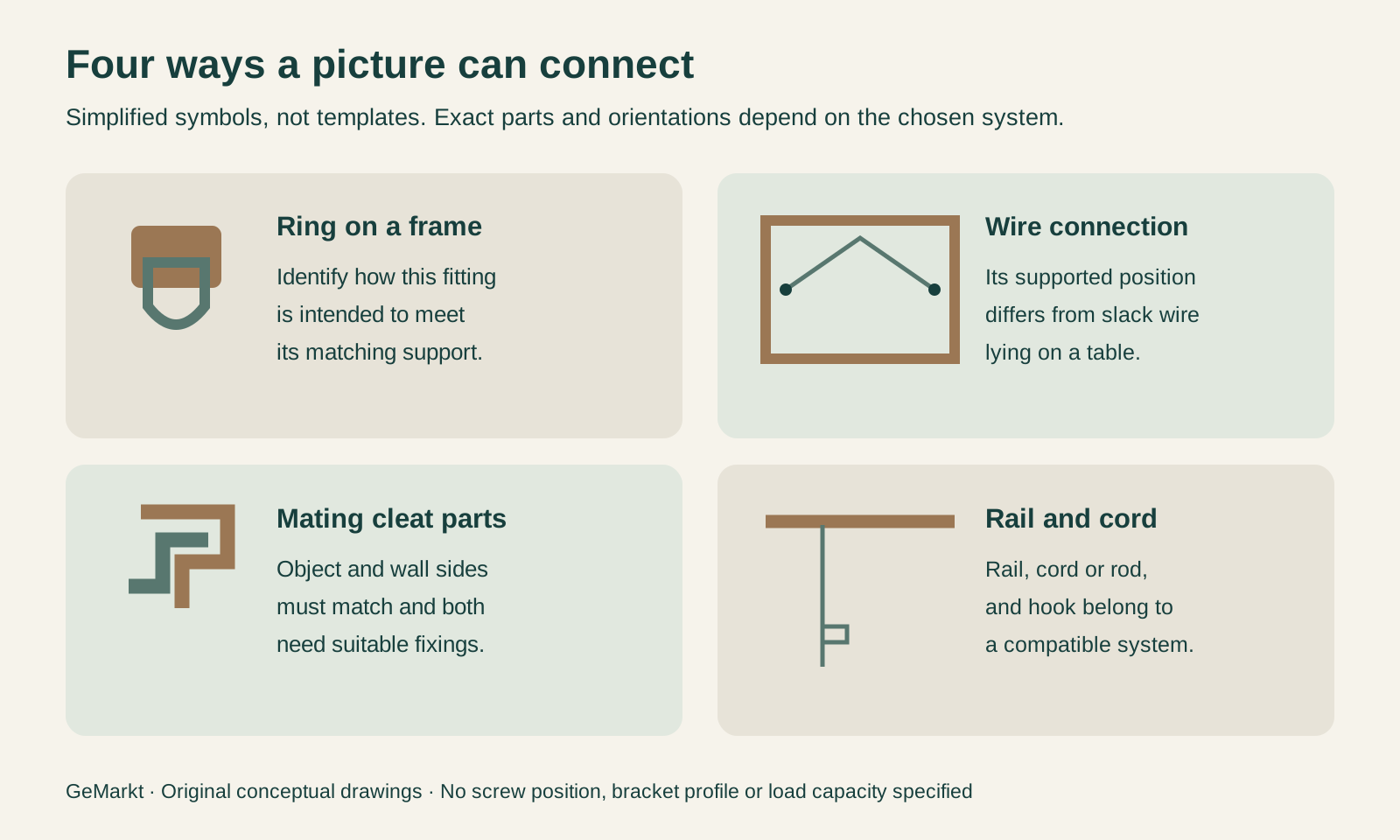
A D-ring is a hinged ring on a metal attachment plate. A screw eye forms an eye at the end of a threaded shaft. Picture wire links suitable frame fittings and rests on the intended wall supports. These descriptions identify the families; they do not establish which size or arrangement your frame needs.
CCI’s discussion of frame hardware distinguishes direct attachment at two points from hanging through wire, and warns that ageing wire can fray or break. It also explains why the main frame, rather than a weak inner liner, matters when choosing an attachment.
Do not add wire merely because two rings are present. They may have been intended to meet separate wall supports. Ask the frame maker or framer how the supplied fittings are meant to work, including any requirements for their orientation and matching parts.
Small sawtooth fittings, recessed slots and specialised canvas hangers introduce further variations. A slot in a moulded frame is not necessarily compatible with the same hook as a D-ring. Photograph the back for identification instead of buying by a familiar name alone.
Separate a wall hook from its fixing
The hook is the part that receives the picture’s hanger. Its nail, screw or other attachment connects it to the wall. An anchor or plug, where the specified system uses one, is another part of that connection. The decorative surface you see may conceal quite a different supporting material.
For example, fischer’s official DuoPower 10 × 50 technical page provides different load figures for concrete, brick and plasterboard, together with dimensional conditions. That is evidence that the base material matters, not a recommendation to use that particular plug for a picture. Its highest displayed number cannot be transferred to another wall.
Do not identify a wall solely by tapping it or recognising its paint. Where its construction is unknown, have someone qualified establish it. Before any penetration, hidden pipes and electrical cables also need assessment. Those are building questions that this hardware guide cannot resolve from the picture’s weight.
Understand cleats and picture rails
Cleat systems use mating parts, one on the object and one on its support. Hangman’s Z-Hanger description, for example, identifies interlocking aluminium brackets. The drawing below shows the idea of a paired connection, not that product’s profile, hole pattern or load rating. A cleat still needs suitable attachments on both sides.
Picture rails work differently: a mounted rail accepts compatible cords or rods and hooks, allowing picture positions to change within that system. STAS describes this relationship in its hooks, cords and rods guide, with different combinations for different rail families.
An existing strip of moulding is not necessarily a functioning picture rail. Establish its identity and installation before loading it. A rail can make rearranging convenient, but a new rail is itself an installation project; it does not remove the need to assess the wall or obtain permission.
Read the rating with its conditions
Record the model, permitted surface or support, matching components and installation requirements alongside any weight figure. Check whether a claim concerns a single item, a pair or a complete arrangement. Do not add ratings together unless the manufacturer expressly documents that combination.
The STAS hooks and cords page illustrates the issue particularly clearly: it lists the same Zipper hook with a perlon cord at a different capacity from that hook with its specified steel cable. The hook’s name alone is not enough to select the combination.
Where several pictures share one cord or rail, their relationship matters too. STAS’s FAQ tells users to respect both the cord’s total allowed load and the chosen rail system’s capacity. Do not assume an unused hook means there is unused capacity elsewhere in the system.
If a seller cannot explain the conditions behind a rating, choose a documented alternative or ask an installer. A generous-looking number is not compensation for an unidentified wall, damaged frame or missing instructions.
Treat adhesives as specific systems
Adhesive hanging products rely on compatible surfaces on both the wall and the frame. “No nails” does not mean that surface preparation, waiting times, removal access or load conditions disappear. Nor does it promise damage-free removal from every finish.
For one concrete example, the US Command Picture Hanging Strips instructions exclude wallpaper, positions above beds and valuable or irreplaceable items. Those are conditions for that named system, not a statement about every adhesive product sold elsewhere.
Keep the exact instructions and packaging. Do not improvise extra strips or substitute a similar adhesive to increase capacity. Our renter-friendly hanging guide explores how permission and product-specific surface restrictions affect this choice.
Take the right information to a framer or installer
Bring the outside dimensions, complete weight, clear photographs of the frame back and any original instructions. Explain the proposed position and the wall construction if it has been reliably identified. Mention restrictions from a lease or building manager before discussing new holes or a rail.
Also explain how the room is used. A picture above sleeping occupants, near children or in a busy circulation route presents a different consequence of failure from one in an unused corner. Large glazed, valuable or awkward objects deserve handling and installation advice appropriate to that situation; this guide does not approve overhead hanging.
Once the system is agreed, settle appearance with a paper layout. Keep the hardware information for future changes. Replacing a frame or glazing can change the requirements even when the image and wall position stay the same. The useful outcome is a compatible, understood arrangement, not a collection of individually strong parts.
Editorial record
About this article
- Author
- Publisher
- GeMarkt
- Published
- Reviewed
- Internal source & rights check. Conducted by GeMarkt Research Review. This is an internal editorial check—not independent peer review.
- Source standard
- Buying guide source standardSeparates measured or first-hand evidence from general guidance and keeps practical limits visible.
Found a claim that needs checking? Report a factual error.