GeMarkt Blog · Essay
Where Your Print Is Made: Our Print Partners
See the documented JONDO connection in one GeMarkt print range, and why a named supplier, production country and your parcel's journey are different questions.

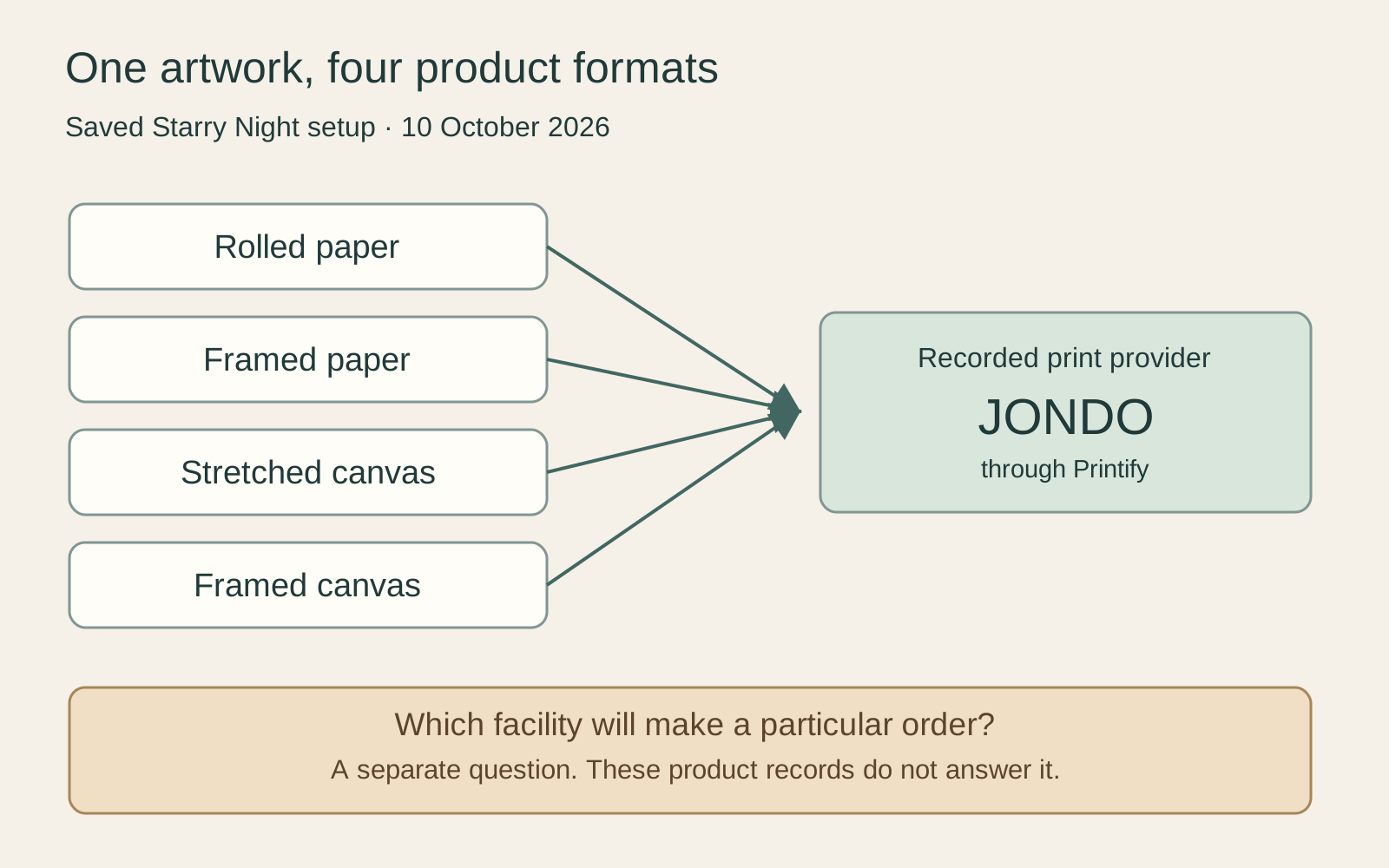
Our saved production records connect the paper and canvas versions of GeMarkt’s Starry Night print to JONDO through Printify. They do not promise one factory or one country for every order. Knowing the production partner is useful; knowing where your particular print will be made requires a more specific answer.
This account uses that documented product range as its example. The product records were captured on 10 October 2026, and the linked provider information was checked on 13 October 2026. It is not a supplier census for every GeMarkt listing, a report of a factory visit or a guarantee about an order that has not yet been placed.
The partner we can name
For the example below, GeMarkt supplies the artwork offering, Printify provides the production platform, and the saved product setup names JONDO as the print provider. Printify’s JONDO catalogue page identifies that provider and includes paper posters, stretched canvas and framed products.
These names describe different roles. A company appearing in a print platform’s catalogue does not mean that GeMarkt owns its equipment or operates its facilities. Nor does using a platform make every printer in that platform’s network our supplier. The connection here comes from our actual product records, not from the existence of a public provider directory.
For customers, this is a more useful distinction than a long list of impressive manufacturing names. It tells you which relationship has been documented, without turning a network membership into a claim that every participant makes our prints.
One artwork four product records
The saved setup for The Starry Night contains separate production products for rolled paper, framed paper, stretched canvas and framed canvas. All four identify the same provider. The paper finish and size combinations belong to the corresponding paper product; the canvas choices belong to their own products.
That separation matters even when the picture on the front is identical. Choosing a framed paper print is not simply asking someone to put a frame around whichever rolled poster happens to be available. The order needs to identify the correct finished product, material option and dimensions together.
For example, a customer comparing a paper print with a framed canvas should retain the whole option name when asking a question. “Where is the Van Gogh made?” is less precise than “Where would this framed canvas, in this size, be produced for my delivery country?” No private account number is needed to ask that question.
A provider is not a single factory
Printify’s current JONDO shipping page lists fulfilment centres in the United States, Canada, Australia, the United Kingdom and Spain. This describes the provider’s listed network, not five guaranteed production choices for every size and finish.
Printify also explains that providers with several facilities generally prioritise a suitable nearby location, but explicitly warns that local fulfilment is not guaranteed. Availability can lead to a different location. Its multi-facility guidance therefore does not support a promise that every British customer receives a British-made print, for example.
If production country is central to your purchase, ask about the exact option before committing. A network map is helpful background, but it should not do the work of a country-of-production answer. The distinction is especially important when buying a gift for someone who cares about local production.
Why a saved product does not settle every order
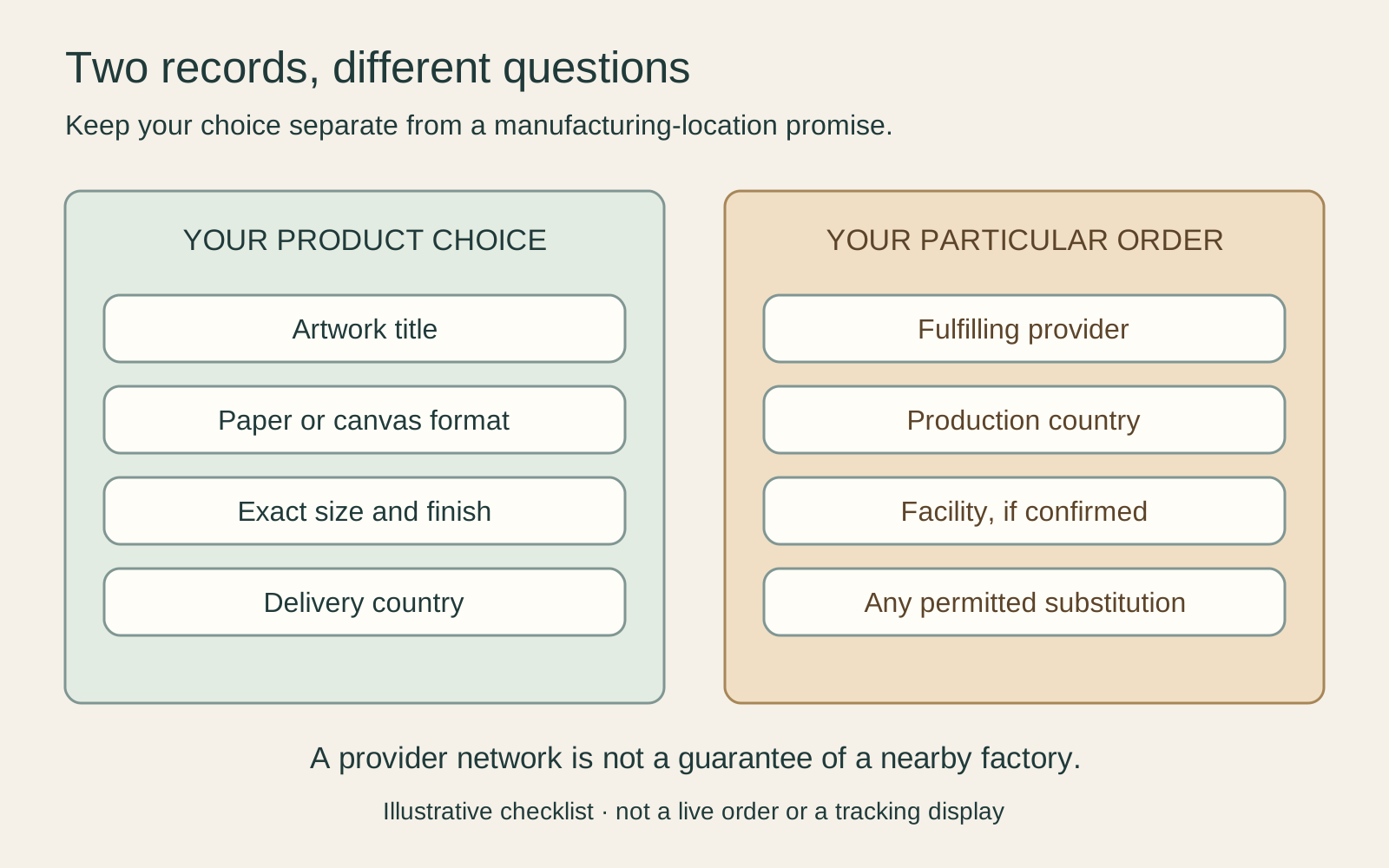
A product setup records an intended production choice. An order records what happens to a particular purchase. Those records can answer different questions without either being wrong.
Printify’s Order Routing explanation describes an optional process that can move an order to an alternative provider, including when stock or provider availability changes. The platform also offers other fulfilment features. A general description of those features is not evidence that a particular feature is enabled for our shops or affected your order.
The records supporting this article do not establish current shop-level routing settings or a completed order’s final facility. Accordingly, the JONDO connection is a dated product-configuration fact, not an unconditional promise about every future parcel. If an exact factory is essential, an unresolved answer should remain unresolved rather than becoming “probably the nearest one.”
The print location is not the origin of every material
Printing a picture, making its paper and manufacturing a frame are separate activities. Printify’s manufacturing explanation distinguishes a provider’s printing location from the wider supply chain; its “Generic brand” label is not the name of a paper mill.
For a concrete example, the platform’s framed paper poster page describes assembly in the United States using globally sourced parts. That wording should not be expanded into “every component is American-made.” It also should not be copied across to a different canvas product just because both have frames.
The same caution applies to inks and paper. A finish called “fine art” is not a complete technical specification. If a particular fibre, coating or ink system matters to you, request confirmation for the selected product rather than assuming that a provider name answers all three.
What to ask before you order
Start with the print you actually intend to buy. Keep its artwork title, finish, size and delivery country together. If you are comparing options, ask about each one rather than treating the whole artwork page as a single manufactured object.
A useful message might be: “I am considering the 20 × 16 inch framed canvas of The Starry Night for delivery to the UK. Can you confirm the expected production country for that option, and whether it is guaranteed or may change?” This is an example of a question, not a claim that this size is currently deliverable to that destination.
Say why the answer matters if you have a firm requirement. A local-production preference, a deadline and a concern about materials are different questions. If the seller can confirm only the provider, do not read that as confirmation of the facility, shipping date or component origins.
What the preview can and cannot show
Our product pages use format and size previews to help you understand how an artwork fits a selected option. A framed-canvas mockup can help explain the relationship between the picture and its frame. It cannot identify the factory that will make your order, prove the ink chemistry or demonstrate the feel of a paper surface.
Keep those decisions separate. Use the preview for composition, the product description for the specified format, and an order-specific answer for a production requirement. Our guide to reading an art listing explains why image size, sheet size and the outside of a frame should also remain distinct.
Keep the answer specific to your print
GeMarkt currently directs purchases to the linked Etsy listing, where you confirm the final option and transaction details. A choice made while exploring a GeMarkt preview is not, by itself, a completed order or a factory reservation.
For this documented Starry Night range, JONDO is the named provider in the saved setup. For your own purchase, the useful next step is to confirm the chosen format and destination, then resolve any production-country requirement before paying. A clear, limited answer is more dependable than a worldwide promise that the underlying records cannot make.
Editorial record
About this article
- Author
- Publisher
- GeMarkt
- Published
- Reviewed
- Internal source & rights check. Conducted by GeMarkt Research Review. This is an internal editorial check—not independent peer review.
- Source standard
- Blog source standardNames the editorial responsibility, keeps evidence close to material claims, and records meaningful revisions.
Found a claim that needs checking? Report a factual error.