GeMarkt Blog · Practical guide
Storing Unframed Prints
Store unframed prints with suitable support and enclosures. Measure the whole sheet, avoid tight packaging and know when rolling or plastic sleeves are unsuitable.

For an ordinary flat print, choose a suitable conservation-quality folder or mount, place it in a supportive box that fits, and keep it in a clean, stable indoor space. Do not squeeze a large sheet into a small container, assume a shipping tube is permanent storage, or let “acid-free” replace checking the actual material.
Good storage should make the next handling easy. If you have to pull at a corner, shuffle a heavy stack or bend the paper to remove it, the arrangement needs improving before the collection grows.
Start with the whole sheet
Measure the paper from edge to edge, including any unprinted border. A 30 × 40 cm image on a 40 × 50 cm sheet needs storage for the larger sheet. Do not trim that border to fit a box: it may include information, be important to the object, or simply be part of the print you chose.
Keep image size, sheet size and existing mount size as separate entries. If the print is already safely mounted, measure the outside of the mount rather than removing it for convenience. Our print-size guide explains the difference between the image, paper and frame measurements.
Check the condition before moving anything. A brittle, torn, flaking, damp or stuck-together object is not an ordinary loose print ready to file. Record what you see and ask a paper conservator about appropriate handling. Do not test whether two stuck sheets will separate by pulling at them.
Choose support not just a cover
A loose bag might keep off some dust without supporting the paper when you lift it. A folder or mount serves another purpose: it gives you something to handle around the sheet. CCI’s storage guidance distinguishes interleaving from the greater support offered by individual enclosures.
Plan the journey to the storage place as well as the place itself. Clear a work surface and remove drinks, pens and loose objects. For a large sheet, arrange enough room and help before lifting it. Avoid carrying it by one edge with the lower portion hanging freely.
The Library of Congress recommends clean hands, a clean work area and avoiding clips, rubber bands, self-adhesive tapes and glue on paper. Handle the enclosure where possible; do not add a fastening through the print to make filing easier.
If a print’s surface is delicate, support beneath it is not the only question. What touches the image above it also matters. A normal loose sheet, a pastel drawing and a hand-embellished print may need different arrangements.
Check what the enclosure is made from
Ask for the material specification, not only the word “archival.” Paper storage products should be appropriate to the medium; a transparent sleeve and a paper folder are not interchangeable just because both are sold for art.
The Library of Congress describes acid- and lignin-free enclosures and notes that some media are sensitive to alkaline buffering. It also warns that static from polyester film can disturb loosely bound media. Do not put a charcoal, pastel or flaking surface into a sleeve on the assumption that clear plastic is always protective.
For an identified, stable modern print, the maker or conservation supplier can help match the enclosure to its paper and coating. For an original, old or uncertain object, let a conservator resolve that question. Avoid wrapping it in whatever tissue, cardboard or plastic happens to be left from a delivery.
Store purchase information separately but alongside the enclosure. A note saying exactly which folder material you bought is more useful than remembering that it came from an “art” aisle.
Make the folder and box fit
Consider a flat 30 × 40 cm sheet. In this geometric example, it sits centrally within a folder measuring 32 × 42 cm. That leaves 1 cm around each side of the sheet. A box with a usable internal base of 34 × 44 cm leaves a further 1 cm around the closed folder.
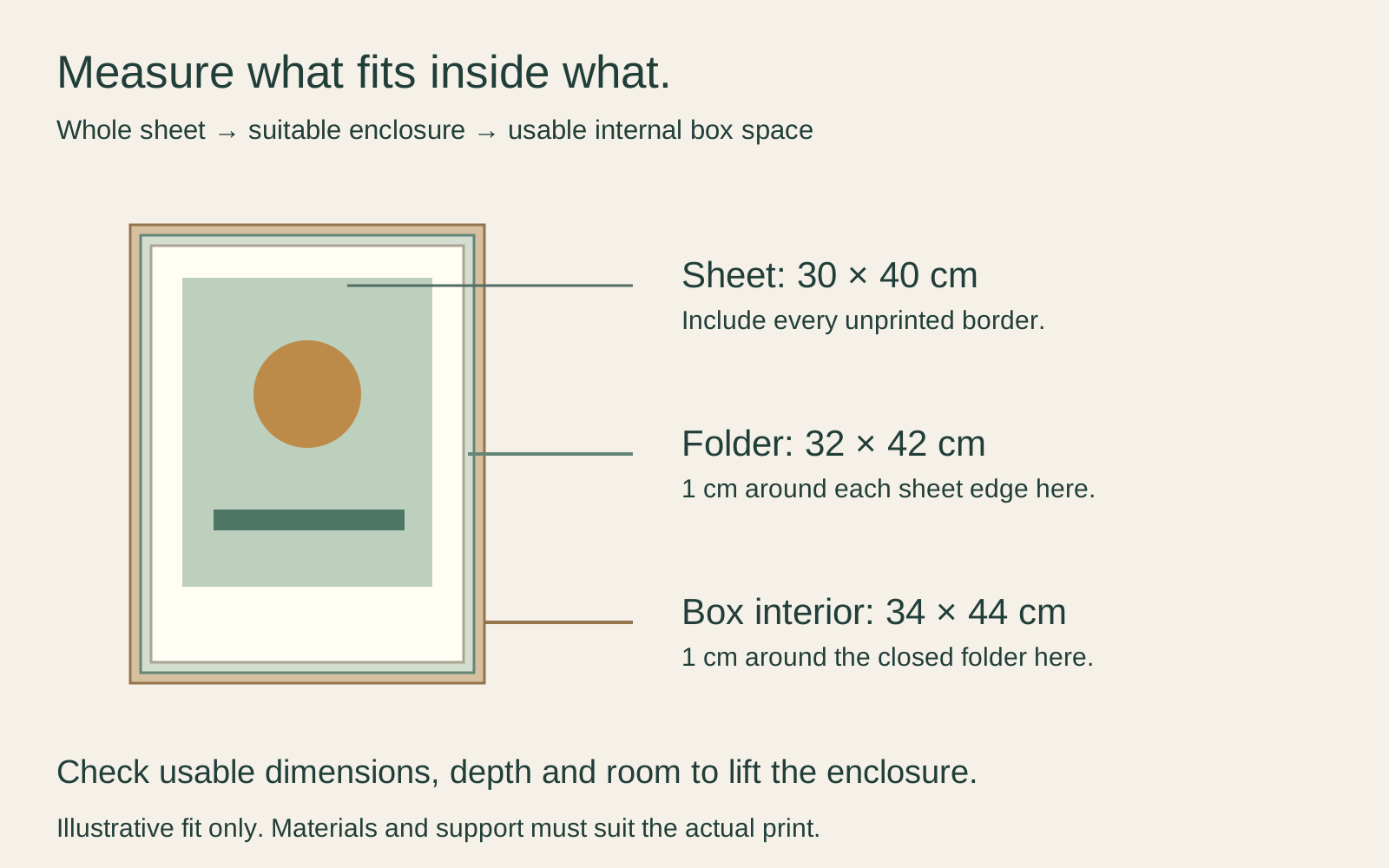
The example is not a shopping list. Real folders have folds and thickness, and a nominal box measurement may describe the outside rather than the usable interior. Confirm the actual fit, including depth and the method of lifting the contents, without sliding or bending the image against an edge.
For six prints, you need room for six appropriate enclosures—not merely six times the thickness of the paper. Do not force a lid down to compress them. Equally, a very oversized box may allow a small folder to move around. Ask the supplier about a suitable fit rather than filling the gap with loose household packing material.
Decide whether rolling is appropriate
A print arriving rolled does not establish that every future storage arrangement should be rolled. A shipping choice and a long-term collection decision have different aims. Flat storage is often easier to inspect and access when appropriate space is available.
The National Park Service’s guidance on oversized paper excludes brittle or rigid paper, extensively damaged objects and loose media such as pastel from its rolled-storage method. Rolling is not a universal solution for a sheet that will not fit your cupboard.
For a new rolled reproduction, follow the producer’s unpacking and storage advice. For an old or resistant curl, ask for help rather than reversing the roll tightly, ironing it, steaming it or adding heavy objects. Finding a suitable folder can wait; a crease made while forcing the sheet flat cannot be treated as a storage accessory.
Choose a storage place you can check
Pick a place you can access without moving furniture or climbing past other boxes. Keep the enclosure supported and away from likely leaks, direct sunlight and heating sources. Do not put art beneath a sink simply because the box fits neatly.
Icon’s guidance for art on paper recommends horizontal storage in suitable enclosures, avoiding damp cellars and uninsulated attics, and checking stored work for changes. A good box is not a substitute for a suitable room.
Make inspection practical: keep the box label visible, leave space to lift it, and do not bury it beneath heavy household items. Check after a leak, a change in heating or a move, as well as during ordinary collection checks. There is no useful universal timetable if the storage space itself has developed a problem.
Label the enclosure not the image
Give each folder a simple identifier and keep a list with the title, sheet dimensions, source and location. Add the date and a brief condition note: for example, “small existing crease at lower-right corner.” A photograph can help locate that feature later.
Put this information on the enclosure or a separate record, not on the image. Avoid sticky notes attached to the sheet. For several similar prints, an outside list reduces the need to expose and handle each one merely to find the right version.
Bring a print back into use
Prepare the viewing or framing surface before removing the enclosure. Check the object rather than assuming that time in a box guarantees unchanged condition. If you see moisture, mould, adhesion or a new surface problem, pause and seek advice.
If everything is sound, take the complete measurements to the framer and explain how you intend to display it. Mat-board choices belong to that next decision. Storage has done its job when the print remains supported, identifiable and easy to handle—not merely out of sight.
Editorial record
About this article
- Author
- Publisher
- GeMarkt
- Published
- Reviewed
- Internal source & rights check. Conducted by GeMarkt Research Review. This is an internal editorial check—not independent peer review.
- Source standard
- Buying guide source standardSeparates measured or first-hand evidence from general guidance and keeps practical limits visible.
Found a claim that needs checking? Report a factual error.