GeMarkt Blog · Essay
Natural History Art: Audubon and Haeckel
Explore eight natural-history plates: Audubon’s birds, Haeckel’s marine forms and Merian’s insects, with exact editions and details worth noticing.

A bird stretches towards an insect. A jellyfish opens into a wheel of delicate folds. A caterpillar occupies the same page as two butterfly views. Natural-history art lets us study these forms slowly, but it also decides how we encounter them: isolated, arranged, enlarged or placed in an apparent moment of action.
John James Audubon and Ernst Haeckel offer especially striking contrasts. Audubon’s birds often look caught in the middle of doing something. Haeckel’s numbered figures invite us to compare their structures. Maria Sibylla Merian supplies an earlier approach, bringing plants and insects together within one image. The eight plates below show those choices directly.
This is not a ranking of scientific accuracy, and these historical pages are not substitutes for current field guides. It is a way to enjoy their art while noticing how their information works. A beautiful page can make a claim persuasive; it cannot, by itself, make that claim correct.
What a natural-history picture does
Look first for the page’s organising question. Does it show what an animal looks like from several sides? How it feeds? How its form changes? Or how one structure compares with another? The same picture may answer more than one.
Next, notice what has been left out. A blank background can remove distracting scenery. A branch can suggest a habitat without showing a whole landscape. Numbered figures can bring together things that would never occupy that exact arrangement in nature. None of this makes the picture worthless. It makes it an illustration rather than a transparent window.
Finally, separate the design from the object in front of you. The four Audubon examples here are printed, hand-coloured impressions after his designs. The two Haeckel images are leaves from a named library copy. Their editions, makers and margins are part of what we can learn.
Cat Bird: two views on one branch
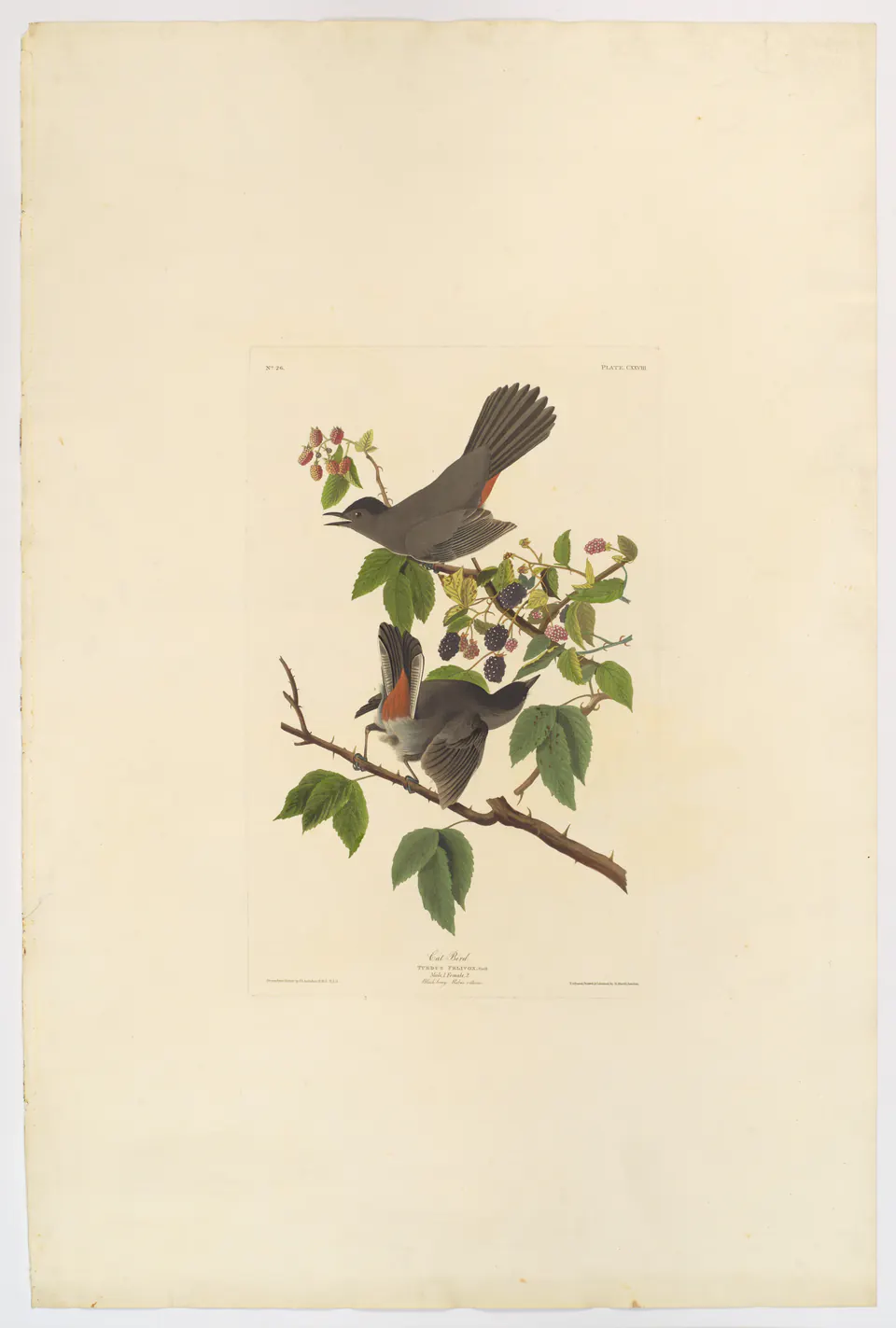
The upper bird leans left with its tail raised. The lower one turns beneath it, giving us a different view of the body. Together they reveal more than a repeated side-on silhouette would. The blackberry stems connect the two positions without making the arrangement symmetrical.
The Met identifies the birds as the species now called Gray Catbird and records the older title printed on the sheet. Both names help locate the object, but they serve different purposes. Notice the ripe and unripe berries too: the surrounding plant carries its own information rather than acting as a generic perch.
Hermit Thrush: a quiet picture with a long paper margin
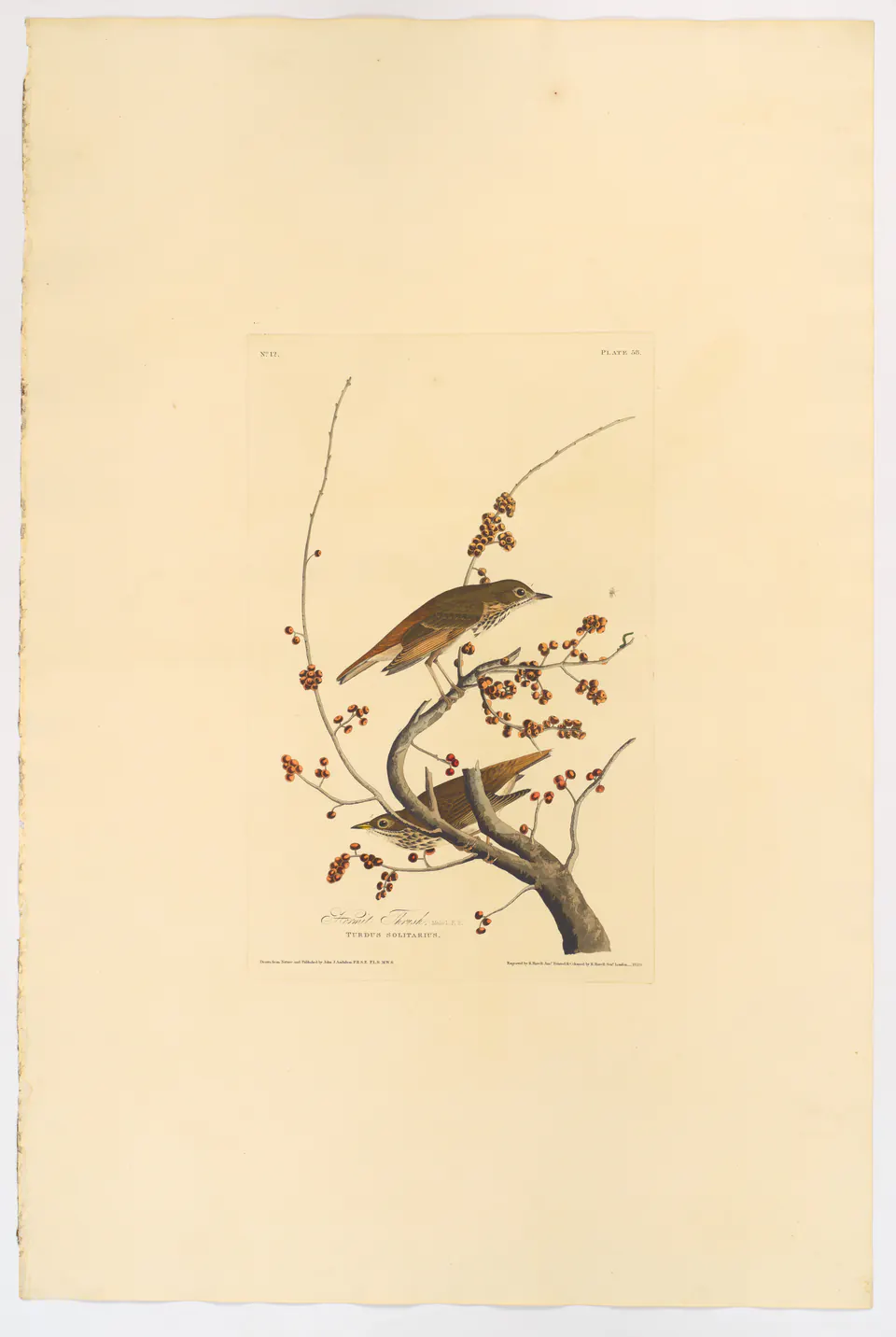
This quieter arrangement makes a good comparison with Cat Bird. One thrush sits above the other; the curving branch turns their opposing directions into a loose circle. Their brown feathers sit close to the colours of the wood and berries. Look for the pale areas around their eyes rather than expecting a brilliantly coloured bird to command attention.
The unusually broad surrounding sheet is not a missing background. The Met records the large folio format and identifies this impression’s printed number as 58, before it became LVIII. A decorative crop would make the birds larger on screen while removing evidence about the publication.
Song Sparrow: small gestures make the picture move
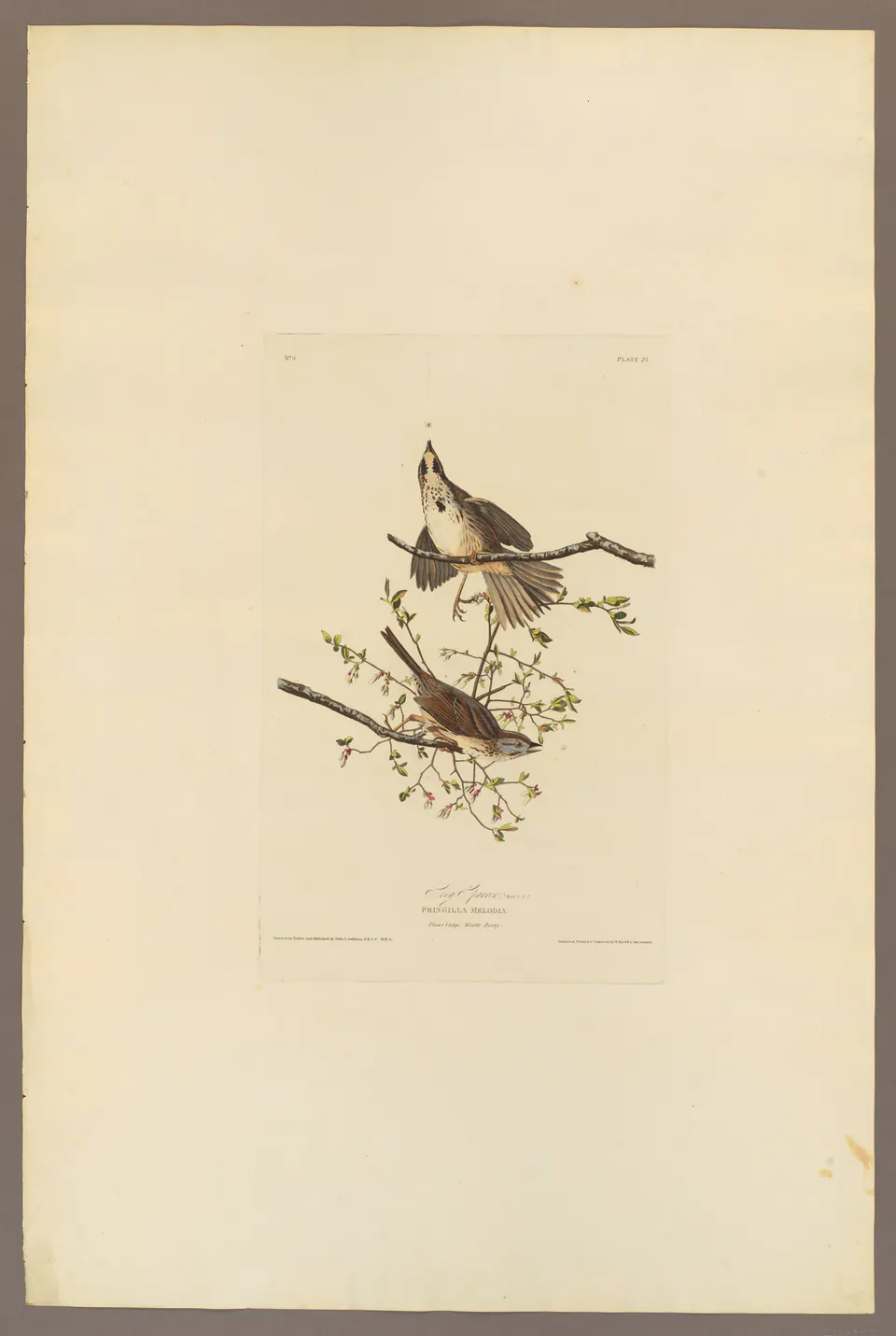
The upper bird looks almost vertical, directing attention towards a tiny spider. The other extends along a lower branch. The difference between these gestures animates a scene that otherwise consists mostly of brown feathers and small leaves. Even a modest subject can become a complicated picture.
Follow the birds’ beaks rather than the largest shapes. Doing so reveals the small creatures that give their movements an apparent purpose. The illustration links looking at a bird’s body with looking at what it might be attending to. Its composition is doing explanatory work, not just adding liveliness to a specimen portrait.
Whip-Poor-Will: a scene built around feeding
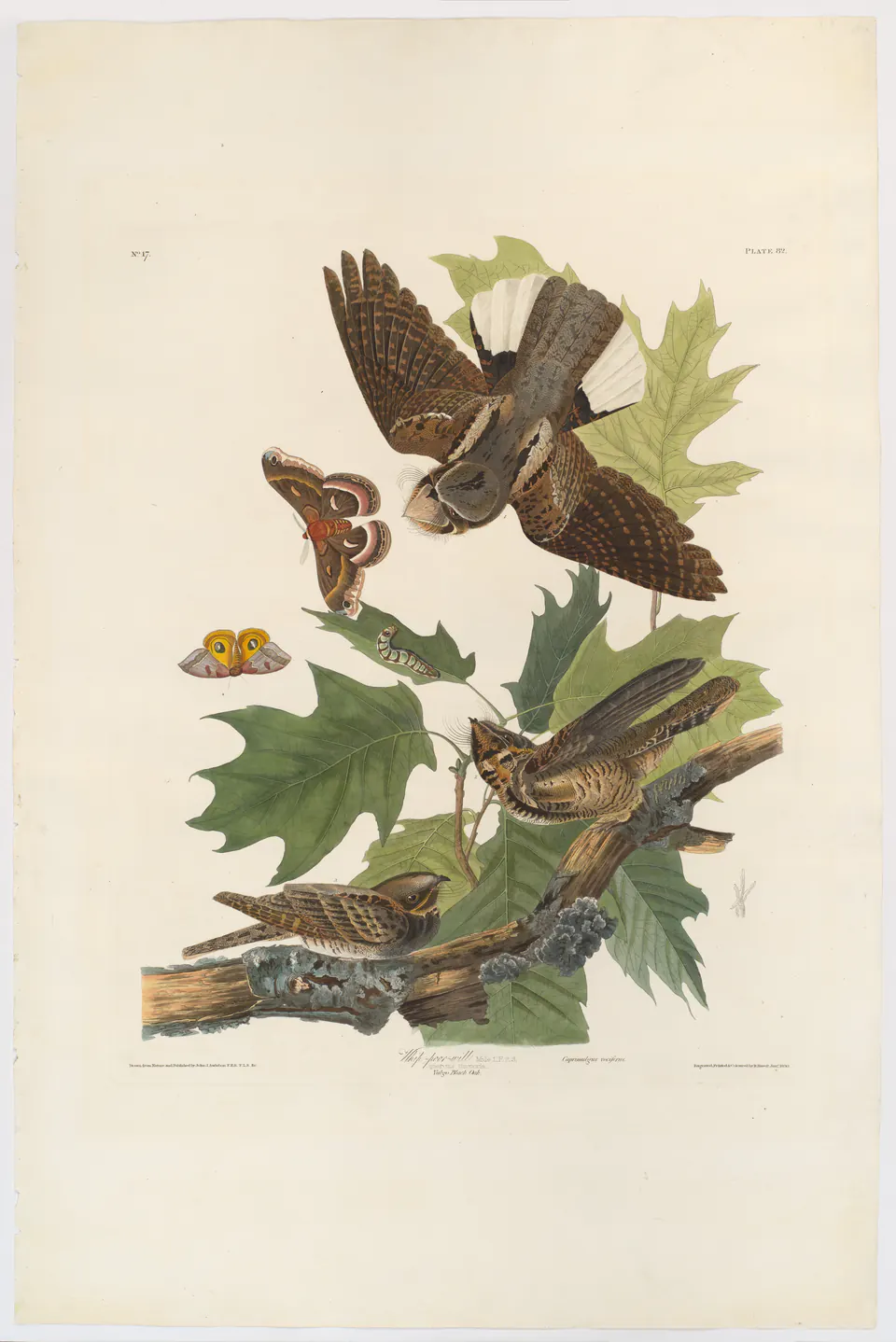
This sheet is much busier. A flying bird opens its mouth towards a moth; another turns towards a caterpillar. Spread wings, overlapping oak leaves and mottled feathers almost fill the image area. The restrained brown palette does not prevent a highly theatrical encounter.
The museum notes an instructive discrepancy: the plate’s text names black oak, while Audubon’s commentary names red oak. It also records his letter describing a killed specimen. Those details warn against treating the image as a photograph of one observed encounter. Its vitality is constructed, and an authoritative-looking inscription can still need checking against other evidence.
Desmonema: flowing lines and numbered views
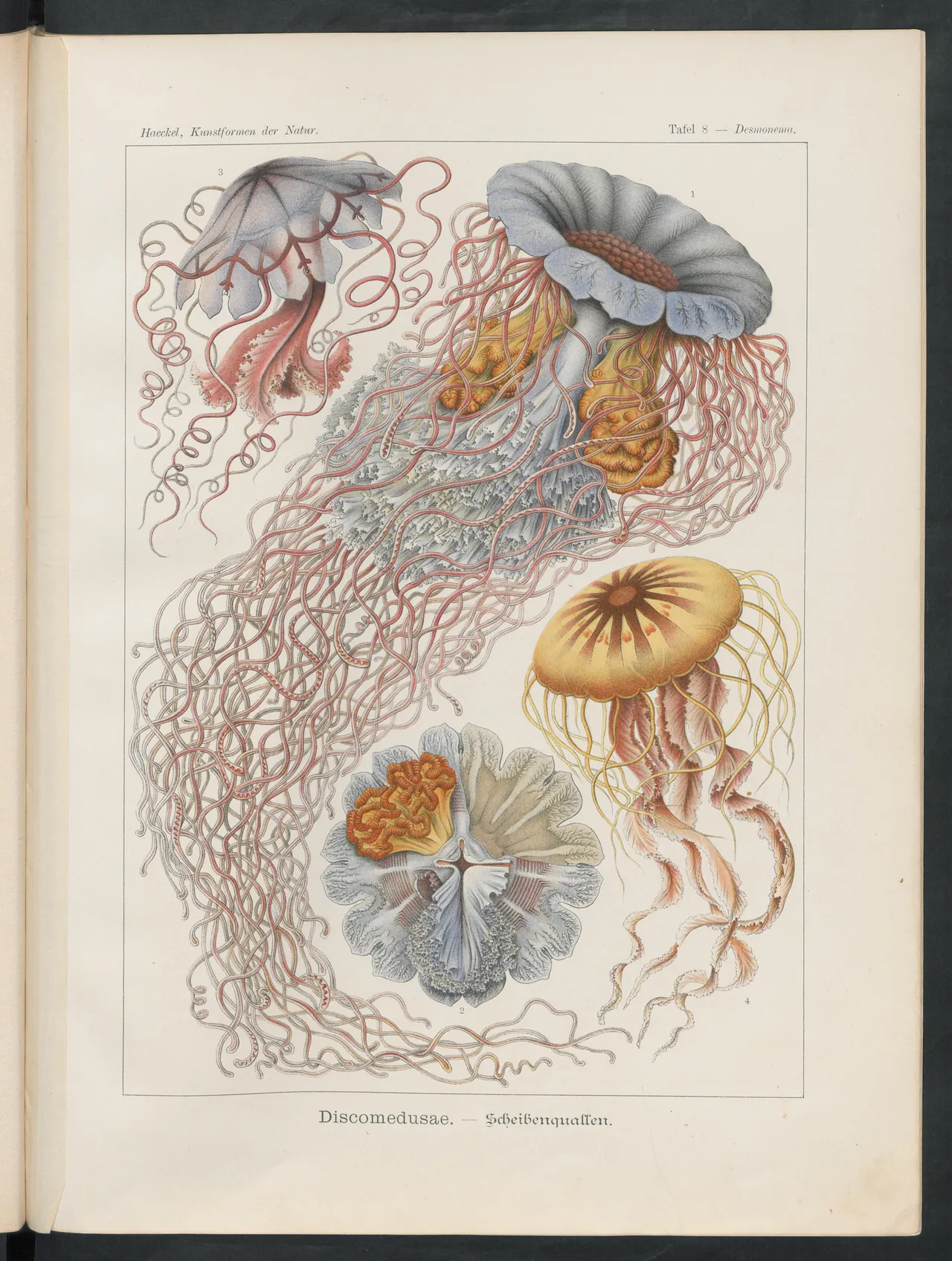
Haeckel’s page does not need a seabed to hold our attention. The long tentacles create most of its movement. Near the bottom, a circular view interrupts their downward flow and allows a different structure to be examined. Numbers tie the figures to an explanation elsewhere in the book.
The heading Desmonema and the lower label Discomedusae are parts of this historical plate. They should not be treated as an independently checked modern classification. Nor does the printed arrangement show a group swimming together at those relative sizes. Read it as a designed comparison, with the accompanying text needed for precise identifications and scale.
Circogonia: comparison instead of a scene
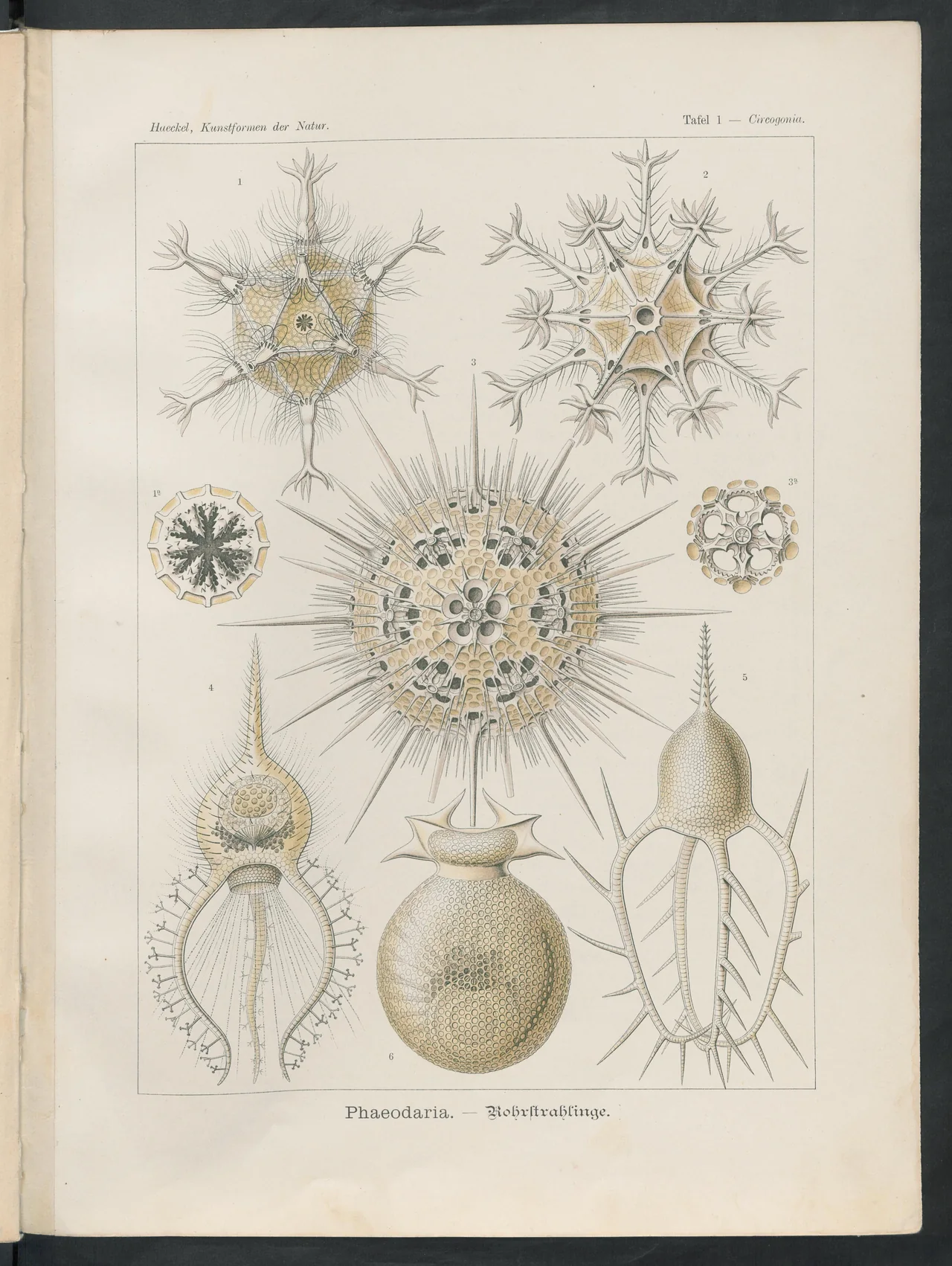
The central spiked form establishes a strong focus, but the surrounding figures resist becoming a simple repeated pattern. Some have long branching projections; others are rounded or elongated. Smaller views labelled with letters sit beside the main numbered forms. The empty spaces keep these differences legible.
Try covering the central figure with your hand. The page still offers several comparisons. That is what makes it more than an attractive radial design: the artist has organised attention across a set. A numbered figure is not automatically a separate species, and a large illustration of a microscopic form does not mean the organism is physically large.
Merian’s plate 7: change on one page
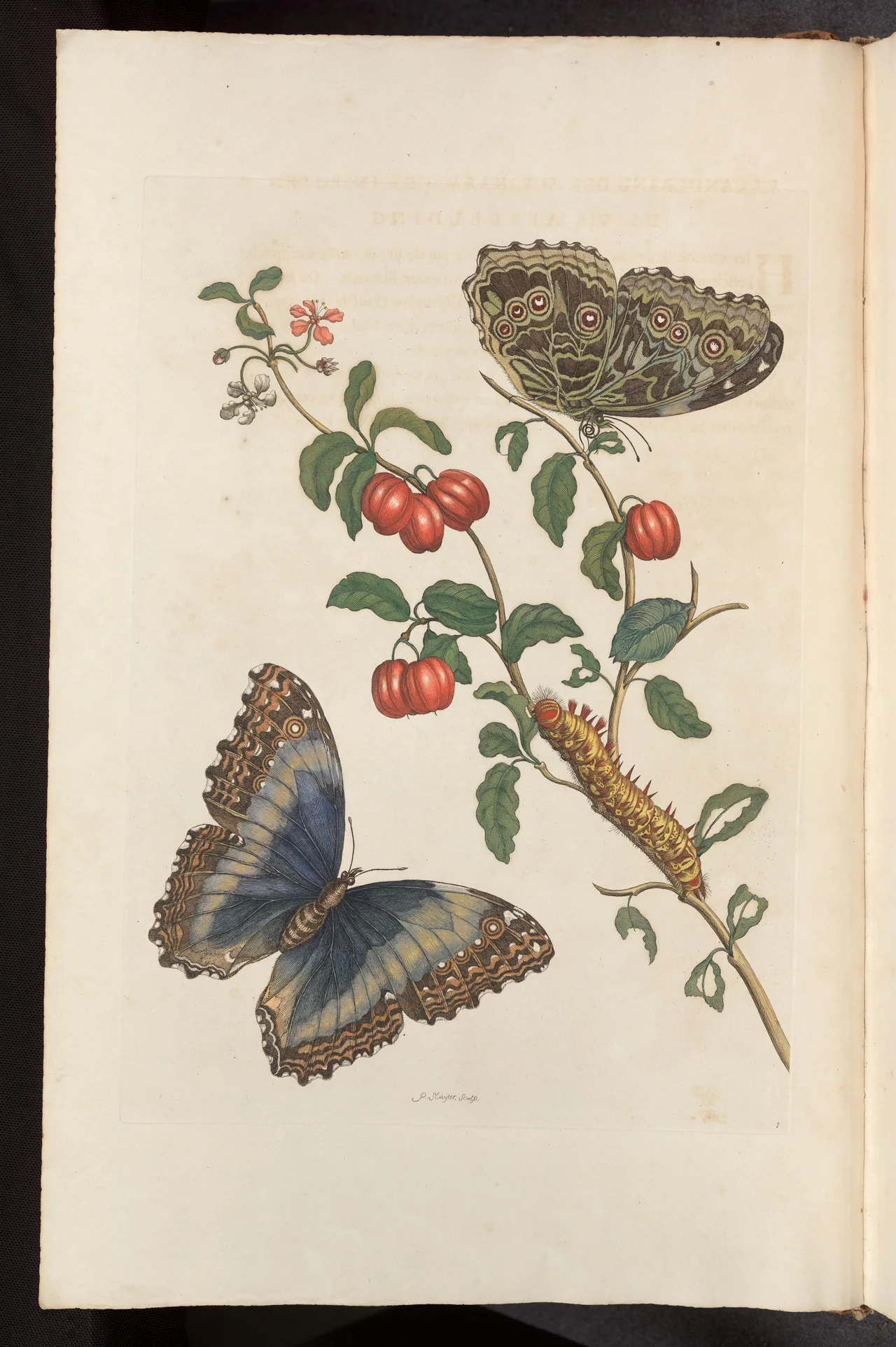
Merian offers an earlier way to join things a reader could not see in one instant. The caterpillar and butterfly views sit around a branch with flowers, fruit and damaged leaves. Instead of Haeckel’s separated numbered figures, the plant helps connect the parts of the page.
Compare the blue wings below with the patterned underside above. Then look at the missing pieces of leaf. The picture makes transformation and interaction visible together. It is worth resisting the urge to extract the most beautiful butterfly: the branch and smaller creature are central to the page’s argument about living things.
Merian’s pineapple: return to the whole plant
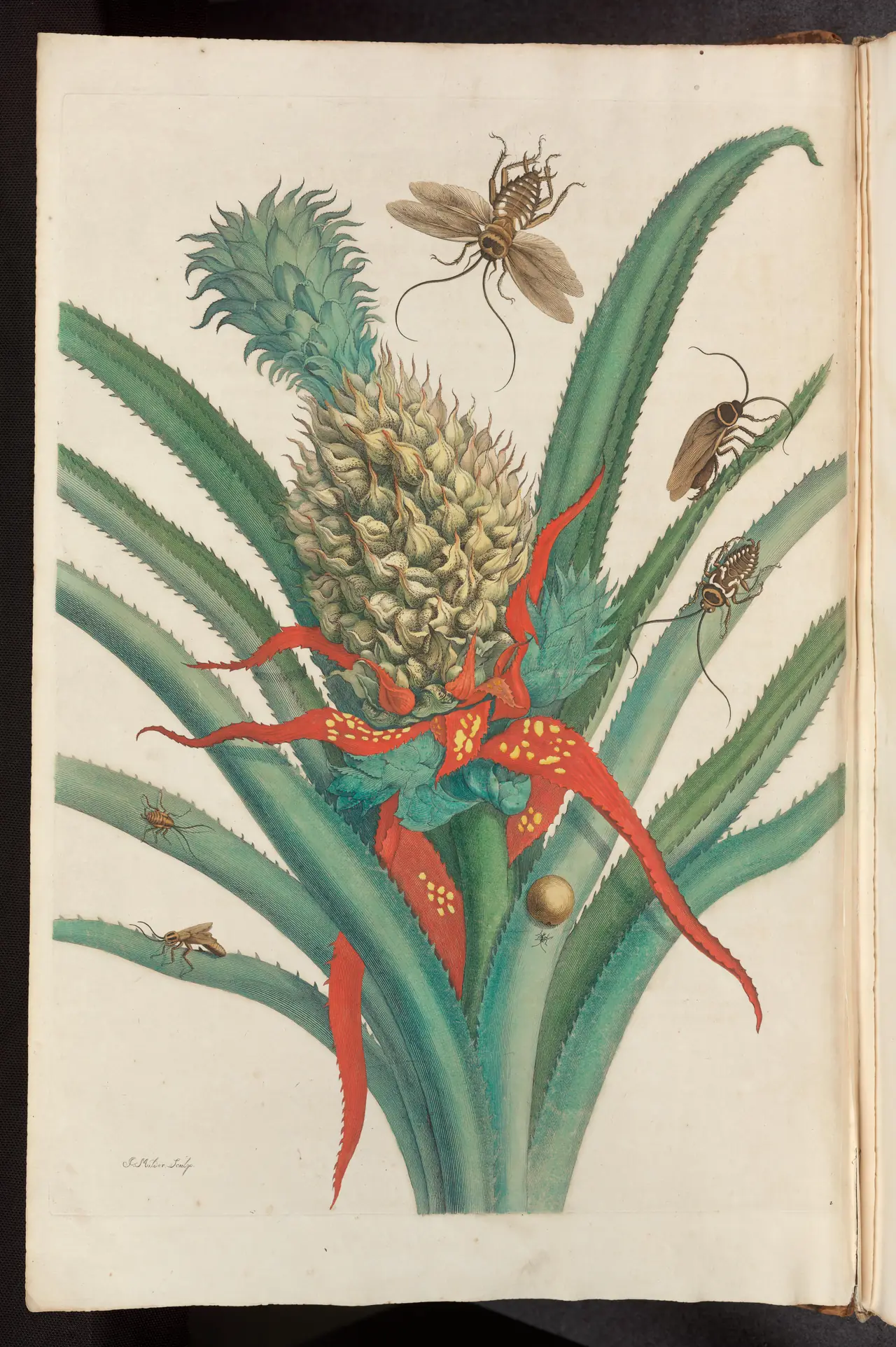
Here the plant takes up most of the leaf. Large insects interrupt its outline, while smaller ones reward a slower second look. The long leaves divide the space into diagonals rather than providing the neat central branch of plate 7. Natural-history illustration does not have to use one repeated layout.
The two Merian leaves come from Basel’s 1705 copy, not a later redesigned selection. Their different organisation is the point of placing them together. One emphasises a slender branch and visible transformations; the other makes a substantial plant the setting for several small encounters.
Illustrators, engravers and the people between
These pages were not all produced by one person from observation to finished print. Audubon’s impressions name Robert Havell Jr. as etcher and aquatinter; the printer varies across the sheets. Merian’s two plates credit Sluyter and Mulder. Haeckel explicitly thanks Adolf Giltsch for the figures’ lithographic execution in his 1899 preface.
That gives this selection three principal illustrators and several indispensable printmakers, not an invented unified school. Their roles explain why medium and edition matter. Getty’s Merian exhibition also restores her daughters to the wider family practice. A famous name is a useful starting point, but a poor place to stop reading the credit.
What to check when you find another plate
Keep the numbered plate, its explanation and its book together whenever possible. Ask whether the image shows an entire sheet or a crop, whether the caption uses a historical name or a current one, and whether the source identifies a specific edition. Preserve uncertainty where a record is inconsistent rather than silently correcting biology from a picture alone.
Our Audubon, Haeckel and Merian guides take those edition and file questions further. For now, choose one small detail and follow it through a whole page. The most rewarding part may be the explanation you almost cropped away.
Editorial record
About this article
- Author
- Publisher
- GeMarkt
- Published
- Reviewed
- Internal source & rights check. Conducted by GeMarkt Research Review. This is an internal editorial check—not independent peer review.
- Source standard
- Art history source standardPrioritises object records and research sources, distinguishes evidence from interpretation, and states material uncertainty.
Found a claim that needs checking? Report a factual error.