GeMarkt Blog · Practical guide
Is Ernst Haeckel’s Art Public Domain? Plates, Editions and Files
Find reusable Haeckel illustrations by identifying the original Kunstformen der Natur plate, its published edition and the exact library scan.
Rights check · reviewed
The short answer
Yes for the original Kunstformen der Natur plates published in 1899–1904, within the ordinary EU term and the U.S. historic-publication term. Use the identified open library files; do not include modern editorial material in that answer.
| What is being checked | Result | Why |
|---|---|---|
| European Union — ordinary author term | Named artist’s own term expired | Haeckel died in 1919; the ordinary life-plus-70 economic term has elapsed. This is not a ruling on every later contributor, publication right or national moral-rights rule. |
| United States — identified historic published illustrations | Historic publication identified | ETH-Bibliothek identifies the original Kunstformen der Natur edition as 1899–1904. These published illustrations are beyond the maximum ordinary publication term; this row does not decide the publication history of unrelated original drawings or later additions. |
| Selected digital files | Exact open institutional sources | Plates 1 and 8 in ETH-Bibliothek Zürich copy Rar 10308, acquired through the advertised e-rara IIIF service, belong to the copy marked Public Domain Mark. This is not CC0 and does not describe another publisher’s files. |
| Other works, countries and modern editions | Separate evidence needed | No worldwide or whole-catalogue clearance. Modern writing, translations, creative adaptations and other providers’ photographs need their own terms. Undisplayed research records are not an approved download set. |
Two exact ETH library scans illustrate this guide. Twelve original plate records are research references, not twelve independently reviewed full-resolution files. Haeckel’s contribution and Giltsch’s printmaking credit remain distinct.
This is a documented research summary, not legal advice. Copyright and moral-rights rules can vary by country and by the history of a particular work.

What we’ll look at
Which Haeckel plate and edition does your image actually reproduce?
Short answer: Yes for the original Kunstformen der Natur plates published in 1899–1904, within the ordinary EU author term and the U.S. term for these historic published illustrations. The two images shown here come from an ETH Zürich library copy marked Public Domain. That answer does not include a modern publisher’s new introduction, translation, layout or altered illustration.
Haeckel’s jellyfish often look like extravagant lamps. His microscopic organisms can resemble cut glass, seed heads or architectural models. They are not invented ornaments: the book presents named life forms, arranged so a reader can compare their structures. Looking at the whole page reveals numbers, labels and different views that a decorative crop can hide.
Start with the book, not a loose image
The ETH-Bibliothek record identifies Kunstformen der Natur as a two-volume publication issued in Leipzig and Vienna by the Bibliographisches Institut, dated 1899–1904. Its title means “Art Forms in Nature.” This guide uses the library’s Rar 10308 copy, not a recently redesigned anthology with a similar English title.
The original preface explains the project’s wish to make often-overlooked natural forms accessible to people interested in both art and science. It also names Adolf Giltsch’s role in carrying the figures into lithography. A credit that says only “Haeckel painting” loses the fact that these are printed illustrations made through a collaborative production process.
The page is part of the evidence. Its printed plate number lets you locate the corresponding explanation; the explanation tells you what the numbered forms represent. A viewer’s page counter includes covers, blank leaves and text, so scan 45 is not plate 45. In this copy, scan 45 contains plate 8.
The historical names are useful for finding the image even when scientific classification has changed. Keep the original title in a caption, but do not turn its nineteenth-century grouping into an unchecked claim about current biology.
Two plates worth looking at closely
Plate 8, Desmonema, is the jellyfish page at the top of this guide. Its four numbered views differ in size, direction and colour. Long tentacles cross the empty space between them. The circular view near the bottom helps the reader understand the form from another angle; it is not just decoration added to fill a gap.
Notice the distinction between the printed heading, Desmonema, and the broader group name, Discomedusae, below the image. Both may appear in image-search results. Checking the plate number is more reliable than assuming every download called “Haeckel jellyfish” is the same picture.
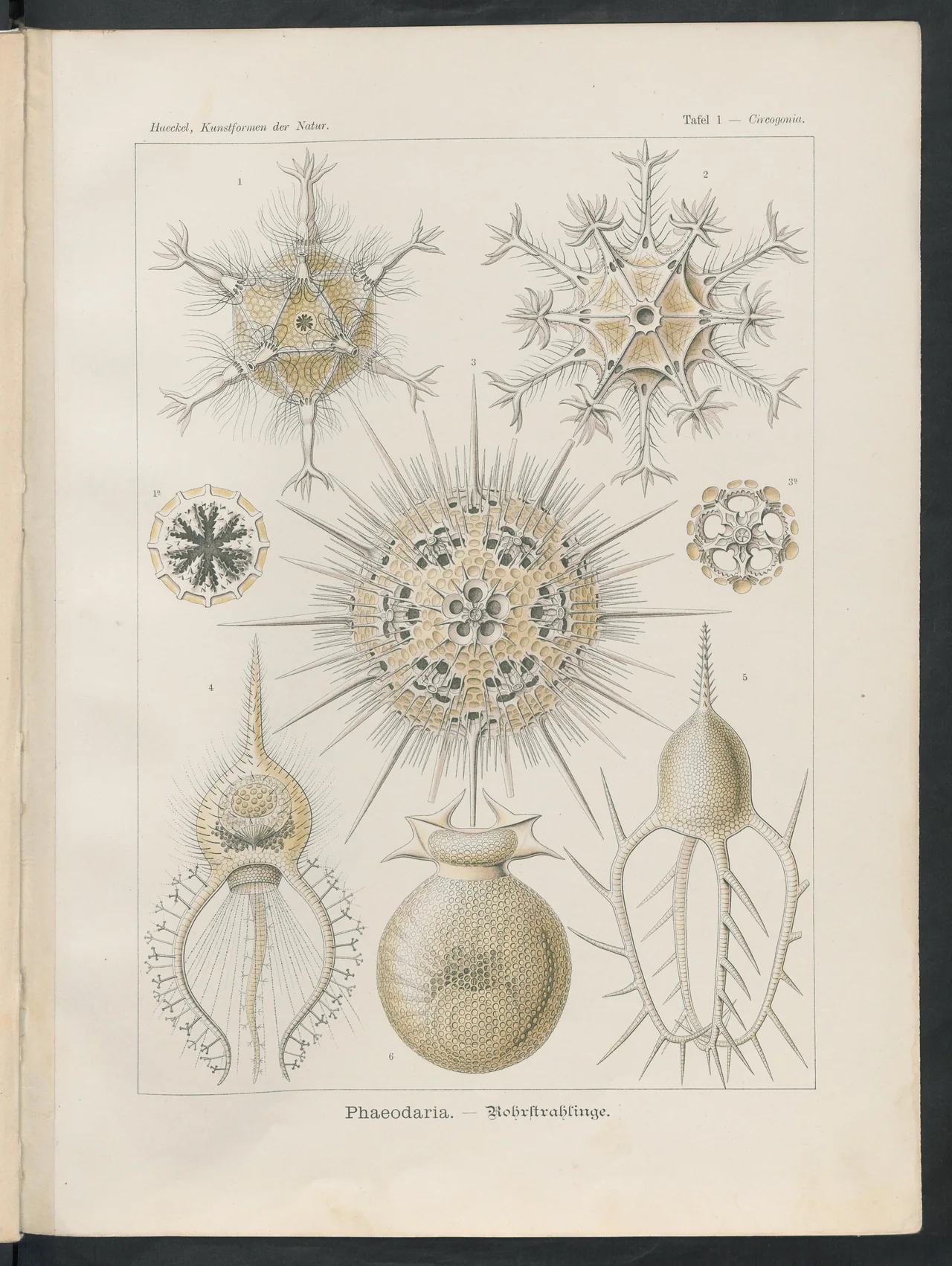
Ernst Haeckel, Kunstformen der Natur, plate 1, Circogonia, 1899–1904. ETH-Bibliothek Zürich, Rar 10308, e-rara-59154. Public Domain Mark.
Plate 1, Circogonia, offers a different kind of complexity. A spiked sphere occupies the centre, while smaller latticed bodies surround it. Tiny subsidiary views sit beside two larger figures. The pale colour allows the network of lines to remain visible. These are magnified forms, not objects all found at the size they occupy on the page.
For an illustration-led project, that difference matters. A close crop can make an attractive pattern, but it stops communicating the comparison built into the original plate. Keep the complete leaf available as your reference before making any separate design decision.
Twelve exact plate references
These are research references to twelve plates in the identified ETH copy, not twelve separately approved product files. The first and eighth have been acquired for this guide. The remaining scans still need full-resolution inspection before any new publication use. The library’s book record and page viewer preserve their edition context.
| Printed plate | Original heading | What distinguishes the page |
|---|---|---|
| 1 | Circogonia | Spiked, latticed forms with subsidiary details; illustrated above. |
| 2 | Globigerina | Many pale shell forms against a dark field. |
| 3 | Stentor | Slender, trumpet-like forms and grouped branching structures. |
| 4 | Triceratium | Geometric views arranged as a comparative sheet. |
| 5 | Ascandra | Tubular and branching sponge forms against a dark ground. |
| 6 | Tubuletta | Fine branching forms with radiating, flower-like ends. |
| 7 | Epibulia | Rounded and hanging forms in a warm-coloured arrangement. |
| 8 | Desmonema | Four flowing jellyfish views; this guide’s opening image. |
| 9 | Maeandrina | Rounded coral forms and surface patterns on a dark field. |
| 10 | Ophiothrix | Several star-shaped bodies with long branching or curling arms. |
| 11 | Heliodiscus | Radiating forms, some coloured pink or green. |
| 12 | Miliola | Small coiled and chambered forms arranged on one sheet. |
The book can include a translucent protective leaf immediately before a plate. Its faint reverse-looking image is not an alternative edition to download. Move to the actual printed leaf rather than enlarging the protective sheet.
What the copyright answer covers
Haeckel died in 1919. His own contribution is beyond the EU’s ordinary life-plus-70 economic term. The named lithographer is not an overlooked modern contributor: the University of Jena’s bibliography records Haeckel’s obituary of Adolf Giltsch in June 1911. Giltsch’s ordinary author term has therefore also elapsed. For these original book illustrations, publication by 1904 places them outside the maximum ordinary U.S. publication term described in Copyright Office Circular 15A. This is evidence about a published edition, not a death-year shortcut for every private sketch or later discovery.
The exact digital source has its own record. ETH supplies this copy through e-rara with a Public Domain Mark. That is a statement of status, not the same instrument as a CC0 dedication. Credit the author, library, shelfmark and persistent link so another reader can identify your source. Neither mark nor age promises that every possible use in every country is free of all other obligations.
A modern Haeckel book may combine the old plates with newly written essays, translations and design. The Smithsonian’s catalogue entry for a 2009 edition, for example, records modern contributors as well as the older illustrations. Open bibliographic metadata is not permission to copy those contributors’ pages.
Choose a useful file, not just a large one
Begin with the institutional record and identify the printed plate. Then inspect its original scan: are the fine lines distinct, are the labels complete, and is the leaf actually in focus? More pixels will not recover detail absent from a blurred source.
The displayed ETH scans retain the paper tone, binding edge and printed headings. We have not whitened the page or redrawn damaged lines. A bright white image from another supplier may reflect different paper, lighting or digital intervention; it is not automatically a truer version.
For your own reuse record, save the plate number, book dates, shelfmark, source URL, rights statement and the exact downloaded file. If you later recolour or rearrange the forms, describe that as your adaptation rather than presenting it as an untouched historical plate. This is general information, not individual legal clearance.
Sources and review method
We checked the artist chronology against museum records, treated each named jurisdiction separately, and recorded the provider policy for the image set. These sources support the legal framework and artist dates used above; the source file for any individual image still needs its own record.
- Kunstformen der Natur, Rar 10308 — ETH-Bibliothek Zürich / e-rara. Exact 1899–1904 edition, holding, persistent ID, Public Domain Mark and public IIIF manifest.
- Original book text and preface — ETH-Bibliothek Zürich / e-rara. Original purpose, numbered illustrations and acknowledgement of Adolf Giltsch; OCR spelling checked against the relevant plate when used.
- Ernst Haeckel — Primärbibliographie, 1911 — Friedrich Schiller University Jena. Records Haeckel’s obituary of Adolf Giltsch, Jenaische Zeitung, 28 June 1911, p. 2; supports that the named lithographer’s ordinary term has also elapsed.
- Public Domain Mark 1.0 — Creative Commons. Status marker used by the holding library, not a CC0 waiver or a modern-edition licence.
- Directive 2006/116/EC, Articles 1, 4, 8 and 9 — EUR-Lex. Ordinary author-life-plus-70 term; later first-publication rights and national moral rights are separate questions.
- Circular 15A: Duration of Copyright — U.S. Copyright Office. Historic published illustrations versus later works and the maximum ordinary publication term.
- 17 U.S.C. Chapter 3, including section 303 — U.S. Copyright Office. Formerly unpublished older works have a separate analysis; an early creation date does not alone establish publication.
Editorial record
About this article
- Author
- Publisher
- GeMarkt
- Published
- Reviewed
- Internal source & rights check. Conducted by GeMarkt Research Review. This is an internal editorial check—not independent peer review.
- Source standard
- Rights guide source standardSeparates the underlying work from the source file, records the review date, and links the evidence used for the conclusion.
Found a claim that needs checking? Report a factual error.