GeMarkt Blog · Practical guide
Is Maria Sibylla Merian’s Art Public Domain? Editions and Images
A guide to Merian’s 1705 Suriname insect plates, later editions and exact library scans, with two openly supplied images and twelve plate references.
Rights check · reviewed
The short answer
Yes for the original plates published in the 1705 Suriname book, within the ordinary EU term and U.S. historic-publication term. The two selected Basel library scans are from a copy marked Public Domain; later editions and modern contributions stay separate.
| What is being checked | Result | Why |
|---|---|---|
| European Union — ordinary author term | Named artist’s own term expired | Merian died in 1717; the ordinary life-plus-70 economic term has elapsed. This is not a ruling on every later contributor, publication right or national moral-rights rule. |
| United States — identified historic published illustrations | Historic publication identified | Universitätsbibliothek Basel identifies UBH AN I 14 as the 1705 Metamorphosis insectorum Surinamensium with sixty plates. These published illustrations are beyond the maximum ordinary publication term; this row does not decide the publication history of unrelated original drawings or later additions. |
| Selected digital files | Exact open institutional sources | Plates 1 and 7 in Basel copy UBH AN I 14, supplied through the advertised e-rara IIIF service, belong to the copy marked Public Domain Mark. The mark does not clear another institution’s photograph or a modern translation. |
| Other works, countries and modern editions | Separate evidence needed | No worldwide or whole-catalogue clearance. Modern writing, translations, creative adaptations and other providers’ photographs need their own terms. Undisplayed research records are not an approved download set. |
This guide identifies Basel’s 1705, sixty-plate copy. The twelve research references do not clear every Merian watercolour or later plate addition. Printed engraver inscriptions are retained, and current species identifications are not invented from the pictures.
This is a documented research summary, not legal advice. Copyright and moral-rights rules can vary by country and by the history of a particular work.

What we’ll look at
Which edition and which surviving copy does your Merian butterfly image come from?
Short answer: Yes for Merian’s original plates published in the 1705 Metamorphosis insectorum Surinamensium, within the ordinary EU author term and the U.S. term for those historic published illustrations. The two scans displayed here belong to a Basel library copy marked Public Domain. Modern translations, edited books, new photographs and adaptations need their own checks.
You may know Merian through a butterfly above a flowering branch. In the complete page, there is often more to find: a caterpillar, damaged leaves, fruit and different stages of an insect’s life. The plant is not merely a background decoration. It helps turn a picture of a specimen into a picture of activity and change.
What Merian was showing
Maria Sibylla Merian lived from 1647 to 1717. She combined close observation with drawing and publishing. The Getty’s account of Merian and her daughters places the Suriname book within a longer career that included flower books, studies of caterpillars and a family workshop.
In 1699 she travelled to Suriname with her daughter Dorothea Maria; they returned in 1701. The resulting publication reached readers in Europe in 1705. The trip happened in a colonial society shaped by plantation slavery, not an empty landscape waiting for a European observer. Getty curator Stephanie Schrader discusses Merian’s accounts of enslaved people. The images should not be made into a story in which local people and existing knowledge disappear.
These pages are historical natural-history illustrations, not modern field photographs. They combine observation, selection, arrangement and printmaking. A beautiful combination of a plant and an insect should not, by itself, be treated as independently verified present-day biological data.
Identify the 1705 edition first
The source used here is Universitätsbibliothek Basel’s UBH AN I 14, catalogued in Amsterdam, with Gerard Valck, in 1705. The record describes sixty plates and Dutch and Latin text. Its persistent identifier is e-rara-5285.
Those details help you recognise what you are holding. A later edition may contain additional plates or a different arrangement. A current publisher may reproduce the old pictures alongside new commentary and translation. None should be labelled “the 1705 original” merely because Merian’s name appears on the cover.
The Getty also describes the daughters’ participation and the expanded 1719 edition. That is a reason to preserve contributor and edition information, not to attribute every later page unthinkingly to Merian alone. Nor should a book plate and a surviving preparatory watercolour be treated as the same physical object.
For the illustrations below, the named edition provides real publication evidence. We are not inferring a publication date from the year a plant was painted.
Two plates in context
The opening image is plate 7. Two large butterflies offer different views of patterned wings; a spiny caterpillar follows the angled branch. Red fruit punctuates the green leaves. The branch sets the direction of the composition, while the open wings make the picture broader than the plant alone.
The name of the engraver, Pieter Sluyter, appears at the foot of this leaf. The caption preserves that contribution. Identifying a plate through its inscription is firmer evidence than relying on a generic “vintage butterfly” filename.
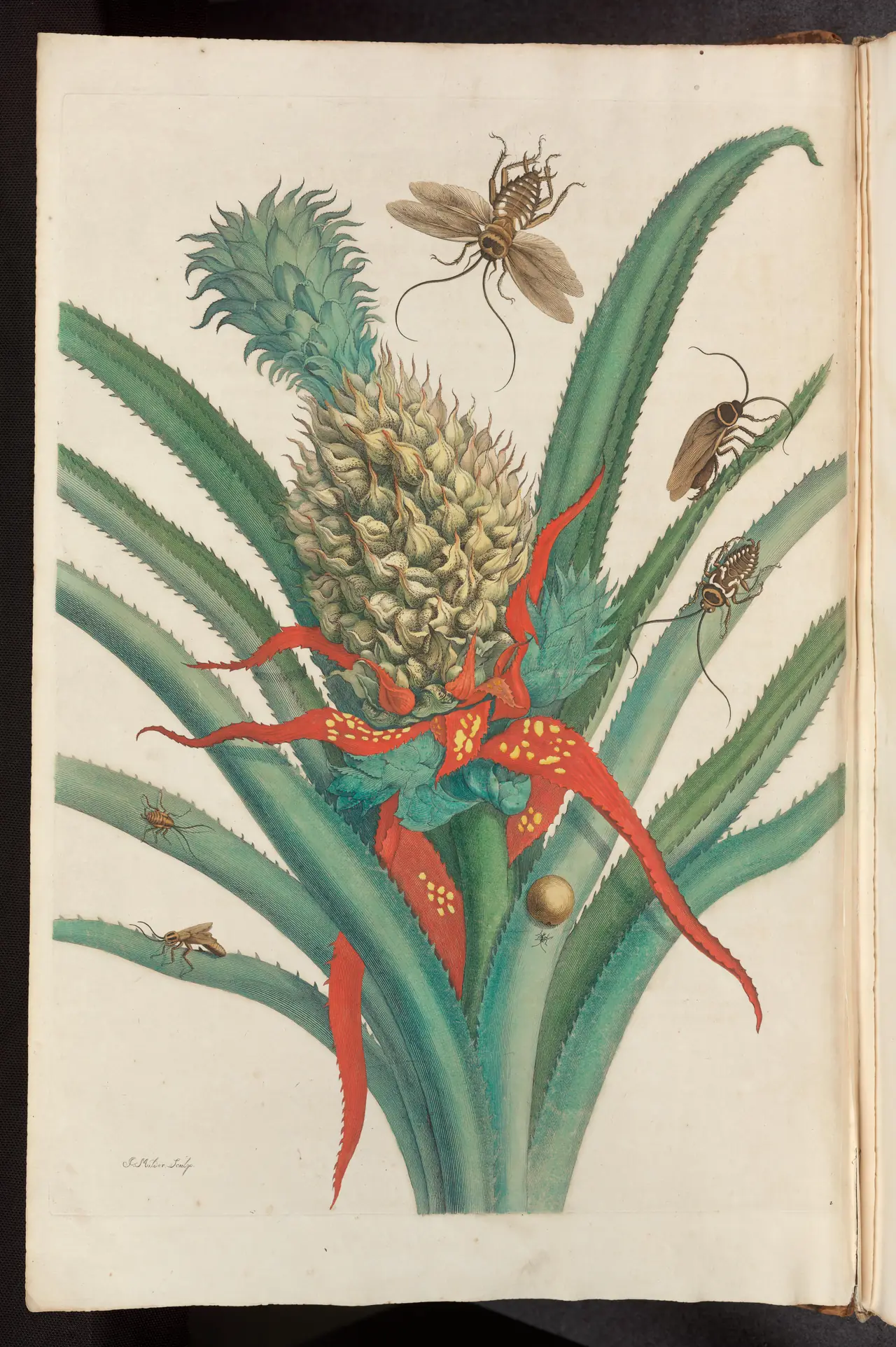
Maria Sibylla Merian, Metamorphosis insectorum Surinamensium, plate 1, 1705; engraved by Joseph Mulder. Universitätsbibliothek Basel, UBH AN I 14, e-rara-5285. Public Domain Mark.
Plate 1 fills much of the leaf with a pineapple plant. Its long leaves lead toward the fruit, while insects occupy the remaining spaces. The bright red bracts make the centre especially striking. Some insects are large enough to be noticed immediately; others sit close to the edges and are easy to lose in a crop.
Compare the two pages before selecting a print size. Plate 7 needs space around the spread wings; plate 1 depends on its long leaves. Forcing either into a narrow decorative strip changes what the reader can see. That may be a separate design choice, but the original page should remain the reference.
Twelve plate references in one identified copy
The first twelve plates form a small, traceable research set. Descriptions below identify visible content, not newly verified species names. The full-resolution files acquired for this guide are plates 1 and 7 only. The others remain research references pending their own full-size inspection and intended-use check.
| Printed plate | Visible subject to help locate the leaf |
|---|---|
| 1 | Pineapple plant with long leaves and several insects; illustrated above. |
| 2 | A more isolated pineapple fruit with insects beside it. |
| 3 | A green branch with rounded fruits and several insect stages. |
| 4 | A palmate-leaved plant with insects arranged around its stem. |
| 5 | A plant shown with large roots, a caterpillar and a winged insect. |
| 6 | A branching plant with lobed leaves and small fruits. |
| 7 | Red fruit, a caterpillar and two large butterflies; opening image. |
| 8 | A flowering branch with pink flowers and insects. |
| 9 | A low flowering plant beneath two large butterflies. |
| 10 | A green leafy branch with caterpillars and winged insects. |
| 11 | A flowering composition with prominent moths and caterpillars. |
| 12 | A bunch of bananas above a large red flower. |
Use the library’s page sequence, then read the number printed on the leaf. The digital sequence includes text pages and reverse sides. A pale image showing through the back of a sheet is not a second, faded version of the composition.
What can be reused—and what stays separate
Merian’s own economic copyright is beyond the EU’s ordinary life-plus-70 term. The original 1705 published plates are also outside the maximum ordinary U.S. publication term; the Copyright Office’s duration guide explains the framework. This conclusion concerns these published illustrations, not every newly discovered drawing with Merian’s name attached.
Basel’s e-rara record marks its digitised copy with a Public Domain Mark. The mark describes a rights status; it is not a CC0 waiver. The library asks users to preserve author, holding institution and persistent identifier information. The captions here do that.
A modern facsimile’s new essays, translations or newly created graphic elements are separate contributions. An open catalogue record for that book does not make its contents open. Equally, another institution’s photograph of a watercolour needs that institution’s exact file statement. Permission attached to the Basel scan does not travel with the subject wherever it appears online.
Choose and credit the actual file
Look at the full leaf before downloading: confirm its plate number, edition and source copy. Preserve the original file with its record. When producing a smaller web image, retain a note of the transformation separately from the historical description.
These scans keep the paper tone, visible leaf edges and small signs of the book’s physical condition. We have not replaced the background, recoloured the wings or reconstructed missing marks. Different copies can vary in colouring and condition; a brighter online image is not automatically more authentic.
For a reusable caption, name Merian, the book, the plate, the edition date, any identified engraver, the library and the persistent source link. That gives the next reader a route back to evidence instead of a vague assurance that the image is “old enough.” This is general information, not worldwide or project-specific legal clearance.
Sources and review method
We checked the artist chronology against museum records, treated each named jurisdiction separately, and recorded the provider policy for the image set. These sources support the legal framework and artist dates used above; the source file for any individual image still needs its own record.
- Metamorphosis insectorum Surinamensium, UBH AN I 14 — Universitätsbibliothek Basel / e-rara. Exact 1705 publication, sixty-plate extent, persistent ID, Public Domain Mark and advertised public IIIF source.
- Merian and Daughters — J. Paul Getty Museum. Family workshop, Suriname journey, published book and later-edition contributors; not an image licence for Getty photographs.
- Public Domain Mark 1.0 — Creative Commons. Status marker used for the selected library copy, distinct from CC0 and modern-edition permissions.
- Directive 2006/116/EC, Articles 1, 4, 8 and 9 — EUR-Lex. Ordinary author-life-plus-70 term; later first-publication rights and national moral rights are separate questions.
- Circular 15A: Duration of Copyright — U.S. Copyright Office. Historic published illustrations versus later works and the maximum ordinary publication term.
- 17 U.S.C. Chapter 3, including section 303 — U.S. Copyright Office. Formerly unpublished older works have a separate analysis; an early creation date does not alone establish publication.
Editorial record
About this article
- Author
- Publisher
- GeMarkt
- Published
- Reviewed
- Internal source & rights check. Conducted by GeMarkt Research Review. This is an internal editorial check—not independent peer review.
- Source standard
- Rights guide source standardSeparates the underlying work from the source file, records the review date, and links the evidence used for the conclusion.
Found a claim that needs checking? Report a factual error.