GeMarkt Blog · Practical guide
Lighting Art at Home: Picture Lights, Spotlights and Daylight
Choose art lighting that reveals the picture without harsh glare, and understand colour quality, aiming and the difference between brightness and exposure.

Good art lighting lets you see the picture comfortably without making the lamp, a reflection or a bright patch its main feature. Start by observing your existing room in daylight and after dark. Add a dedicated light only if it solves something specific: an unreadable corner, an unevenly lit picture or a work that disappears when the room lights are dimmed.
A picture light, an adjustable spotlight and a window do different jobs. None is automatically the best choice for every print. Treat lighting as two related decisions: how the art looks while you enjoy it, and how much light it receives over time.
Look at the picture before buying a light
Stand where you usually enter the room, then sit where you spend time. Can you see the image, or mostly the window reflected in its glazing? Is the top brighter than the bottom? Does the frame cast a shadow across a face or an important caption? Write down the actual problem before browsing fixtures.
Also look at the surrounding wall. One brilliant rectangle in an otherwise dark room can feel more like a display case than a comfortable living space. You may prefer a modest accent on the picture with enough general room light to connect it to the furniture.
Decide which work should receive attention. A wall of six pictures does not necessarily need six individual lamps. You might light the whole group gently, or give one anchor picture a little more emphasis. These are composition choices, not rules that require every object to have the same brightness.
Choose between a picture light and a spotlight
A picture light makes the fixture part of the display. Before choosing one, ask the supplier how its light spreads over your picture’s dimensions and how it is meant to attach. A decorative bar that looks balanced above the frame may still leave the lower corners dark. Do not select it solely by matching the metal finish to the frame.
An adjustable spotlight can suit a changing arrangement because its direction can be reconsidered when the picture moves. Check that its adjustment and beam options suit the intended position; “adjustable” is not a promise that it can reach every wall from an existing socket or track.
For a rental, a compatible plug-in fixture may avoid a new electrical circuit, but its mounting, cable route and power requirements still need checking. Ask a qualified electrician about new wiring, concealed cabling or incompatible fittings. This guide does not provide electrical installation instructions. Never improvise a frame attachment for a fixture not designed to use it.
Start with the angle, then check the view
ERCO’s gallery guidance uses an aiming direction of approximately 30 degrees from vertical as a starting point for accent lighting. Its picture-lighting study explains why a more grazing direction can exaggerate frame shadows and why other angles can introduce reflections or viewer shadows. This is a useful starting geometry, not a guarantee for every glazed picture. See ERCO’s gallery guidance and its museum-angle study.
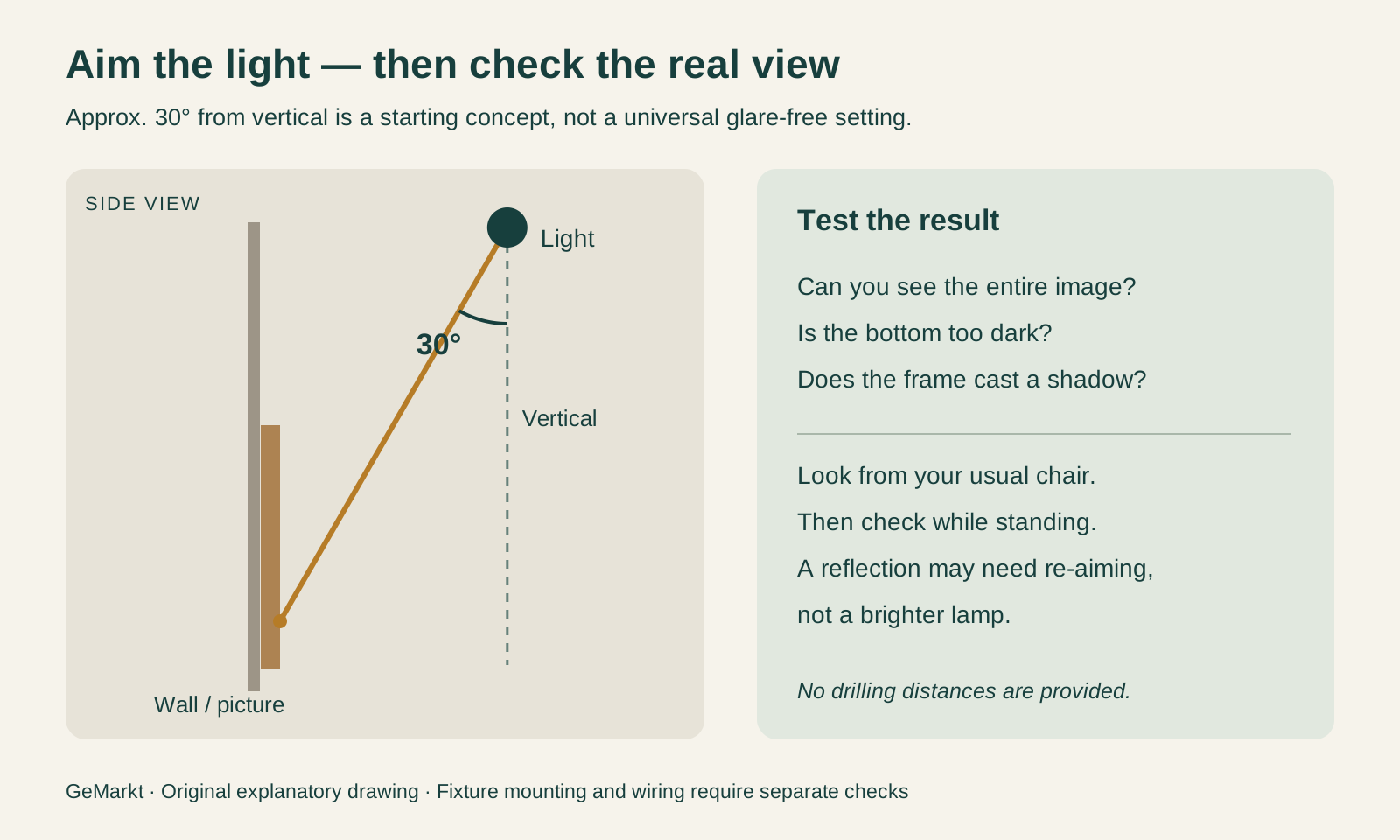
Evaluate the entire image after aiming. A lovely centre with a dark lower edge is not an even result. Move to another chair and check again. If you are adjusting an accessible fixture as its instructions allow, change one setting at a time so you can tell whether direction, beam spread or brightness solved the problem. Leave inaccessible adjustments to the installer.
Separate warmth from colour quality
The Kelvin number describes the light’s colour appearance; it does not tell you everything about how faithfully the artwork’s colours will appear. The US Department of Energy distinguishes colour temperature from colour fidelity and notes that CRI alone is weak at describing saturated reds; the supplementary R9 value can help. See its LED colour-quality explanation.
Among CCI’s criteria for good museum LED lighting are CRI of at least 90 and R9 of at least 50. These are useful colour-rendering checks, not the whole specification or a certification of a particular home fixture or print. CCI also treats colour temperature as a choice rather than a simple quality ranking. See LED Lighting in Museums and Art Galleries.
Where possible, compare the candidate light with the lighting already in the room. Do you like the whites, reds and skin tones together? A warmer lamp is not automatically more flattering, and a cooler one is not automatically more accurate. Avoid buying several different lights before you have seen one satisfactory combination.
Treat daylight as a changing condition
A picture that is comfortable to view at breakfast may receive direct sun later. Observe the intended wall at several times rather than judging it during one visit. Reflected windows can also make a well-lit picture difficult to see. The aim is to find a position that works through an ordinary day, not only in the photograph you take of the room.
CCI explains that visible light contributes to fading as well as the damage associated with ultraviolet radiation. UV filtering therefore does not remove all light-related risk. Reducing unnecessary illumination and avoiding strong sunlight remain important. See its light-damage guidance.
Use existing blinds or curtains to control troublesome daylight, or choose another wall when practical. Do not assume that a label such as “archival” makes a print immune. For glazing decisions, our UV-protective glazing guide separates that protection from glare reduction and other specifications.
Count the hours as well as the brightness
Illuminance is measured in lux; exposure can be expressed as lux multiplied by hours. In the invented example below, 100 lux for two hours and 50 lux for four hours both give 200 lux-hours. This arithmetic illustrates accumulation, not a recommended exposure limit. Actual sensitivity varies with the artwork’s materials and the light source; equal calculated exposure is not a universal promise of equal damage. CCI discusses this distinction in its light guidance.
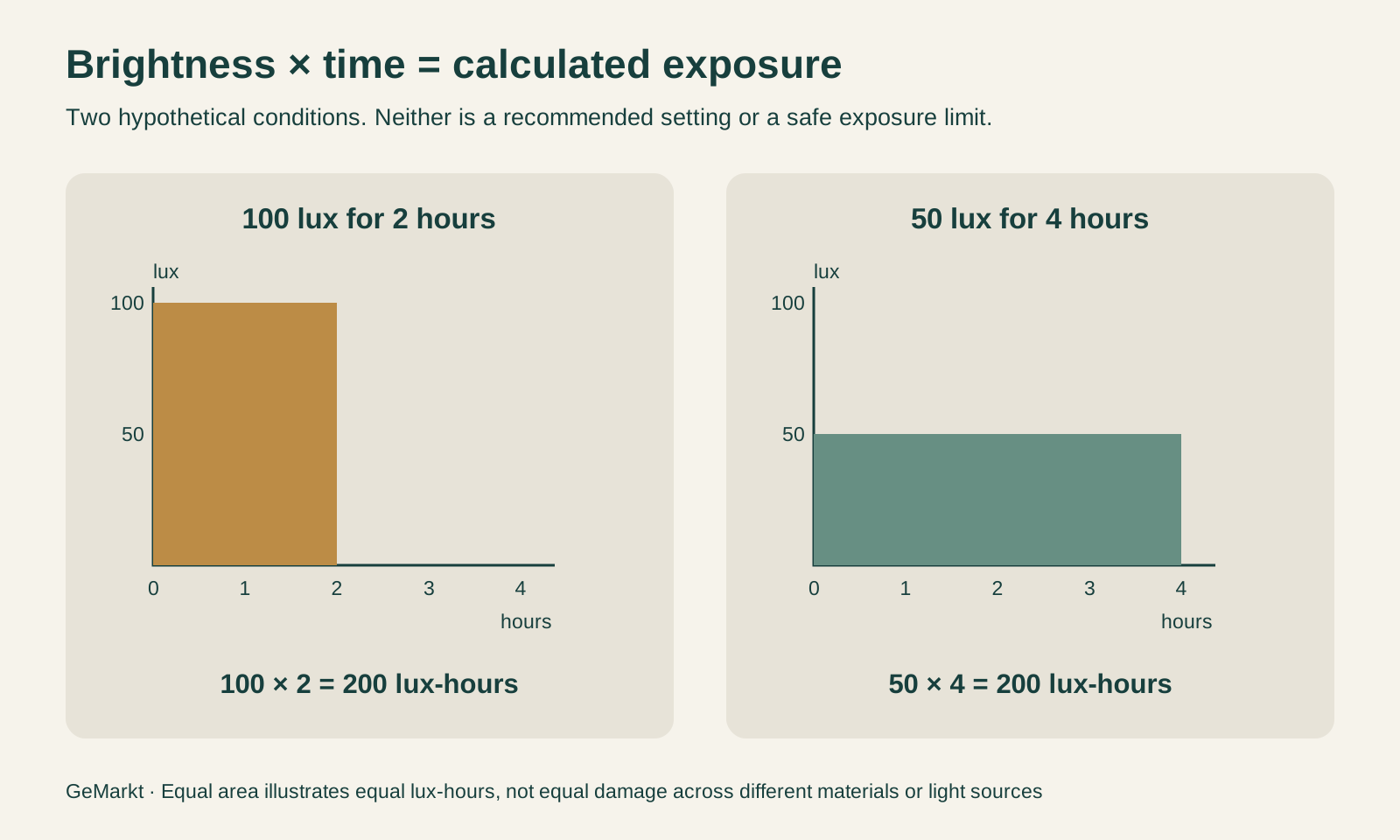
For everyday use, decide when you actually want the picture illuminated. Leaving a dedicated art light running through an empty afternoon may add nothing to your enjoyment. Turning it off is often a more useful first change than searching for a supposedly harmless lamp.
Choose controls you will actually use
A straightforward on/off control within reach may be more useful than a complicated system you rarely adjust. If you want dimming, check the particular fixture, lamp and controller combination with the supplier. Do not assume that a dimmer already on the wall is suitable for a replacement light.
Choose an evening setting while seated, not while looking directly into the lamp. You should be able to enjoy the picture without feeling obliged to run its fixture at maximum output. A timer can be convenient if your routine is predictable, but remember to revise it when the room’s use changes.
Do not put improvised filters, fabric or covers over a fixture to soften it. Ask for suitable optics or choose another light instead. For valuable originals or unusually sensitive materials, get object-specific conservation advice rather than adopting a museum lux figure as a universal home limit.
Finish with a room test, not a brighter bulb
Live with one considered arrangement before extending it to every wall. Check the work in daylight, with the main room lights on, and in your usual evening setting. Look for visible detail, comfortable contrast and reflections that interrupt the picture.
If something is wrong, name it precisely. A reflection needs a different response from insufficient light; an uneven beam needs a different response from an unwanted colour cast. Buying a brighter lamp first can leave the original problem unchanged.
For longer-term care, continue with protecting prints from sunlight and fading. The most useful result is a picture you can see clearly when you want to, without leaving it unnecessarily illuminated the rest of the time.
Editorial record
About this article
- Author
- Publisher
- GeMarkt
- Published
- Reviewed
- Internal source & rights check. Conducted by GeMarkt Research Review. This is an internal editorial check—not independent peer review.
- Source standard
- Buying guide source standardSeparates measured or first-hand evidence from general guidance and keeps practical limits visible.
Found a claim that needs checking? Report a factual error.