GeMarkt Blog · Practical guide
Kitchen Wall Art Ideas
Find a place for kitchen art beyond the splashback. Compare subjects, breakfast-corner views, frame size and the real effects of cooking and cleaning.

Start kitchen wall art with the position, then choose the picture. A breakfast corner, the wall beside a table or a clear area near the entrance may give you more time to enjoy an image than the space above a busy worktop. You do not need a food-themed print, and you do not need to fill every strip between cupboards.
The useful test is ordinary life: can you see the picture when you sit down, will cooking expose it to grime or splashes, and can you clean the surrounding room without handling it? Answer those questions before deciding on a size.
Find a wall outside the working area
Walk through the kitchen while imagining a normal meal being prepared. Locate the hob, kettle, sink, draining area and places where ingredients get mixed. A wall can look empty in a photograph and still be part of a busy working area.
The Canadian Conservation Institute identifies airborne cooking oils and accidental food or drink splashes as risks to paintings. Its advice supports reconsidering the position, not assuming an attractive frame makes every location suitable. CCI painting-care guidance.
Treat the splashback as a working surface rather than a default display wall. Do not cover vents, switches or controls, and do not use an art arrangement to justify changing appliance clearances. Those belong to the appliance and installation instructions, not a decorating guide.
An open-plan kitchen often offers another answer: place the picture where the kitchen becomes a sitting or eating area. It can still be part of the kitchen’s view without sitting immediately beside the cooking.
Look from where you have breakfast
Sit in the chair you actually use. A picture above your own head may be almost invisible to you, while a smaller work on an adjacent wall stays in view throughout breakfast. Check other seats before assuming everyone gets the same experience.
In the illustrative plan below, a 360 × 300 cm room has a 140 × 80 cm table away from the main counter. The highlighted wall position is a place to test from the table, not a promise that cooking cannot affect it. Doors, ventilation and actual splashing still need checking in the real room.
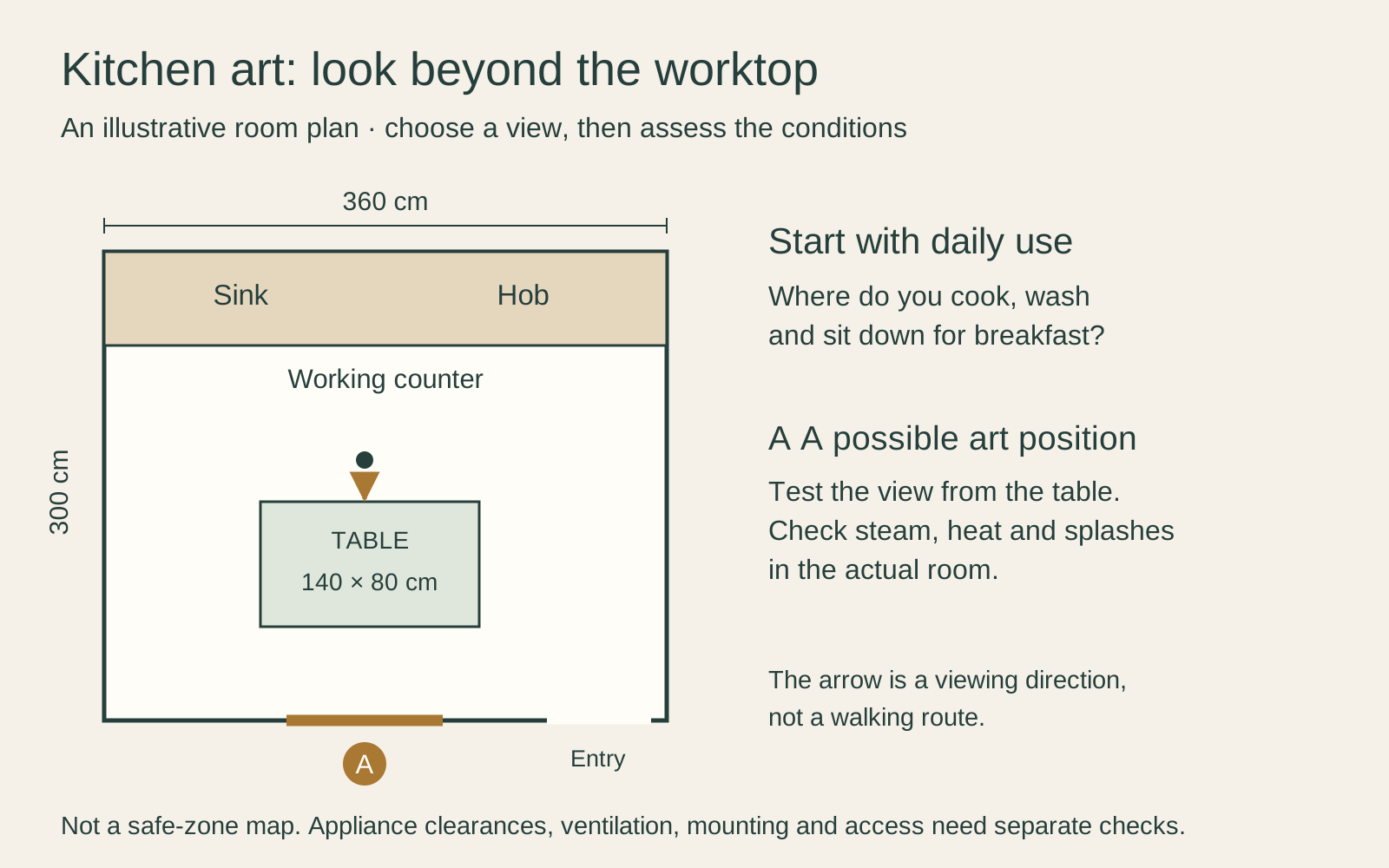
If your kitchen has no eating area, look from the doorway or from the place where you pause for coffee. The picture should reward an actual view rather than exist only for someone standing in the middle of the room.
Choose a subject beyond food
A still life can connect naturally with cups, fruit or flowers already in the room. Look for a composition you enjoy, though, rather than buying the first image of lemons because the room contains a lemon bowl.
A small landscape can suggest an extra view. A botanical drawing can echo plants without requiring another living pot on the counter. A graphic print with broad shapes may stay readable beside patterned tiles, while a detailed engraving can suit a quieter breakfast corner where you sit close enough to examine it.
These are starting points, not kitchen rules. A portrait you love is a stronger choice than a fashionable food poster you barely notice. Consider the image without its title and ask what part of it you would enjoy seeing each morning.
Give the picture enough space to be read
Measure the outside frame, including its mat and moulding. Then mark the visible image inside your paper template. A compact picture with a broad mat may take up more wall than you expect while leaving the actual image quite small.
For example, a 40 cm-wide finished frame centred in a 70 cm-wide clear wall strip leaves 15 cm on either side. That arithmetic tells you it fits horizontally; it does not tell you that the picture will be legible from your table. Stand or sit at the viewing distance and compare a larger and smaller template.
Do not count wall hidden behind an open cupboard door as usable display space. Check the full opening, handles and any objects that regularly hang from hooks. A picture should not need continual adjustment whenever someone uses the kitchen.
Compare the art with the room in use
Leave the toaster, utensils, washing-up items and everyday containers where they normally live. Styling them away for a photograph can make a delicate, busy image look clearer than it will in practice.
Choose one relationship to test: a colour shared with a tile, a dark frame that relates to the hardware, or a contrasting image that stands apart from pale cupboards. You do not have to match all three. If the kitchen already has several strong finishes, a single picture can be easier to place than a group of unrelated small ones.
Check daylight and evening lighting. Glare across the picture at dinner matters more than how its surface looks under bright shop lights. Move the template, rather than immediately buying a different frame, if the position itself causes the problem.
Ask about the complete print and frame
“Canvas” and “framed print” are formats, not kitchen-use certifications. Ask the seller what the surface, edges, backing and frame are made from, how the finished object should be cleaned, and whether its care instructions allow your intended position.
Glass or acrylic in front of a print does not make the whole assembly waterproof. Nor does a wipeable front tell you what happens at the back. If the seller cannot answer an important question, choose another location instead of filling the gap with an assumption.
Keep irreplaceable drawings, family pieces and valuable originals out of experimental locations. A replaceable reproduction is a different financial decision, but it still deserves an honest description of where it can be used.
Plan for cooking and cleaning
Think about cleaning the wall, not just looking at it. A frame crowded between appliances may be awkward to remove without knocking something. A print leaning on a food-preparation surface can be in the way even before you consider splashes.
Follow the finished product’s care directions; do not apply kitchen degreaser to a print or artwork. If grime reaches the image, improvising with a damp cloth can make matters worse. Our cleaning guide for framed art and canvas separates routine care from situations that need professional advice.
For mounting, identify the wall and complete framed weight, then use instructions for that combination. A tiled surface, rental restriction or uncertain wall construction is a reason to ask a qualified installer, not to add random extra hooks.
Test one picture before making a set
Begin with one full-size template and a small image preview. Leave it long enough to encounter breakfast, cooking, cupboard use and evening light. If the location works but the picture feels too busy, change the image before multiplying the frames.
A pair can come later. Repeat something deliberate, such as frame finish or subject, and leave enough room for both pictures to read as a group. For an eating area that extends beyond the kitchen, our dining-room art guide develops the seated-view approach further.
The aim is a picture you notice with pleasure during an ordinary day. A clear, usable position and one well-chosen image can do that without turning the kitchen into another display project.
Editorial record
About this article
- Author
- Publisher
- GeMarkt
- Published
- Reviewed
- Internal source & rights check. Conducted by GeMarkt Research Review. This is an internal editorial check—not independent peer review.
- Source standard
- Buying guide source standardSeparates measured or first-hand evidence from general guidance and keeps practical limits visible.
Found a claim that needs checking? Report a factual error.