GeMarkt Blog · Reference
Is The Yellow Cow by Franz Marc Public Domain?
Separate Marc’s 1911 Yellow Cow from a modern photograph: check the original painting, country rules and the exact CC BY-SA image credit.


The short answer
Marc’s Yellow Cow is beyond its ordinary author copyright term in the UK and EU. The photographer has licensed his photographic contribution under CC BY-SA 2.0, with attribution and applicable ShareAlike conditions. Those are two different statements: the painting’s age does not erase a photographer’s licence.
This guide checks Yellow Cow, 1911, Guggenheim accession 49.1210, and Dr. Alexey Yakovlev’s 2019 photograph. As of 12 October 2026, we have not independently established the painting’s U.S. publication and authorisation history. The photograph’s licence does not supply that missing evidence or grant rights its photographer did not own.
The Guggenheim painting, not any yellow cow
The Guggenheim’s collection record identifies Franz Marc’s Yellow Cow, also known by its German title Gelbe Kuh. Its museum teaching material confirms 1911, oil on canvas, and Solomon R. Guggenheim Founding Collection 49.1210.
The prominent yellow animal, blue mountains and dark tree trunks make the composition recognisable. However, a recognisable motif is not an accession number. Marc made other animal paintings, and images loosely titled “yellow cow” can include studies, reproductions or new work borrowing his colours.
Here, the supplied photograph’s description mistakenly names the Thannhauser Collection. The museum’s own record takes precedence: the work belongs to the Founding Collection. This small correction illustrates why file descriptions should be checked against institutional records rather than copied wholesale into captions.
A date attached to a photograph also needs care. 2019 describes this photograph, not Marc’s canvas. 1911 describes the painting, not the first occasion on which copies were distributed. Neither date should silently replace the other in a rights record.
Look at how the cow fills the landscape
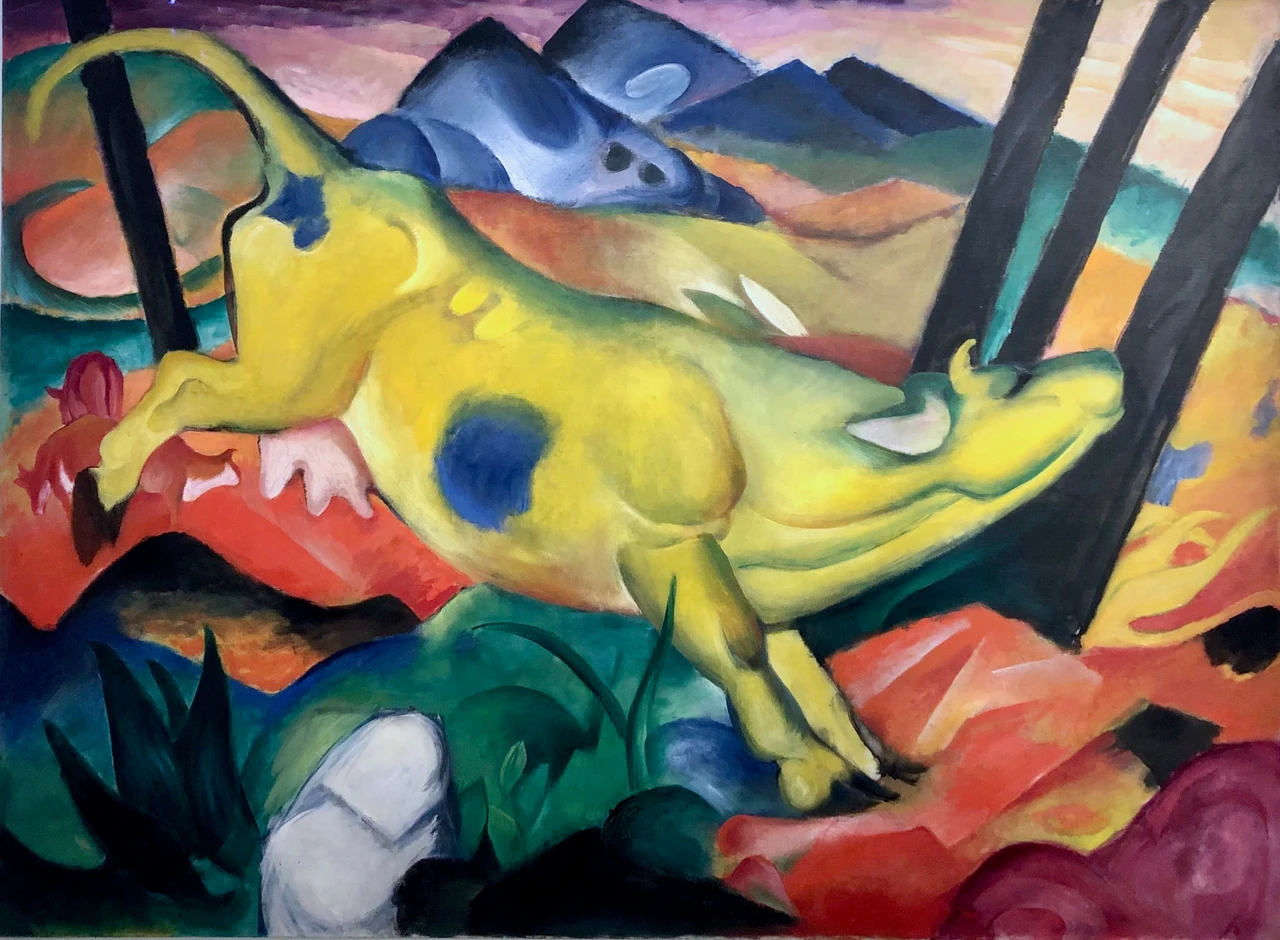
The cow stretches almost from one side of the painting to the other. Its raised tail curls around the dark trunk at the left; its head tilts upwards near the trees at the right. The legs do not sit tidily beneath a level back. Together, those features make the animal feel caught in an expansive movement rather than standing for inspection.
The blue patch on the body is particularly useful to notice. It interrupts the yellow at close range, then directs attention towards the blue mountain shapes above. Around the animal, red and green areas push against one another. The landscape is not a neutral setting that could easily be removed while leaving the same picture intact.
Follow the dark trunks as well. They establish strong diagonals near the cow’s head, contrasting with the rounded body. The pale forms near the lower edge give another change of weight and colour. A crop concentrating only on the head loses much of this exchange between animal and surroundings.
This is a documentary photograph, not a studio-certified record of the painting’s colour. Its slight perspective and lighting belong to the photographic encounter. We have not straightened, retouched or repainted it. Those limits are preferable to presenting an altered image as a uniquely accurate version of Marc’s canvas.
Marc’s colours are an interpretation, not a rule
The Guggenheim’s teaching account explains that Marc developed a personal symbolism for colour and associated yellow with a feminine, joyful principle. That is historical context for his painting, not a universal claim that yellow produces happiness in every viewer.
A 1965 Guggenheim lecture by Rose-Carol Washton Long draws attention to the repeated colours and curves linking the cow with its surroundings. It offers a helpful way to look: compare the blue on the animal with the mountains, rather than searching for a literal farmyard scene.
You do not need to accept a single symbolic reading to appreciate the construction. The picture can feel playful, energetic or strange. What matters for an accurate reproduction is that its relationships remain visible. Removing the landscape, recolouring the cow or turning it into an isolated sticker creates a different presentation, which should be identified as an adaptation or detail rather than silently attributed to Marc.
Country and publication are different checks
Marc died in 1916, as the museum’s teaching material records. The ordinary life-plus-seventy artistic-work term in UK guidance and EU guidance has elapsed. That does not settle every national exception, moral-rights question or later photographic contribution.
In the United States, creation and exhibition are not substitutes for publication. The statutory definition distinguishes distribution of copies from public display. We have not verified an authorised early reproduction of this particular painting that closes its U.S. analysis.
For older works, U.S. duration provisions depend on the relevant publication history; some previously unpublished works have transitional protection. It would be misleading to label this painting automatically cleared worldwide because “1911 is more than a century ago.” Equally, an unresolved research question is not evidence that someone currently owns an enforceable claim.
The photograph has its own credit and licence
The illustration comes from this exact Commons file, credited to Dr. Alexey Yakovlev and dated 19 September 2019. Its linked Flickr source also identifies CC BY-SA 2.0. This is not a Guggenheim CC0 release.
The licence permits sharing and adaptation, including commercial uses. Credit the photographer, identify the image, link to the licence and indicate modifications where required. If an adaptation engages ShareAlike, the adapted contribution must use the same licence. We retain that licence for our reduced reproduction and its applicable photographic contribution; it is not being relicensed as an exclusive GeMarkt image.
There is no need to call the photograph “public domain” to explain why it can be used. A copyright licence and a public-domain assessment are different routes. Neither implies that the photographer, museum or artist endorses the surrounding article or any product.
What a different download would change
Suppose you find a sharper, more evenly lit reproduction tomorrow. It may be better suited to close study, but the credit above will not automatically cover it. Find its own source record and terms before replacing the image.
An anonymous repost is particularly weak evidence. The absence of a watermark does not reveal who made the file, whether it was copied from a restricted museum download, or whether someone added new elements. Conversely, a photographer’s name is not a reason to reject a file when that photographer has supplied a suitable licence.
Keep the original filename, source page, licence link and download date together. Note which changes you made. That small record prevents a common mistake: checking one image carefully, then publishing a different, near-identical file with the first image’s permissions attached.
A useful credit and a sensible final check
A reader-facing credit should identify Marc’s painting and collection, then separately identify Yakovlev’s photograph and CC BY-SA 2.0. Keep any alteration notice beside the image where people can find it. A general website copyright footer should not suggest that a separately licensed photograph has become proprietary.
For a U.S.-facing commercial project, complete the unresolved painting-level publication check as well as complying with the photo licence. For broader research, our Franz Marc guide compares selected works and sources. The useful question is not simply whether Marc is “old enough,” but whether you can account for this painting and this exact image.
Editorial record
About this article
- Author
- Publisher
- GeMarkt
- Published
- Reviewed
- Internal source & rights check. Conducted by GeMarkt Research Review. This is an internal editorial check—not independent peer review.
- Source standard
- Rights guide source standardSeparates the underlying work from the source file, records the review date, and links the evidence used for the conclusion.
Found a claim that needs checking? Report a factual error.