GeMarkt Blog · Reference
How Long Does Copyright Last on Art?
Understand life-plus-70 terms, publication-based rules and older unpublished art without confusing an expired artwork with a reusable image file.

The short answer
Art copyright often lasts for the artist’s life plus 70 years, but there is no worldwide expiry date for every artwork. The relevant country, the kind of work and its publication history can change the answer. A date painted on a canvas is not enough to decide whether you can reproduce it.
Think of this as two connected questions: has copyright in the particular artwork ended where you intend to use it, and can you use the particular image you have downloaded? A correct answer to the first does not remove the second.
This guide concerns copyright duration as checked on 12 October 2026. It gives a way to organise the facts, not legal advice or clearance for a particular commercial project. If a missing date determines whether you can print or publish an image, resolve that date before treating the work as available.
Start with a country, not a famous name
Copyright laws operate through national legal systems. International agreements connect those systems, but they do not give every work a single global countdown. WIPO’s copyright guidance explains that national terms vary and that the Berne framework generally requires at least life plus 50 years, with longer protection possible.
For an online project, write down the countries involved instead of recording only where the artist was born. A UK publication, a print offered to U.S. customers and a download distributed internationally need an appropriately scoped assessment. The country where a museum currently keeps the canvas is useful identification information, not a substitute for that assessment.
“Public domain in the United States” is therefore a meaningful, limited conclusion. “Public domain everywhere” needs much more support. When a website gives an unexplained yes-or-no label, look for the territory behind it before adopting the label yourself.
Understand the different clocks
The ordinary EU rule is life plus 70 years, with joint authorship generally measured from the last surviving author; Your Europe sets out that starting point. National implementation and older-work provisions still matter. Do not turn the general rule into a declaration that every work by everyone who died in the same year has identical status everywhere.
The UK government’s duration overview likewise lists 70 years after the author’s death for artistic works, while noting that older works may need different treatment. Neither rule means 70 years after the painting was made, sold or donated to a museum.
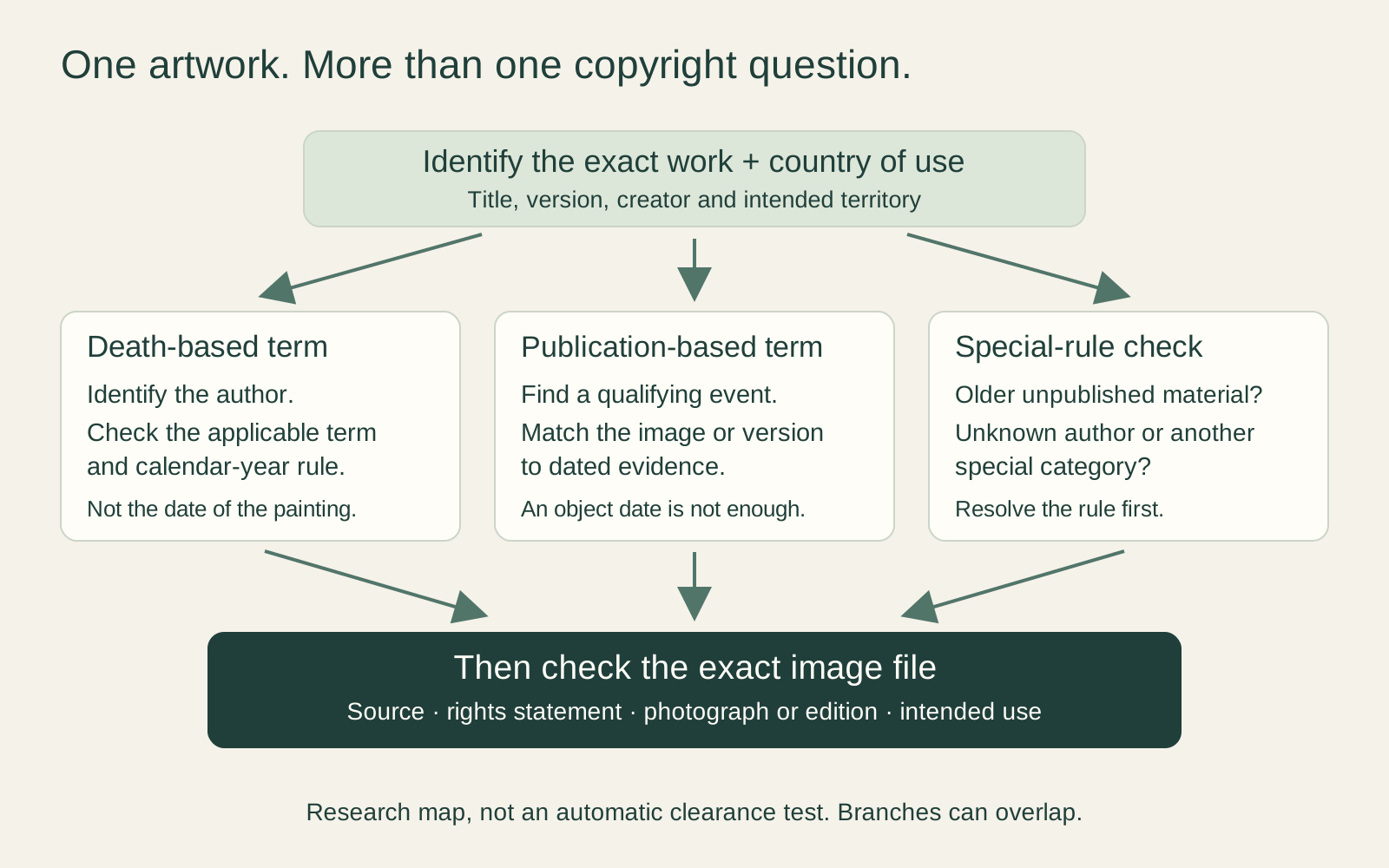
Suppose a catalogue gives three dates: painted in 1910, artist died in 1960, image uploaded in 2024. Under an applicable life-based rule, the death date is the starting fact. The upload date does not replace it. Under a publication-based rule, none of those entries necessarily tells you when an authorised reproduction first reached the public. These are hypothetical dates, not a decision about a named painting.
That distinction also helps when reading museum records. “Date” usually describes the object. “Acquired” describes the collection’s history. “Image updated” may describe the website. Give each date a label rather than putting whichever looks oldest into a calculator.
Why the United States needs publication evidence
The United States has several duration routes. For works created from 1978 onward, the usual individual-author term is life plus 70 years. For works made for hire, anonymous works and pseudonymous works, different rules can apply, including 95 years from publication or 120 from creation, whichever ends sooner, with qualifications for subsequently identified authors. The U.S. Copyright Office’s Circular 15A explains these categories.
For older art, publication and earlier copyright history can be decisive. A work created in 1900 and first reproduced decades later is not automatically equivalent to a work published in 1900. Publication evidence should identify the actual image or version: a dated book containing a different painting with the same title does not answer your question.
For a hypothetical work correctly within a 95-year term calculated from publication in 1930, the arithmetic reaches the end of 2025; the next day is 1 January 2026. The hard part is establishing that this is the correct legal route and the correct publication event. Sections 304 and 305 provide the older-term and calendar-year rules. Our U.S. publication guide explains the evidence in more detail.
Old and unpublished is a separate question
An artwork can be very old without having the publication history a particular rule requires. For certain works created before 1978 that were neither already in the public domain nor previously federally copyrighted, U.S. law supplied a minimum term through 2002. If a qualifying work was published by the end of 2002, the minimum can extend through 2047. That is the specific transition in section 303, not an extra term added to every newly discovered old painting.
The UK has a different set of transitions. Its official duration notice identifies certain older unpublished works protected through 2039, including qualifying engravings and photographs. This is not a rule covering all unpublished paintings. Type of work, earlier events and dates have to be checked together.
For an archive discovery, record “publication history unresolved” until you have the relevant evidence. That is a useful research result, not a reason to guess. The next task may be to ask the archive for a publication reference, identify an earlier edition or obtain permission. A recent scan alone does not establish what happened before it.
An expired artwork is not every image of it
Separate the artwork from photographs, editions and other material surrounding it. A museum catalogue page can contain an old painting, a new essay and a designed page layout. Do not assume a conclusion about the painting automatically covers the entire page.
Ownership of the physical object is another question. Under U.S. section 202, buying the material object does not, by itself, transfer copyright in the work embodied in it. Owning an original, owning a photograph and having permission to reproduce either are not interchangeable facts.
A clearly identified open image can simplify the file question. CC0 allows broad reuse through a dedication of rights to the extent permitted by law. It does not clear somebody else’s rights, remove trademark or privacy issues, or promise that every application of the label is correct. Check who applied it and which exact file it describes. Our image-rights guide explains why a faithful reproduction and a creatively composed photograph need different attention.
Make a record you can use again
Keep one short record per work and file. Start with the artist, exact title, version or accession number and the countries assessed. Add the death-date source, any publication evidence needed for that legal route, the rule applied and the date of your conclusion. Then attach the image’s source page, rights statement and a filename that distinguishes it from other downloads.
For example, “museum image, public domain” is difficult to check later. “Object accession X; country Y; term based on evidence Z; this downloaded file supplied under these terms” tells a future editor what was actually decided. Leave unresolved fields visibly unresolved rather than replacing them with a convenient date.
If the same picture appears in a new source, compare it with the existing record before reusing the conclusion. It might be another impression, a later photograph or a redesigned edition. Keep the artist’s credit even when the ordinary copyright term has ended; accurate attribution helps readers identify what they are seeing. The aim is not a longer checklist for its own sake, but a decision that remains understandable when the download has been separated from the page where you found it.
Editorial record
About this article
- Author
- Publisher
- GeMarkt
- Published
- Reviewed
- Internal source & rights check. Conducted by GeMarkt Research Review. This is an internal editorial check—not independent peer review.
- Source standard
- Rights guide source standardSeparates the underlying work from the source file, records the review date, and links the evidence used for the conclusion.
Found a claim that needs checking? Report a factual error.