GeMarkt Blog · Reference
Is Olympia by Édouard Manet Public Domain?
Check Manet’s 1863 Olympia, its authorised 1867 printed reproduction and the separate rights evidence for a museum or Commons image.


The short answer
Manet’s Olympia is beyond the ordinary European author-copyright term, and an authorised reproduction was published during his lifetime. That supports a public-domain assessment of the historic composition; it does not make every modern photograph or download unrestricted.
This guide concerns the 1863 oil painting in the Musée d’Orsay, RF 644, not an unspecified image called Olympia. We also show Manet’s related 1867 etching. As checked on 13 October 2026, the colour file used here carries a Wikimedia Commons PD-Art/Public Domain Mark assessment, while the print image comes from Cleveland’s CC0 collection. Those are different source records, not interchangeable permissions.
Identify the painting before the file
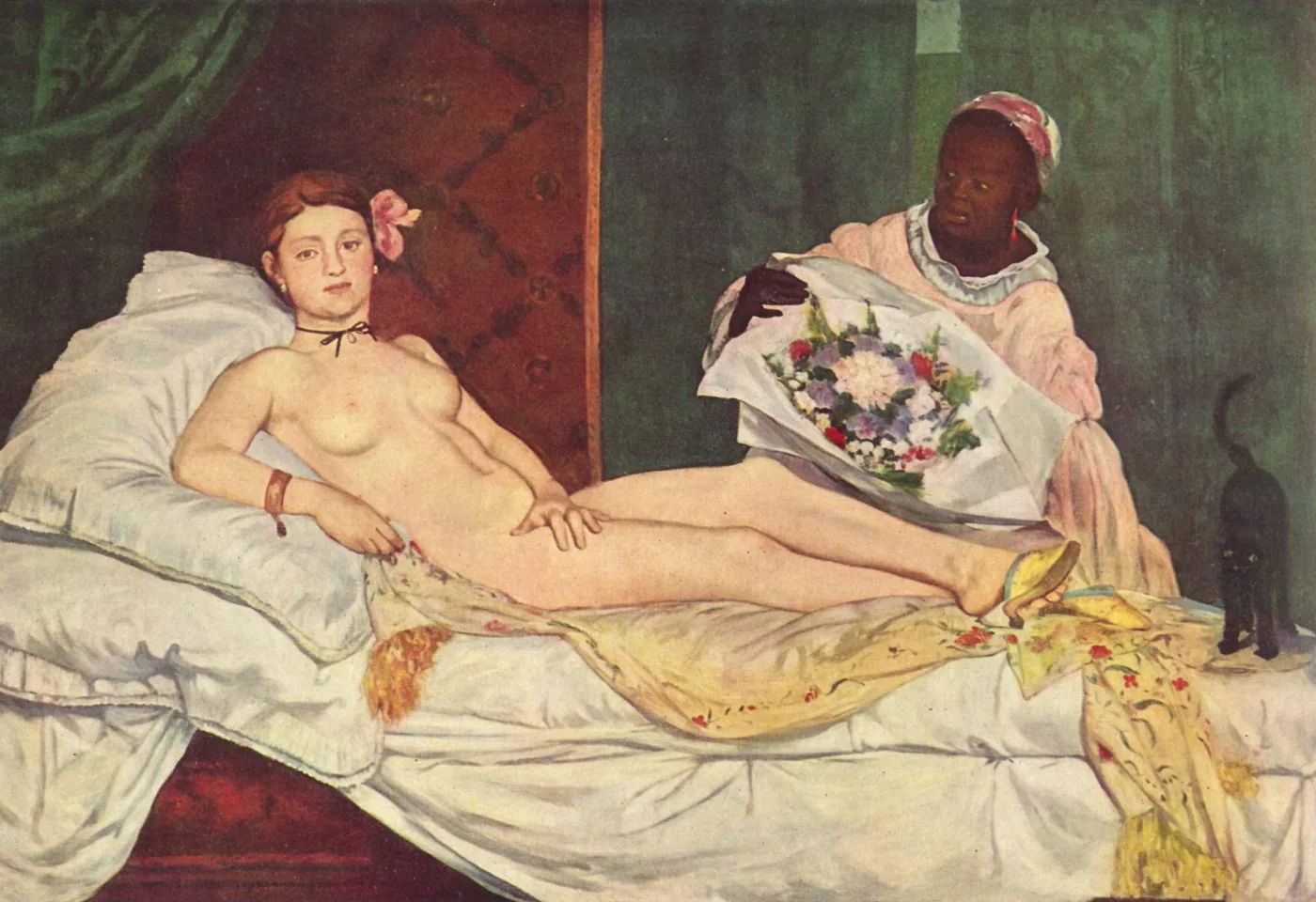
The Musée d’Orsay’s object record identifies an oil on canvas measuring 130.5 × 191 cm. It records the painting’s appearance at the 1865 Salon and its gift to the French state in 1890, following a subscription organised by Claude Monet. These dates describe making, exhibition and ownership. They do not all describe publication.
The museum explains how Manet reworked the tradition of the reclining nude into a contemporary subject that provoked the Salon audience. That history matters more than treating the picture as a generic Victorian nude. The woman’s direct look, the attendant and the offered bouquet establish an encounter, not a solitary body arranged in an empty room.
When a source offers “Olympia, 1867,” check the medium before correcting its date. It may describe Manet’s etching accurately. A small black print and the large coloured canvas share a subject but remain separate works and physical objects.
What a crop can leave out
The long pale body and bedding dominate the foreground, but the right side does important work. The attendant holds a wrapped bouquet above the bed; the cat rises against a dark curtain. Flowers, ribbon, slippers and patterned fabric interrupt the broad light areas. These details keep the eye moving rather than letting the reclining figure become an isolated silhouette.
A narrow portrait-shaped crop could remove the attendant almost entirely. A very dark reproduction could make the cat disappear. Neither problem is solved by a public-domain label: legal availability says nothing about whether a file represents the picture well.
For an article discussing the bouquet or the cat, show that part clearly and label a detail as a detail. For a reproduction offered as the whole painting, compare its boundaries against a reliable institutional view. Our colour illustration preserves the supplied composition; it is not a newly photographed, colour-certified print master.
The 1867 print provides better evidence than the Salon
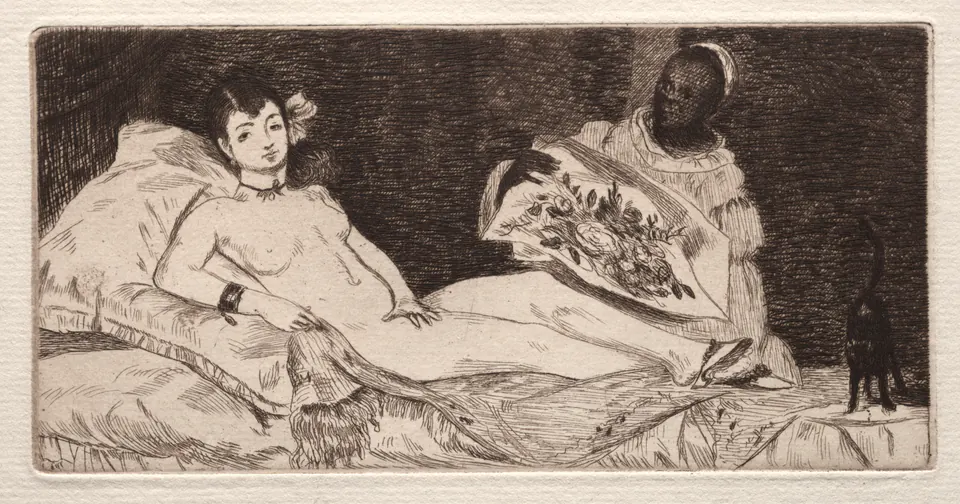
The Cleveland Museum of Art identifies this etching as Manet’s reproduction of his controversial painting. Look at how the dark background becomes a mesh of lines, while the bouquet and bed remain readable through outlines and patches of untouched paper. It is a translation into another medium, not the colour painting with saturation removed.
For actual publication evidence, the Metropolitan Museum’s copy of Émile Zola’s book, accession 32.91, is particularly useful. Its catalogue names E. Dentu as publisher, dates the volume 1867, and credits Manet with the Olympia plate. This is an illustrated publication, not merely an exhibition list naming the painting.
Zola’s May 1867 preface, available in a transcription of the original book, adds something the date alone cannot: he thanks Manet for supplying his etching and permitting its inclusion. We therefore have evidence of author participation and permission, rather than assuming that any old printed copy was authorised.
The Cleveland image illustrates the related print. We have not established that this particular museum impression was bound into that particular Met volume, or that every state of the plate appeared in the first edition.
Country rules and the limit of that evidence
Manet died in 1883, as both museum records state. The ordinary artistic-work term described by EU guidance and UK guidance has long elapsed. That conclusion concerns the historic work’s economic copyright, not every right in every later reproduction.
France also protects the author’s name and the integrity of the work through Article L121-1, which describes moral rights as perpetual. A public-domain reproduction should not be misattributed, or an alteration passed off as Manet’s untouched original. The treatment of a particular alteration requires its own assessment.
For the United States, publication is distinct from public display. Under the maximum ninety-five-year published-work term, qualifying works published by 1930 have passed that term in 2026. The documented 1867 publication is far earlier; the Salon’s 1865 date alone would not have answered the question.
Our evidence supports the old printed composition. It does not independently settle every colour-specific detail of the canvas through a fully traced colour-reproduction history. Nor does it grant rights in a later photograph, edited scan, translation or book layout. We do not present this article as a legal opinion clearing a particular commercial edition worldwide.
Our colour image is not the museum’s current photograph
The exact Commons file identifies The Yorck Project’s 2002 art-image collection as its source. Commons marks this faithful reproduction PD-Art/PDM. We have retained the already-used file, rather than silently replacing it with the sharper-looking photograph currently displayed by the museum.
The Orsay record credits its current photograph to Patrice Schmidt through the museum/RMN distribution system. The museum’s legal information is not an open commercial-image licence. A visible download button does not erase those terms, and our Commons source assessment must not be attached to that different download.
The Public Domain Mark records an assessment of copyright status; it is not a new licence issued by Manet or a guarantee for every jurisdiction. Cleveland’s CC0 release is a separate institutional statement for its designated image. Keep each credit attached to the file it actually describes.
Using Olympia with an honest caption
Start with the medium and accession. Save the source page and its rights statement beside the downloaded file. If using the painting, do not label it as the 1867 etching. If using the print, do not promise the canvas’s colours or texture.
Describe a crop or colour change plainly. Avoid museum logos or wording that implies endorsement. Before commissioning a commercial reproduction, check the intended country, the exact image supplier and any unresolved edition-specific issue; the title alone is not a permission document.
For a printed comparison, place the painting and etching side by side with their separate dates. Keeping the two captions visible prevents readers from mistaking differences in line, proportions or colour for damage to a single original.
For further examples, the Manet artist guide considers other works and files. Olympia’s useful lesson is unusually concrete: an artist-authorised nineteenth-century print can establish more than an exhibition date, while still leaving the modern image-source check necessary.
Editorial record
About this article
- Author
- Publisher
- GeMarkt
- Published
- Reviewed
- Internal source & rights check. Conducted by GeMarkt Research Review. This is an internal editorial check—not independent peer review.
- Source standard
- Rights guide source standardSeparates the underlying work from the source file, records the review date, and links the evidence used for the conclusion.
Found a claim that needs checking? Report a factual error.