GeMarkt Blog · Reference
Bridgeman v. Corel: What the US Reproduction Ruling Means
The 1999 ruling concerned faithful copies of public-domain paintings, not every museum photograph. Understand its reasoning, limits and practical implications.

The short answer
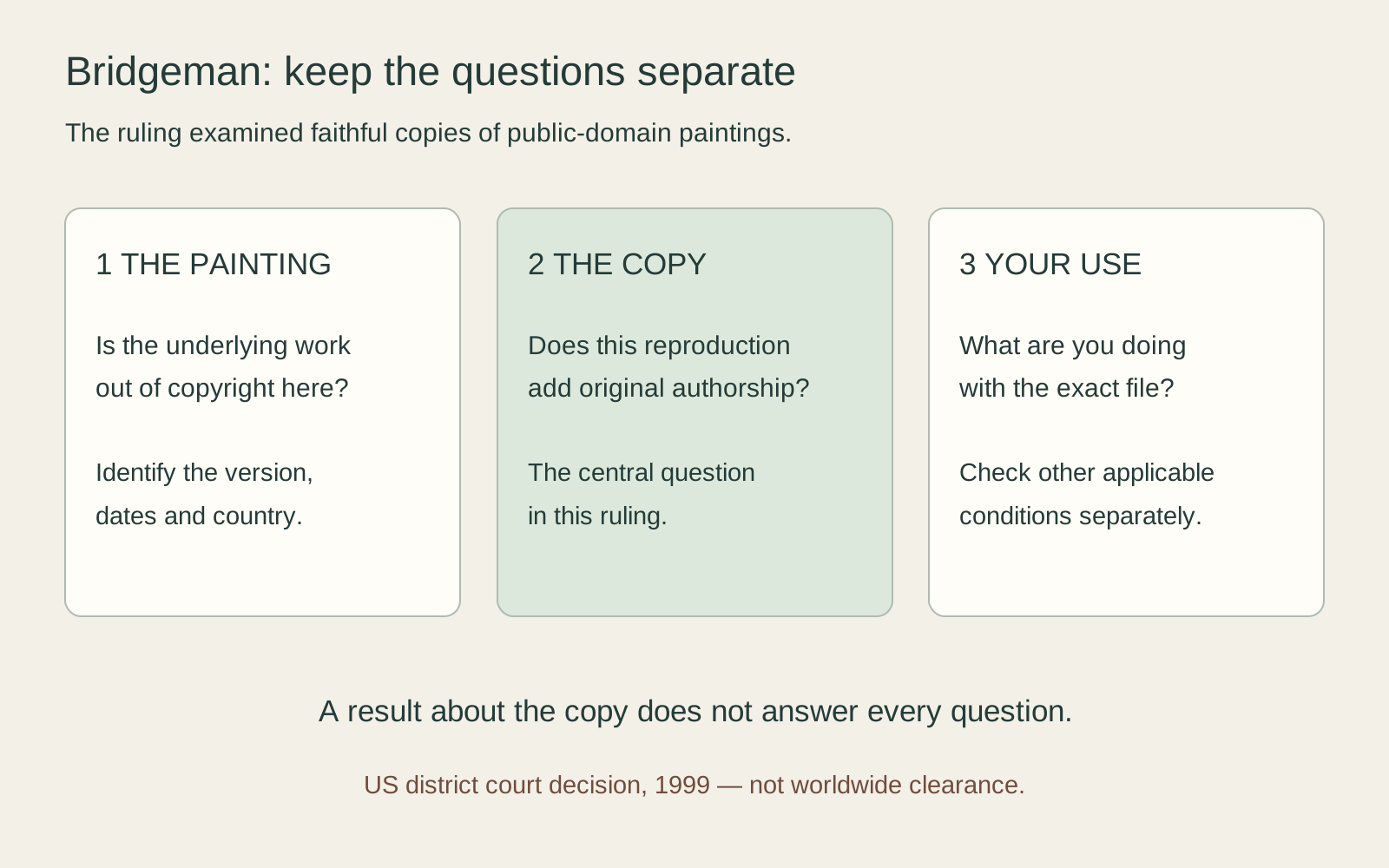
Bridgeman v. Corel held that the faithful photographic reproductions of public-domain paintings at issue lacked the originality required for US copyright. It did not hold that every photograph of an old artwork is free to use. The distinction matters when a search result shows a flat scan beside a carefully lit sculpture photograph and labels both “museum images”.
The 1999 opinion came from the US District Court for the Southern District of New York. It is an important explanation of the originality problem, not a Supreme Court ruling or a worldwide clearance certificate.
For a reader choosing an image, its most useful lesson is to separate three questions: Is the underlying artwork out of copyright? Does this particular reproduction add protectable authorship? What else affects the proposed use? Answering the second does not automatically answer the first or third.
This guide is general information, checked on 12 October 2026, not legal advice about a particular file or dispute.
What the court actually decided
Bridgeman Art Library supplied photographic reproductions of artworks. In its dispute with Corel, the relevant underlying works were already in the public domain. The court examined the claimed copyright in the reproductions, rather than deciding whether the historical painters’ copyrights had expired.
Judge Lewis A. Kaplan considered the effort to reproduce the originals as faithfully as possible. The very aim was to remove the photographer’s expressive departures from the paintings. On those facts, the court found no sufficiently original contribution in the photographic copies. After reconsidering its earlier decision, it again granted summary judgment to Corel. The opinion was issued on 18 February 1999 and amended on 2 March.
That is a narrower result than “any picture of any old object is public domain”. The type of subject, the copying process and the contribution being claimed all mattered. The court did not make modern paintings public domain merely because someone photographed them accurately.
Why effort was not enough
US copyright begins with original authorship, not a calculation of production expense. Section 102 of the Copyright Act protects original works fixed in a tangible medium. In Bridgeman, technical skill and labour did not supply the missing originality when their purpose was exact replication.
This does not mean that faithful photography is easy or worthless. Accurate colour, careful lighting and a well-resolved file can make a reproduction much more useful. The distinction is between the quality of a service and the legal basis for a new exclusive right. A difficult copying job can still be a copying job.
Current US Copyright Office registration guidance, particularly sections 909.3(A) and 917.1, likewise distinguishes original photographic authorship from faithful reproductions, scans and exact duplicates. The Compendium describes registration practice; it is not another court judgment.
Think of two hypothetical commissions. One asks a technician to match a painting without adding anything. The other asks a photographer to interpret a room containing that painting. The second commission may involve expressive choices the first was designed to eliminate. Calling both deliverables “a photo of the painting” hides the important difference.
Which photographs fall outside that example?
A photograph of a sculpture can involve choices of viewpoint, depth, lighting and background. A gallery photograph can arrange people, architecture and pictures into a new composition. A dramatically angled photograph of a framed canvas can show reflections and its surroundings. These are not automatically equivalent to a faithful, flat reproduction of the painted surface.
The Copyright Office’s discussion of photographic authorship in section 909.1 identifies creative choices such as composition, camera position, lighting and timing. Whether a particular image qualifies still depends on what its author actually contributed; buying an expensive camera does not answer that question.
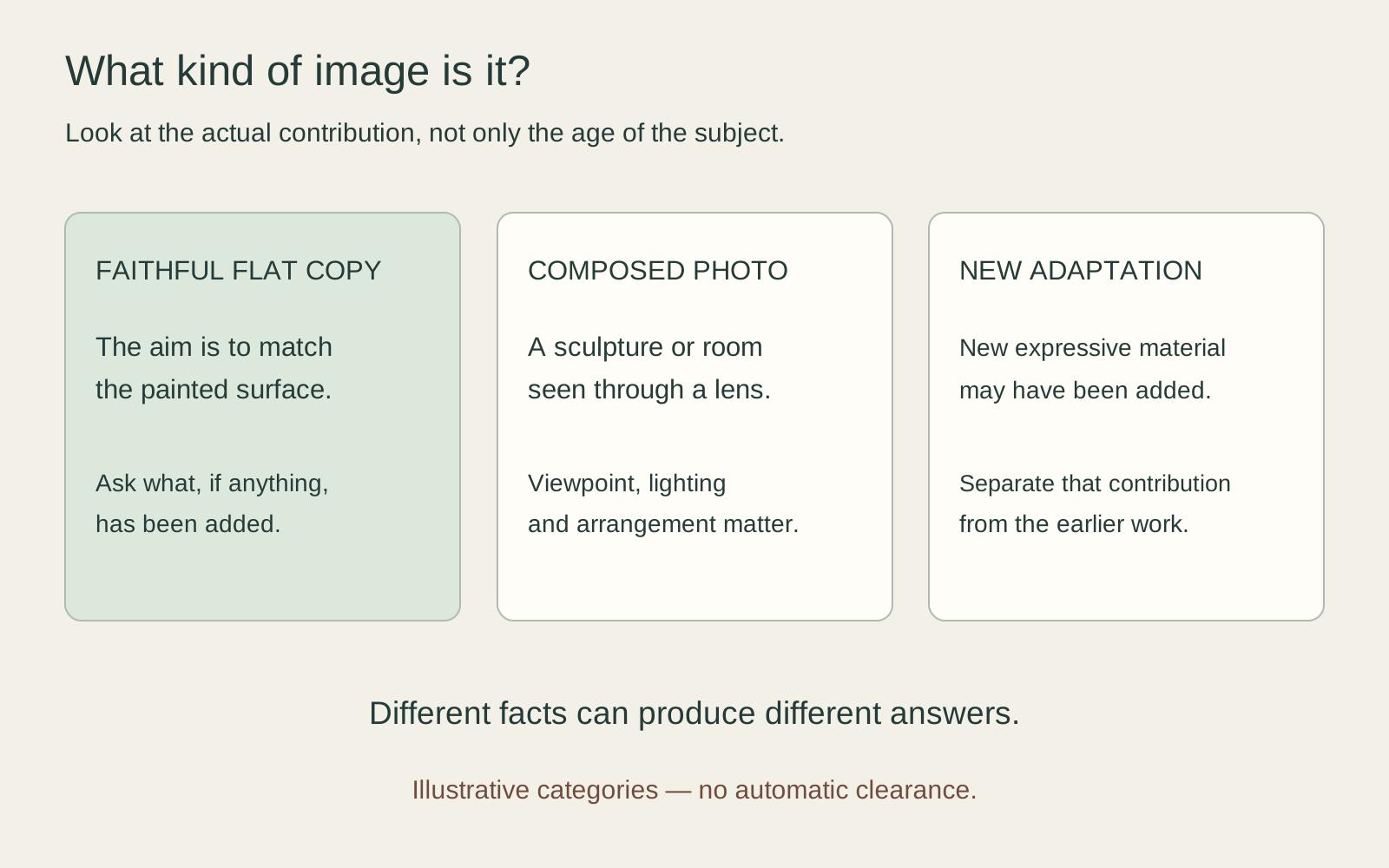
A newly colourised or substantially reworked image raises another question: which new material, if any, is original? Under section 103, copyright in a derivative work extends to the author’s contribution, not the pre-existing material as such. Our guide to restored, colourised and AI-upscaled files examines those distinctions. Do not treat every retouched file as either entirely protected or entirely unprotected.
A district court decision is not a worldwide rule
Bridgeman’s court level is part of the answer, not a footnote to discard. A federal district court decision does not become binding precedent in every other case simply because it is often cited. The Supreme Court explained that general distinction in footnote 7 of Camreta v. Greene. Camreta was not an art-copyright case; it is relevant here only to the status of district court decisions.
Bridgeman can offer persuasive reasoning. It should not be presented as a personal exemption from any future claim, or as a command to courts abroad. For a contested commercial use, the relevant jurisdiction and more recent applicable authorities need proper legal consideration.
Nor does ownership of an object settle copyright in an image. Section 202 separates ownership of the material object from copyright ownership. A museum’s possession of a painting and a photographer’s claim in a photograph are different matters, even when the same organisation administers both.
The UK question needs its own sources
The Bridgeman opinion also discussed UK law, but an American district judge’s analysis is not a binding UK ruling. Do not export its conclusion merely because the image supplier was British.
Current UK Intellectual Property Office guidance says that a merely digitised image of an older work is unlikely to be original where there is little scope for free and creative choices. That is a separate, qualified statement from a UK authority, not proof that every museum photograph lacks copyright. The UK art-copyright guide explains the country-specific starting points.
How to use the case when checking a file
Start with the actual image rather than a slogan attached to its subject. Identify the artwork and version. Then open the source record for the exact download: does it show the complete painted surface, a detail, a sculpture, a room or an altered interpretation?
Save the source URL and the statement that accompanies that file. Note whether you are relying on an express licence or on a conclusion about public-domain status. Those are different bases for reuse. A licence may also settle practical questions without requiring you to test a disputed originality claim yourself.
Keep your intended use specific: a blog illustration, a print for sale and a supplied download are not interchangeable descriptions. Check any relevant agreements and access conditions separately; this case is not an instruction to bypass technical controls or ignore a notice.
If the record is unclear, a clearly documented alternative file is often the simplest next step. If a rights holder challenges an important use, preserve the evidence and obtain qualified advice. Bridgeman is most useful when it helps you ask a precise question about a reproduction—not when its name replaces the investigation.
Editorial record
About this article
- Author
- Publisher
- GeMarkt
- Published
- Reviewed
- Internal source & rights check. Conducted by GeMarkt Research Review. This is an internal editorial check—not independent peer review.
- Source standard
- Rights guide source standardSeparates the underlying work from the source file, records the review date, and links the evidence used for the conclusion.
Found a claim that needs checking? Report a factual error.