GeMarkt Blog · Practical guide
Farmhouse and Cottage Wall Art
Choose landscapes, botanical prints and personal pictures for a farmhouse or cottage-inspired home, with useful advice on scale, frames and placement.

Landscapes, botanical prints and personal pictures can give a farmhouse or cottage-inspired room character without turning it into a themed set. Start with a subject you want to live with. Then choose its scale and position around the furniture, light and everyday activity of the room.
You do not need a rural address, distressed lettering or artificially aged paper to make this work. A well-observed field or flower is interesting in a new apartment too. What matters is that the image has room to be seen and some connection to your life beyond the fact that a shop has labelled it “country”.
Choose a subject connected to your life
Think about the things you notice outside: a garden plant, a particular kind of sky, an orchard or a stretch of coastline. A botanical plate of a rose you recognise may be a better starting point than a large anonymous landscape selected only to fill a space.
Personal photographs can belong in the same room. A picture of a family garden and a historical print do not have to share a date or technique. A related frame colour or a little space between them may be enough to make the pairing feel deliberate.
Do not let the decorating label conceal the subject. A painting of agricultural work is not simply a neutral arrangement of brown and green. Look at the people, weather and activity before deciding whether it is the scene you want at your dining table every day.
Look at Millet’s worked landscape
Millet’s Haystacks: Autumn gives the land a particular season and purpose. The Met’s account identifies it as a work of about 1874, part of a series of the seasons. The harvest is over and sheep graze near the stacks outside Chailly, close to Barbizon.
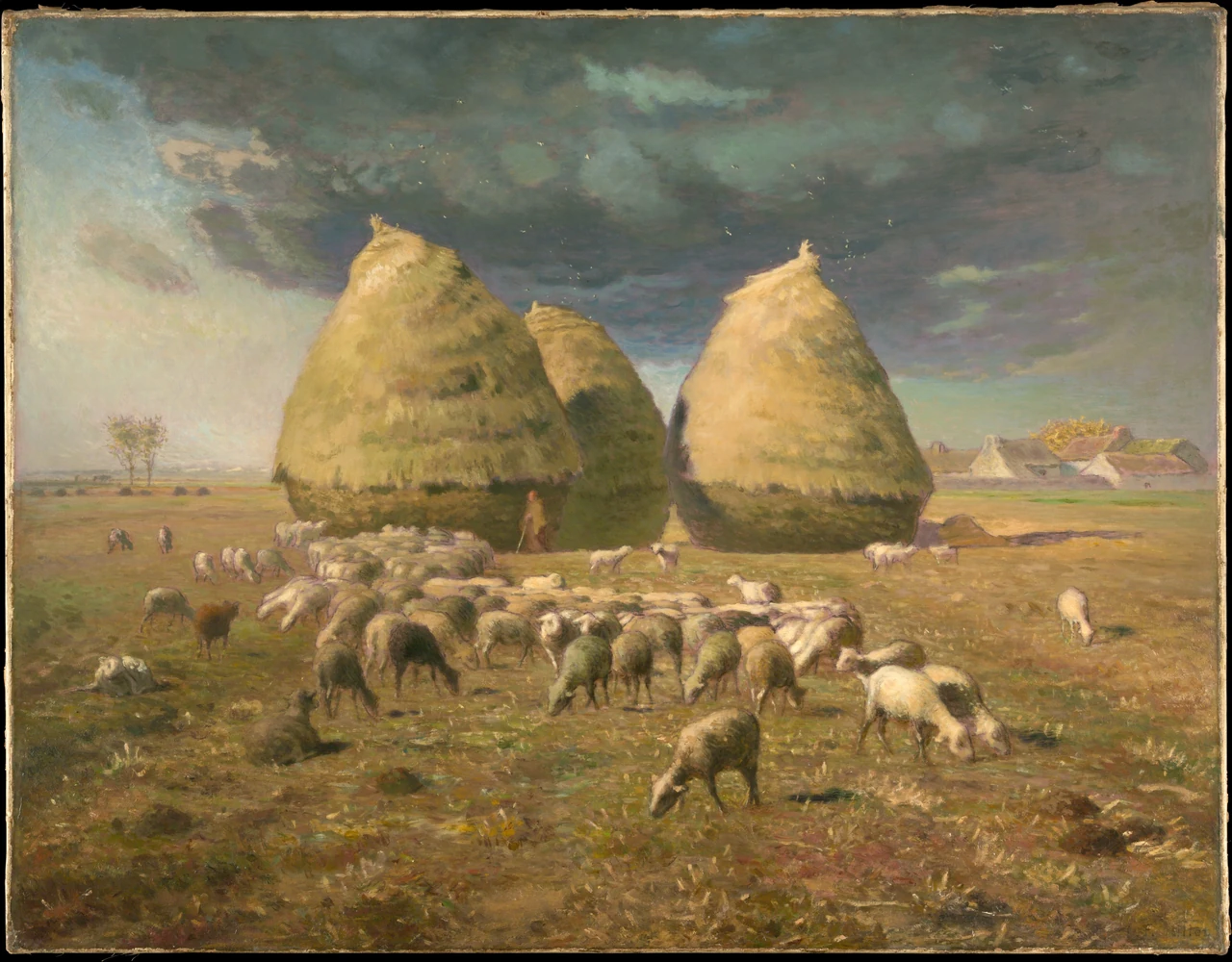
Notice how much of the picture belongs to the sky, and how the largest stacks stand against it. The weather and dark ground are part of the appeal. If you crop down to one stack because your frame is narrow, you lose much of that relationship.
I would try a reproduction where its broad forms can be seen across the room, perhaps above a cabinet rather than high in a stairwell. Timber furniture can provide a connection without matching the painting’s browns exactly. A simple frame lets the uneven, painterly surface remain more noticeable than the surrounding decoration.
This is also a useful reminder that rural art need not look sugary or permanently sunny. Choose the actual picture, not an assumption that every field scene will deliver the same atmosphere.
Give a botanical print a place to be read
A botanical sheet invites a closer kind of attention. In Redouté’s Rosa turbinata, the flower, leaves and small lettering occupy distinct parts of a pale sheet. The Met records this as a colour stipple engraving from Les Roses, 1817–24, rather than an original watercolour.
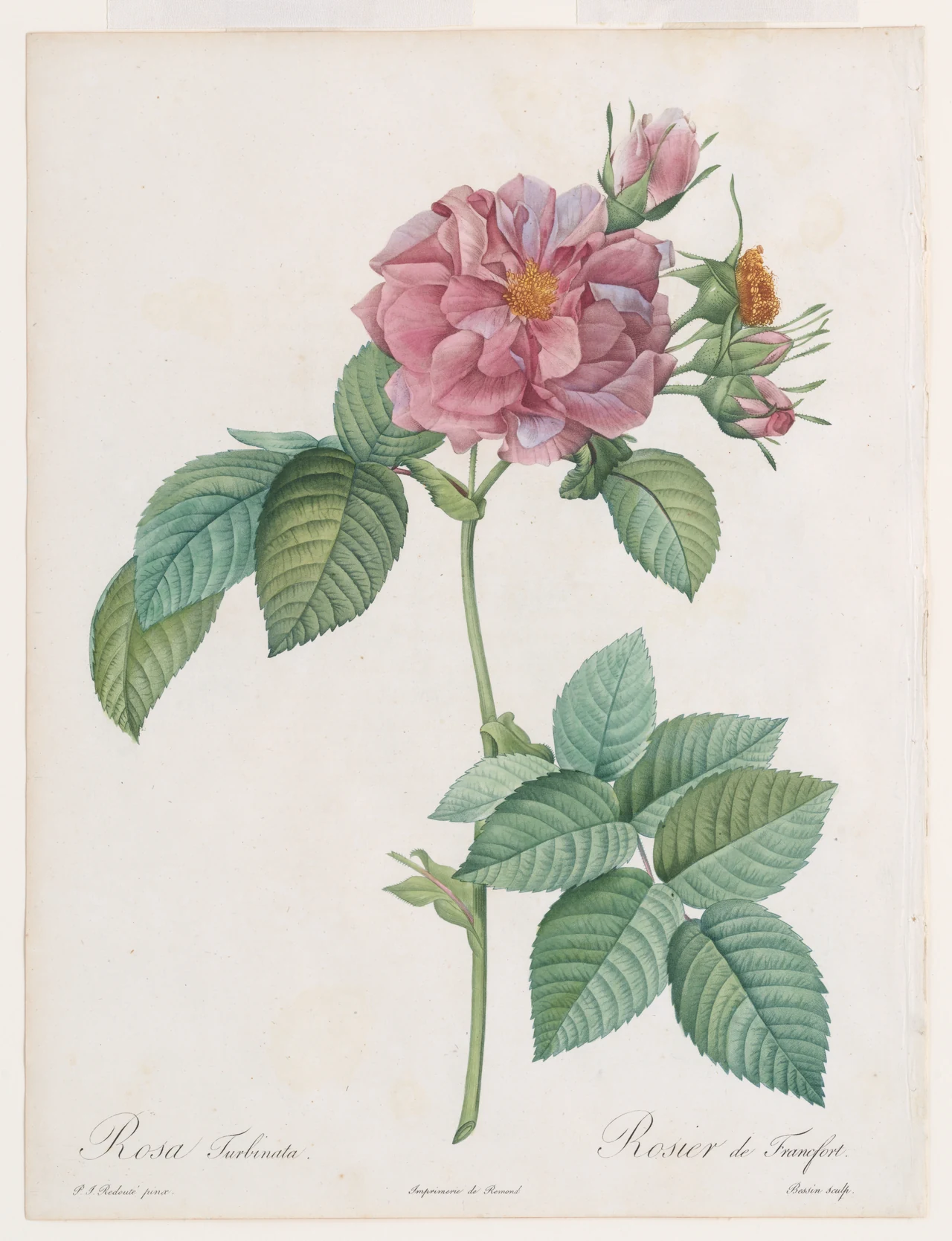
A small wall beside a chair or in an entrance can give this kind of image a useful home. Keep the lettering visible if the whole plate is the subject you chose. A mat that covers the bottom of the image may remove information rather than merely tidy a border.
If you are pairing botanical plates, compare their actual sheet proportions and printed areas. Equal outer frames can contain images with different margins; they do not need to be enlarged until every flower has exactly the same apparent size. That sort of adjustment can erase what makes the original plates distinct.
Use long walls and small corners differently
A long cabinet may suit one broad landscape, while a nearby nook suits two smaller vertical prints. You do not need to solve both walls with a repeated three-picture arrangement. The diagram shows those different jobs using invented pictures, not altered versions of Millet or Redouté.
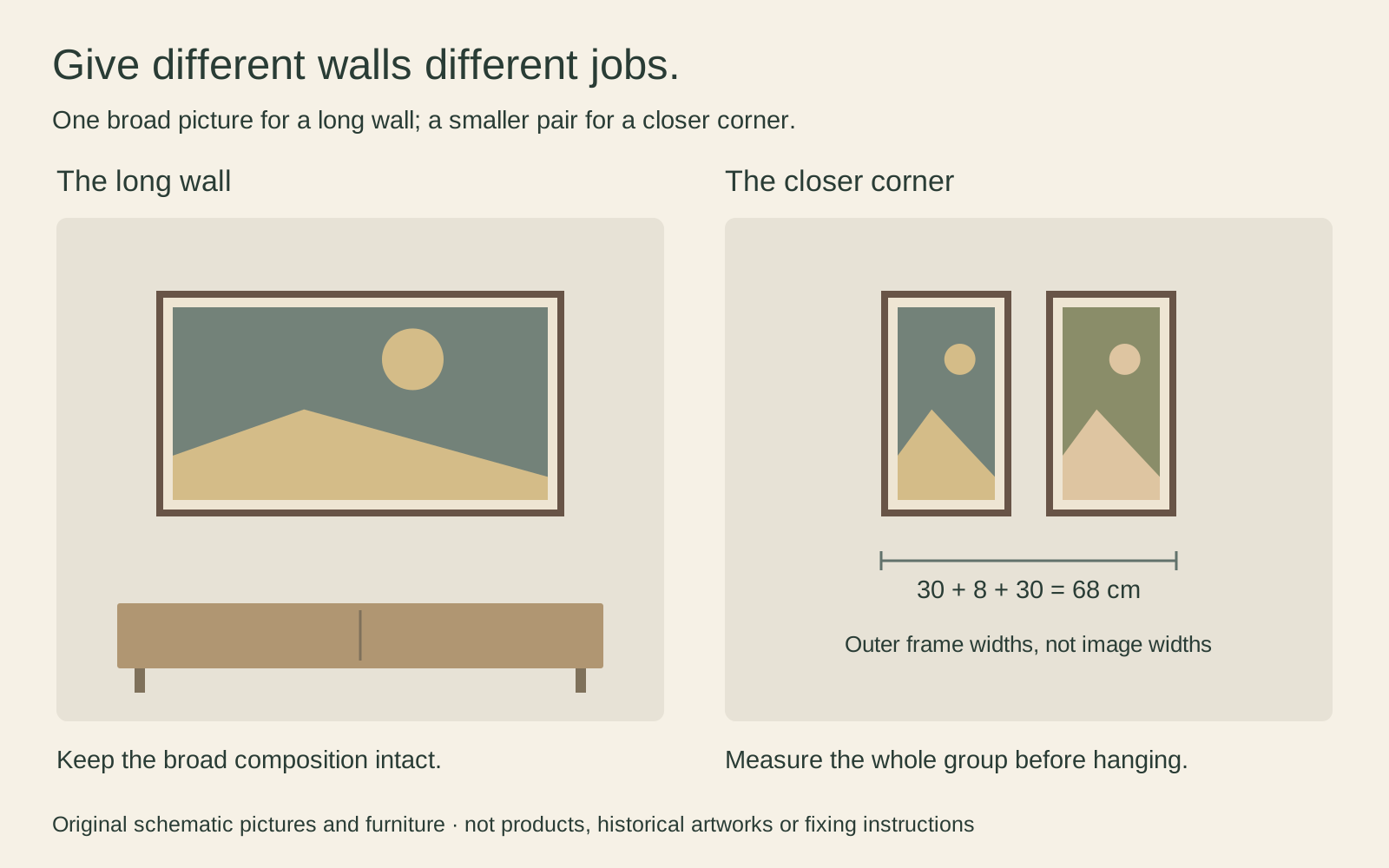
For a specific test, two outer frames each 30 cm wide with an 8 cm gap need 68 cm of wall width. In a 90 cm-wide space, centring that group leaves 11 cm at each side. Check the space beyond the arithmetic: a curtain, switch or opening door may make the apparently available wall unusable.
Try full-size paper templates before ordering. Measure the outer frames, not just the pictures printed inside them. The guide to one large print or several small ones can help you decide which arrangement deserves the larger wall.
Let wood and paper look like themselves
An old-looking subject does not need a fake stain around its edge. The source image may already show paper colour, plate marks or wear. Ask what a reproduction includes rather than adding an antiqued filter simply to make it coordinate with furniture.
Similarly, pale timber, dark timber and painted frames can all work. If the room already contains several wood colours, adding a supposedly perfect match may be less helpful than choosing a simple contrasting frame. Our frame colour and material guide separates appearance from practical frame choices.
A reused frame can be attractive, but assess its condition and suitability before putting a valuable print inside. Old backing or mounting materials are not automatically safe because they look traditional. Ask a competent framer about an important object rather than experimenting with adhesive tape or cleaning fluids.
Keep pictures away from working hazards
A kitchen or dining room contains more than attractive wall space. Think about splashes, steam, food handling and heat before hanging a print near a work surface. There is no single distance from every appliance that this article can safely prescribe; follow the appliance instructions and the requirements of the actual framed object.
The Library of Congress paper-care guidance recommends avoiding unsuitable environments, including heat sources and food or drink around collections. That is particularly important for originals and valuable paper. A replaceable modern print may justify a different level of caution, but a frame is not a promise of waterproofing.
You can put the rose in a dining nook instead of above the sink. You can move the landscape away from direct sun without losing the country reference. A useful location that protects the picture is better than one selected only because its subject matches the activity underneath it.
Build a collection rather than a themed set
Begin with one or two pictures and see how you use the room around them. Add a photograph, another artist or a small drawing when something genuinely interests you. A repeated frame detail can connect those additions without disguising their differences.
Keep enough information to name what you own: artist, title, source and whether the image is a full work or a detail. The strongest farmhouse or cottage wall is not necessarily the oldest-looking one. It is the one whose pictures remain worth noticing after the decorating project is over.
Editorial record
About this article
- Author
- Publisher
- GeMarkt
- Published
- Reviewed
- Internal source & rights check. Conducted by GeMarkt Research Review. This is an internal editorial check—not independent peer review.
- Source standard
- Buying guide source standardSeparates measured or first-hand evidence from general guidance and keeps practical limits visible.
Found a claim that needs checking? Report a factual error.