GeMarkt Blog · Practical guide
One Large Print or Several Small Ones?
Compare one large print with a pair or gallery wall using the total framed width, the pictures you want to see, and a simple paper test.

Choose one large print when you want one picture to hold the wall. Choose several smaller prints when the relationship between the pictures is part of the pleasure. Neither is automatically better for a small room. Compare the outside dimensions of the finished arrangement, including frames and gaps, before comparing individual print sizes.
Start with the wall you actually have
Measure the usable area, not simply the distance between two corners. A door that swings open, a tall lamp, a curtain and the back of a chair can all take space out of the arrangement. If the pictures belong above furniture, include that furniture in your sketch.
Then decide where you will usually see the art. A picture above a dining bench may be viewed from across the room and from a seat immediately underneath it. A small, detailed engraving can reward close attention but may not read clearly from the doorway. That is a reason to test the view, not a reason to exclude small prints.
Our wall-size guide offers starting measurements. Treat its suggested ranges as a first sketch, not a requirement to fill a fixed percentage of every wall.
What one large print does well
A single picture makes the choice of subject clear. There is no need to decide which of six images should be the focal point. It can also be a practical choice when you already love one composition and want to see more of it.
This does not mean the picture must dominate the entire room. A large print with generous space around it can be quieter than a crowded group. Conversely, a small image with a dark frame and strong contrast may attract attention immediately. Size is only one part of what you notice.
Before increasing the size, look at the available file and the actual product preview. A larger sheet does not create more detail in the source. Nor does a larger rectangle necessarily preserve more of the painting: a different aspect ratio may introduce a crop.
One large object also means one object to move and install. Check its finished outside size, weight and route through your home. Do not assume one large frame is easier to handle than three smaller ones.
What a pair or small group does well
A pair gives you a conversation between two images: different weather, related colours, two views of water, or a landscape beside a figure. The connection need not be the same artist or an identical frame.
Start with pictures you want to look at separately. A matching colour palette cannot rescue an image you do not particularly like. If you are uncertain, set the images beside one another on a screen or as small paper reproductions before ordering.
A group can also adapt to a wall with an interruption. But flexibility has limits. Several pictures crowded around a light switch can look like several compromises rather than a useful arrangement. You may get a better result by leaving that wall alone and choosing another position.
Compare the same overall width
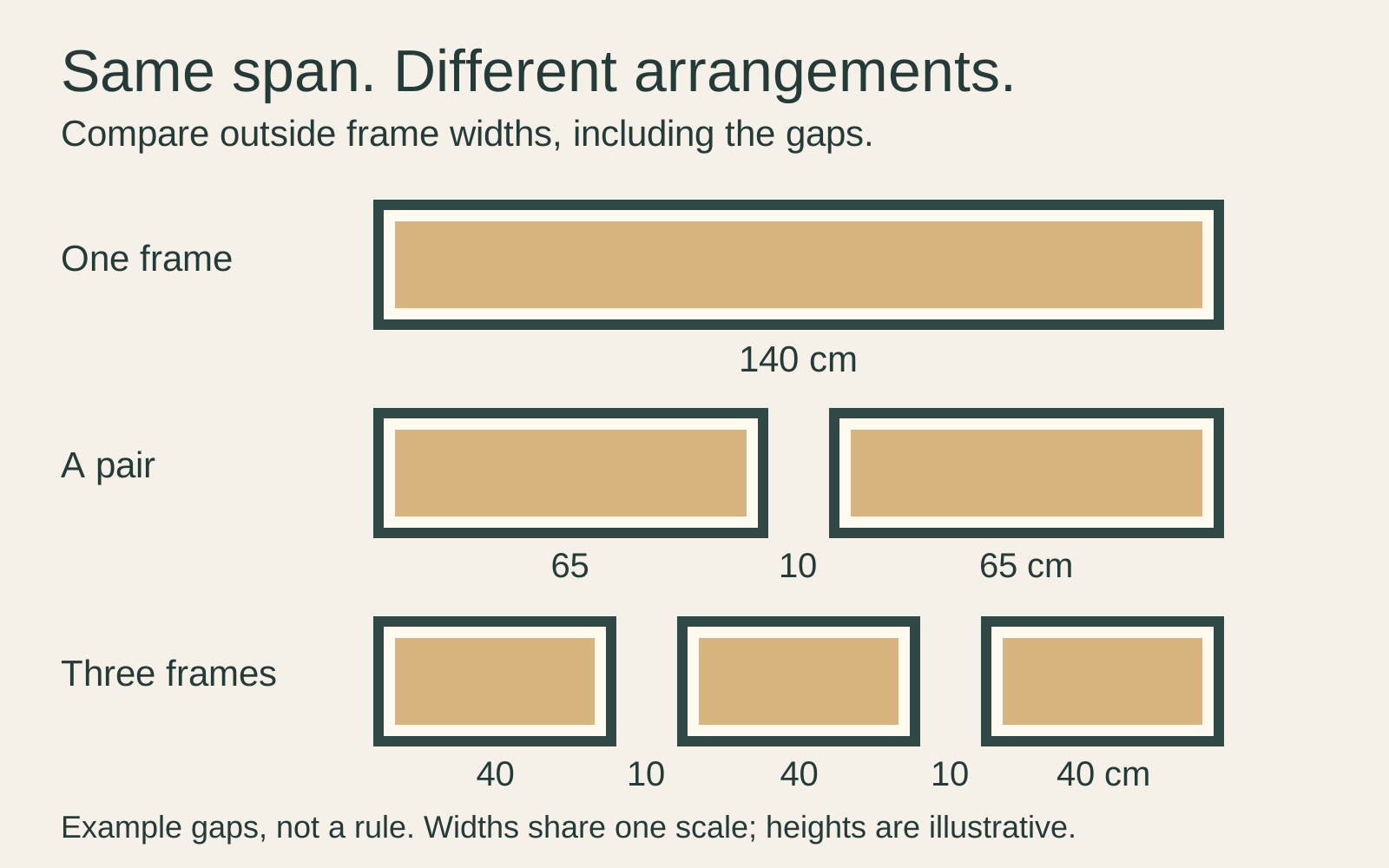
Suppose you are testing a 140 cm-wide arrangement above a sofa. That is an example, not a recommended size for every sofa. Compare these three layouts using outside frame measurements:
| Test layout | Width calculation | Total width |
|---|---|---|
| One finished frame | 140 cm | 140 cm |
| Two finished frames | 65 + 10 + 65 cm | 140 cm |
| Three finished frames | 40 + 10 + 40 + 10 + 40 cm | 140 cm |
The pairs and triples cover the same span, but not the same amount of picture. Gaps contain no image, and the frame edges and any mats occupy part of each object. You cannot calculate the visible image area from this table alone.
If the seller gives only a 40 × 50 cm paper size, you do not yet know the finished frame’s footprint. Ask for the outside measurements. For a group, small differences add up across the row. Our print-size guide explains the difference between the image, sheet, mat window and frame.
Compare the complete cost, not just the prints
Add up what each arrangement needs: the prints, frames, mats if wanted, delivery and suitable hanging hardware. Several inexpensive sheets can require several separate framing purchases. A large print may need a less common frame size. Neither route is automatically the cheaper one.
Use current quotations for your particular sizes rather than a general claim that small prints are good value or that custom framing is always unaffordable. Consider what happens later, too. Would you enjoy replacing one image in a group, or would you prefer to make one decision and leave it there?
These are practical preferences. You do not need to buy extra pictures merely to make a wall appear finished.
Make two paper versions before buying
Cut paper to the outside dimensions of the proposed frames and label each piece. Test one large rectangle, then the smaller arrangement in the same area. Paper templates are also recommended in IKEA’s gallery-wall guidance. Any temporary attachment must be suitable for your wall finish; try an inconspicuous area first.
View both options from the doorway, from your usual seat and from the nearest walking route. Ask which composition you prefer, rather than which fills more empty wall. Photograph the alternatives from the same position so perspective does not decide the comparison for you.
Paper tests size and placement, not weight-bearing safety. The Canadian Conservation Institute stresses matching hanging hardware to the object and wall. Follow the actual frame and fixing instructions; use an installer when the load or wall construction is uncertain.
The useful final question
Would you miss the individual pictures if the group were separated? If yes, a pair or group may be worth the extra decisions. If one image is clearly the reason you want art on that wall, give that image enough room instead. The best arrangement is the one you want to keep looking at, not the one containing the most frames.
Editorial record
About this article
- Author
- Publisher
- GeMarkt
- Published
- Reviewed
- Internal source & rights check. Conducted by GeMarkt Research Review. This is an internal editorial check—not independent peer review.
- Source standard
- Buying guide source standardSeparates measured or first-hand evidence from general guidance and keeps practical limits visible.
Found a claim that needs checking? Report a factual error.