GeMarkt Blog · Practical guide
Corporate Gifts: Art Prints for Clients and Teams
Choose an art gift colleagues or clients can actually live with. Plan recipient choice, print size, a complete budget and delivery without turning art into an advert.

An art print makes a better business gift when the recipient has a say in it. Choosing one image for an entire team is easy for the organiser, but a picture occupies someone else’s home, desk or office long after the presentation. A small, thoughtful choice is usually a more considerate starting point than a large surprise with a company logo across it.
This guide is for a team organiser, a small-business owner or someone thanking a client. It offers three different pictures to help start a conversation, followed by a practical plan for format, budget and delivery. They are examples of ways to choose, not a claim that these exact prints are available in a particular size or gift package.
Start with permission and a real recipient
Before choosing art for a client, ask whether they can accept a gift and whether their organisation sets any restrictions. Do not assume that a small value, a holiday or a friendly relationship makes that question unnecessary. Follow the recipient’s and your own organisation’s rules; this guide does not establish a tax treatment or a permitted gift value.
For colleagues, decide what you are recognising. A welcome, a completed project and a long-service thank-you suggest different messages. Keep that message in a separate note. It gives the gift personal meaning without making the artwork permanently commemorate an employer.
Also distinguish a personal gift from a picture for a shared workplace. A receptionist should not have to decide alone what hangs in a public waiting room. Ask the person responsible for that space about scale, placement and who will see it. If the gift is for someone’s home, make declining or choosing something else straightforward and private.
Offer a small choice rather than one safe picture
Try a short selection with genuinely different qualities: a green garden, a city scene and a vertical Japanese print. Show the complete compositions, label the artist and title, and indicate the proposed finished size. Three almost identical blue landscapes do not give much choice to someone who dislikes landscapes.
Avoid predicting taste from a colleague’s nationality, age, gender or job title. A personal connection they have actually mentioned is more useful: they enjoy gardening, remember a museum visit or love a particular city. Equally, do not assume a landscape is culturally neutral just because it contains no visible religious scene. Let the person see and understand the picture before choosing it.
Set a common budget and comparable finish for a team gift. Recipient choice can vary without making one person’s package look obviously more substantial than another’s. Allow an alternative for people who do not want physical objects, rather than treating a framed print as a mandatory display of appreciation.
Monet for someone who enjoys a garden
Claude Monet’s The Japanese Footbridge, 1899, in the National Gallery of Art, shows the garden at Giverny that the painter helped shape. The bridge, lilies and dense foliage form a particular place, not a generic illustration of “wellness.”
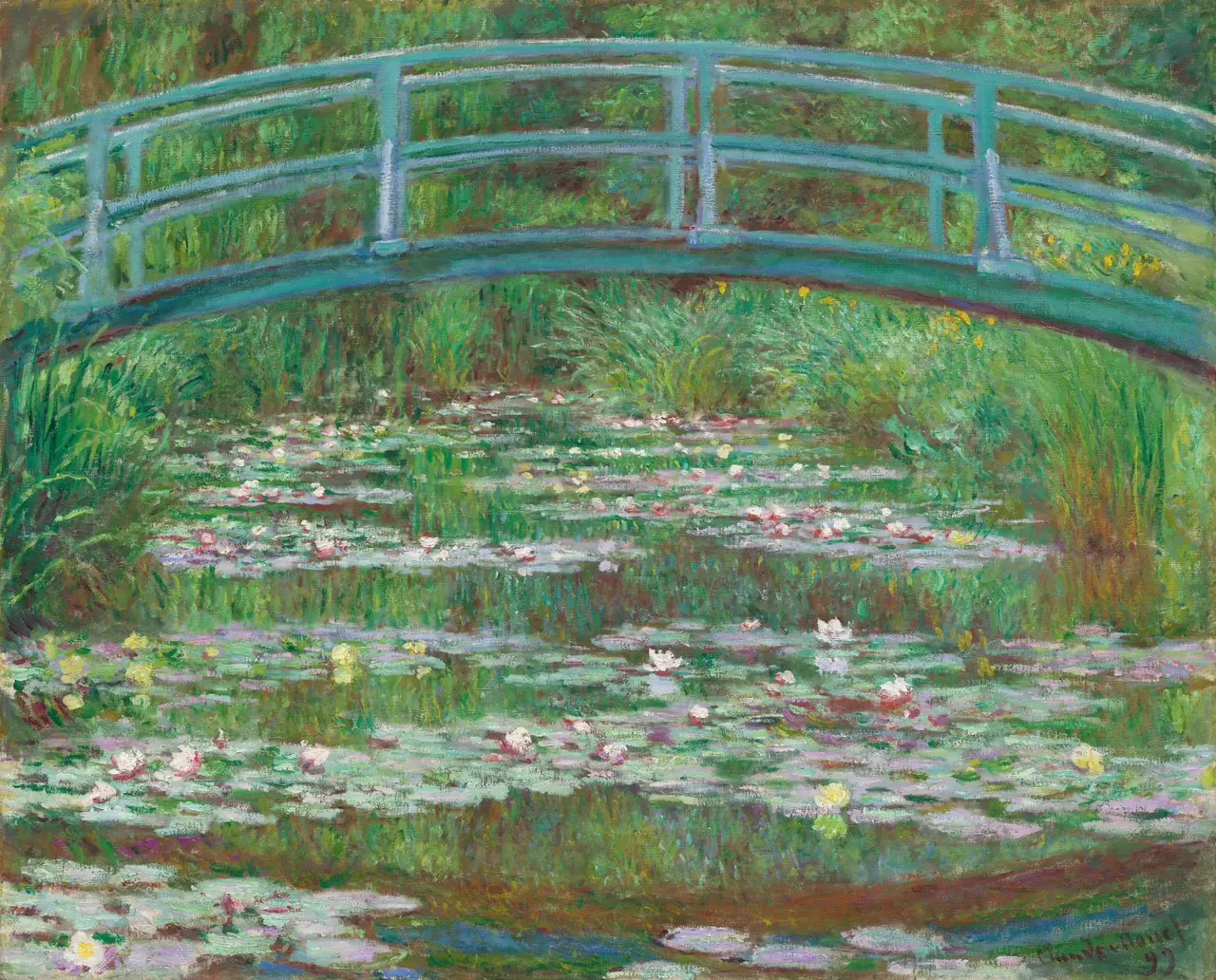
For a recipient who already enjoys gardens, the little changes in green, blue and pink give them something to return to. For someone who prefers spare line drawings, its busy surface may be exactly the wrong choice. Neither response is a failure to appreciate art.
The horizontal format can fit a wider wall or a shelf arrangement, but choose a reproduction size for the destination rather than the original painting’s dimensions. A note about a shared garden visit makes a stronger connection than promising the print will reduce stress or improve productivity. For more options within the artist’s work, start with the Monet guide.
Caillebotte for a shared city connection
Gustave Caillebotte’s Paris Street; Rainy Day, 1877, offers a different kind of atmosphere. The Art Institute of Chicago identifies the scene as a Paris intersection near the artist’s home. Umbrellas, wet paving and figures crossing one another’s paths make urban experience its subject.
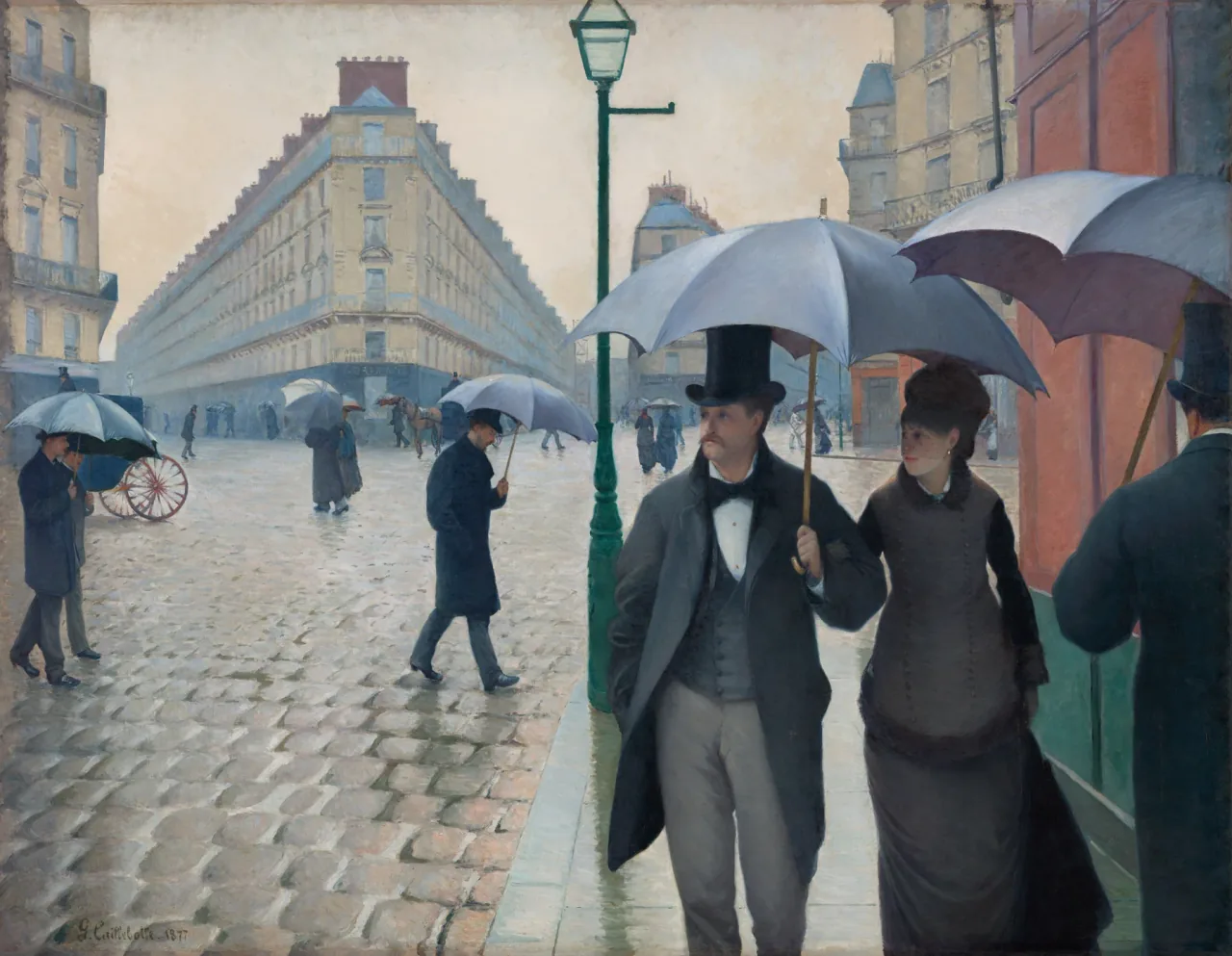
It could suit someone with a fond memory of Paris, an interest in architecture or a taste for everyday city scenes. That is a possible personal connection, not the painting’s official meaning. Do not describe its passers-by as a celebration of teamwork simply to fit an office occasion.
Look at the complete composition before deciding on a narrow frame. The open street on the left and the large figures on the right balance one another. A strong crop would alter that relationship. If the recipient has only a tall, narrow space, choosing a different picture may work better than cutting this one to fit.
Hiroshige for a tall and more intimate space
Utagawa Hiroshige’s Plum Garden at Kamata, 1857, belongs to One Hundred Famous Views of Edo. The Met’s impression is a colour woodblock print, accession JP2510. Its tall tree trunks and small visitors create a very different scale from Caillebotte’s approaching figures.
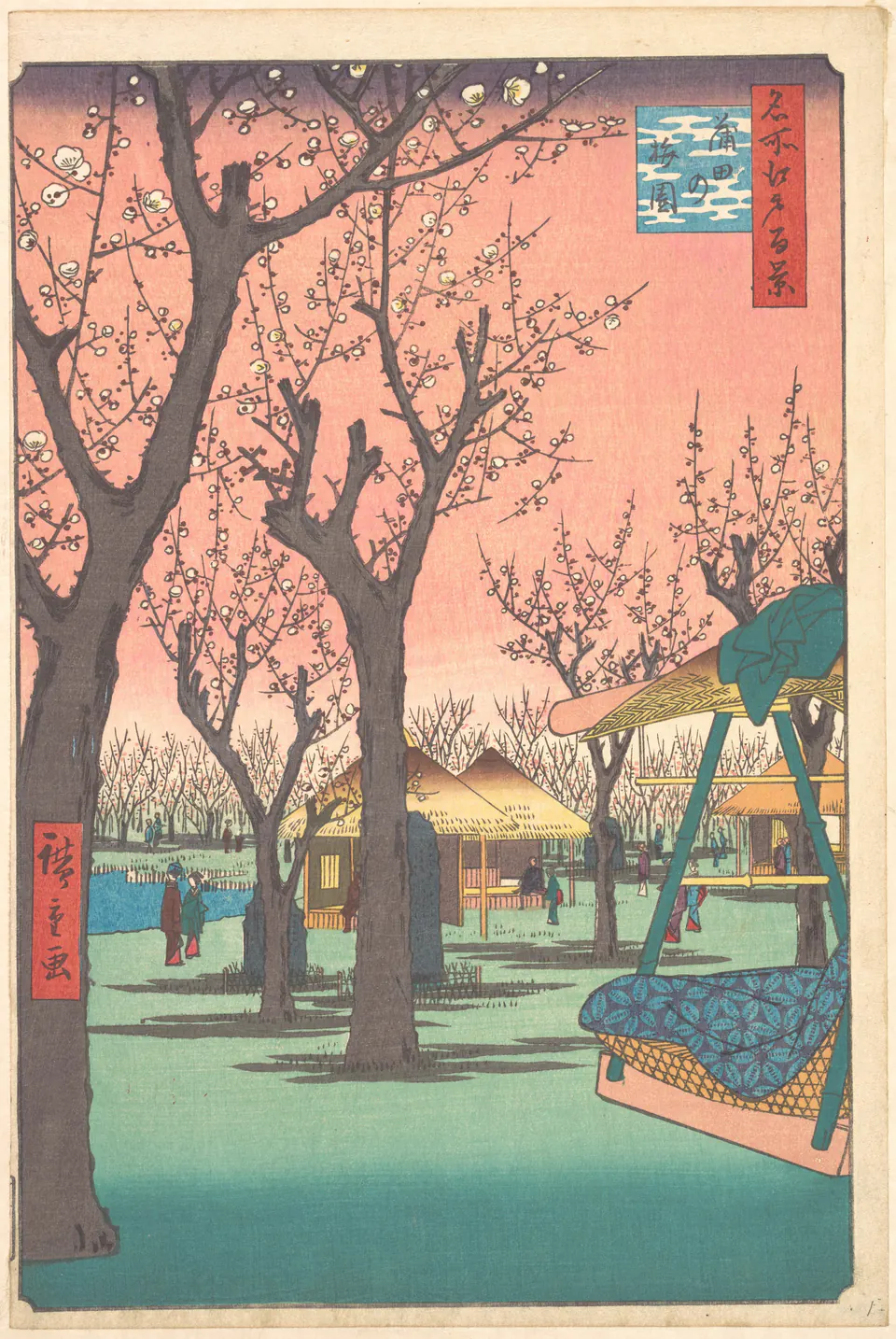
Its vertical shape can be useful beside a desk or in a smaller gap between furniture. Keep the title cartouche and garden details visible in the preview. A mat can help accommodate the image in a frame without cutting the composition; it also increases the overall size you need to allow for.
A card can name the work and explain why you chose it. It need not attach an invented universal meaning to plum blossom. If the recipient is curious, our Hiroshige guide is a more useful next step than a slogan about success or prosperity.
Budget for a finished gift
Compare the complete cost per recipient, not just the unframed sheet. Your planning list should include the print, any mat and frame, protective packaging, delivery, and applicable charges confirmed for that order. Leave room for a replacement if something arrives damaged. These are budget headings, not a promise of a particular seller’s services or refund terms.
For an illustrative budget of $600 for 12 recipients, the total allowance is $50 each. If framing and delivery together are quoted at $30 per gift, only $20 remains for the print and other charges. Those figures are arithmetic examples, not current prices. A smaller complete gift may be preferable to a larger unframed print that leaves the recipient with unexpected framing costs.
For a digital gift, confirm what the purchased licence allows. One download does not automatically include permission to distribute twelve copies of the file. When using an open-access source, check that exact image: The Met’s policy distinguishes eligible public-domain images from restricted material. A famous artist’s name is not a licence for every file found online.
Order one example before a large batch
If time and budget allow, inspect one finished example in the proposed size and finish. Check small details, trimming, colour, frame corners and the actual outer dimensions. A website mockup cannot show you how the paper feels or guarantee what a print looks like under the recipient’s lighting.
Then confirm the quantity, destination and deadline with the seller. Do not assume twelve individual addresses are equivalent to one bulk delivery. Ask who will handle a damaged parcel and keep the order information accessible to the person organising replacements. Collect delivery details privately and only when needed; a public team spreadsheet is not a considerate way to gather home addresses.
Give the picture without demanding wall space
Keep prominent branding on the removable card or packaging, not on the artwork. Include the artist, title and a short personal reason for the choice. Say clearly that the recipient is free to place it wherever they like, or not display it at all.
The strongest business art gift feels like something chosen for a person, not a miniature advertisement. A modest format, a real choice and a complete delivery plan do more for that feeling than expensive packaging or a claim that everyone loves the same masterpiece. Our online art buying checklist can help turn the chosen image into a clear order.
Editorial record
About this article
- Author
- Publisher
- GeMarkt
- Published
- Reviewed
- Internal source & rights check. Conducted by GeMarkt Research Review. This is an internal editorial check—not independent peer review.
- Source standard
- Buying guide source standardSeparates measured or first-hand evidence from general guidance and keeps practical limits visible.
Found a claim that needs checking? Report a factual error.