GeMarkt Blog · Reference
Can You Sell Prints of Public Domain Art?
Yes in principle, but check the artwork, country, exact image and intended uses. A practical guide to selling reproductions without claiming rights you do not own.

The short answer
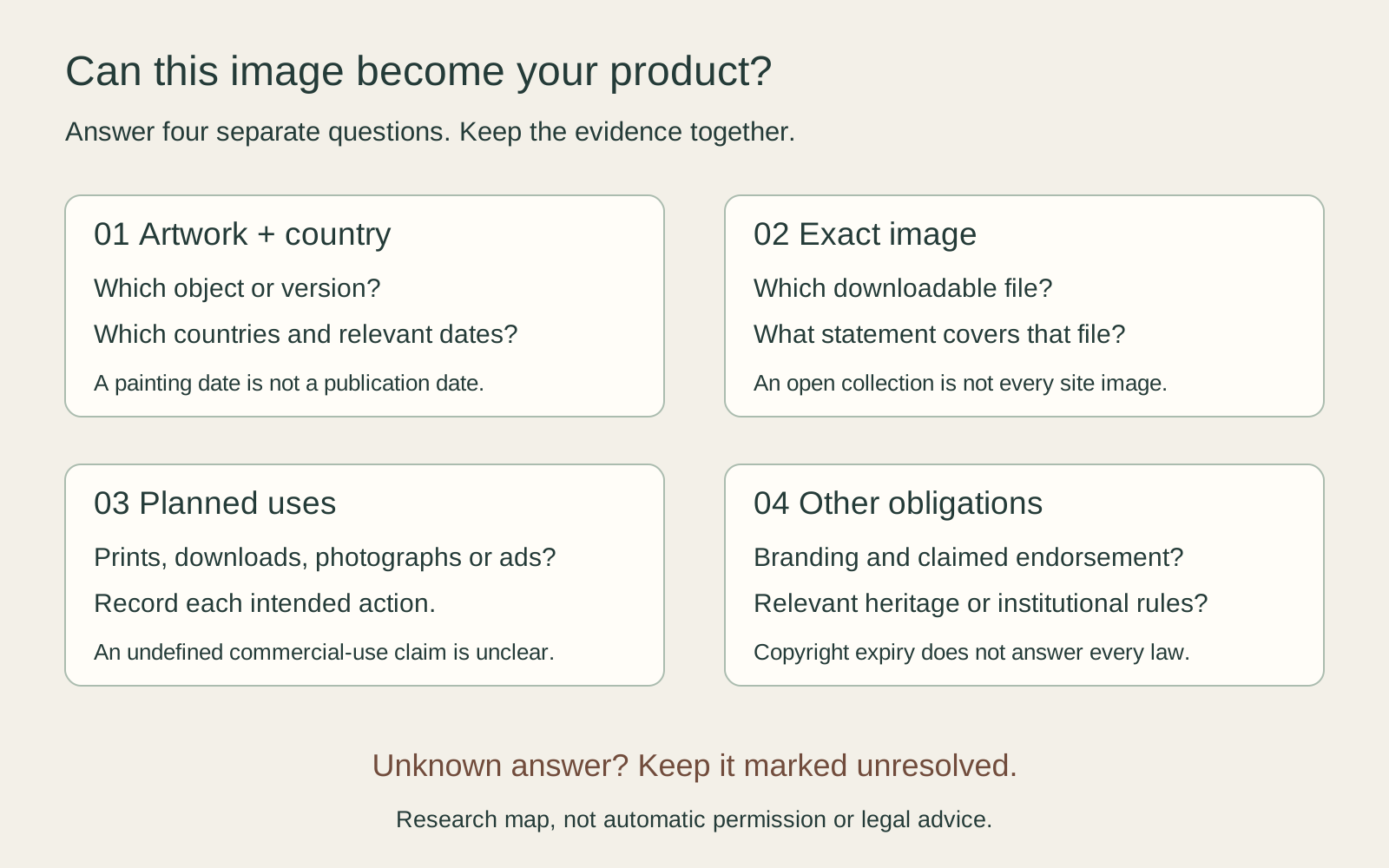
Yes, in principle: a work being in the public domain does not stop you charging for a print of it. The useful question is whether the particular work, image file and proposed use are clear in the countries that matter to your business. “Old painting” is not a complete answer to those questions.
The US Copyright Office explains that public-domain works include material whose copyright has expired and that users may rely on that status. Public domain is not a special category reserved for education, charities or people giving things away.
That does not make every file showing the work interchangeable. You may have a suitable museum image but an unsuitable photograph from someone else’s shop. You might also have permission to make prints but no basis for using a museum logo in the listing.
This guide is general research information, checked on 12 October 2026, not legal advice. For a disputed work, an important product launch or an uncertain cross-border use, get advice about the specific facts.
Identify the work and the country
Start with a museum or catalogue record that identifies the actual object. Record the artist, title, version and collection number where available. “Sunflowers” or “The Scream” may describe more than one work. A rights conclusion for one version should not quietly become a conclusion for every version, photograph and adaptation bearing that name.
Next, identify the relevant territories. Where will you reproduce, offer and sell the product? A source’s US conclusion should not be restated as worldwide permission. Our guide to copyright duration explains why dates of death, creation and publication answer different questions. Do not replace missing publication evidence with the date printed next to the painting’s title.
For a practical example, imagine finding an old botanical plate in two archives. One record identifies the edition and date; the other only says “vintage flower”. The first is a better research starting point, even if the second supplies a larger download. Good evidence and good resolution are separate requirements, and a large file does not compensate for an unknown source.
Find a file that covers the job
Follow the rights statement to the exact download, not just to the website’s home page. The Met’s Open Access programme makes its designated public-domain artwork images available under CC0. Its Open Access indication helps distinguish those images from other material on the site. This is a useful, explicit route; it is not permission to take every photograph found anywhere on a museum website.
CC0 permits commercial reuse without asking the person applying it for further copyright permission, to the extent the waiver operates. It does not promise that every other right has disappeared or that the provider has correctly assessed every underlying right. Save the object record and the file’s statement together.
A different file might carry CC BY-NC. Where that licence is needed for your use, it does not authorise selling reproductions as a commercial activity. The deed also recognises that its conditions do not govern public-domain elements or uses allowed by an applicable exception. Do not treat either “NC” or “public domain” as a shortcut around identifying what the file actually contains.
When the record is contradictory, choose a better-documented source or resolve the conflict before investing in the product. Removing a watermark is not a substitute for that work. Our guide to CC0, public-domain labels and museum licences explains the different kinds of statement.
Separate the print from the listing
A product involves more than the picture sent to the printer. There may be a product photograph, a room mockup, a description, packaging and a digital download. Write down which files supply each part. US law lists reproduction, distribution and public display as distinct rights, subject to its limitations, in section 106. Do not assume one vague permission answers every intended action.
Suppose you obtain an appropriate open-access image and make your own print. That does not entitle you to copy another seller’s photograph of a framed version above a sofa. Their photograph may contain original lighting, staging and other material that is absent from your museum file. Likewise, writing your own description is different from lifting a contemporary catalogue essay.
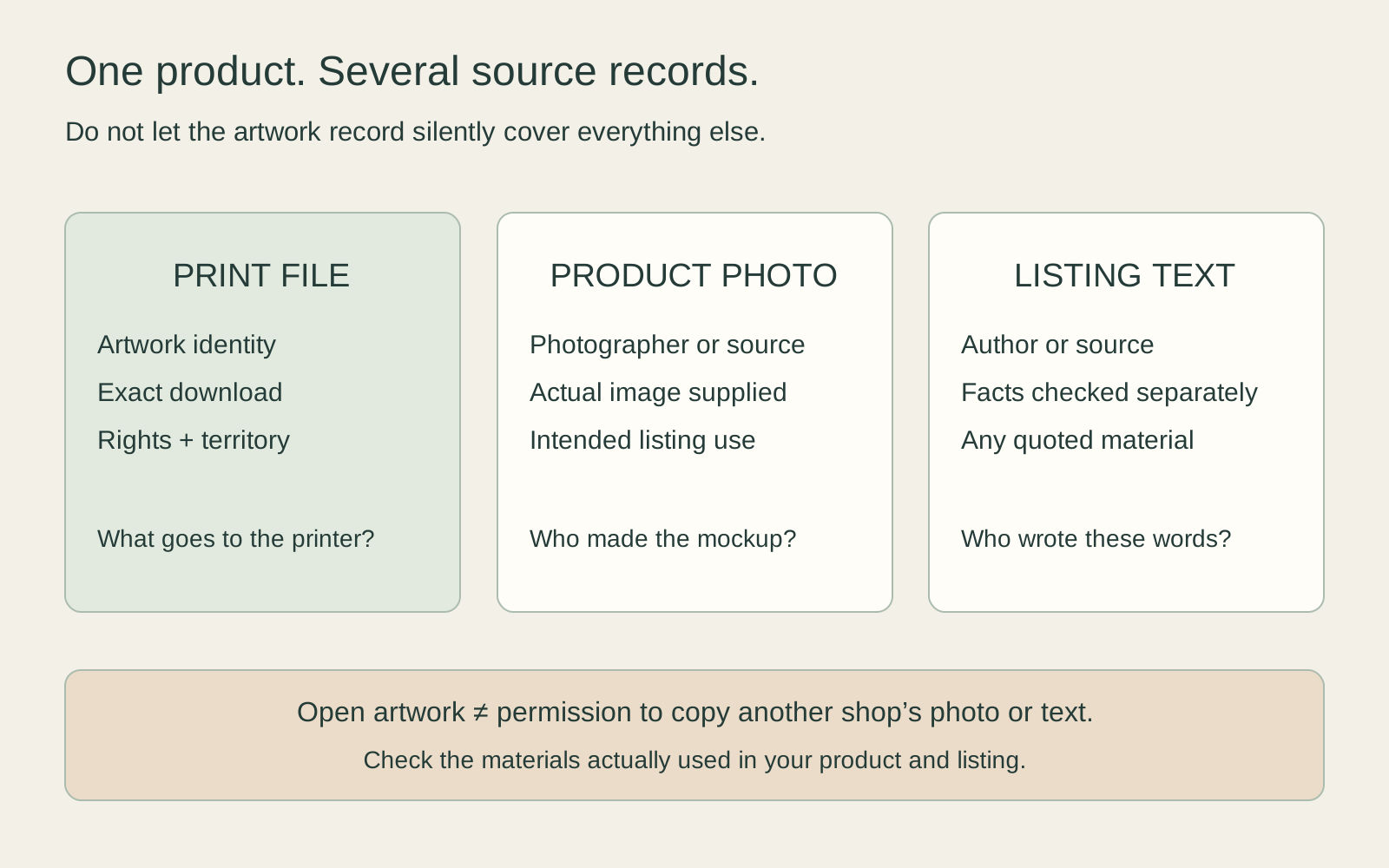
Keep the same distinction when commissioning help. Give a designer the source record, identify the permitted work and ask them to document anything they add. A file named “final-cleared.jpg” is a filename, not evidence. Check the delivered file against the source rather than assuming that a contractor’s export has preserved the agreed image and composition.
Check obligations outside copyright
Do not imply that the museum, artist’s estate or another brand endorses your product. USPTO guidance explains that trademark infringement concerns, among other things, use likely to confuse people about the source or sponsorship of goods or services. A factual artwork credit and a prominent borrowed museum logo do different jobs. An artist’s name is not automatically forbidden, but branding decisions deserve their own check.
Some institutions also administer cultural-heritage permissions separate from the ordinary artwork copyright question. The Uffizi’s official commercial image-use procedure refers to Italian cultural-heritage legislation and its authorisation process. That is a specific reason to investigate the institution and relevant law, not evidence that all old art everywhere needs a museum licence.
Keep these findings separate. “Artwork copyright expired” and “institutional image-use procedure checked” are different statements. If your project depends on assuming a rule does not apply outside its home country, get qualified advice rather than converting that assumption into an assurance to customers.
Describe your product without claiming the past
Call a modern reproduction a reproduction. State whether the buyer receives paper, canvas or a file, and whether a border, crop or colour adjustment is part of your version. Do not describe a newly printed object as an antique, an original painting or an official museum edition unless that description is genuinely supported.
Selling your version also does not give you exclusive ownership of the public-domain composition. The Copyright Office’s Circular 14 distinguishes new original contributions from pre-existing material: copyright in qualifying additions does not extend to the underlying public-domain work. A new layout may introduce a separate question; it does not make the historical painting yours.
This distinction is useful rather than discouraging. A customer can choose a reproduction for its presentation, size and suitability without being told that the seller owns the artist’s image. Make only the material and quality claims you can actually support. A rights check establishes neither print quality nor a reliable fulfilment process.
Keep a record that another person can follow
For each design, keep the object identity, relevant countries, exact source URL, downloaded filename, rights statement, access date and planned uses. Record any open question explicitly. Add the separate sources for photographs and text rather than hiding them under the artwork’s entry.
Then compare the record with what you publish. A later switch to a different scan, a new mockup or a cropped edition needs its own check. Retain earlier records so that a future question can be answered with the file actually used at the time.
The decision you want is specific: this work, this file, these uses and these territories, with any remaining limits stated. That is more useful than either “everything old is free” or “selling public-domain art is not allowed”. Neither slogan does the research for you.
Editorial record
About this article
- Author
- Publisher
- GeMarkt
- Published
- Reviewed
- Internal source & rights check. Conducted by GeMarkt Research Review. This is an internal editorial check—not independent peer review.
- Source standard
- Rights guide source standardSeparates the underlying work from the source file, records the review date, and links the evidence used for the conclusion.
Found a claim that needs checking? Report a factual error.